Component & Equipment Manufacturing Advanced Professional Website Template
Volt is a zigzag landing page template built for battery and electrical parts suppliers. It uses a structured comparison layout to show procurement teams exactly why their current supply chain falls short. With an infographic header, alternating audit sections, and two clear conversion paths, Volt turns spec-driven buyers into confident leads.
by Rocket studio
Quick summary
Volt is a single-page landing page template designed for industrial battery and electrical parts suppliers. It leads with a data-rich infographic header, then walks procurement professionals through a side-by-side supplier audit. Two conversion paths capture both ready buyers and research-stage engineers, making every scroll a step closer to a parts inquiry.
Who this template is for
This template is built for suppliers serving high-stakes industrial buyers. If your customers cannot afford downtime, this layout speaks their language from the first scroll.
- Fleet maintenance managers who cross-reference OEM part numbers and need verified stock before ordering
- Facility engineers replacing battery banks under tight seasonal deadlines
- Industrial purchasing agents sourcing bulk orders on a fixed delivery schedule
What problem this template solves
Most battery and electrical parts suppliers look identical online. Generic product pages, vague lead times, and unspecified SKUs make procurement decisions feel like guesswork. Volt removes that uncertainty by structuring the entire page around a procurement audit that exposes supply chain gaps row by row.
- Buyers cannot easily compare their current supplier against a better alternative on a single page
- Engineers need specification data fast, not marketing slogans or stock photography
- Purchasing agents need proof of stock, exact part numbers, and clear logistics terms before committing
What you get with this template
You get a fully structured, single-page layout built around the buyer's decision process. Every section is designed to address a specific procurement objection and move the visitor toward one of two clear actions.
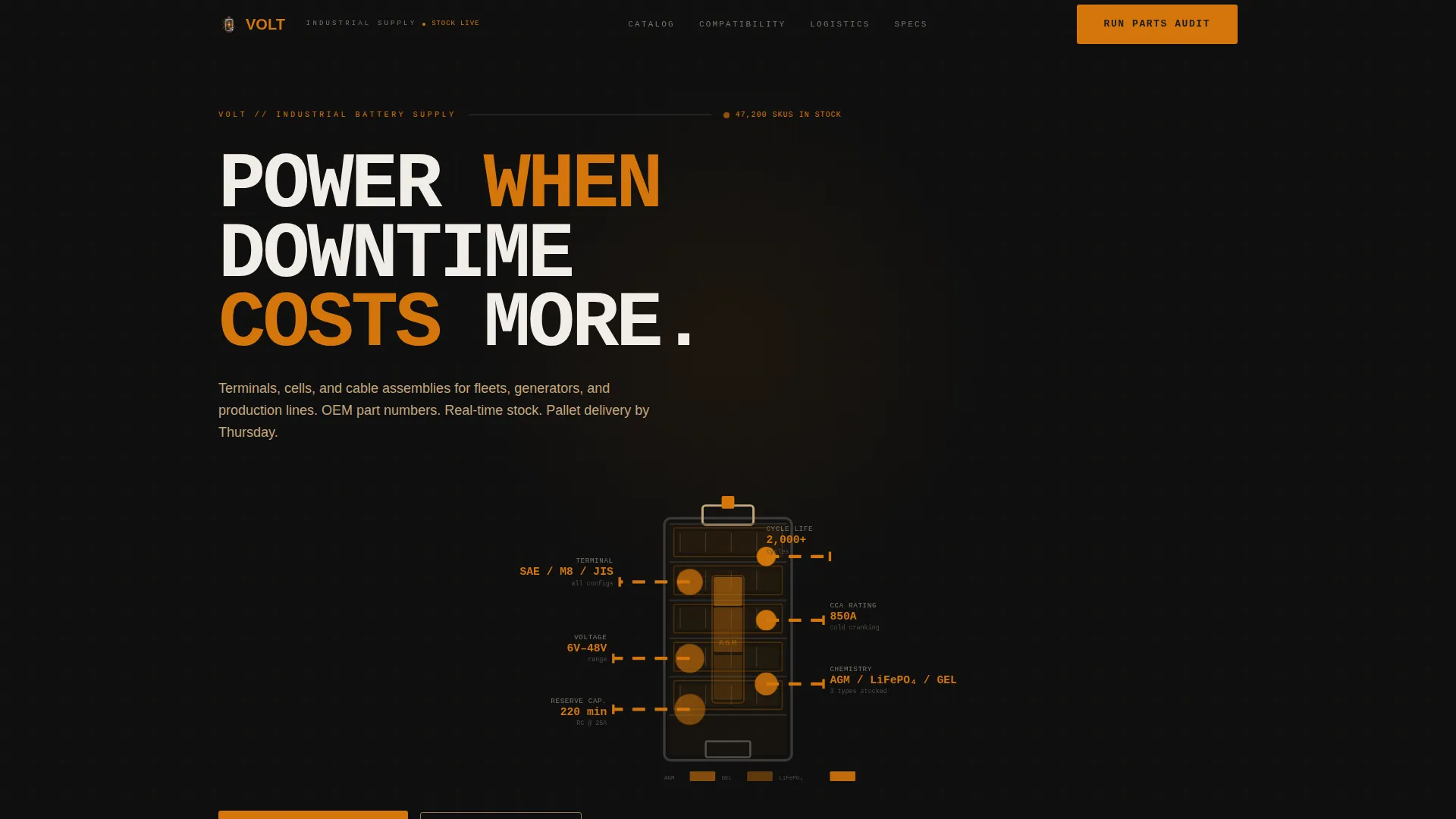
- A full-width infographic header with battery cell cross-section vector art and amber data callouts covering cycle life, cold cranking ampere ratings, terminal types, and chemistry comparisons
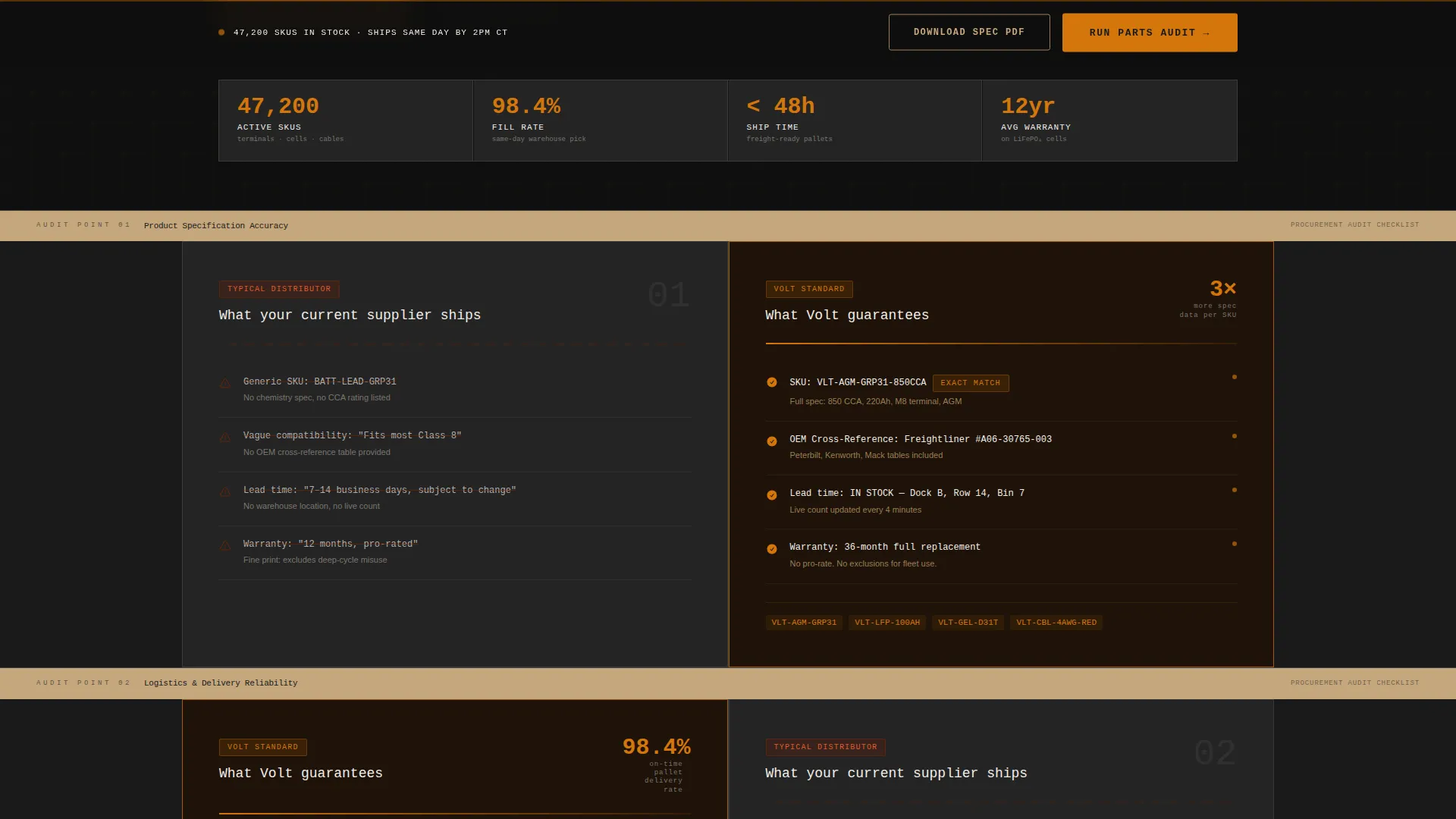
- Alternating zigzag sections that place "current supplier" weaknesses alongside guaranteed supplier specifications, stock counts, and warehouse location tags
- A midpage interactive compatibility checklist tool where visitors enter their equipment model and receive a matched parts list
- Two conversion paths: a three-field "Run a Parts Audit" form and a gated "Download the Spec Comparison PDF" email capture
Feature list
This section covers the core built-in components that define how Volt works as a conversion tool.
Infographic Battery Cell Header
The header renders a stylized cross-section diagram of a battery cell in clean vector lines against a forge-black background. Amber data callouts branch outward with large monospaced figures covering cycle life, cold cranking ampere ratings, terminal types, and chemistry comparisons including AGM, lithium-iron-phosphate, and gel. No photography is used. The information itself is the visual.
Zigzag Comparison Layout
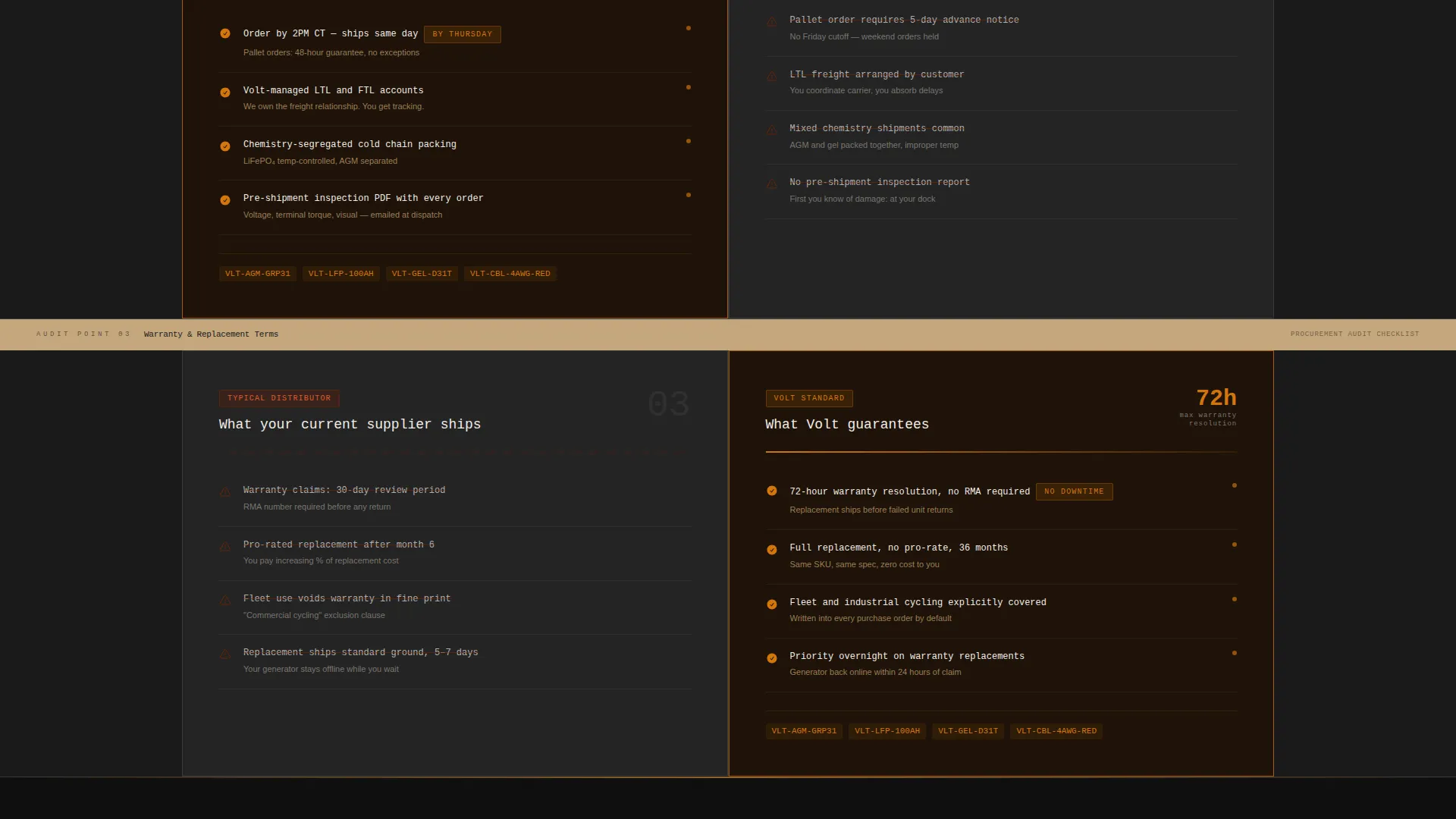
Each alternating section presents one procurement decision point. The left panel shows what a generic supplier typically delivers: grayed-out spec sheets, vague lead times, and non-specific SKUs. The right panel shows the supplier's offer with exact part numbers, warehouse location tags, and real-time stock counts rendered in amber. The rhythm escalates from product quality to logistics reliability to warranty terms.
Midpage Compatibility Checklist Tool
Midway through the page, an interactive tool lets visitors enter their equipment model and receive a matched parts list. This positions the supplier as a technical resource, not just a catalog, and gives engineers a reason to engage before they are ready to buy.
Dual Conversion Path Design
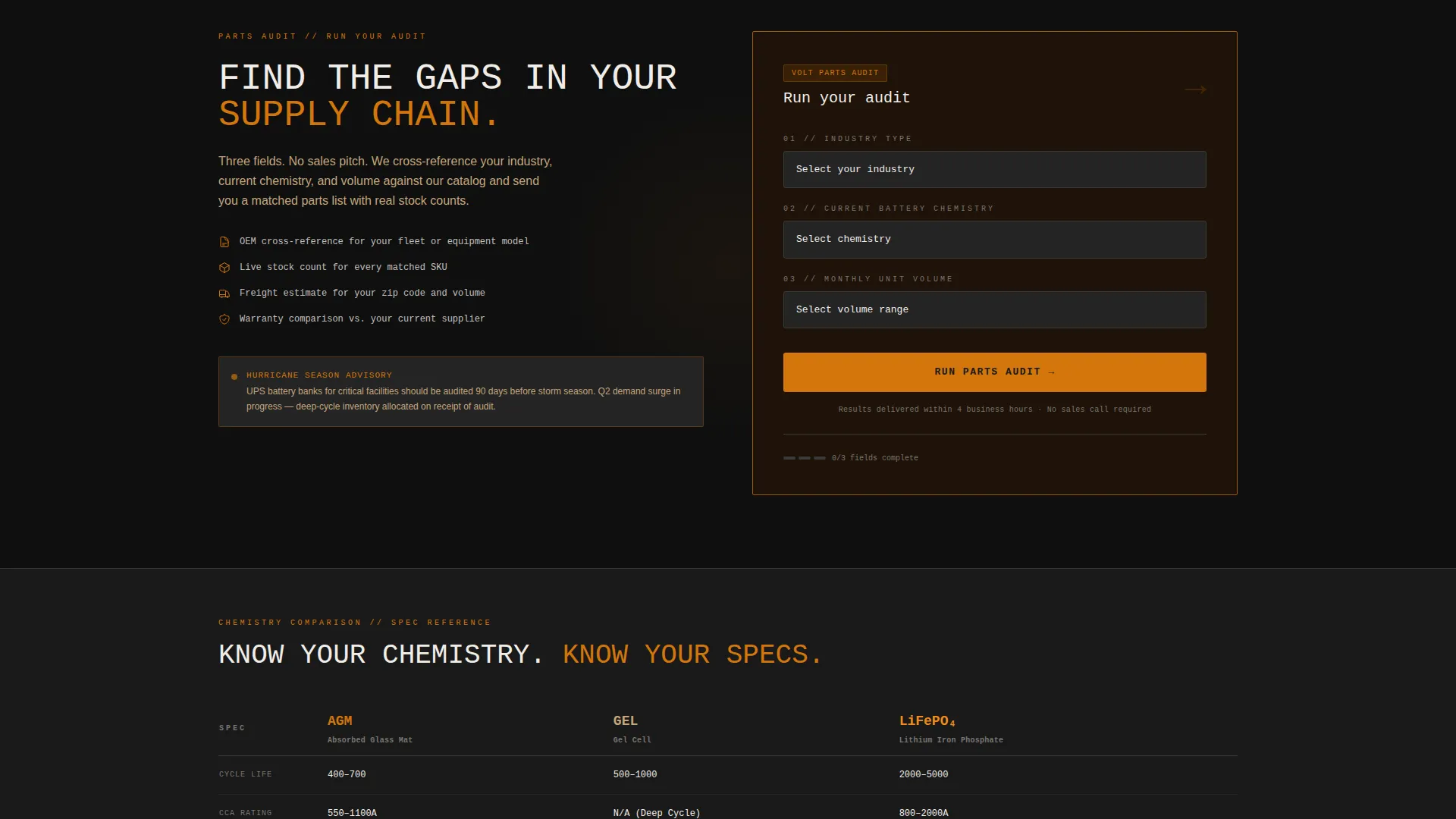
The primary call to action is "Run a Parts Audit," a three-field form asking for industry type, current battery chemistry, and monthly unit volume. It appears after the third zigzag block and repeats in a sticky bottom bar. The secondary path offers a downloadable Spec Comparison PDF gated behind a single email field, capturing engineers in the research phase.
Sticky Bottom Conversion Bar
A persistent bar at the bottom of the page keeps the primary call to action visible throughout the entire scroll. This ensures the "Run a Parts Audit" prompt is always one tap or click away without interrupting the reading flow.
Corporate Precision Visual Theme
The layout uses a structured, catalog-style design with clear section dividers, fired-clay tan bands, and consistent typographic hierarchy. Every element is labeled and positioned to feel like a well-organized parts catalog opened on a steel workbench.
Page sections overview
| Section | Purpose |
|---|---|
| Infographic Header | Communicate battery specs visually with amber data callouts and vector cell diagram |
| Zigzag Block One | Compare product quality: generic SKUs versus exact part numbers |
| Zigzag Block Two | Compare logistics reliability: vague lead times versus warehouse location tags |
| Zigzag Block Three | Compare warranty terms: generic coverage versus defined guarantees |
| Parts Audit call to action | Primary conversion form capturing industry type, chemistry, and volume |
| Compatibility Checklist Tool | Interactive model lookup returning a matched parts list |
| Spec Comparison PDF Gate | Secondary email capture for research-phase engineers |
| Sticky Bottom Bar | Persistent repeat of the primary "Run a Parts Audit" call to action |
Design & branding system
The visual identity follows a Corporate Precision theme built on a Fire and Earth color system. The palette evokes the mineral cross-section of a copper mine: dark, warm, and industrial without feeling cold or sterile.
- Forge-black (#1A1A1A) for primary backgrounds, iron-oxide red (#8B2500) for warning callouts and comparison highlights, molten amber (#D4760A) as the primary accent that functions like a charge indicator light
- Fired-clay tan (#C4A77D) for secondary surface bands and section dividers, creating visual rhythm between the alternating zigzag blocks
- Monospaced industrial typography for all specification figures, reinforcing the catalog-style precision that technical buyers expect
Mobile & speed optimization
The zigzag layout and infographic header are structured to remain readable and functional on smaller screens. The sticky bottom bar is particularly useful on mobile, keeping the primary call to action accessible without requiring a scroll back to the top.
- The alternating left-right panels reflow to a single-column stacked format on mobile, preserving the comparison logic without horizontal scrolling
- The compatibility checklist tool and the two-path conversion forms are designed as compact, low-friction inputs that work cleanly on touch devices
How this template helps you convert
Volt is built around a Comparison and Versus conversion strategy. Every section adds another reason for the visitor to act, not just read.
- The infographic header establishes immediate technical credibility, signaling to spec-driven buyers that this supplier understands their language before a single word of copy is read.
- The escalating zigzag audit builds a cumulative case across product quality, logistics reliability, and warranty terms, making the gap between the visitor's current supplier and the alternative increasingly difficult to ignore.
- Two conversion paths ensure no visitor leaves empty-handed: the three-field audit form captures ready buyers, while the PDF email gate retains engineers who need more time to evaluate.
Other information about this template
Volt is categorized under Manufacturing and Industrial, with a specific focus on the Automotive Parts and Components subcategory and the Battery and Electrical Parts niche. It is a strong fit for suppliers dealing in terminals, deep-cycle battery cells, cable assemblies, uninterruptible power supply battery banks, and related electrical components.
- The template suits industries including fleet maintenance, industrial facilities management, telecom infrastructure, and solar energy storage procurement
- The three-field audit form is intentionally minimal: industry type, current battery chemistry, and monthly unit volume cover the qualifying information a supplier needs without creating friction
- The downloadable Spec Comparison PDF path is a practical secondary funnel for buyers who are evaluating multiple suppliers simultaneously
- The page is designed as a single-page landing layout, not a multi-page website, so all content and conversion logic lives within one scrollable flow
Theme
Corporate Precision
Creative direction
Checklist & Audit
Color system
Fire & Earth
Style
Zigzag/Alternating
Direction
Comparison/Versus
Page Sections
Infographic Battery Cell Header
Escalating Zigzag Audit Layout
Midpage Compatibility Checklist Tool
Dual Conversion Path Design
Sticky Bottom Conversion Bar
Corporate Precision Visual Theme
Related questions
Who is this landing page template designed for?
What are the two conversion paths included in this template?
Does this template use stock photography?
Can this template support multiple battery chemistries?
How does the compatibility checklist tool work?