Autism Spectrum Care Professional Website Template
Spectrum is a warm, split-screen landing page template built for autism spectrum support groups. It pairs tender hero statistics with a calming frequently asked question-driven scroll, a low-friction "Save My Seat" lead capture form, and a Soft Mist color palette designed to feel like a safe, dimly lit room where someone has already saved you a seat.
by Rocket studio
Quick summary
Spectrum is a single-page, split-screen landing page template created for autism spectrum support communities. It opens with tender hero statistics, moves through a gentle frequently asked question-driven conversation, and closes with a low-friction lead capture form. Every design choice, from the cloud lavender gradients to the handwritten-adjacent typography, is made to reduce anxiety and build trust the moment a visitor arrives.
Who this template is for
This template is for anyone building a welcoming online presence for an autism support group, peer circle, or community-led program. It does not require a large organization or a technical team. If you have a group and you want more families to find it, this template gives you a ready-made foundation to work from.
People who will get the most from this template include:
- Parents and caregivers who run informal weekly circles and want a professional-looking page that still feels warm and human.
- Nonprofit coordinators and community organizers launching autism spectrum support services and needing a landing page that converts anxious visitors into members.
- Autistic adults, self advocates, and peer supporters who want to describe their group online without sounding clinical or corporate.
What problem this template solves
Most autism support group pages feel like intake forms. They lead with lists of services, diagnostic criteria, and registration paperwork. That format works fine for a hospital. It does not work for a parent who is Googling at midnight after a new diagnosis, or a twenty-something autistic adult who is finally searching for words that fit their experience, or a grandparent trying to understand why Sunday dinners feel so difficult now.
The core problem is that the people who need community most are also the people most likely to close a page that does not immediately feel safe. This template solves that problem directly.
- It leads with emotional validation before logistical information, letting visitors feel seen before they are asked to fill out anything.
- It removes the biggest barriers to joining, including the fear of needing a formal diagnosis and the fear of having to speak in front of people, through a calm frequently asked question-driven layout.
- It offers two low-pressure conversion paths so that even visitors who are not ready to commit still have a gentle door to walk through.
What you get with this template
You get a fully structured, single-page landing page layout that covers every stage of the visitor journey, from first impression to form submission. The template is built around a 50/50 split-screen composition, a sensory-friendly color system, and a frequently asked question-driven scroll rhythm that feels like a conversation rather than a pitch.
Everything included in this template is grounded in what the page needs to do: reduce anxiety, build trust, and invite action.
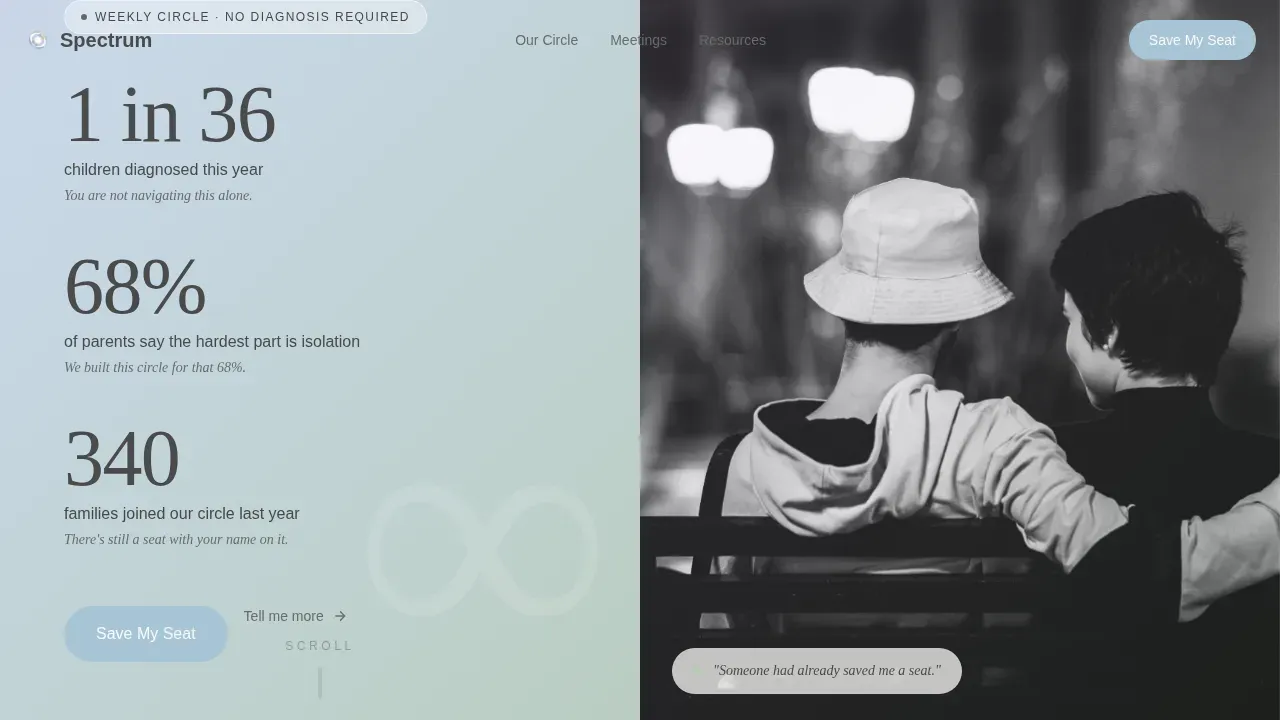
- A hero section with three staggered stat fade-in animations, a soft-focus bench photograph composition, and a primary "Save My Seat" call to action.
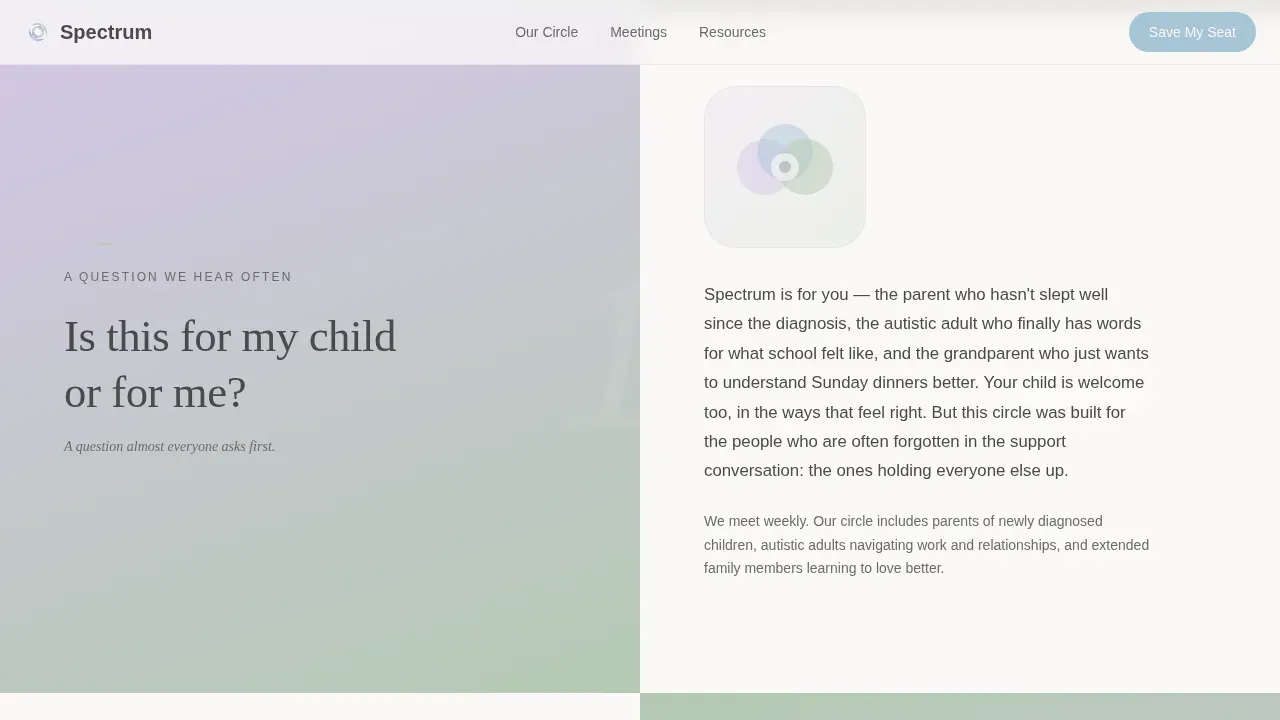
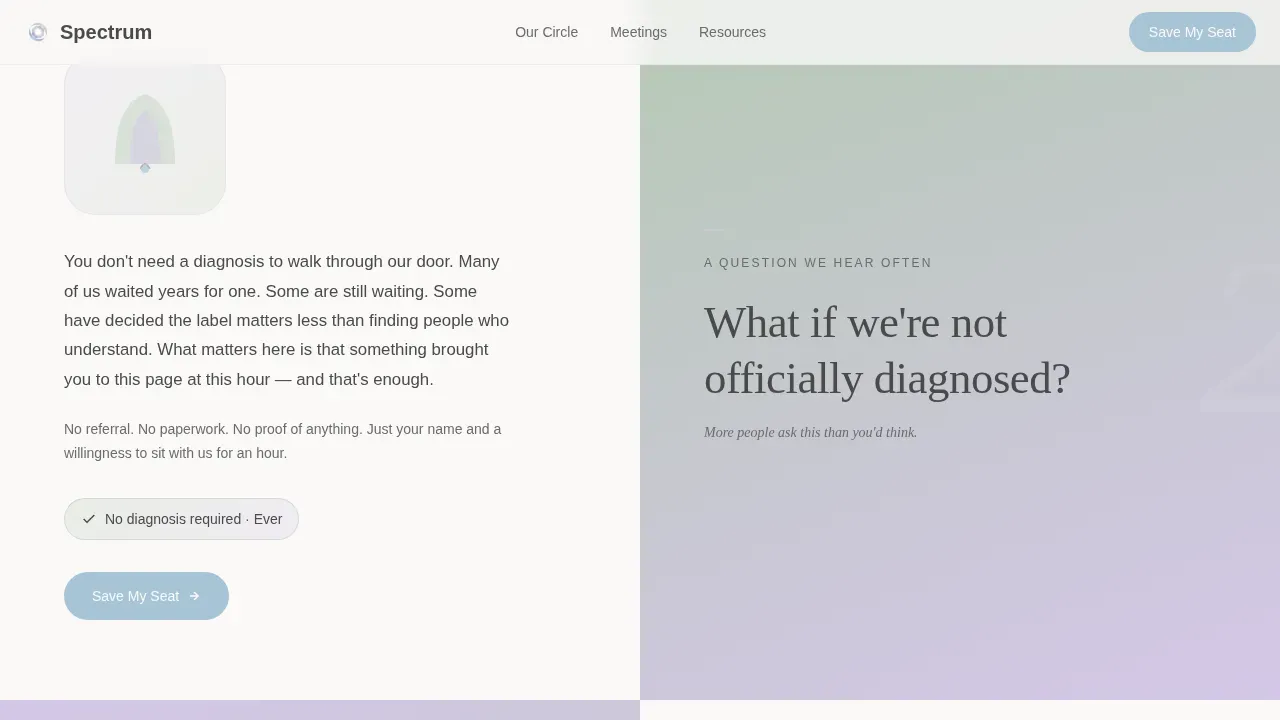
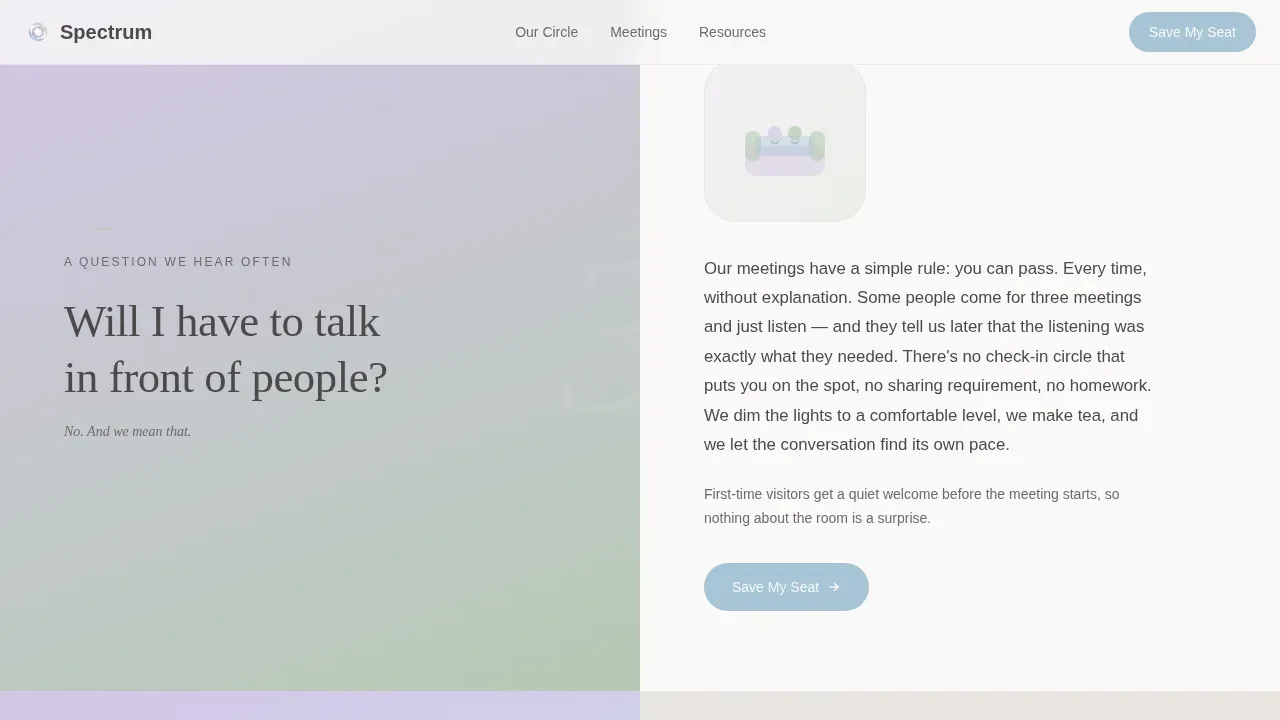
- Three frequently asked question conversation panels that answer the real questions visitors are already asking, each with a left-panel question in large gentle type and a right-panel answer with a supporting illustration or icon.
- A lead capture section with a first-name field, an email field, a soft optional open-text area ("What brought you here today?"), and a secondary "Download Our First-Meeting Guide" path for visitors who want a gentler first step.
Feature list
This template packages a carefully considered set of features, each one chosen because it directly serves the needs of autism community groups and the people who search for them.
Tender Stats Hero with Staggered Fade-In
The hero section opens on the left half of the split screen with three large numbers that fade in one at a time. The numbers are set in a rounded, low-contrast typeface that feels handwritten-adjacent, floating on a lavender-to-sage gradient. Each stat is chosen to validate the visitor's experience: 1 in 36 children diagnosed this year, 68 percent of parents report isolation as the hardest part, and 340 families joined the circle last year. On the right half, a soft-focus photograph of two people sitting side by side on a bench, shoulders almost touching, communicates presence without performance. The hero immediately communicates who this page is for and why they belong here.
frequently asked question-Driven Conversation Scroll
After the hero, the page becomes a call-and-response experience. Each frequently asked question section poses one real question a visitor is already carrying: "Is this for my child or for me?" validates parents, autistic adults, and grandparents equally. "What if we're not officially diagnosed?" removes the single biggest barrier to joining. "Will I have to speak in front of people?" dissolves social anxiety before it can take hold. The left panel holds the question in large, gentle type. The right panel answers it in plain, warm language with a single illustration or icon. Each answer lowers one more wall. By the bottom of the page, the visitor feels like the group already understands them.
Dual-Path Lead Capture Form
The lead capture section offers two conversion paths. The primary path is the "Save My Seat" form, which asks for a first name, an email address, and a soft optional question presented as an open text area: "What brought you here today?" The text area matters. Dropdowns feel like intake forms. A text area feels like someone listening. The secondary path offers a "Download Our First-Meeting Guide" for visitors who are not ready to commit. Both paths capture email and give the visitor something meaningful in return, without pressure.
Soft Mist Color System
The entire template is built on a Soft Mist palette that prioritizes sensory comfort. Cloud lavender (#D5C7E8), morning fog gray (#E8E4E1), still-water blue (#A8C4D6), and gentle sage (#B5C9B3) are used across backgrounds, gradients, and interactive elements. Text sits in soft charcoal (#4A4A4A) for legibility without harshness. Gradients drift slowly between lavender and sage, feeling like weather rather than decoration. Backgrounds use morning fog gray with generous whitespace. Interactive elements glow in still-water blue on hover, easing rather than snapping. The palette is specifically calibrated to avoid sensory overload, a core requirement for any landing page serving the autism community.
Handwritten-Adjacent Typography Pairing
Headings use Fraunces, a serif typeface with a warm, handwritten-adjacent quality that feels personal without being informal. Body text uses DM Sans, a clean geometric sans-serif that supports readability at small sizes. The combination gives the page a human warmth that clinical typefaces cannot achieve, and it supports the emotional tone the community needs to feel welcome.
Minimal Animation with Gentle Scroll Reveals
Animations are intentionally low-to-medium in intensity. The stat fade-ins in the hero are staggered so each number lands with weight. Scroll reveals across the frequently asked question sections ease in gently, never snapping. There are no auto-playing videos, no flashing elements, and no abrupt transitions anywhere on the page. This directly supports sensory-friendly design principles and reflects best practices for landing pages built for autism communities, where reduced motion is a meaningful act of inclusion.
Page sections overview
| Section | Purpose |
|---|---|
| Split Screen Hero | Opens with tender stats on the left and a soft bench photograph on the right, establishing emotional trust immediately |
| frequently asked question Panel One | Answers "Is this for my child or for me?" to validate parents, autistic adults, and grandparents simultaneously |
| frequently asked question Panel Two | Answers "What if we're not officially diagnosed?" to remove the biggest barrier to joining |
| frequently asked question Panel Three | Answers "Will I have to speak in front of people?" to dissolve social anxiety before the form |
| Lead Capture Form | Presents the "Save My Seat" form with a soft optional text area and a secondary downloadable guide path |
| Minimal Footer | Closes the page cleanly using a horizontal flow layout with essential links and contact information |
Design & branding system
The visual identity of this template is built around a single emotional target: the feeling of a room where the lights have been dimmed just right and someone has already saved you a seat. Every color, typeface, spacing decision, and animation choice points back to that target.
The design system is structured to be calm, predictable, and sensory-friendly from the very first scroll.
- The Soft Mist color system uses cloud lavender as the primary tone, still-water blue as the interactive accent, morning fog gray as the page background, gentle sage as a secondary warmth tone, and soft charcoal for all body text. The palette uses muted, soft tones across the entire page to prevent sensory overload.
- Gradients between lavender and sage are slow and smooth, giving the page a breathing quality. Hover states use still-water blue with an ease-in-out glow rather than a hard color switch. Whitespace is generous throughout, keeping the layout open and uncluttered.
- Typography pairs Fraunces (serif headings with handwritten-adjacent warmth) with DM Sans (clean, readable body text). Together they create a voice that feels human without feeling unprofessional.
Mobile & speed optimization
The template is built mobile-first. The brief is explicit: midnight Googling happens on phones. A parent sitting in a hospital parking lot, an autistic adult lying awake searching for words, a grandparent trying to understand a grandchild's diagnosis from a kitchen table. These visitors are not on desktop computers. The template prioritizes their experience at every decision point.
Performance choices reflect the same care as the visual design.
- Static content sections use server components to minimize the amount of JavaScript loaded on the page, keeping the experience fast even on slower mobile connections.
- Animations are intentionally lightweight. Staggered stat fade-ins and gentle scroll reveals are built with CSS transitions rather than heavy JavaScript libraries, so the page stays responsive and smooth.
- The split-screen layout adapts gracefully to smaller viewports. The two-column composition stacks into a single-column flow on mobile, so no content is hidden, clipped, or lost on small screens.
How this template helps you convert
The Spectrum landing page template is built around one core conversion insight: people who are searching for autism support are not shopping. They are hoping. They are exhausted, uncertain, and ready to leave the moment a page makes them feel like a case file rather than a person. This template is designed to meet them where they are and walk them gently toward taking action.
Every structural and design decision on this page exists to reduce friction, build trust, and lower the emotional cost of saying yes.
- The hero section leads with validated community statistics rather than a product pitch, so the visitor's first thought is "someone else feels this too" rather than "what are they selling me." That shift in the visitor's internal experience is what makes the primary "Save My Seat" call to action feel like relief rather than pressure.
- The frequently asked question-driven scroll acts as a trust-building engine. Each question answered is one more wall taken down. By the time the visitor reaches the lead capture form, they have already rehearsed the emotional experience of belonging to this group. The form asks only for a first name and email, plus a soft optional open-text area, keeping the commitment bar as low as possible.
- The secondary "Download Our First-Meeting Guide" path ensures that visitors who are not ready to register still have a way to engage and leave their email address. This two-path approach recognizes that different visitors arrive at different stages of readiness and gives every person a door that fits where they are right now.
Other information about this template
This section covers additional context about the template's design philosophy, its relationship to established autism support resources, and the broader ecosystem of tools and organizations that groups using this template may find valuable for their members.
Building a landing page for an autism support group is a specific kind of design challenge. The goal is not simply to look good. The goal is to reduce anxiety and build trust within the first few seconds of a visit. Research and community practice consistently show that predictable navigation, descriptive headings, plain English, and sensory-friendly design choices are not nice-to-haves for this audience. They are essential.
This template is built with those principles as the foundation, not as an afterthought. The Spectrum Warm Autism Spectrum Support Group Landing Page Template reflects those commitments in every section.
- The page uses plain English throughout, avoiding jargon, metaphors that may confuse, and clinical language that can make visitors feel categorized rather than welcomed. Accessible contact information is intended to be prominently displayed so that visitors who have questions before joining can reach the group easily.
- The lead capture form is designed to be a low-stakes first step. The optional open-text area labeled "What brought you here today?" is not a required field, and it is presented as a text area rather than a dropdown specifically because open text feels like a conversation, not an intake form. This design choice directly supports the self determination of each visitor, honoring their right to share on their own terms.
- Autism Understood is a website that provides resources specifically for autistic young people, and groups using this template may want to link to it as part of their resources section. Spectrum Gaming is a community aimed at building friendships and increasing self-acceptance among autistic young people. The Autistic Self Advocacy Network focuses on empowering autistic individuals through advocacy and support. These kinds of organizations make strong partner links for a group's resource section, giving members access to a broader network of support beyond the local circle.
- The National Autistic Society in the United Kingdom is a charity that offers support services for autistic individuals and their families, and Beacon NeuroConnect is a not-for-profit agency that provides therapeutic family support for children with autism. SWAN Scotland is an autistic-led charity that delivers services and support for autistic women, girls, and non-binary individuals. For groups with international membership or members who search for support across borders, these organizations represent the kind of trusted, reputable links worth including on a resources page.
- Groups can use the free "Download Our First-Meeting Guide" secondary path to share practical knowledge with new members before they ever attend a meeting. This guide path can cover what to expect at a first session, how the circle is structured each week, what sensory accommodations are in place, and what topics the group covers on a regular basis. The free guide reduces the unknown, and reducing the unknown is one of the most effective inclusion strategies available.
- The Spectrum Autism Support Group model, as reflected in the brief, offers monthly support group meetings for parents of children with autism, free social skills groups for children ages 5 to 22, and childcare for children under age 5 during support group meetings. The Pathway of Inclusion fundraising campaign supports families and community members who need financial assistance to access services. These facts are important context for any group customizing this template for their own community and wanting to describe their specific offerings accurately.
- Healthcare navigation is a frequent topic for autism support groups. The Healthcare Toolkit approach, which includes worksheets, checklists, and tools to help autistic individuals and their supporters prepare for appointments and track follow-up actions, is the kind of practical resource set that groups built around this template can point members toward. Customizable communication templates are another valuable tool, helping parents describe a child's strengths, challenges, and preferred accommodations to educators in school settings. These resources support self advocacy and give families the training and knowledge they need to navigate complex systems.
- The template's design choices align with established best practices for autism community landing pages: a calming color palette, reduced motion, no auto-playing videos, short and scannable sentences, descriptive headings, and community ground rules that are visible and affirming. Neurodiversity-affirming language focuses on belonging rather than fixing. Authentic imagery of real, friendly people builds genuine connection. A clear "What to Expect" section, presented here through the frequently asked question conversation panels, describes the meeting format and reduces the anxiety of attending for the first time.
- For groups running events such as training workshops, school-readiness programs, speech and language sessions, social skills games, or co-facilitated practice sessions for autistic children and their families, the page structure can be lightly adapted. The frequently asked question panels can be updated to address event-specific questions, the stats in the hero can be swapped for event-relevant figures, and the form can be adjusted to capture relevant date preferences or topic interests from interested attendees.
- Groups can also use the template as a starting point for building a broader online presence. The footer uses a horizontal flow layout with minimal design, leaving clean space for links, a contact line, and social profile references. Groups that want to join the Nextdoor community to share resources and information with neighbors will find the minimal footer easy to update with those links.
Theme
Soft Gradient
Creative direction
FAQ-Driven
Color system
Soft Mist
Style
Split Screen (50/50)
Direction
Lead Generation
Page Sections
Tender Stats Hero with Staggered Fade-in
Faq-driven Conversation Scroll
Dual-path Lead Capture Form
Soft Mist Sensory-friendly Color System
Handwritten-adjacent Typography Pairing
Minimal Animation with Gentle Scroll Reveals
Related questions
Do I need a formal diagnosis to use this template for my group?
Can autistic adults use this template for a group they run themselves?
Does the template include the 'Download Our First-Meeting Guide' as a ready-made document?
Is this template suitable for groups that support both children and families?
Can I update the frequently asked question questions to match what my specific group gets asked?