Textile Artist Bento Grid Landing Page Template
Weave is a bento grid landing page template built for textile artists who need to present their practice as a credentialed, process-driven body of work. It pairs a full-bleed macro photo header with an evidence-board grid of case study tiles, recognition badges, and a partnership-focused collaboration form, designed to speak directly to gallery curators, design houses, and cultural institutions.
by Rocket studio
Quick summary
Weave is a single-page bento grid landing page template for textile artists. It frames finished works as layered creative processes, supports institutional recognition display, and guides serious professional visitors toward a partnership inquiry or case study download. Every section is designed to convert informed collaborators, not casual browsers.
Who this template is for
This template is built for textile artists whose primary audience is professional and institutional. It suits practitioners at the stage where their work is being acquired, shortlisted, or commissioned, and who need a page that reflects that standing.
- Textile artists seeking gallery curators, design house collaborators, or cultural institutions as clients
- Artists with process-rich practices involving material sourcing, dye work, or site-specific fiber installations
- Creative professionals who need a landing page that reads like a peer introduction, not a vendor pitch
What problem this template solves
Most portfolio templates treat work as a finished image in a grid. For a textile artist whose value lies in process rigor and institutional credibility, that approach undersells the practice entirely. Visitors from acquisitions teams or curatorial departments need evidence, not just aesthetics.
- Curators and design houses cannot assess an artist's depth from a simple image gallery
- There is no clear path for institutional visitors to initiate a structured collaboration inquiry
- Recognition and credentials get buried rather than foregrounded as the primary argument for partnership
What you get with this template
You get a complete single-page layout built around a bento grid structure that doubles as a credentialing engine. The template includes every section needed to move a professional visitor from first impression to collaboration inquiry without leaving the page.
- A full-bleed macro photo header with a timed fade-in for the artist name and a citation line
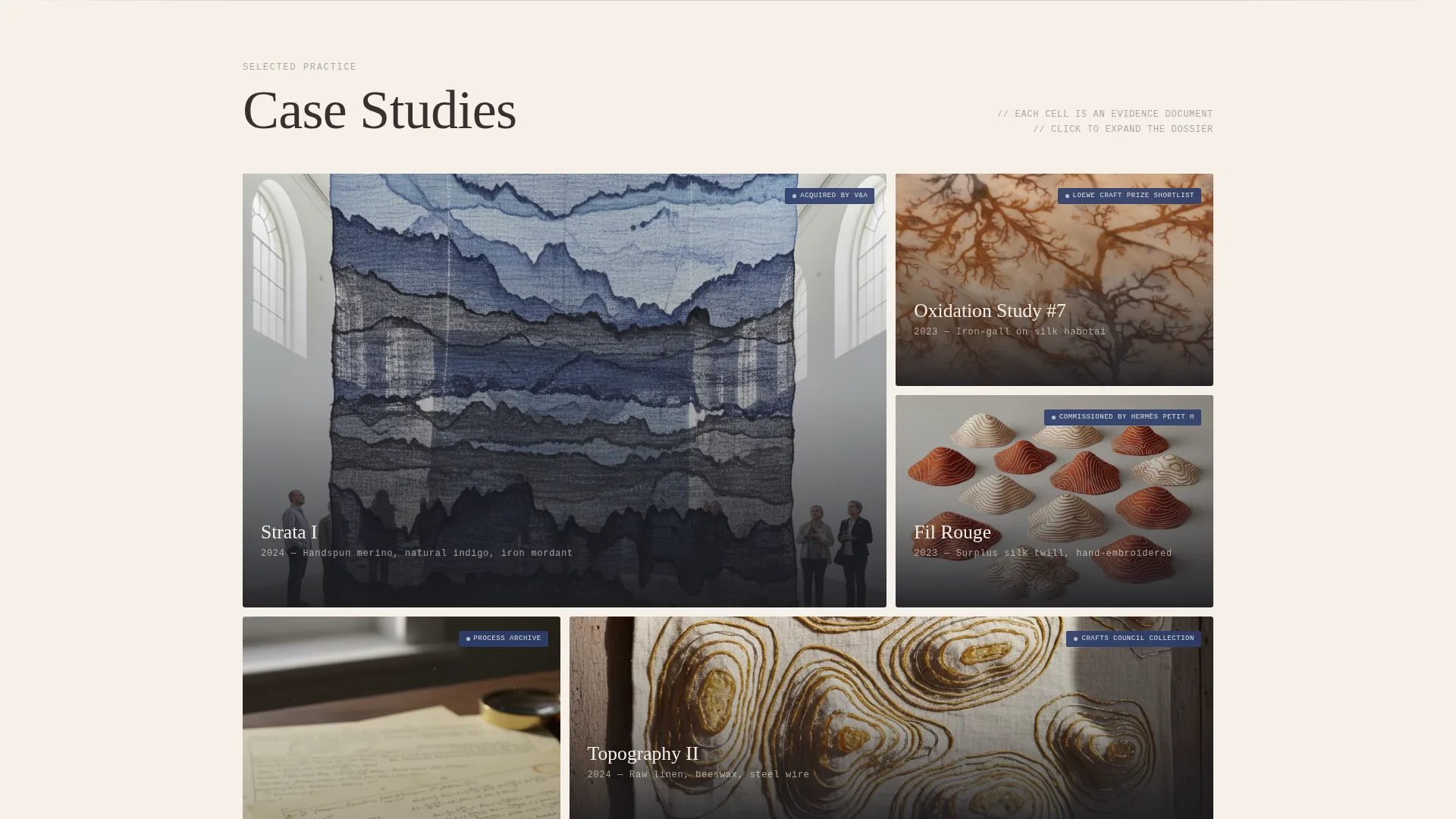
- An award and recognition bento grid with expandable case study tiles and credential badges
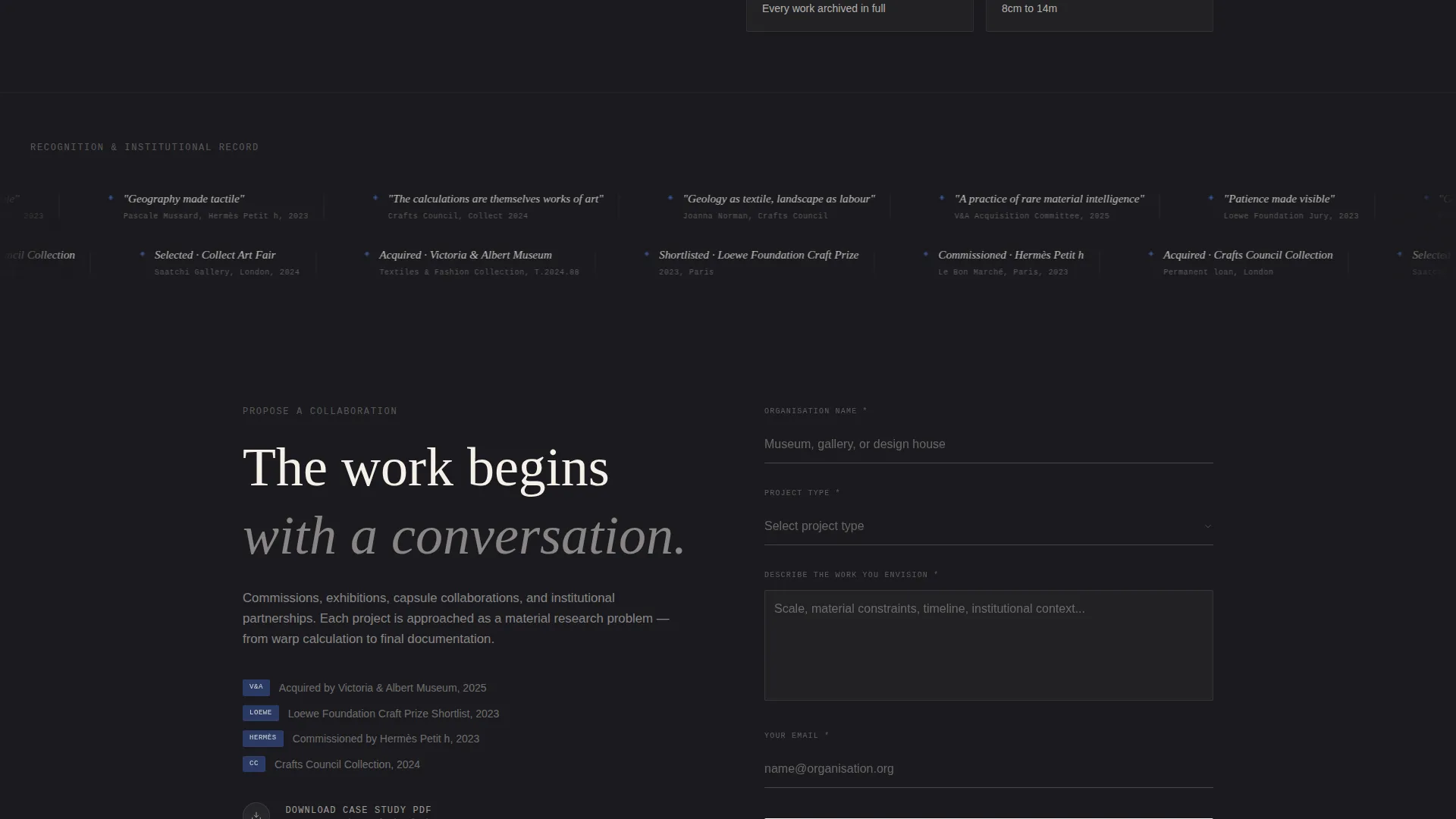
- A partnership-focused contact form and an email-gated case study PDF download path
Feature list
This template ships with six focused components, each mapped to a specific need in a textile artist's professional presentation.
Full-Bleed Macro Photo Header
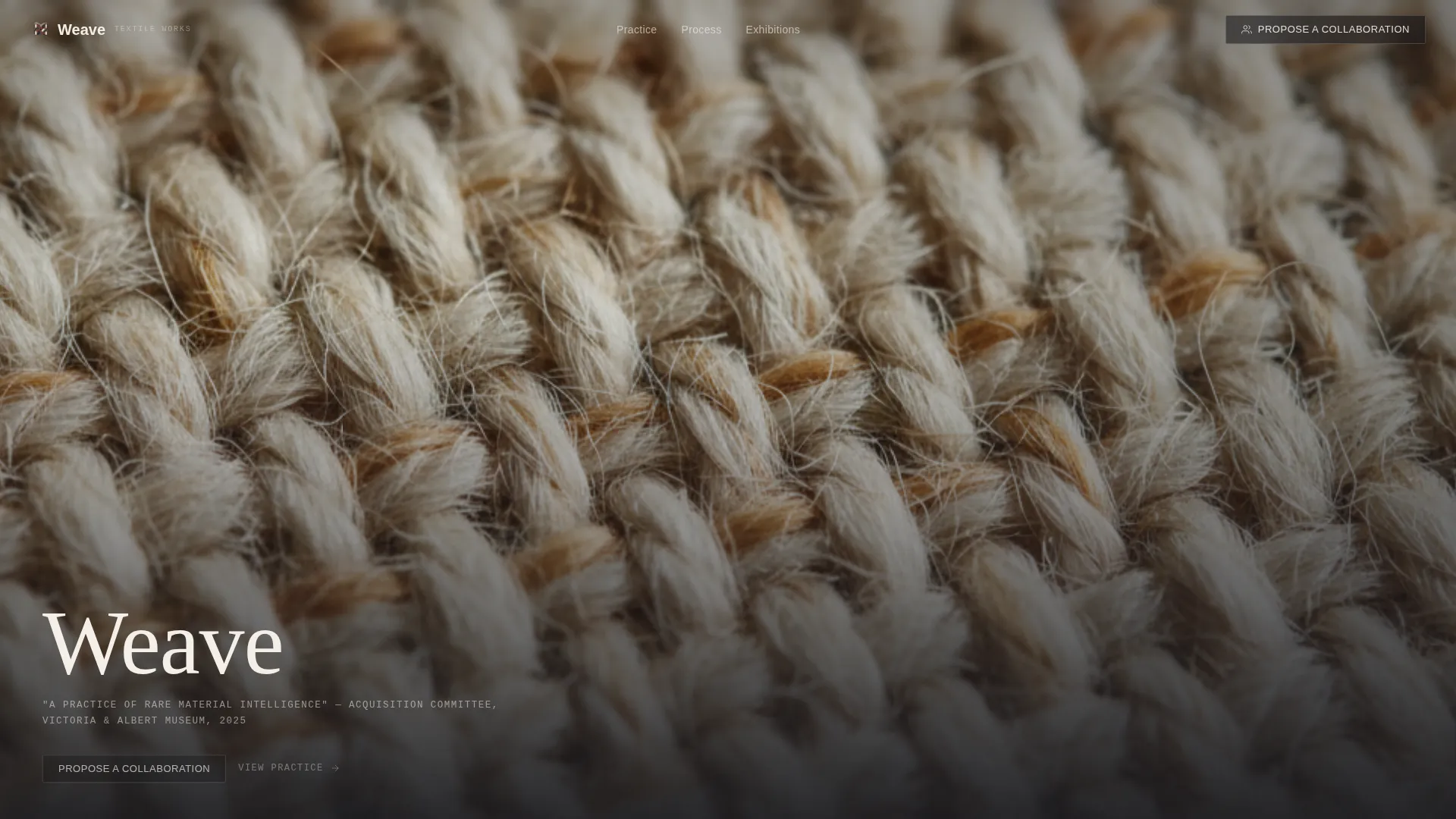
The header opens with an overhead macro photograph of a textile surface, lit from a low angle to cast micro-shadows across the weave structure. The image bleeds past every viewport edge. The artist's name and a single acquisition note or jury citation fade in after two seconds, set in a thin wide-tracked serif and positioned bottom-left like a museum wall label.
Bento Grid Case Study Layout
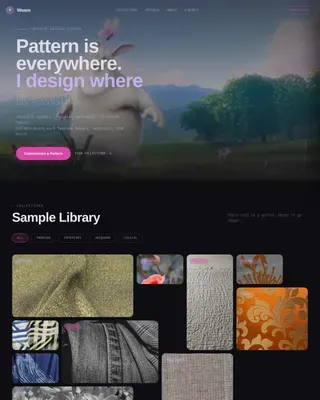
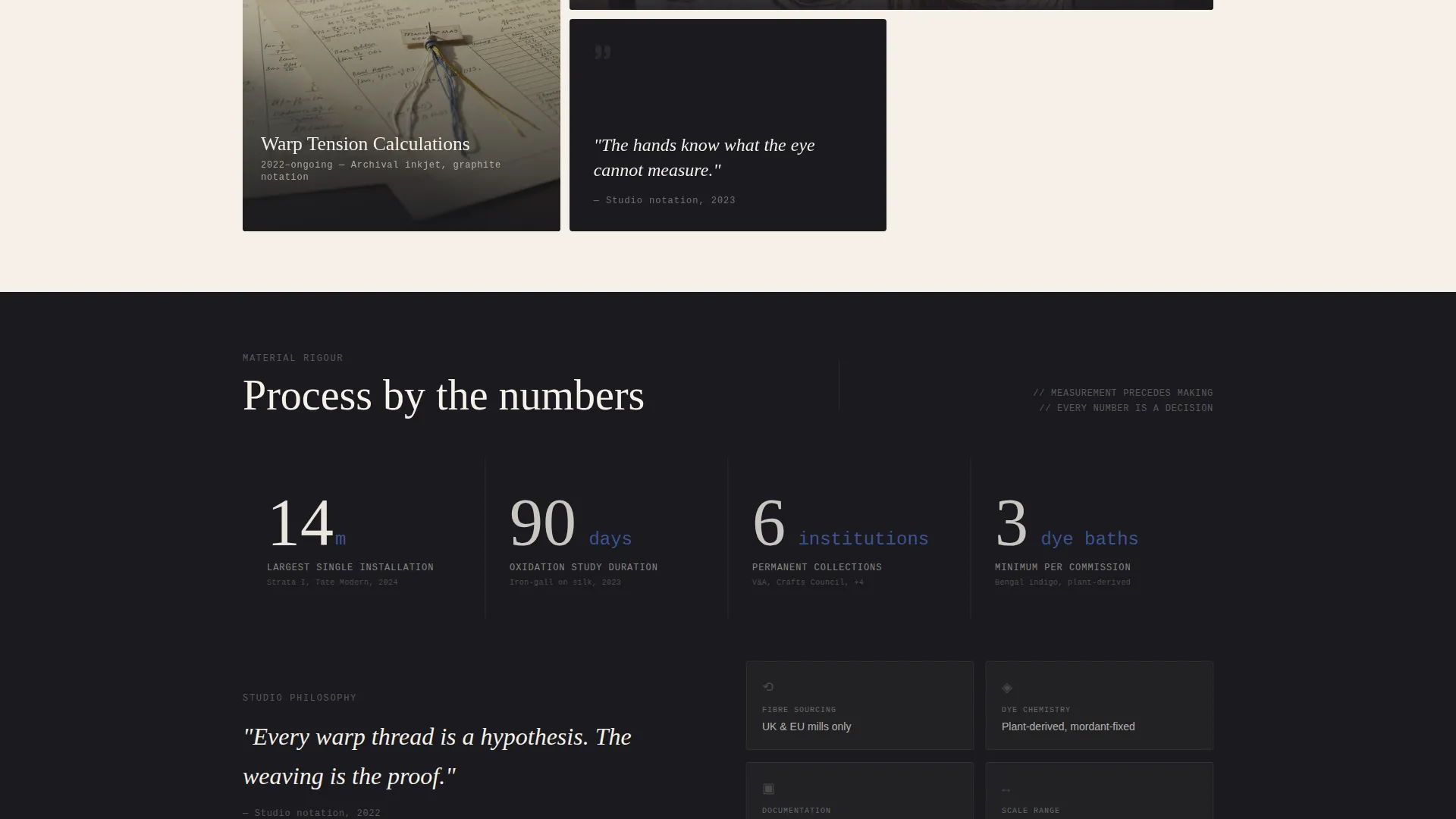
The main grid arranges case study tiles in varied sizes: tall, wide, and square cells that keep the eye moving. Each tile carries a small recognition badge such as an institutional acquisition note or prize shortlist credit. Scale shifts between a large detail shot, a thumbnail of the artist's hands, and a curator quote card prevent the grid from reading as a static gallery wall.
Expandable Case Study Tiles
Clicking any bento tile expands it into a full case study view. The expanded state includes process photography, material sourcing notes, and installation documentation, giving curators and collaborators the depth they need to build an internal case for commissioning or acquisition.
Persistent Partnership Call to Action
A "Propose a Collaboration" pill sits in the top-right navigation at all times. The same call to action reappears at the bottom of the grid. This dual placement ensures the inquiry path is always visible without interrupting the credential-building scroll experience.
Structured Collaboration Inquiry Form
The contact form opens with organization name, then asks for project type using four defined options: exhibition, product collaboration, commission, or licensing. A free-text field labeled "Describe the work you envision" closes the form. This structure filters serious institutional inquiries from general contact requests.
Email-Gated Case Study PDF Download
A secondary conversion path offers a downloadable case study document behind an email gate. This gives curators a formatted file they can circulate internally, extending the artist's reach into institutions without requiring a follow-up call.
Page sections overview
| Section | Purpose |
|---|---|
| Full-Bleed Header | Opens with macro textile photography and delayed artist name fade-in |
| Recognition Badge Grid | Displays credentialed bento case study tiles with varied scale |
| Expanded Case Study | Shows process photography, material notes, and installation docs |
| Persistent Nav Pill | Keeps the collaboration call to action visible throughout the scroll |
| Partnership Inquiry Form | Collects organization name, project type, and project vision |
| PDF Download Gate | Captures curator emails in exchange for a shareable case study |
Design & branding system
The visual identity uses a Tech Glass theme expressed through an Ink and Paper color system. The palette is built around four values: deep manuscript black (#1A1A1E), unbleached cotton (#F5F0E8), iron-gall ink brown (#3B2F2F), and a single indigo dye accent (#2C3E6B). The indigo appears only on hover states and active selections, as if the visitor's interaction activates the color.
- Backgrounds alternate between cotton white and manuscript black, with text inverting accordingly to maintain contrast
- Typography uses a thin, wide-tracked serif that echoes archival labeling and museum wall text conventions
- The overall feel references a conservator's worktable: archival tissue, graphite notations, and a pinned swatch of hand-dyed silk under glass
Mobile & speed optimization
The bento grid layout is structured to reflow cleanly across screen sizes. Tile proportions and the header bleed are set to adapt without cropping critical photographic content or breaking the credential badge placement.
- The persistent navigation pill and the collaboration call to action remain accessible on smaller screens throughout the scroll
- The email-gated PDF path and the structured form are designed to function clearly on touch devices without requiring horizontal scrolling
How this template helps you convert
The page is built around a single conversion logic: earn trust through evidence before asking for action. By the time a visitor reaches the form, they have already moved through institutional credentials, process documentation, and curator endorsements.
- The header sets authority immediately with a macro textile image and a timed citation fade-in, positioning the artist as someone whose work has already been recognized
- The bento grid builds a layered case across multiple tiles, each carrying a credential badge that functions as a third-party endorsement from a gallery, prize committee, or commissioning institution
- The dual-path conversion structure offers a direct collaboration form for ready buyers and a PDF download for curators who need internal approval before committing
Other information about this template
This template is a strong fit for textile artists who exhibit or collaborate across international creative and institutional contexts. It is built as a single-page landing page, so all content lives in one scrollable view without requiring a separate site architecture.
- The template style is Bento Grid, which suits portfolios where varied content types, process images, quotes, and credentials, need to coexist in a single non-linear layout
- The landing page direction is Partnership and Business-to-Business, meaning every design decision from the form structure to the badge placement prioritizes professional inquiry over casual browsing
- The color system and header concept are drawn from archival and material references, making the template suitable for artists working in fiber, weaving, embroidery, natural dyeing, or mixed-textile installation practices
Theme
Tech Glass
Creative direction
Award & Recognition
Color system
Ink & Paper
Style
Bento Grid
Direction
Partnership/B2B
Page Sections
Full-bleed Macro Photo Header
Bento Grid Case Study Layout
Expandable Case Study Tiles
Persistent Partnership Call to Action
Structured Collaboration Inquiry Form
Email-gated PDF Download Path
Related questions
Can I customize the recognition badges with my own credentials?
How does the expandable case study tile work?
Who is the collaboration inquiry form designed for?
Can the PDF download path help with curators who need internal approval first?
Is this template suitable for artists working across multiple textile disciplines?