Clean Water Nonprofit Reviews & Social Proof Website Template
The Wellspring Family First Clean Water Nonprofit Landing Page Template is a single-column, scroll-driven landing page built for grassroots clean water organizations. It leads with a floating testimonial card, guides visitors through a mosaic of real family stories, and connects each story to a practical resource. A three-field inline form and an ungated resource library work together to earn trust before asking for anything.
by Rocket studio
Quick summary
The Wellspring Family First Clean Water Nonprofit Landing Page Template gives grassroots clean water organizations a warm, story-first landing page that earns trust before asking for anything. A floating testimonial card opens the experience. Real family stories guide visitors through every scroll. Each narrative connects directly to a downloadable resource, a plain-language guide, or a practical action step. The result feels like a neighbor handing you exactly what you need.
Who this template is for
This template is built for small, community-rooted clean water organizations that test tap water in underserved towns and hand results directly to families. It suits teams that prioritize trust-building over conversion pressure, and who want their page to feel human rather than institutional.
- Parents, grandparents, and PTA volunteers who discovered a water quality problem and are building an organization to help their neighbors
- Grassroots nonprofits that provide assistance to families, serve rural and small-town communities, and need a landing page that works on a phone screen forwarded from a group chat
- Community health advocates and mission-driven organizations that want to offer free resources, support families, and grow a list of people they can help over time
What problem this template solves
Most nonprofit landing pages feel like brochures. They list programs without context, speak in institutional language, and ask visitors to trust before they have any reason to. Families who are already struggling with water quality fear, who may be dealing with health concerns in their children, who may not know their rights as renters, do not connect with pages that feel like government forms.
This template solves the trust gap directly. It leads with story instead of statistics, and it earns the click by proving, one family at a time, that someone just like you already used these resources and something actually changed.
- Families who notice a faint smell from the faucet or a rash on their child after bath time do not know where to start. This template hands them clear next steps immediately, without jargon.
- Renters who are struggling to get their landlord to address water issues need a letter template and guidance, not a homepage about the organization's history. This template serves them with the exact resource they need, right when they need it.
- Organizations that want to provide assistance to their community without gatekeeping safety information now have a page that lets visitors skip the form entirely and browse the resource library directly, because access to safe water should never be conditional.
What you get with this template
You receive a fully designed, single-column flow landing page with every section, every component, and every interaction pre-built to match the Wellspring creative brief. The page is ready to be populated with your own family stories, your own zip codes, and your own downloadable resources.
- A floating hero testimonial card, a testimonial mosaic scroll with alternating card alignment, a three-field inline form with a skip option, and an ungated resource library card grid
- A complete Soft Mist color system, Fraunces serif typography paired with DM Sans, and a GSAP-powered animation layer with staggered card entrances, scroll reveals, and a subtle hero float
- A footer following the minimal horizontal flow pattern, a green call-to-action button system that appears after every third testimonial, and a secondary path that lets visitors reach resources without filling out any form
Feature list
This section details the core capabilities built into the template as described in the project brief.
Floating Hero Testimonial Card
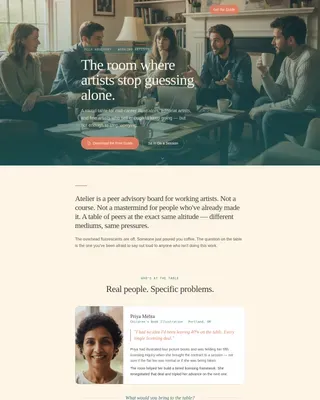
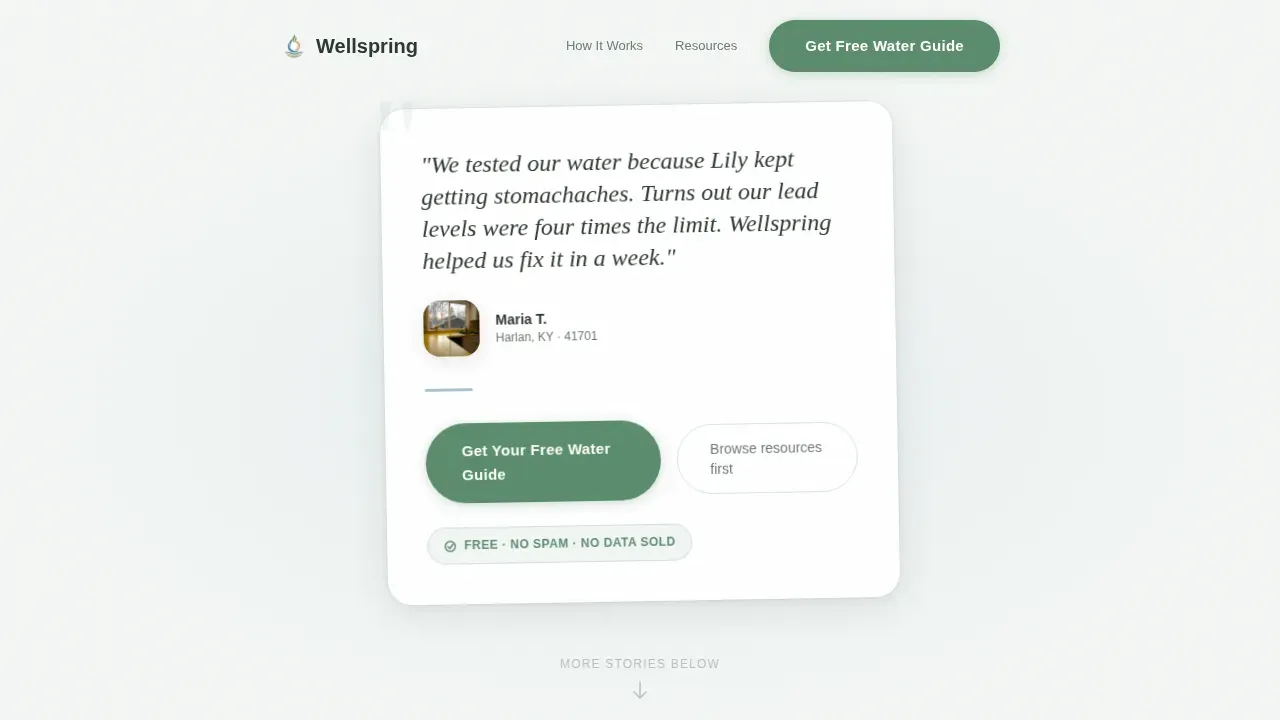
The page opens with a handwritten-feeling quote card floating on a fog-white field. The card carries a real parent's words, a phone-camera snapshot of a mother and daughter at a kitchen sink, and a green call-to-action button below it. No logo competes with the face. The card is styled to feel like something pinned to a refrigerator door, which immediately signals warmth and honesty to families who are already worried.
Testimonial Mosaic Scroll Layout
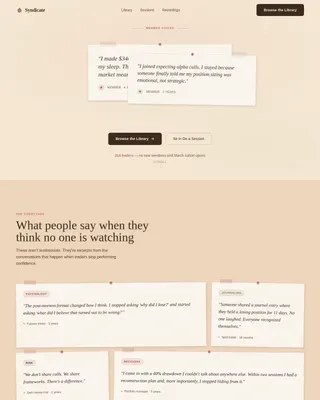
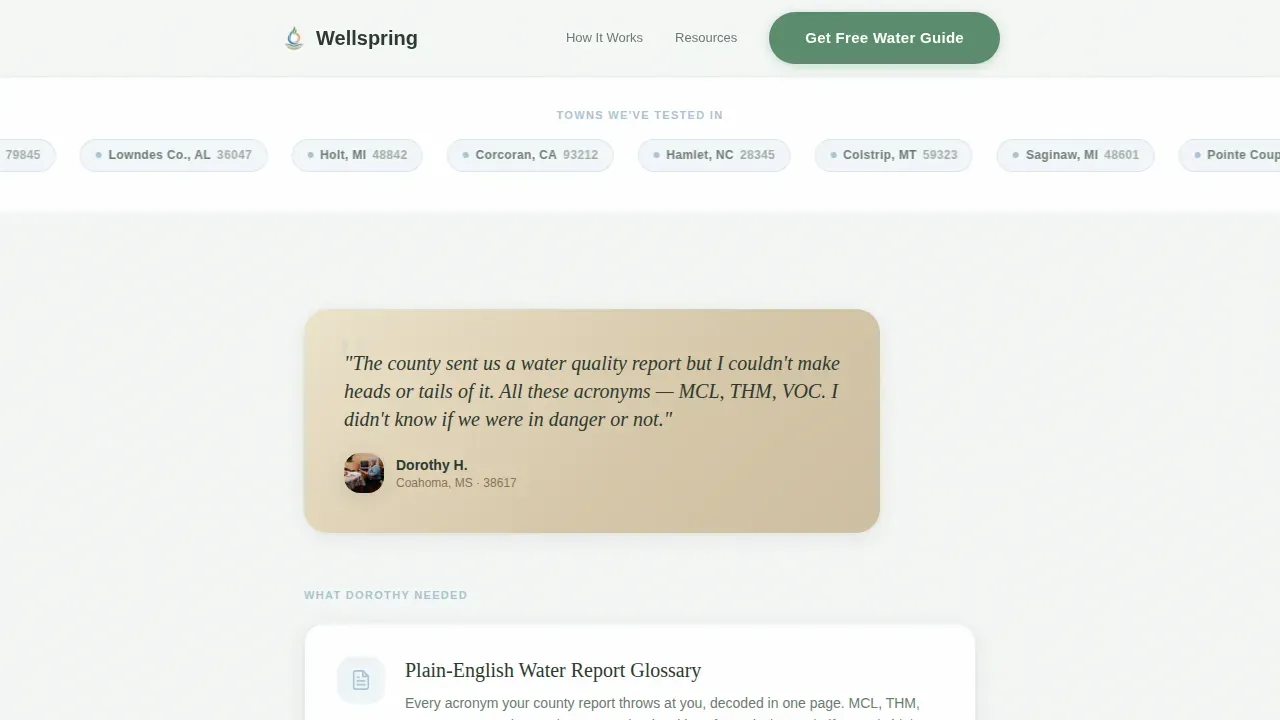
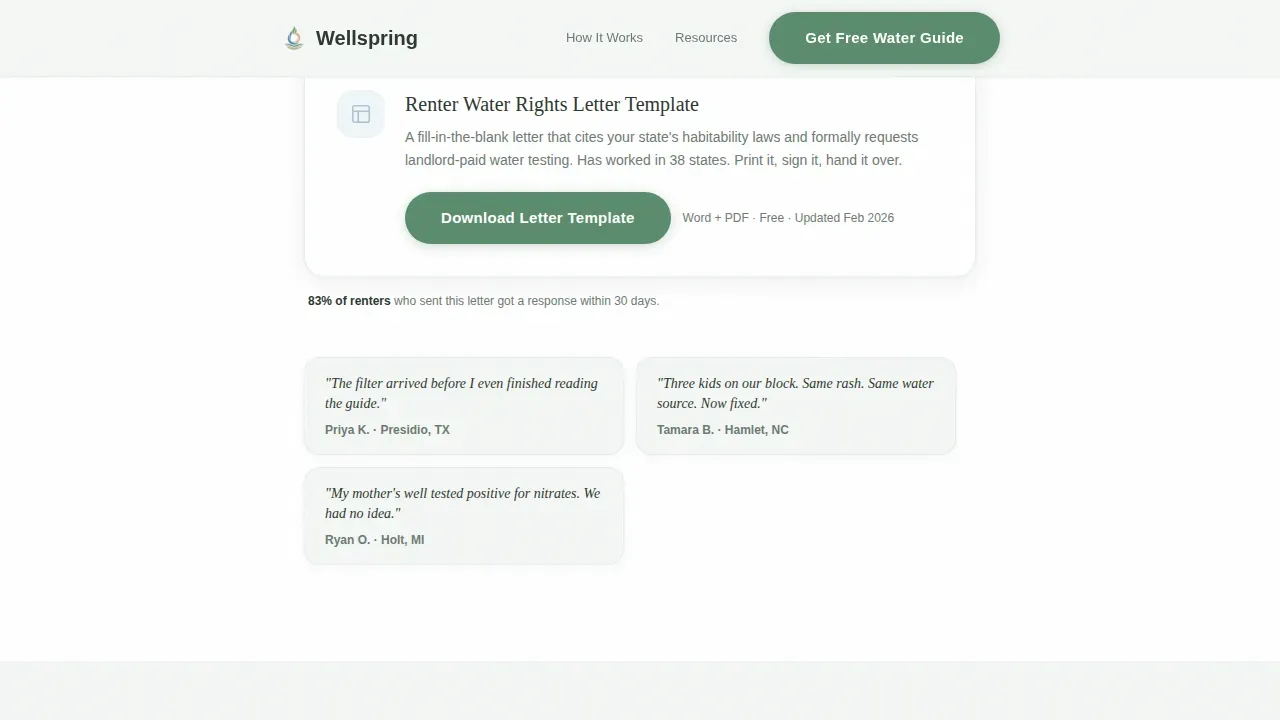
As visitors scroll, each section opens with a family's story before revealing the resource it connects to. A grandmother's quote about confusing water-quality reports leads into a plain-English glossary. A father's frustration with his landlord leads into a renter letter template. Cards alternate alignment subtly, some with photos, some with only a town name and a zip code. The mosaic builds a sense that this problem is everywhere and so are the answers.
Three-Field Inline Form with Skip Option
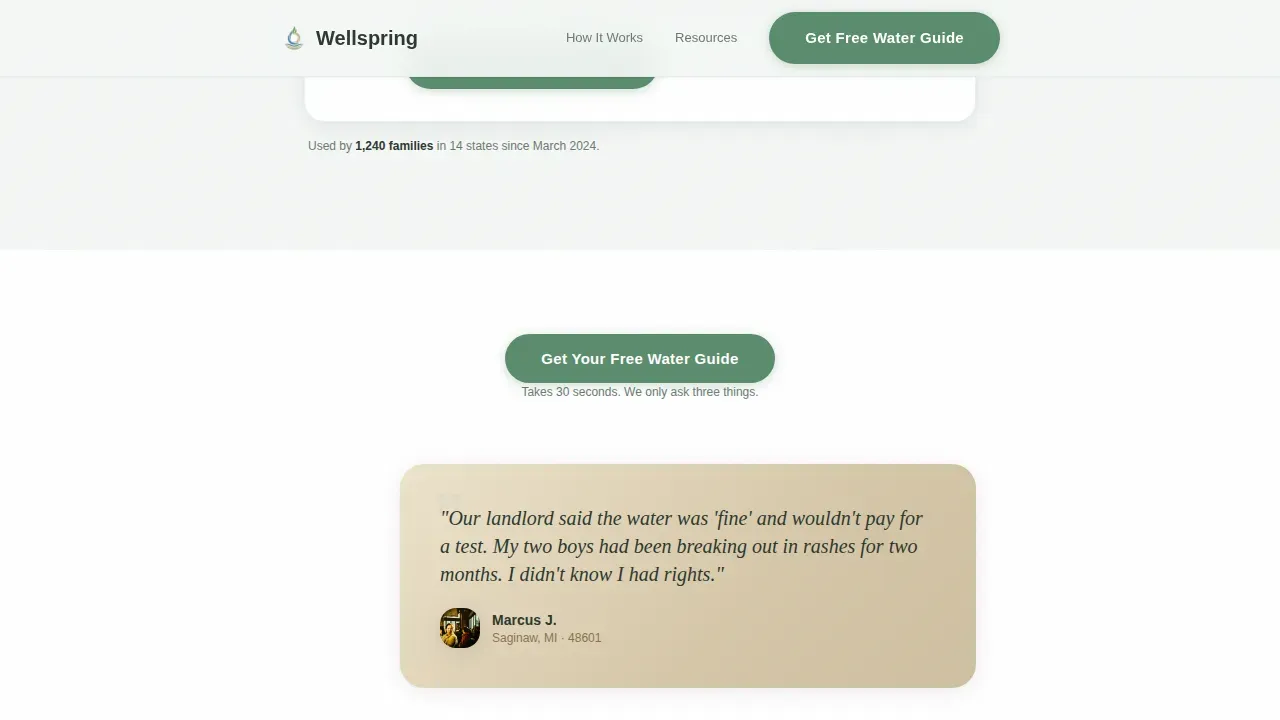
The primary call to action is "Get Your Free Water Guide," rendered in the reassurance green and repeated after every third testimonial. Clicking it opens an inline form asking only for a first name, a zip code, and whether the visitor rents or owns. Nothing invasive, because families already feel surveilled by systems that failed them. A secondary path lets visitors skip the form entirely and browse the resource library directly, preserving access to safety information for everyone.
Ungated Resource Library Card Grid
Below the form, a card grid displays all free downloads without requiring any sign-up. Visitors can contact resources, download guides, access glossaries, and find letter templates without giving any information first. This design choice reflects the organization's core belief that earning trust means not gatekeeping safety. The grid uses resource card hovers and a clean card layout to make navigation intuitive and fast on any screen.
GSAP Animation and Interaction Layer
The template uses GSAP-powered scroll reveals, staggered card entrances, and a subtle float effect on the hero card. The green call-to-action button uses a ripple effect on click. Form toggling is handled client-side, while static sections use server components for performance. Interactivity is purposeful and never distracting, keeping the emotional focus on family stories rather than visual noise.
Soft Mist Color and Typography System
The Soft Mist palette pairs morning fog white, well-water blue, worn kitchen-pine, and a quiet reassurance green. Backgrounds stay in the fog-white range. Well-water blue anchors section dividers and iconography. Pine warms the testimonial cards. Green appears only on trust indicators and action buttons, making it a genuine signal rather than a decoration. Fraunces serif headlines give the page warmth; DM Sans body text keeps it easy to read quickly on a phone.
Page sections overview
| Section | Purpose |
|---|---|
| Hero Testimonial Card | Opens with a floating parent quote, phone-camera photo, and primary green call-to-action button |
| Testimonial to Glossary | Grandmother story leads into a downloadable plain-English water report glossary |
| Testimonial to Renter Resource | Father story leads into a renter letter template for demanding water testing from landlords |
| Inline Form Block | Three-field form for name, zip, and rent/own status, with a skip link to the resource library |
| Resource Library Grid | Ungated card grid of all free downloads, accessible without any sign-up required |
| Minimal Footer | Horizontal flow footer pattern with quiet branding and essential contact links |
Design & branding system
The visual identity follows the Family First theme, built on a Soft Mist color palette that feels like condensation on a cold glass of water held up to window light. Every color choice is deliberate. Nothing about this page looks clinical, corporate, or intimidating, because the families who need it the most are the ones most likely to leave if it does.
- Morning fog white (#F4F7F5) covers all backgrounds. Well-water blue (#A8C5D6) anchors section dividers, icons, and decorative elements. Worn kitchen-pine (#D6C7A8) warms the testimonial cards. Quiet reassurance green (#5B8C6E) appears only on trust indicators and action buttons.
- Fraunces, a warm variable serif, sets all headlines and quote text, giving the page a handwritten, kitchen-table quality. DM Sans handles body text and form labels, keeping the reading experience clean and fast at small sizes on phone screens.
- Photography follows a phone-camera aesthetic: natural light, slightly warm, no studio polish. Images show real moments at kitchen sinks and dining tables, not staged scenes with perfect lighting.
Mobile & speed optimization
Over 60 percent of visitors will arrive on a phone screen, forwarded from a group chat, a neighborhood app, or a county boil-water notice email. The template is built mobile-first, with every layout decision made for the small screen before scaling up to desktop.
- The single-column flow means no layout breaks on any screen width. Testimonial cards stack cleanly. The resource grid adapts to a single column on phones without any horizontal scrolling.
- Static sections use server components, keeping the initial page load fast even on slower rural data connections. GSAP animations and the form toggle are loaded client-side only, so they never block the first visible content.
- The three-field inline form is thumb-friendly by design. Fields are large enough to tap accurately. The skip link is visibly placed so families who do not want to fill out a form can reach the resource library in one tap.
How this template helps you convert
Trust is the conversion mechanism on this page. Every design and layout decision is built to reduce fear and increase confidence before any ask is made. The page earns the click by proving, story after story, that someone just like you already walked this road.
- The testimonial mosaic builds social proof continuously as visitors scroll. Real quotes, real town names, real outcomes like lead levels fixed and rashes stopped create a cumulative sense of credibility that no statistic could achieve alone. By the time the form appears, the visitor already knows this organization delivers.
- The green call-to-action button appears after every third testimonial, timed to coincide with peak trust moments in the scroll journey. It never appears before the visitor has read at least one story. The repeat placement increases the chance of a click without feeling pushy, because the surrounding context always justifies the ask.
- The skip option and the ungated resource library remove the primary barrier to engagement. Families who are not ready to share their information can still access every guide, every glossary, and every letter template. Getting help first, before giving anything, is what transforms a first-time visitor into a long-term supporter.
Other information about this template
This template draws on a long tradition of community-centered organizations that have served families facing overlapping challenges including mental health pressures, domestic violence, homelessness, and poverty. Understanding that context helps any organization using this template recognize the population it is most likely to serve and the sensitivity required to serve them well.
- Wellspring Family Services, which began in 1892 as the Bureau of Associated Charities in downtown Seattle, has spent more than 120 years as a source of aid and comfort to the poor and troubled of Seattle and King County. The Charity Organization Movement that inspired it aimed to replace uncoordinated philanthropy with a systematic approach to charity. By 2011, Wellspring Family Services was assisting more than 9,000 children, adults, and families in King County in a single year.
- The organization grew through a series of name changes reflecting an expanding mission: from the Charity Organization Society of Seattle in 1896, to Associated Charities of Seattle in 1917, to the Social Welfare League in 1919, to the Family Society of Seattle in 1934, to Family Services of King County in 1980, to the current name in 2009. Each transition marked a broadening of programs and a deeper commitment to serve the whole family.
- Wellspring Family Services focuses on building healthy families and addresses overlapping challenges of mental health, domestic violence, and homelessness. It offers counseling, classes, and workshops for individuals and families. Its mission is to build emotionally healthy, self-sufficient families and a non-violent community.
- In the broader world of community support resources, families may need access to food assistance, emergency financial aid, emergency housing, emergency shelter, rent assistance, and eviction prevention services alongside clean water resources. A clean water landing page can serve as one trusted point of contact that connects families to other resources they did not know existed.
- Organizations that provide assistance across King County, Federal Way, and other communities often find that water quality concerns intersect with other pressing needs. Families struggling with child care costs, substance use challenges, behavioral health concerns, or legal issues related to family law may arrive at a clean water page first. Meeting them there with warmth and then pointing them toward other resources builds lasting community trust.
- Community events, fundraising events, and workshops hosted by clean water nonprofits can be promoted through this landing page. A resource card in the library grid or a testimonial card linked to an event sign-up extends the page's usefulness beyond guide downloads.
- Students experiencing food insecurity, families navigating foster care systems, individuals dealing with legal system complexity, and adults managing developmental disabilities all benefit from plain-language community resources. This template's ungated library model works for any organization that wants to provide assistance without requiring families to prove eligibility first.
- Nonprofits that rely on donations and volunteer support to fund their clean water initiatives often look to templates that communicate mission clearly and build donor confidence. A transparency section explaining how funds are used, or a donation call with a highlighted impact match, can be added to the resource library section or the footer of this template without altering the core layout.
- The professional association of grassroots water advocates and community health organizations increasingly recognizes that behavioral health outcomes are connected to environmental health. Families living near contaminated water sources report higher rates of anxiety, depression, and stress. A landing page that acknowledges this connection serves families more completely.
- Mental health support, substance use resources, health insurance guidance, and financial assistance links can all appear as resource cards in the ungated library. Families who arrive worried about a smell from the faucet may leave with a water guide and a connection to a behavioral health program they did not know was available.
- In recent years, community organizations across the world have recognized that stable housing and safe water are inseparable. Emergency shelter programs and emergency housing services are natural partners for clean water initiatives, because families who are homeless or at risk of eviction face the highest exposure to unregulated water sources.
- Veterans, young men, young people, and women in rural communities are among the groups most likely to face unaddressed water quality issues without the financial aid or the knowledge to seek help. A page that speaks in plain language, leads with stories, and offers a safe place to access resources removes barriers for all of these groups.
- Financial aid programs, financial assistance networks, and college and university community service programs can be featured as other resources in the library grid. Higher education institutions with environmental science or public health programs are natural members of a clean water coalition board.
- This template is designed to serve organizations that want to build community, grow their members list, recruit advocates, and give families hope, not just a water test result. The mission of any clean water nonprofit extends into every corner of community life: food safety, child care, poverty reduction, housing stability, and access to a safe place for every family.
- The Wellspring Family First Clean Water Nonprofit Landing Page Template is a complete, ready-to-use page for any grassroots organization that wants to lead with story, earn trust, and provide assistance to families who need it most.
- Mission Waco, known for its holistic relationship-centered programs, has installed over 300 water pumps and runs a poverty simulation that has changed the lives of 25,000 participants by building empathy for those living in poverty. Its model of community-first action is a strong reference point for organizations using this template to build their own approach.
- Giving Echoes is a specialized template designed for water initiatives, featuring a full-screen hero section, animated impact counters, and a donation widget, offering a different visual approach for organizations that prefer bold impact metrics over story-first design. It serves as a useful comparison point for teams deciding which template style fits their audience.
- Community organizations, nonprofit board members, agency staff, and individual advocates who want to contact families, build new friends in their community, and succeed in their mission will find this template gives them a strong, credible, and emotionally resonant starting point.
Theme
Family First
Creative direction
Testimonial Mosaic
Color system
Soft Mist
Style
Single Column Flow
Direction
Content/Resource
Page Sections
Floating Hero Testimonial Card
Testimonial Mosaic Scroll
Three-field Inline Form with Skip Path
Ungated Resource Library Card Grid
Soft Mist Color and Typography System
GSAP Animation and Interaction Layer
Related questions
Can this template be used by organizations outside of water quality advocacy?
Does the template include the actual water guides and downloadable resources?
How does the three-field form work, and can visitors really skip it?
Is this template suited for mobile visitors?
Can I add sections for other community resources beyond water quality?