Colonial Architecture Booking Website Template
Wick is an asymmetric 60/40 landing page template built for colonial brass lighting designers. It guides visitors through an origin story scroll, from a 1762 pattern book to a candlelit installation, using full-bleed photography, editorial serif typography, and a self-drawing chandelier animation. A single primary call to action drives consultation bookings.
by Rocket studio
Quick summary
Wick is a single-page landing page template designed for heritage craft studios in the colonial lighting space. It pairs an Editorial Magazine visual style with an Origin Story scroll structure, carrying the visitor from archival reference through the foundry and into a finished installation. The closing section presents a full-width brass-toned call to action to book a consultation.
Who this template is for
This template is built for artisan studios and heritage manufacturers who need to communicate deep craft authority before asking for a commitment. It speaks directly to buyers who value authenticity over speed.
- Preservation architects matching fixtures to Historic American Buildings Survey (HABS) documentation
- Interior designers furnishing Georgian manors and colonial properties with period-correct lighting
- Homeowners of pre-Revolutionary structures seeking fixtures that are historically accurate to the property
What problem this template solves
Generic portfolio pages flatten the story of a bespoke craft into a product grid. For a studio casting brass from patterns unchanged since 1780, that approach destroys credibility before a visitor reads a single word.
- Visitors with no context for the process cannot justify the lead time or investment without a clear narrative
- Preservation architects and specifiers need documented authenticity signals, not marketing headlines
- A standard contact form feels mismatched for a commission-based, high-touch engagement process
What you get with this template
The template delivers a complete, ready-to-customize landing page structured as a six-section origin story scroll. Every section has a defined purpose and a designated layout rhythm.
- Six named page sections, each with a distinct 60/40 or 40/60 asymmetric column layout
- An SVG self-drawing chandelier animation in the hero, built with GSAP ScrollTrigger path-drawing
- A dual call-to-action system: a quiet text link at the story's climax and a full-width brass button in the closing section
Feature list
A single paragraph introduces the feature set. Each capability below is drawn directly from the template brief and reflects what is built into this layout.
SVG Self-Drawing Chandelier Hero
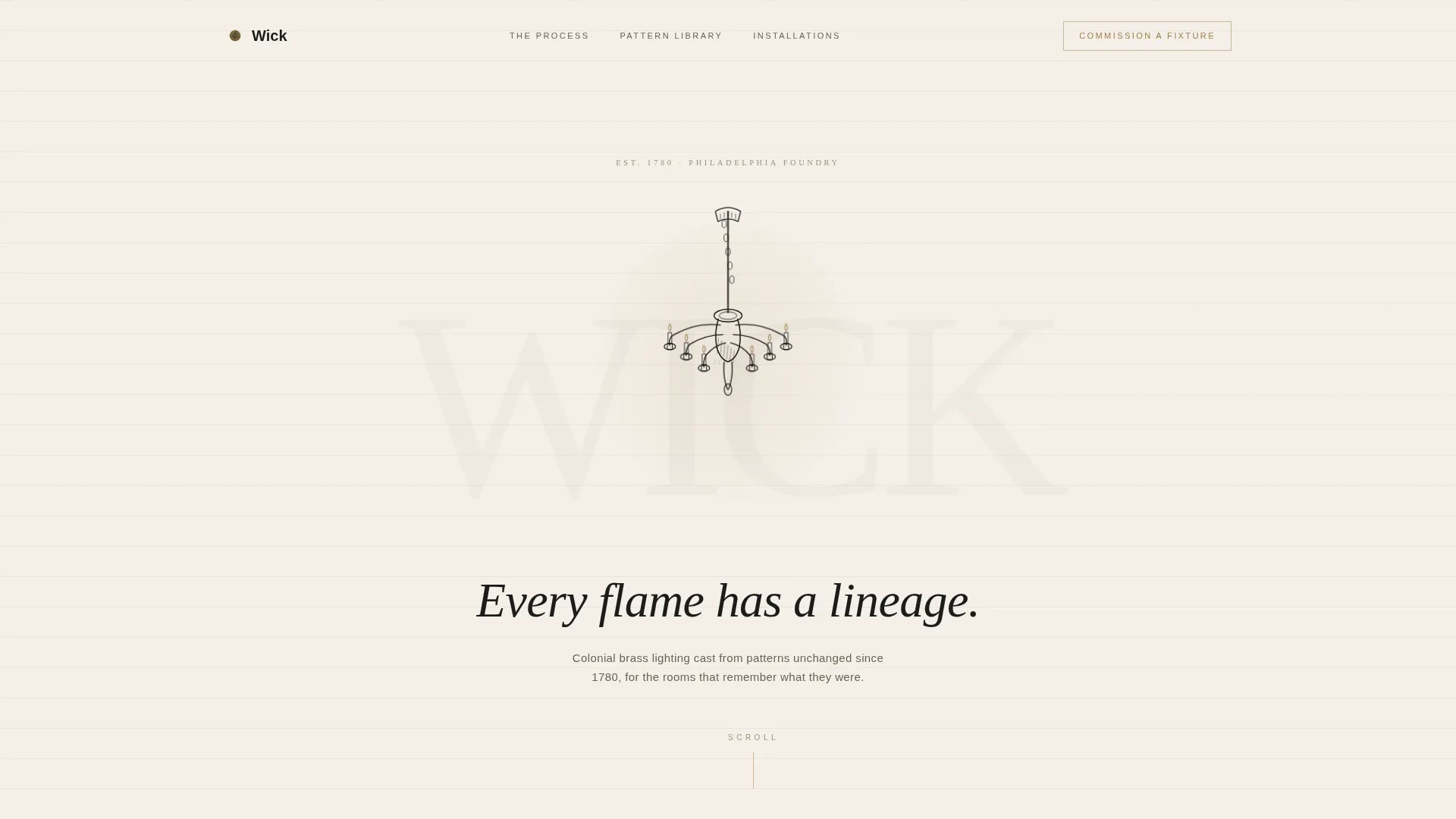
The header opens with a line-drawn six-arm chandelier that sketches itself stroke by stroke, as if cut live into a copper plate. When the drawing completes, a subtle brass watercolor bleed washes across the illustration. The editorial headline "Every flame has a lineage." sits beneath in tracked-out serif type.
Asymmetric 60/40 Scroll Grid
The layout alternates between 60/40 and 40/60 column splits across the scroll. The wider column carries full-bleed photography at every stage of the origin story. The narrower column holds typeset narrative in the cadence of long-form craft journalism.
Scroll-Linked Image Darkening
As the visitor scrolls from the daylight foundry sections into the evening installation section, photography darkens progressively via scroll-linked transitions. The page itself appears to move from workshop light into candlelight by the time the call to action appears.
Dual Call-to-Action Architecture
The primary action, "Commission a Fixture," appears first as a quiet text link after the origin story's climax. It then anchors the closing section as a full-width brass-toned button with a magnetic hover state. A secondary path, "Browse the Pattern Library," keeps researchers in the ecosystem without pressure.
Qualifying Commission Brief
A short paragraph above the closing call to action explains the bespoke process and typical lead times. This sets expectations before the click, reducing friction for visitors who are serious but unfamiliar with the commission timeline.
GSAP ScrollTrigger Parallax Reveals
Staggered section reveals and parallax depth are handled through GSAP ScrollTrigger. Content elements enter the viewport with deliberate timing, reinforcing the unhurried pace of the editorial narrative.
Page sections overview
| Section | Purpose |
|---|---|
| Hero with chandelier | Introduce brand through animated SVG illustration and editorial headline |
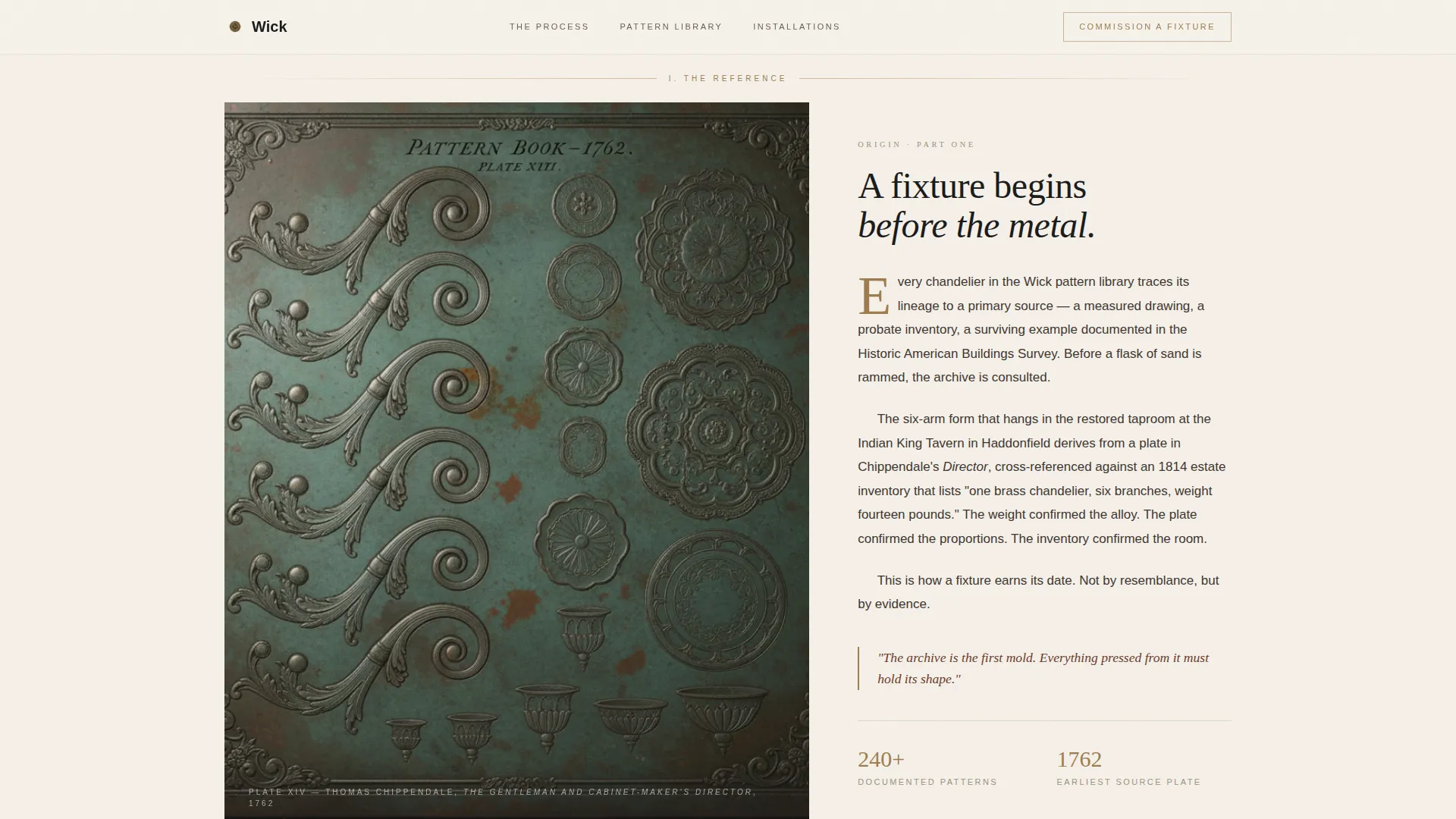
| The Reference | Establish historical origin using a 1762 pattern book archival layout |
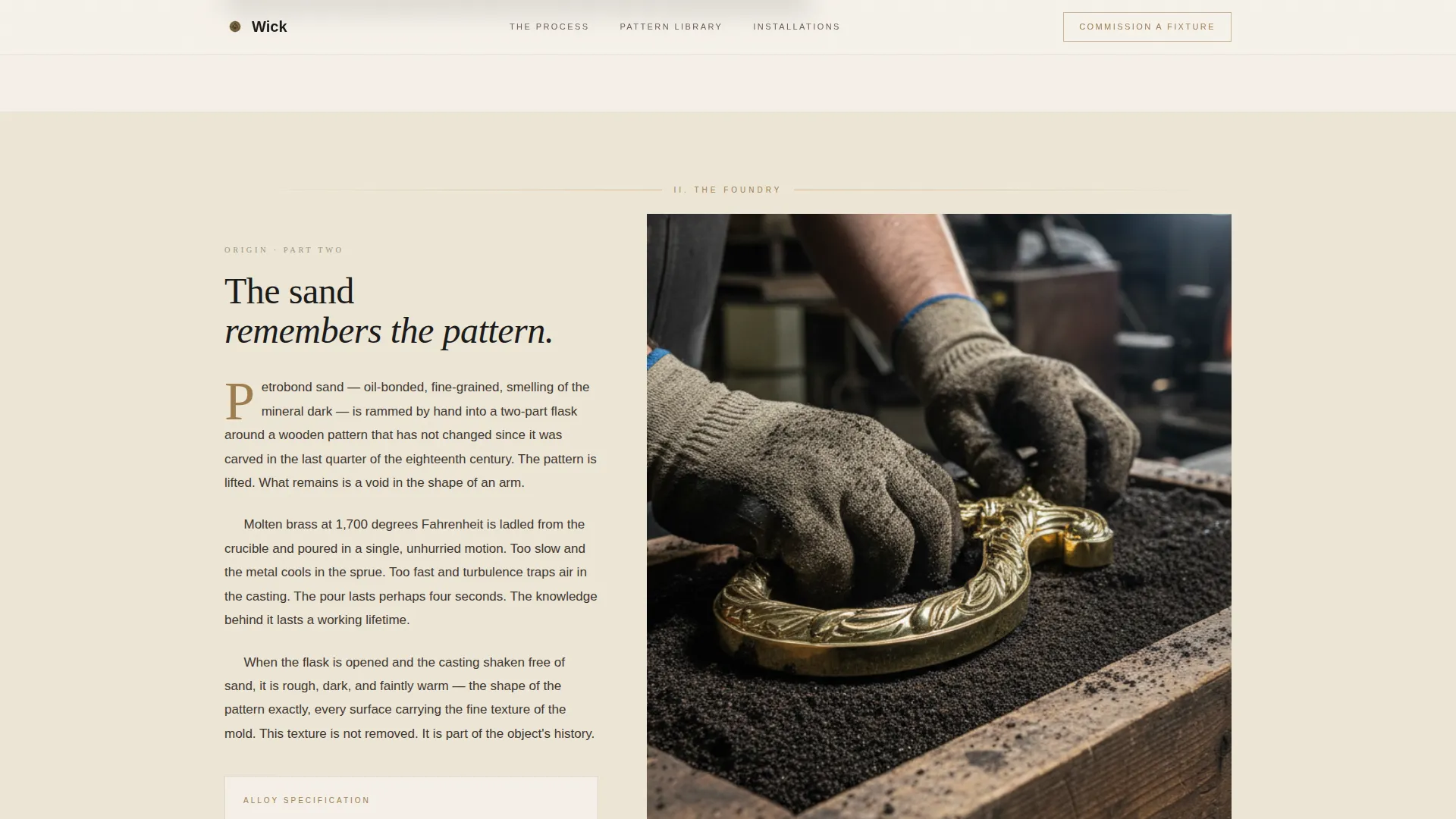
| The Foundry | Show the hand-packed sand casting process in a reversed 40/60 split |
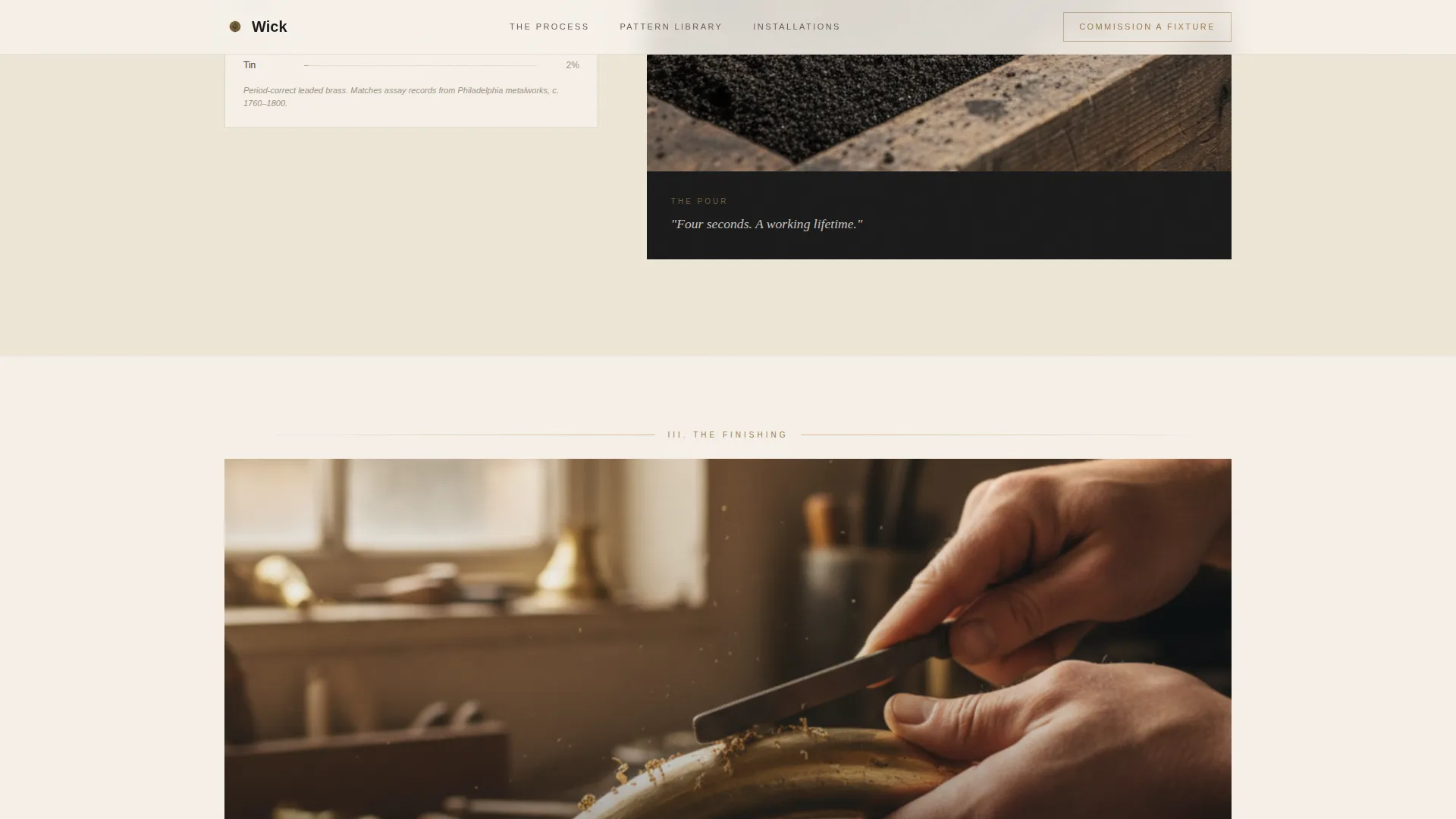
| The Finishing | Detail chasing and filing of raw castings in a 60/40 column layout |
| The Installation | Deliver the candlelit arrival moment and the quiet primary text-link call to action |
| Commission section | Close with the full-width brass button, process brief, and secondary pattern library link |
Design & branding system
The visual identity follows an Editorial Magazine theme built on an Ink & Paper color system. The palette references a broadsheet printed on handmade rag paper, restrained and tactile.
- Colors: aged parchment (#F5F0E8) background, letterpress black (#1A1A1A) body text, tarnished brass (#9E7C4E) for accents and the primary button, and muted iron oxide (#6B3A2A) reserved for pull quotes and hover states
- Typography: Fraunces serif for headlines with generous tracking, paired with DM Sans for body copy to maintain editorial legibility
- Layout style: asymmetric grid with alternating 60/40 and 40/60 splits, full-bleed photography, and ample white space that slows the reading pace
Mobile & speed optimization
The template is designed desktop-first, reflecting the working environment of preservation architects and interior designers who specify on large screens. A mobile-responsive fallback is included for all sections.
- Server Components handle static content sections, keeping non-animated page areas lightweight
- Client Components are scoped to animation-dependent sections, isolating GSAP and SVG path-drawing to where they are needed
- The asymmetric grid collapses gracefully on smaller viewports, preserving the narrative hierarchy without breaking the column logic
How this template helps you convert
The conversion strategy is built into the scroll structure itself. Visitors are never asked to commit before they understand the craft, the process, and the typical engagement path.
- The origin story scroll builds trust section by section, so by the time the primary call to action appears, the visitor has already moved through the full narrative context of what a commission involves.
- The qualifying commission brief above the closing button sets timeline expectations before the click, filtering for serious buyers and reducing friction for the right audience.
Other information about this template
This template sits at the intersection of colonial architecture and artisan craft, making it relevant for studios operating in the heritage manufacturing and luxury preservation space. A few additional details are worth noting.
- The footer follows Pattern 3 (Vercel Horizontal), a minimal horizontal layout suited to editorial contexts
- Social proof is carried through installation photography in historically significant properties and through the specificity of archival references, rather than through testimonial widgets or review counts
- The template is localized for English (US) with imperial measurements and USD pricing context in mind
- Animation intensity is set to high, with SVG path drawing, GSAP ScrollTrigger parallax, and staggered reveals working together across the scroll
- Interactivity is set to medium, covering hover states, scroll-linked image darkening, and a magnetic call-to-action button
Theme
Editorial Magazine
Creative direction
Origin Story
Color system
Ink & Paper
Style
Asymmetric Grid (60/40)
Direction
Click-Through
Page Sections
SVG Self-drawing Chandelier Hero
Asymmetric 60/40 Scroll Grid
Scroll-linked Image Darkening
Dual Call-to-action Architecture
Qualifying Commission Brief
GSAP Scrolltrigger Parallax Reveals
Related questions
Is this template suitable for a single-product or single-service studio?
Does this template include a contact form?
Can I adapt the six sections for a different craft or heritage product?
How does the template handle commission process information?
What technical skill is needed to customize the animations?