Urgent Care & Walk-In Cost Calculator Website Template
Workcomp is a hub-and-spoke landing page template built for worker's compensation clinics. It opens with an interactive Claim Response Time Estimator, then flows through four anchor-nav spokes covering Speed, Outcomes, Compliance, and Network. Every section leads with an oversized statistic, giving safety managers, HR directors, and injured workers instant evidence before they read a single paragraph.
by Rocket studio
Quick summary
Workcomp is a single-page, anchor-navigated landing page template designed for occupational health and worker's compensation clinics. It front-loads outcome data with an interactive estimator, then guides visitors through four evidence-driven spokes. The goal is to earn referrals before trust even becomes a question.
Who this template is for
This template is built for worker's compensation clinics that need to convert three very different visitors at once. Safety managers want numbers fast. HR directors want process clarity. Injured workers want to know someone will pick up the phone.
- Safety managers tracking active claims across multiple job sites
- HR directors at mid-size manufacturers managing modified duty logistics
- Injured workers in trades such as forklift operation, warehouse work, and construction
What problem this template solves
Most occupational health clinic pages bury their value in paragraphs of reassurance. By the time a safety manager finds the scheduling information, they have already moved on. This template fixes that by leading with proof, not promises.
- Slow-loading claim data and buried contact options leave injured workers without direction
- Generic clinic pages fail to speak directly to safety managers who need fast intake confirmation
- Compliance and documentation details are rarely surfaced prominently, creating doubt for HR teams
What you get with this template
You get a fully structured, single-page layout with a sticky anchor navigation bar linking to four content spokes. Each spoke opens with a dominant statistic before any explanatory text appears.
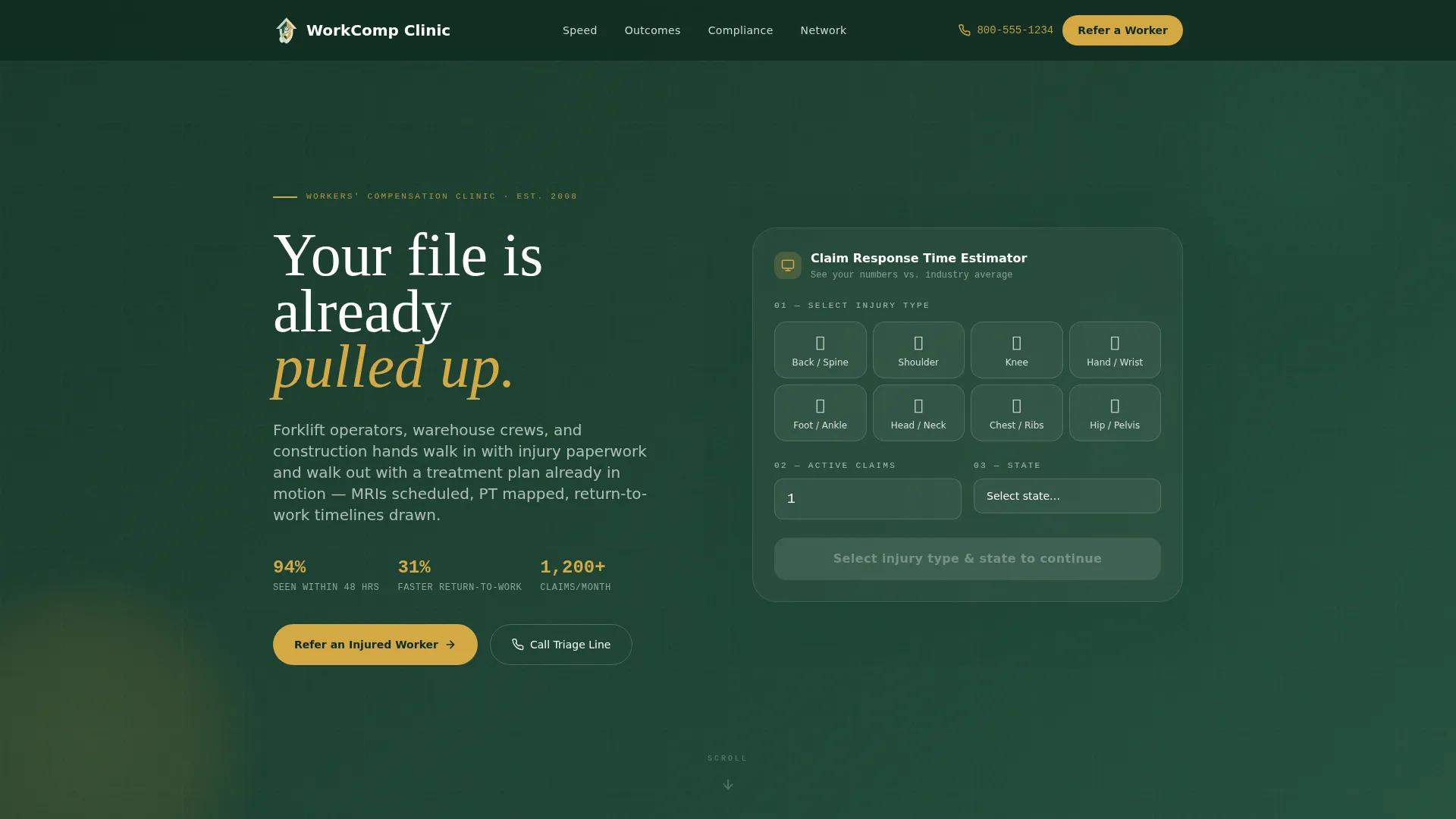
- An interactive Claim Response Time Estimator in the hero section with a visual body map, state selector, and animated results
- Four anchor-linked spokes covering Speed, Outcomes, Compliance, and Network, each closing with a "Refer an Injured Worker" call to action
- A floating "Call Our Triage Line" button with a visible phone number on mobile
Feature list
This template delivers several carefully scoped components that work together to build confidence and drive referrals.
Interactive Claim Response Time Estimator
The hero section includes a calculator where visitors select an injury type from a visual body map, enter the number of active claims, and choose their state. The tool returns an estimated first-appointment wait time contrasted against the industry average of 7 to 12 days, plus a projected return-to-work acceleration in weeks. Results animate upward in meadow gold against deep evergreen.
Stats-First Spoke Sections
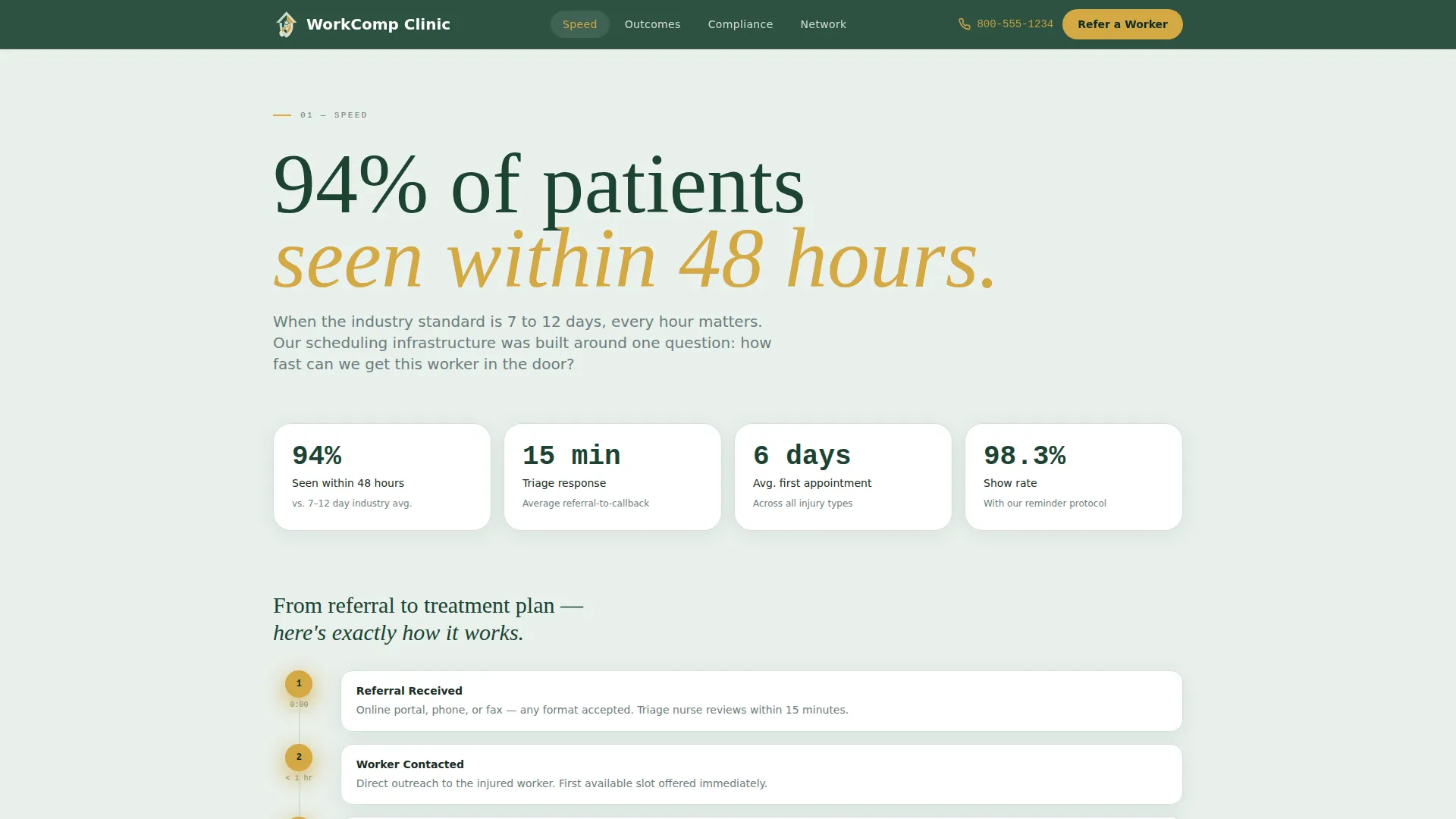
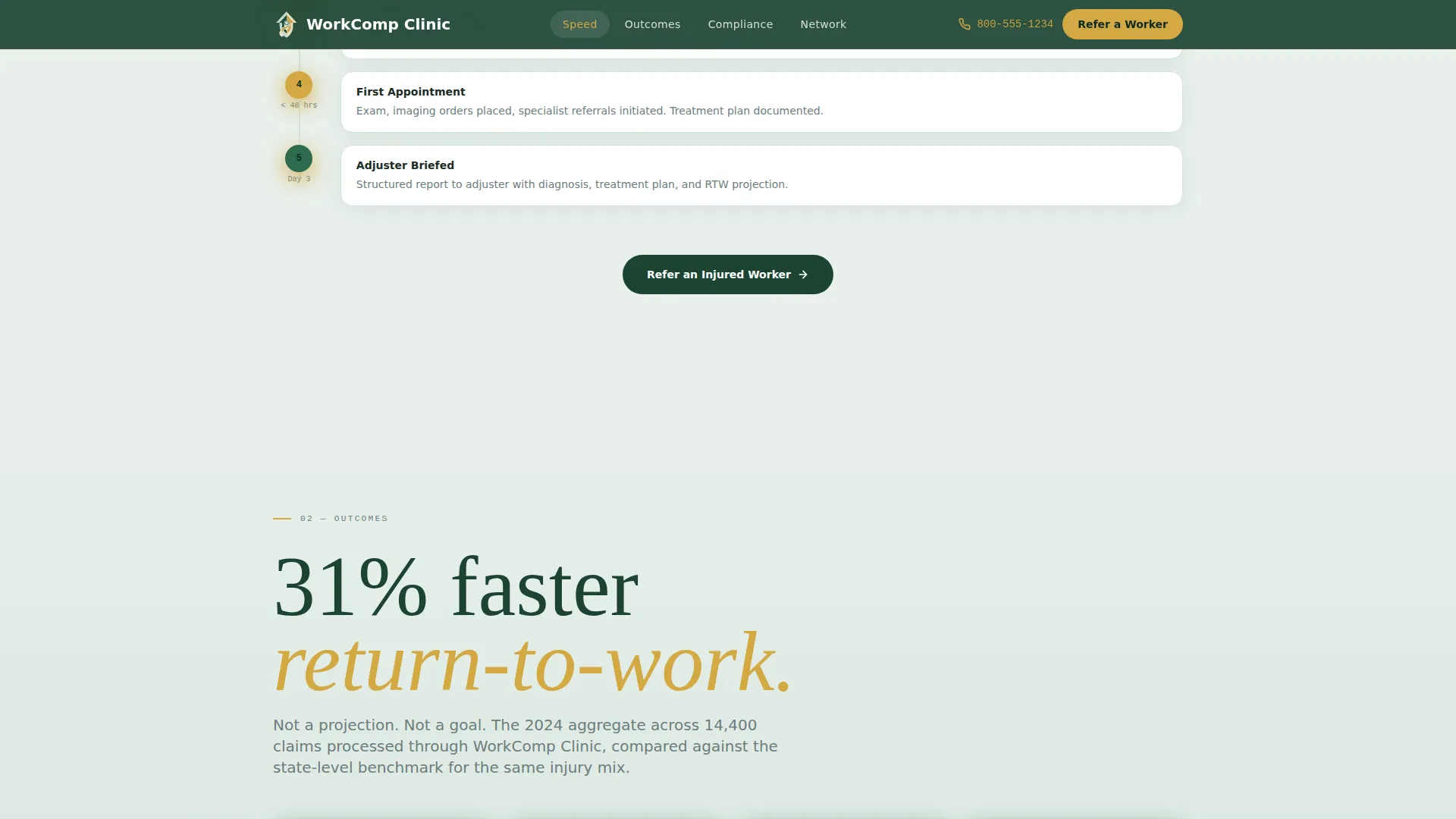
Each of the four anchor-linked spokes opens with a single oversized statistic before any supporting copy appears. The rhythm is number, then proof, then number, then proof again. This structure builds an evidence wall that makes the referral decision feel inevitable rather than uncertain.
Animated Progress Bar Timelines
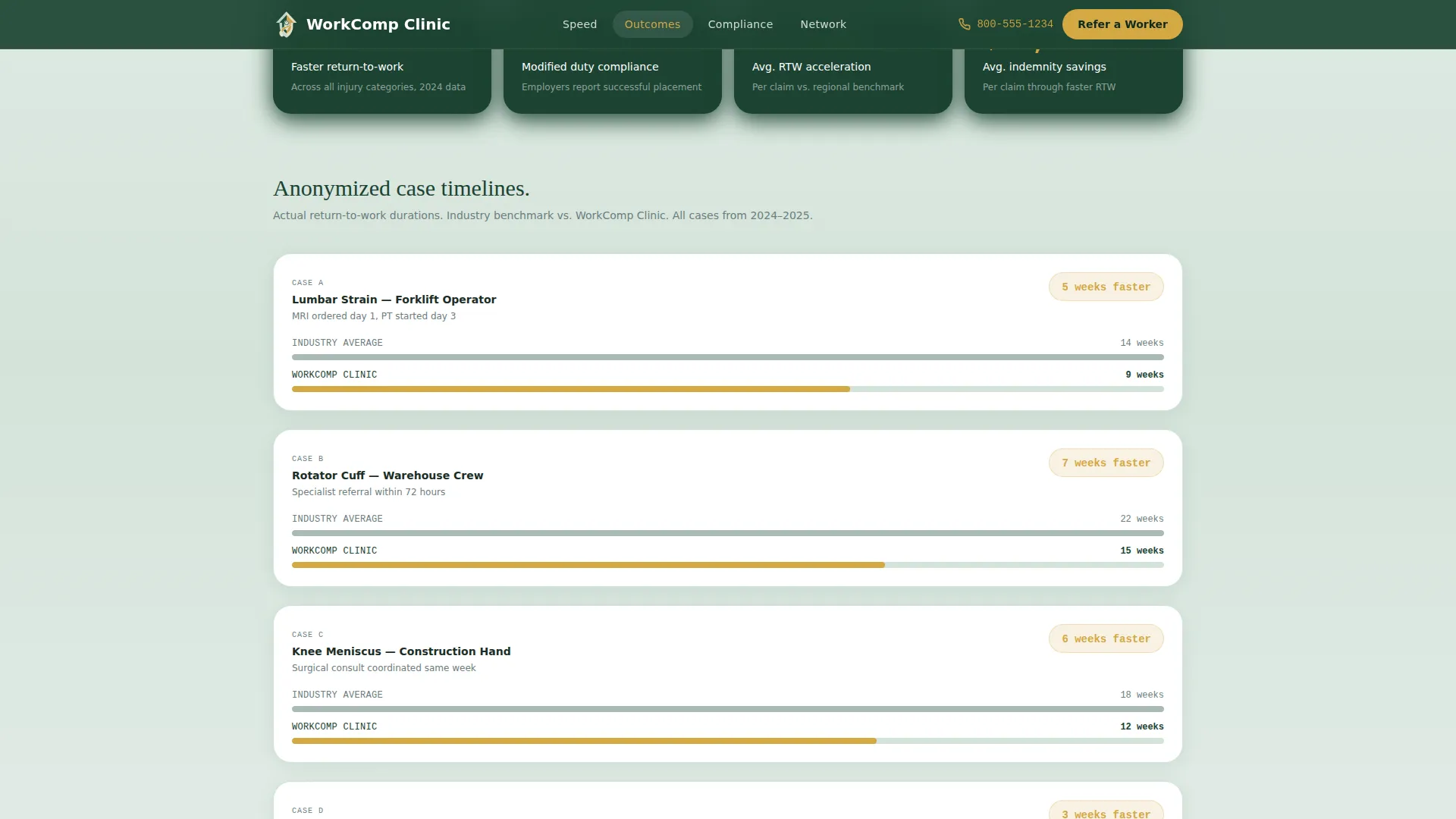
The Outcomes spoke renders anonymized case timelines as horizontal progress bars. Visitors can see the 31% faster return-to-work claim visualized as a comparative timeline rather than a plain sentence. Animations are driven by GSAP ScrollTrigger so the bars fill as the user scrolls into view.
Anchor Navigation Hub
A sticky top navigation bar links directly to each spoke: Speed, Outcomes, Compliance, and Network. Visitors can jump to the section most relevant to their role without scrolling through content intended for someone else.
Dual Call-to-Action System
The primary call to action, "Refer an Injured Worker," appears at the hub and at the close of every spoke. A secondary floating button reading "Call Our Triage Line" keeps the phone number visible at all times on mobile, supporting injured workers who need immediate contact.
Page sections overview
| Section | Purpose |
|---|---|
| Hero + Calculator | Introduces the clinic and delivers instant claim response estimates |
| Speed Spoke | Surfaces the 94% within-48-hours stat and scheduling infrastructure |
| Outcomes Spoke | Shows 31% faster return-to-work data via animated progress bars |
| Compliance Spoke | Covers documentation, adjuster communication, and regulatory proof |
| Network Spoke | Highlights coverage geography, specialist access, and employer partnerships |
| Footer | Linear single-row layout with contact and navigation links |
Design & branding system
The visual identity follows an Organic Flow theme paired with an Alpine Fresh color system. The overall feeling is a clean exam room with a mountain-air quality: restorative without being cold, organized without being sterile.
- Deep evergreen (#1B4332) anchors the navigation bar and footer; glacier mist (#E8F0EB) washes section backgrounds; exposed granite (#6B7D7D) is used for body text; meadow gold (#D4A843) highlights calls to action and animated stat callouts
- Typography uses DM Serif Display for headings and IBM Plex Sans for body copy, pairing editorial authority with clinical clarity
- No stock photography of smiling doctors; the visual language is built entirely from data, typography, and structured layout
Mobile & speed optimization
This template is built with a mobile-first priority because injured workers are most often on their phones. Desktop parity is maintained for safety managers and HR directors working at desks.
- The floating "Call Our Triage Line" button keeps the phone number persistently visible on small screens
- Animations use GPU-accelerated transforms to keep scroll performance smooth as count-up numbers and progress bars trigger on entry
- CSS smooth scroll connects anchor navigation links to their destination sections without jarring jumps
How this template helps you convert
The conversion architecture is intentional from the first pixel. Every design and content decision is built to reduce hesitation and shorten the path to a referral.
- The Claim Response Time Estimator delivers a personalized outcome before any paragraph is read, replacing generic trust-building with specific, animated proof
- The repeated "Refer an Injured Worker" call to action at every spoke close means the action is always one step away, regardless of where a visitor stops scrolling
- By the time a visitor reaches the final spoke, the only remaining question is logistics, not trust, because the evidence wall is already complete
Other information about this template
This template is part of a broader occupational health and urgent care category. It is suited to clinics that handle a high volume of worker's compensation claims and need a single digital touchpoint for multiple decision-maker roles.
- Localization is set for the United States, with dollar currency, MM/DD/YYYY date formatting, a US state selector in the estimator, and 12-hour time display
- Animation is implemented at a high fidelity level using GSAP ScrollTrigger for count-up numbers, animated progress bars, and parallax effects
- The footer follows a linear single-row pattern, keeping the page close clean and uncluttered
- This template suits clinics positioned in the occupational medicine and urgent care walk-in space, where speed of intake is the primary competitive differentiator
Theme
Organic Flow
Creative direction
Stats-First Impact
Color system
Alpine Fresh
Style
Hub & Spoke (Anchor Nav)
Direction
Click-Through
Page Sections
Interactive Claim Response Time Estimator
Stats-first Anchor Spoke Layout
Animated Horizontal Progress Bar Timelines
Sticky Anchor Navigation Bar
Dual Call-to-action System
Related questions
Who is the primary audience for this landing page template?
Can I customize the statistics shown in the spoke sections?
Does the Claim Response Time Estimator connect to a live database?
Is this template suitable for a clinic with multiple locations?
What makes this different from a standard clinic website template?