Chemical & Pharmaceutical Manufacturing Professional Website Template
Yield is a GMP contract biotech manufacturing landing page template built for biologics contract development and manufacturing organizations. It presents six capability cards in a filterable modular grid, giving technical buyers spec-dense information across upstream fermentation, downstream purification, aseptic fill-finish, analytical development, regulatory filing support, and cold-chain logistics, all styled in a documentary Forest Trust palette that communicates operational depth before the first click.
by Rocket studio
Quick summary
Yield is a single-page landing page template designed for a biologics contract manufacturing organization. It uses a card grid layout to surface detailed service specifications, letting technical buyers self-qualify against their own project requirements before clicking through to a dedicated inquiry page. The Forest Trust color system and Service Utility design language reinforce institutional credibility without manufactured polish.
Who this template is for
This template is built for contract development and manufacturing organizations, commonly known as CDMOs, that need to communicate operational depth and GMP readiness to sophisticated buyers. It suits any manufacturing organization that produces biologics at pilot or commercial scale and wants a page that earns trust through data rather than narrative.
- Biotech Series B companies with a lead compound, no internal facility, and a VP of Manufacturing who needs scale specs and compliance certifications before opening a conversation
- Mid-size pharma companies outsourcing overflow batches and looking for capacity windows and phase-fit confirmation quickly
- Academic spinouts translating bench protocols into reproducible standard operating procedures for the first time and seeking a manufacturer that can meet them at the preclinical entry point
What problem this template solves
Technical buyers in the biotech and pharmaceutical manufacturing industry do not convert from generic capability pages. They arrive with a specific molecule, a development stage, and a list of qualification questions. A standard marketing page cannot answer those questions fast enough to hold their attention. This template solves that problem by replacing narrative with specification density.
- Visitors can filter six service cards by development phase, preclinical, Phase I through II, or commercial, and read key specs on each card face without scrolling into secondary pages, reducing the time it takes to self-qualify
- A persistent call-to-action button on every card routes buyers to a dedicated inquiry page pre-tagged with the selected service, removing friction from the handoff and ensuring that every purchase order conversation starts with a qualified lead
- The page does not host a form, which keeps the landing page focused purely on earning trust through specs, not on capturing unqualified submissions
What you get with this template
The template delivers a complete, production-ready landing page layout with all six service sections, a filterable card grid, a facility specs strip, a compliance trust band, a process flow section, and a footer, all wired to a single click-through goal.
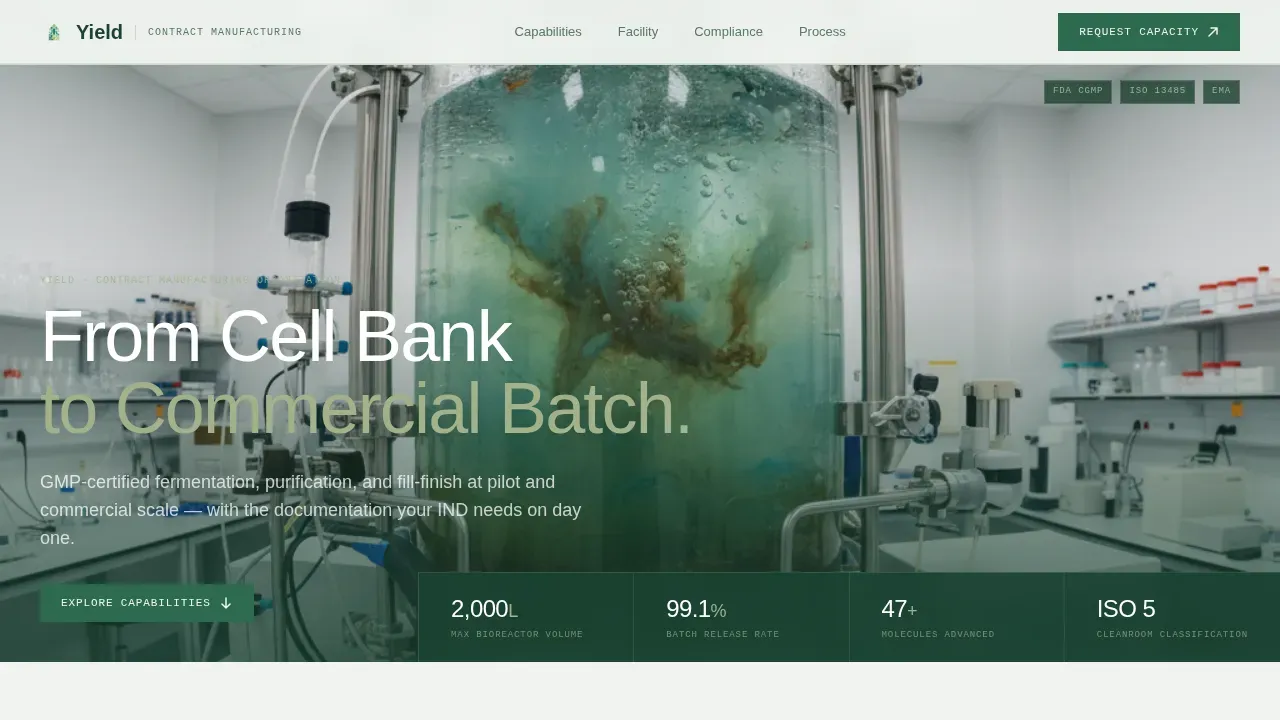
- A hero section with a panoramic facility photograph, the headline "From Cell Bank to Commercial Batch," and a stats bar showing key proof points
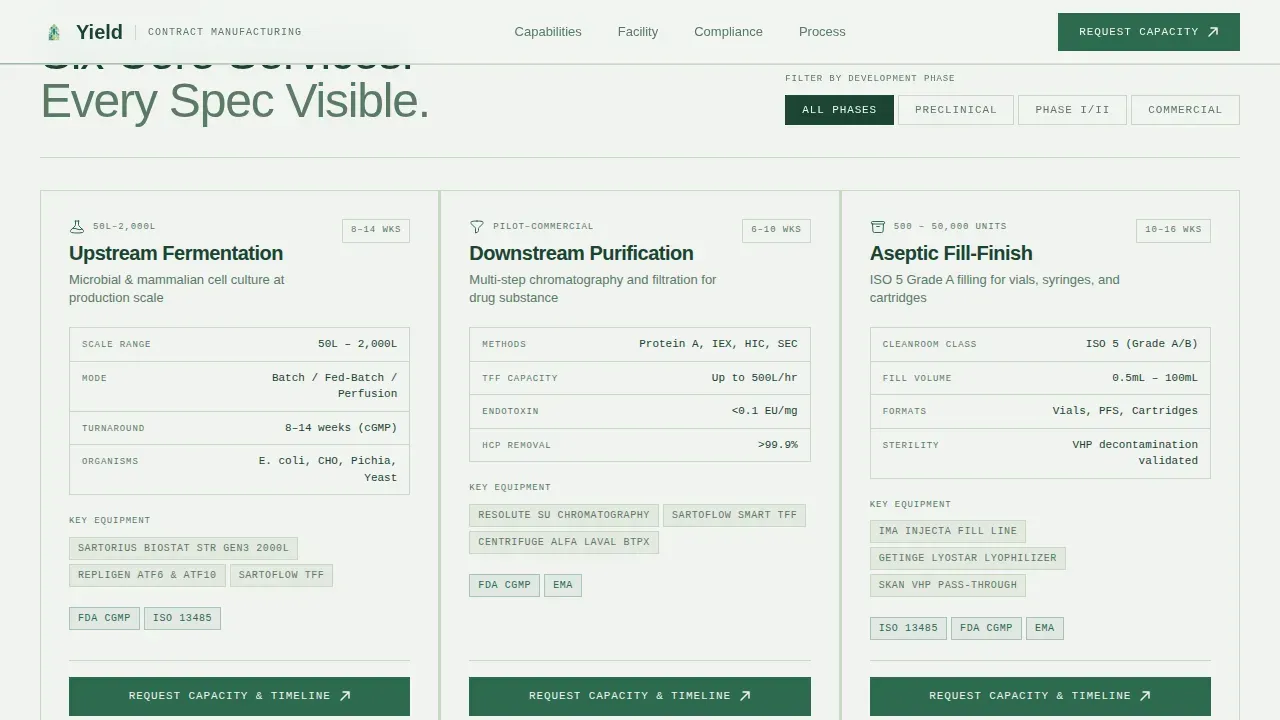
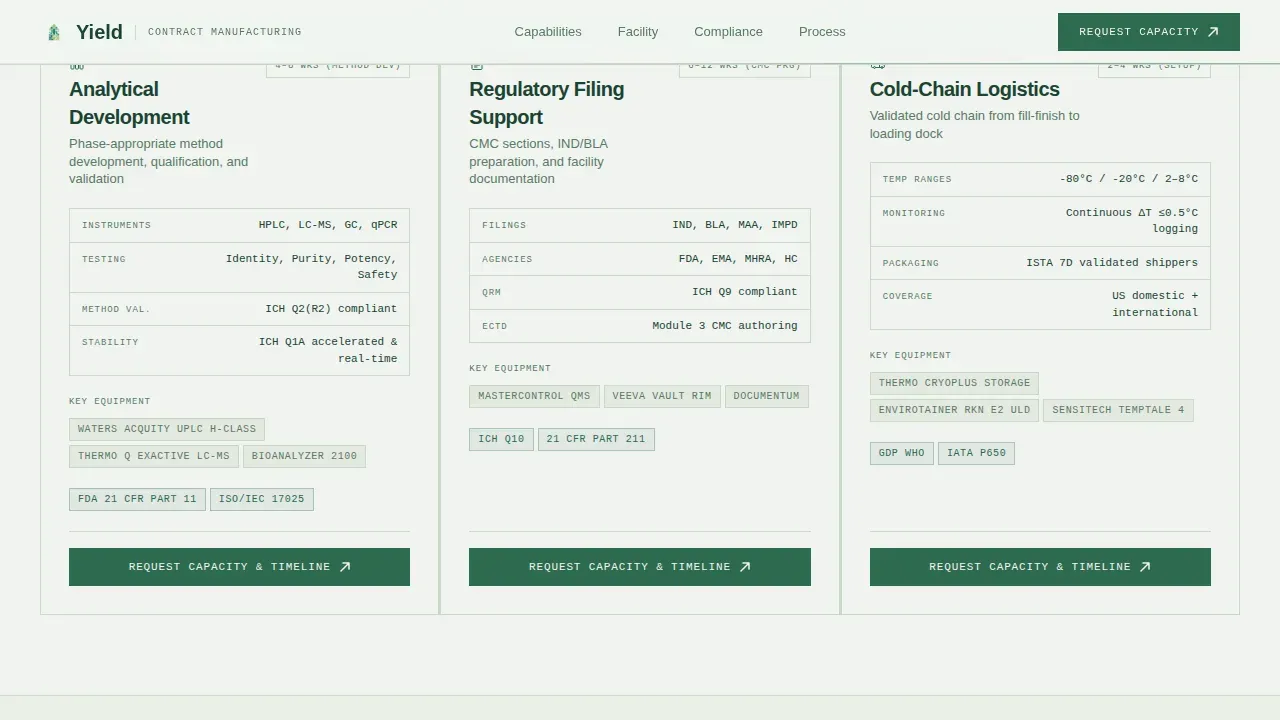
- Six capability cards styled as data sheets, each covering one manufacturing service with batch scale ranges, equipment references, turnaround windows, and compliance certifications
- A sticky-scroll process flow section that walks visitors through the molecule journey from upstream through downstream, fill-finish, and release testing
Feature list
This section describes the key capabilities built into the Yield template. Each feature is grounded in the prompt brief and reflects what the layout actually delivers.
Filterable Capability Card Grid
Six modular service cards are arranged in a responsive grid. Each card reads like a capability data sheet dedicated to a single service: upstream fermentation, downstream purification, aseptic fill-finish, analytical development, regulatory filing support, and cold-chain logistics. Cards expose key specs on their face, including batch scale ranges, equipment models, turnaround windows, and compliance certifications such as FDA, EMA, and ISO 13485. A quiet toggle bar pinned below the hero header lets visitors filter cards by development phase, preclinical, Phase I through II, or commercial, using smooth filter transitions. This makes it straightforward for a technical buyer to compare manufacturing capacities relevant to their current project stage without navigating away from the page.
Phase Filter Toggle Bar
The filter bar sits persistently below the hero section and allows visitors to narrow the card grid to services that match their development phase. This interaction is built with client-side logic for filter transitions while cards themselves render as static components for performance. The toggle is designed to be thumb-friendly so researchers accessing the page on mobile devices can operate it without precision tapping. This feature directly addresses one of the most common friction points in biotech contract manufacturing evaluation: the inability to quickly match a manufacturer's capabilities to a specific phase without a sales call.
Panoramic Hero with Stats Bar
The hero section uses a seamless, edge-to-edge facility photograph taken from the mezzanine level of a working manufacturing suite. The image holds bioreactors, a gowning corridor, and a quality control lab with analysts at HPLC stations in a single frame. It is documentary in tone, unglamorous and unstaged. A single line of white text sits low in the frame: "From Cell Bank to Commercial Batch." Below the image, a stats bar displays key social proof figures such as batch success rate, years operational, molecules advanced, and certifications. An interactive counter animation gives the stats bar a live, accumulating quality that reinforces operational credibility.
Facility Specs Strip
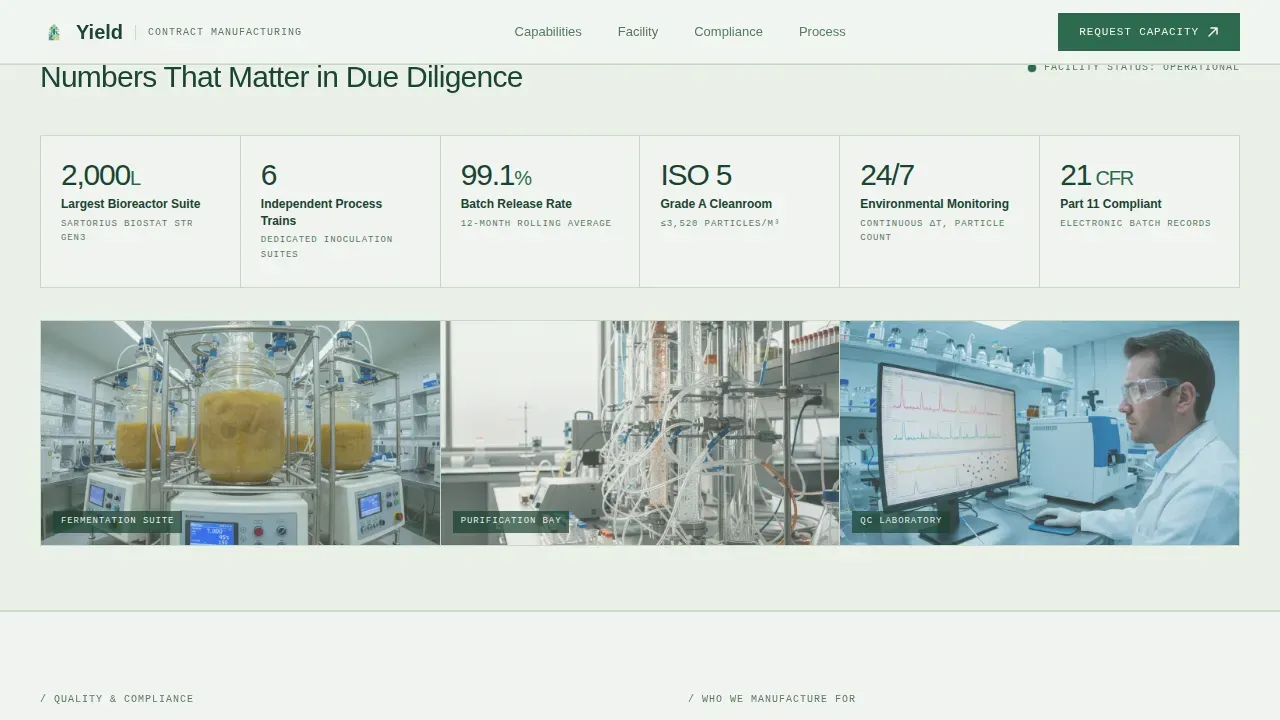
A dedicated horizontal strip below the card grid surfaces key facility numbers at a glance. This includes fermentation volume, cleanroom class, and batch success rate. These figures are formatted using IBM Plex Mono to give them the visual weight of instrument readouts rather than marketing copy. The specs strip helps mid-size pharma companies and biotech startup teams confirm minimum viable manufacturing capacity before committing to an inquiry, reducing back-and-forth during qualification.
Trust and Compliance Band
A dedicated section displays FDA, EMA, and ISO 13485 certification status alongside client segment callouts. High-visibility certification badges lower decision anxiety in a high-stakes field where regulatory compliance is non-negotiable. The band also acknowledges the three distinct buyer segments the template serves, funded biotech companies, overflow pharma clients, and academic spinouts, so each visitor sees themselves reflected in the page. This approach to presenting quality agreement readiness and GMP manufacturing credentials helps establish the manufacturing organization as a credible long-term supply partner.
Sticky-Scroll Process Flow
A process flow section uses a sticky scroll layout to walk visitors through the molecule journey step by step: upstream fermentation, downstream purification, aseptic fill-finish, and release testing. This section provides the kind of structured, sequential clarity that technical buyers need to understand whether a manufacturer can handle their specific manufacturing process end to end. The sticky scroll keeps the current step anchored while the supporting detail scrolls into view, making complex biologics workflows easier to follow without requiring a video or separate documentation download.
Page sections overview
| Section | Purpose |
|---|---|
| Hero with Stats | Panoramic facility photo, headline, and animated proof-point bar |
| Phase Filter Bar | Toggle to filter capability cards by development phase |
| Capability Card Grid | Six spec-dense service cards covering each manufacturing discipline |
| Facility Specs Strip | Key facility numbers rendered in monospace type for credibility |
| Trust and Compliance Band | Certification badges and client segment callouts |
| Molecule Process Flow | Sticky-scroll journey from upstream to release testing |
| Footer Arc Split | Logo and tagline left, navigation links right |
Design & branding system
The visual identity follows a Service Utility theme built on the Forest Trust color system. Every color choice communicates competence through restraint. The palette feels like a Pacific Northwest research campus: institutional calm wrapped in living green, where nothing is staged and nothing is decorative without purpose.
- Old-growth evergreen (#1B4332) anchors all body text, navigation, and structural elements; lichen gray (#A3B18A) appears as the faintest wash on alternating section backgrounds; clean-bench white (#F0F4F0) provides the primary page background; and assay-positive teal (#2D6A4F) is reserved exclusively for buttons, tags, and interactive card borders so that every actionable element is immediately identifiable
- Typography uses DM Sans for display headlines, IBM Plex Mono for specs and data values, and Plus Jakarta Sans for body text, creating a three-tier typographic system that visually separates narrative, data, and action
- The overall aesthetic is documentary industrial, sharp, unglamorous, and trustworthy, matching the sensibility of the due-diligence teams who are the primary audience for this page
Mobile & speed optimization
The template is built desktop-first to match the workstation behavior of technical buyers conducting due diligence, but the mobile layout is fully considered and follows thumb-friendly design principles throughout.
- A persistent bottom bar on mobile mirrors the primary call-to-action button so that researchers accessing the page on a phone or tablet never have to scroll back to initiate contact, keeping conversion paths accessible at all times
- Cards are designed to be readable at mobile widths with specs visible on the card face without requiring hover interaction, and the phase filter toggle is sized and spaced for thumb operation
- The template uses a static-first architecture with server components handling all card rendering and client components limited to filter logic and counter animations, keeping the interactive layer lightweight
How this template helps you convert
The Yield template is designed to move a technical buyer from first impression to qualified inquiry in a single session. Every layout decision supports that goal.
- Specification density earns trust before the call to action appears: visitors read batch scale ranges, equipment references, turnaround windows, and certification marks on the card face, which means they arrive at the inquiry page already convinced of fit rather than seeking basic qualification information
- The teal "Request Capacity and Timeline" button appears on every capability card and routes to a dedicated inquiry page pre-tagged with the selected service, so the next page can ask only the essential project data needed to move the conversation forward, reducing friction in the same way that short, specialized multi-step forms reduce inquiry abandonment
- The minimalist navigation keeps only the logo and the primary call-to-action visible, removing distraction links that would pull a qualified buyer off the page before they complete the click-through
Other information about this template
The Yield template is specifically structured as a yield gmp contract biotech manufacturing landing page template for biologics CDMOs operating across preclinical through commercial stages. This section covers additional context that prospective buyers and platform users may find useful when evaluating the template against their own project requirements.
- Contract manufacturing agreements in the pharmaceutical and biotech industry typically rely on commercially reasonable efforts obligations rather than absolute delivery guarantees. The meaning of commercially reasonable efforts differs significantly across jurisdictions, and a well-structured contract should outline payments or adjustments based on yield performance to establish financial predictability. This template's inquiry flow is designed to route buyers to a dedicated page where those terms can be scoped properly, rather than forcing premature commitment through an on-page form.
- Establishing the supply chain is a foundational requirement for product approval in the biotech and pharmaceutical industries. A manufacturing organization presenting its supply chain capabilities, from raw materials sourcing through cold-chain validated delivery, helps prospective clients assess supplier reliability before entering a quality agreement. The template's compliance trust band and facility specs strip are structured to address exactly this qualification need.
- After the development stage, biotech and pharma companies expect that the manufacturer will provide a warranty that the product complies with specifications and applicable laws. The template's trust and compliance band is the correct location for surfacing regulatory status, certification marks, and the manufacturing organization's position with regard to FDA, EMA, and ISO 13485 requirements.
- Technology transfer is a critical and often underestimated step in moving from bench-scale protocols to GMP production. The process flow section of this template is designed to communicate the manufacturer's ability to manage each step in the molecule journey, including the technology transfer phase from the client's development records into the manufacturer's qualified production environment.
- Intellectual property protections and quality agreement terms are among the first concerns raised by biotech companies entering a contract manufacturing relationship. The template's click-through architecture keeps sensitive negotiation details off the public landing page while still demonstrating the operational depth that makes those conversations worth initiating. Each purchase order discussion begins with a buyer who has already confirmed that the manufacturing capacities, certifications, and phase range match their project requirements.
- The global biologics market is projected to reach $750 billion by 2028, reflecting sustained growth in demand for contract development and manufacturing services. Recombinant proteins and plasmid DNA are among the most actively produced molecule classes in GMP manufacturing today, and CDMOs that can articulate their capabilities for recombinant proteins and plasmid DNA production clearly will attract more qualified inquiries from the growing pipeline of biologics programs entering clinical development.
- Biomay is one example of a specialized manufacturing organization that has built end-to-end GMP manufacturing and testing services for mRNA and plasmid DNA. The Yield template is structured to accommodate similar positioning for any CDMO that produces recombinant proteins, plasmid DNA, mRNA, or related biologic modalities at GMP scale.
- Contract manufacturing templates are essential tools for managing the lifecycle of agreements from initial request through approval, execution, and renewal. Accurate and detailed information in a contract manufacturing template avoids manufacturing problems and ensures clarity between the manufacturer and the client organization. This landing page template supports that goal by giving buyers enough specification depth to arrive at the agreement stage already aligned on scope, cost, and delivery expectations.
- Including a gated download such as a Yield Optimization Success Story can provide prospective clients with real-world production data and reinforce the manufacturing organization's track record. This type of content asset is a natural complement to the click-through architecture of the template, adding a secondary conversion path for buyers who want additional evidence before initiating a formal inquiry.
- Product stability data, storage conditions, and cold-chain validation records are typically requested during due diligence. The template's facility specs strip and process flow section provide the correct visual context for surfacing product stability credentials alongside fill-finish and cold-chain logistics capabilities.
- Current stage capabilities covered by this template span preclinical through commercial scale, with project timelines and phase-specific capacity information surfaced through the filterable card grid. This gives buyers at every stage of development a relevant entry point into the inquiry process.
Theme
Service Utility
Creative direction
Spec Sheet
Color system
Forest Trust
Direction
Click-Through
Page Sections
Filterable GMP Capability Card Grid
Panoramic Hero with Animated Stats Bar
Sticky-scroll Molecule Process Flow
Trust and Compliance Certification Band
Facility Specs Strip in Monospace Type
Persistent Mobile Call-to-action Bar
Related questions
Does this template include a contact form on the landing page?
Can the capability cards be filtered by development phase?
Is this template suitable for a CDMO that produces recombinant proteins and plasmid DNA?
How does the template surface trust signals for regulated manufacturing?
What design elements can be customized in this template?