Food Processing & Packaging Privacy Policy Website Template
Yield is a precision-focused B2B landing page template built for commercial meat processing operations. It combines a technical isometric facility header, sequential case study narrative sections, and dashboard-style data panels to communicate scale, compliance, and throughput. The design uses a monochrome steel palette with USDA-stamp red accents, guiding procurement and partnership decision-makers toward a capacity assessment inquiry.
by Rocket studio
Quick summary
Yield is a single-page B2B template designed for industrial meat processing facilities. It opens with an isometric facility illustration, then walks visitors through escalating case study narratives backed by data grids and before-and-after dashboard panels. The result is a page that communicates processing scale and operational precision before a buyer reads a single headline.
Who this template is for
This template is built for commercial meat processing businesses that sell capacity and co-packing services to wholesale buyers. It speaks directly to operations running structured programs with measurable output standards.
- Regional grocery chains managing consistent boxed beef or boxed pork programs
- Foodservice distributors and private-label brands sourcing a reliable co-packer
- Processing facility operators presenting their capabilities to procurement teams
What problem this template solves
B2B processors often struggle to communicate technical capability through a website. A standard brochure page fails to convey yield precision, audit-readiness, or cold chain control. Buyers need proof, not promises.
- Procurement contacts leave without understanding the facility's actual processing scale
- No structured way to capture partnership leads at different stages of the buying cycle
- Case study results and spec compliance are buried in PDFs rather than front-and-center
What you get with this template
The template delivers a full single-page conversion flow built around industrial credibility. Every section is designed to move a wholesale buyer from initial impression to qualified inquiry.
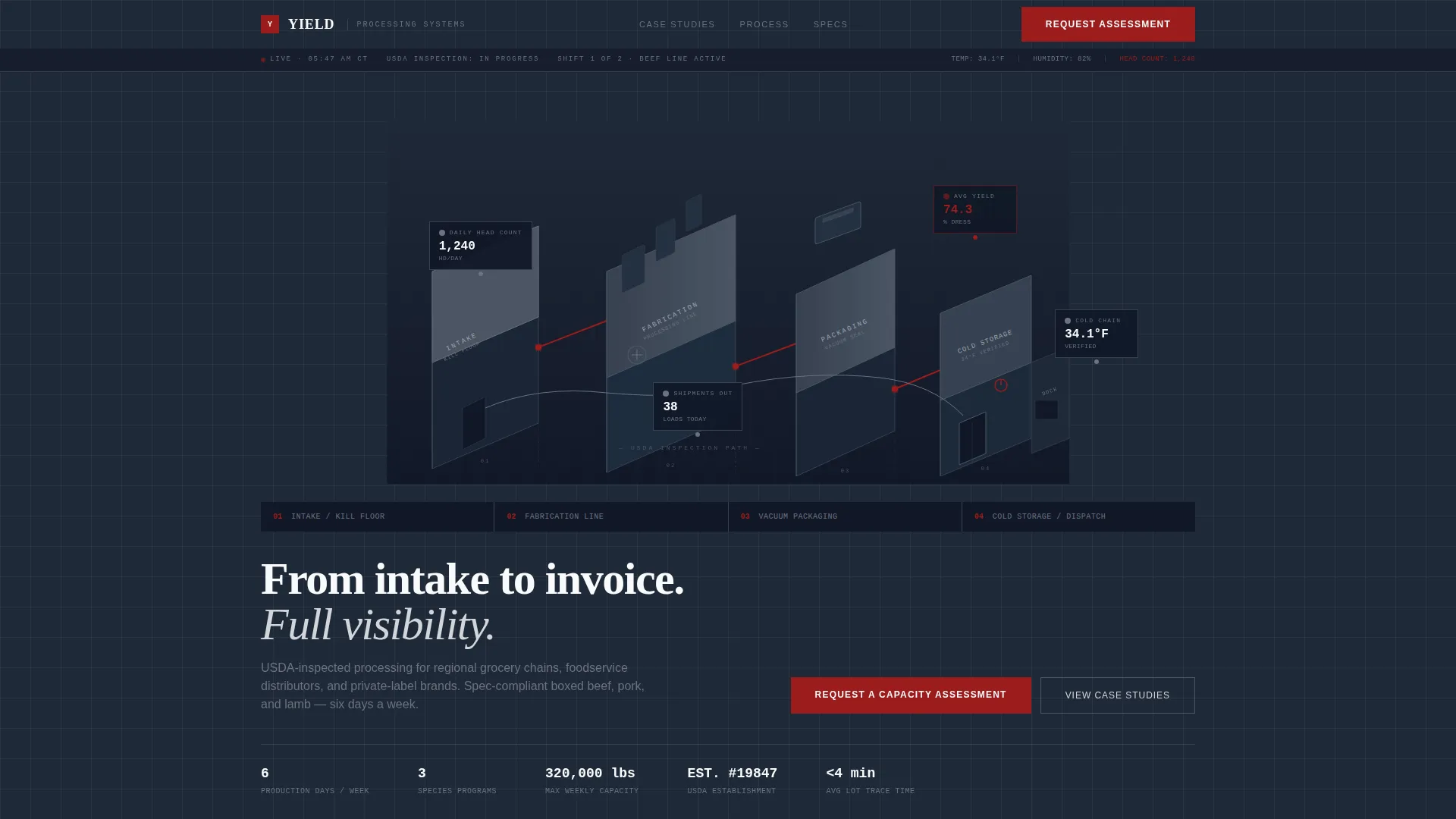
- An isometric facility header with live-data-style callouts covering head count, yield percentages, cold chain temperature, and shipments dispatched
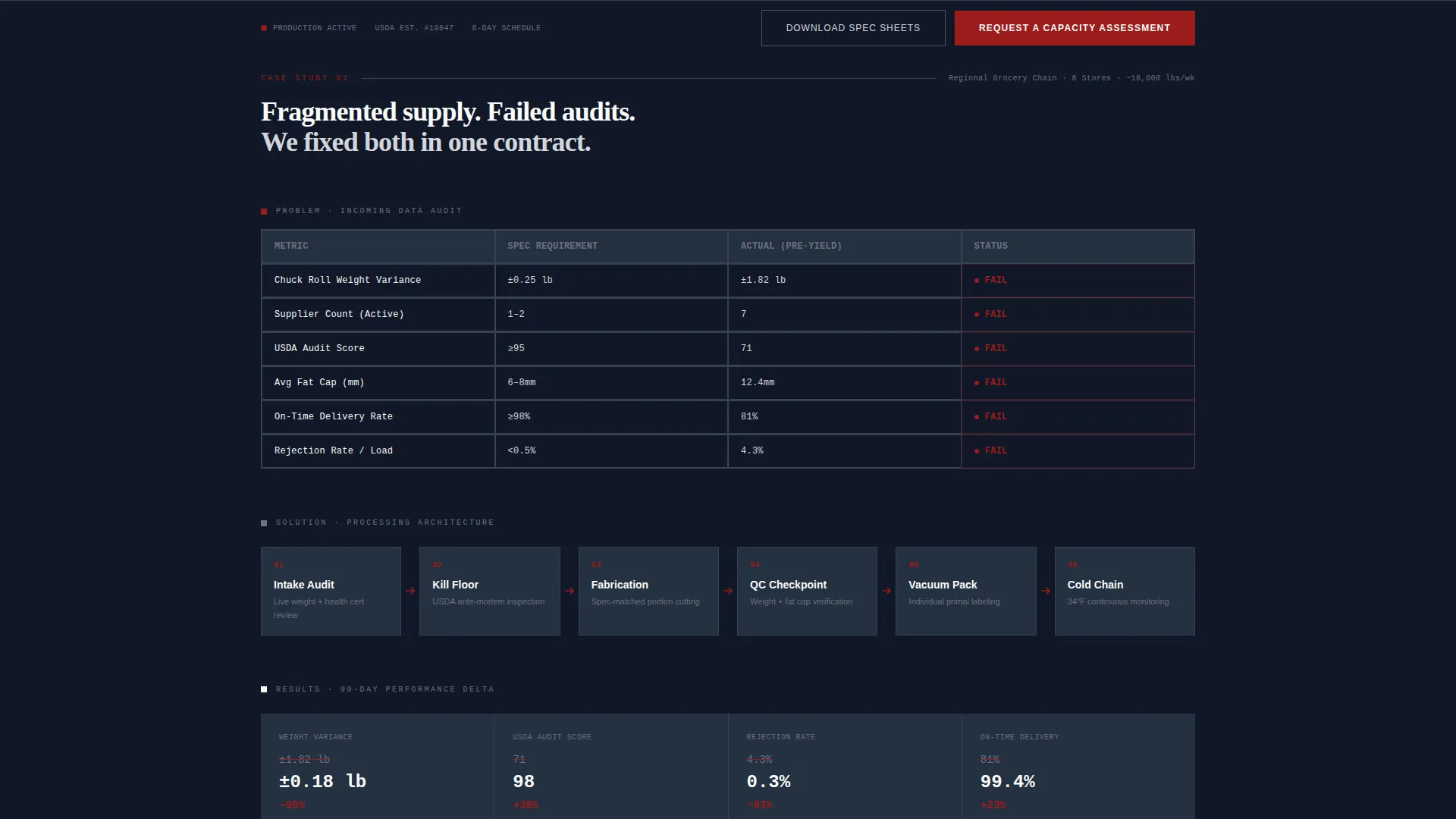
- Three escalating case study blocks, each showing client problem data grids, solution flowcharts, and before-and-after results panels
- Two conversion paths: a primary capacity assessment form and a secondary spec sheet library download gated behind a business email
Feature list
This template includes a focused set of structural and visual components drawn directly from the brief.
Isometric Facility Header
The header renders the entire processing facility as a clean technical cutaway illustration. Departments are labeled from intake to cold storage, and data callouts display daily head count, yield percentages, cold chain temperature, and shipments dispatched. No photography is used. The diagram communicates operational scale instantly.
Case Study Narrative Flow
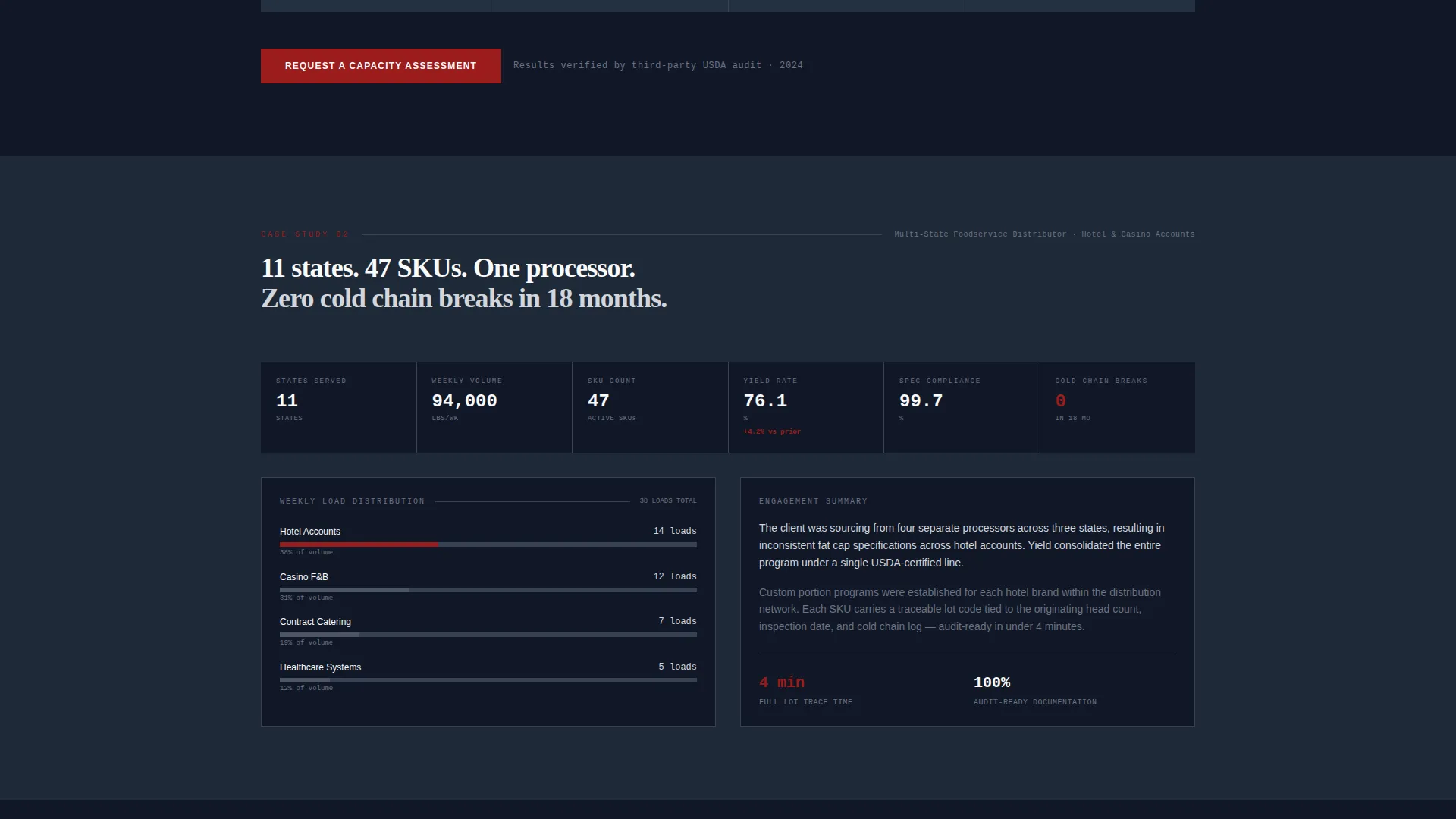
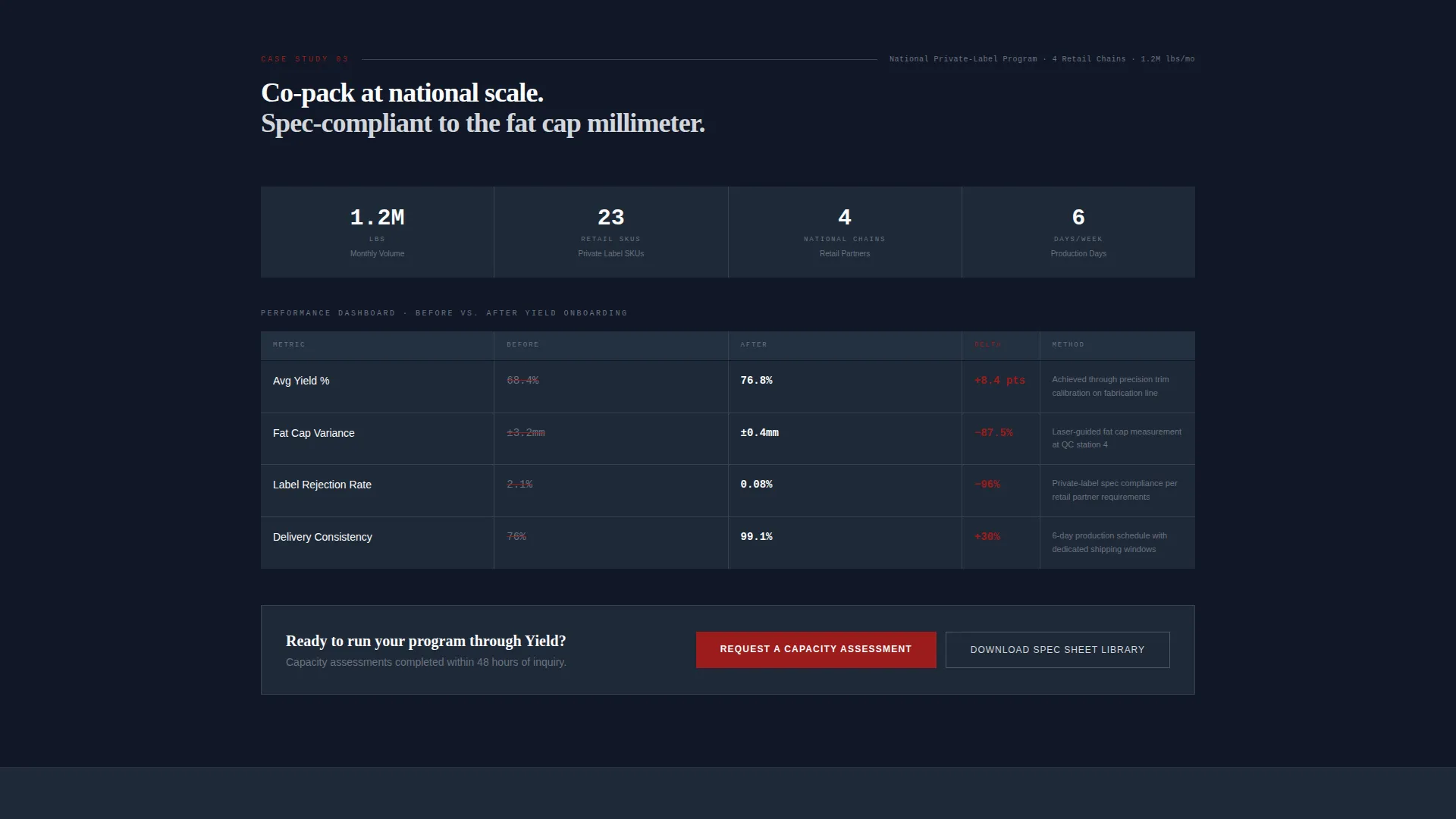
Three sequential case study sections build credibility at increasing levels of complexity. The first covers a regional grocery account, the second a multi-state distributor, and the third a national private-label program. Each block contains a client problem data grid, a numbered solution flowchart, and before-and-after performance panels.
Dashboard Data Panels
Before-and-after dashboard panels display yield improvement percentages, rejection rate reductions, and delivery consistency scores. These panels present results in a format that mirrors the visual language procurement and operations teams already use internally.
Primary Conversion Form
The capacity assessment form collects company name, estimated weekly volume in pounds, primary species via dropdown (beef, pork, lamb), current packer relationship status via yes or no toggle, and a direct phone number. The form appears after the first case study and again pinned to the bottom rail of the page.
Secondary Lead Capture Path
A gated download for the spec sheet library captures earlier-stage leads who are comparing processors. Access requires a business email address, creating a parallel funnel for buyers not yet ready to commit line time.
Monochrome Steel Color System
The palette uses surgical stainless, cold-room charcoal, and inspection white as the base. USDA-stamp red is reserved exclusively for calls to action and critical data points. The result is a visual system that reads like a compliance document rendered in brushed metal.
Page sections overview
| Section | Purpose |
|---|---|
| Isometric Facility Header | Communicates processing scale and live operational data before copy |
| Hero Tagline Line | Delivers the single positioning statement after the diagram loads |
| Case Study One | Documents a regional grocery chain partnership with data grid and results |
| Case Study Two | Escalates to a multi-state distributor engagement with flowchart and panels |
| Case Study Three | Presents a national private-label program at full complexity |
| Capacity Assessment Form | Primary B2B conversion form with volume, species, and contact fields |
| Spec Sheet Download | Secondary lead capture gated behind a business email address |
| Bottom Rail call to action | Pinned repeat of the capacity assessment call to action |
Design & branding system
The visual identity follows a Corporate Precision theme that mirrors the environment it represents. Every design decision reinforces the feeling of a HACCP audit report printed on brushed metal.
- Color palette: surgical stainless (#D1D5DB), cold-room charcoal (#1F2937), inspection white (#F9FAFB), and USDA-stamp red (#9B1C1C) for calls to action and critical data points only
- Layout language: isometric technical illustration, data grids, numbered process flowcharts, and dashboard-style before-and-after panels with no decorative imagery
- Typography and tone: clean, monochrome, and precise, reflecting a production floor built on measurement and traceability rather than warmth or lifestyle appeal
Mobile & speed optimization
The template is structured for readability and usability across device sizes. The data-heavy layout is organized into scannable sections that collapse cleanly on smaller screens.
- The isometric header and case study panels are designed as discrete visual blocks that stack without losing their informational hierarchy
- Forms and calls to action remain prominent and accessible on both desktop and mobile viewpoints
- The monochrome palette and flat illustration style keep the visual load focused without requiring complex media queries
How this template helps you convert
The page is engineered around a two-track conversion model. Buyers at different stages of evaluation each find a path that matches their readiness to commit.
- The primary capacity assessment form captures qualified leads who are actively comparing processors, collecting operational details like weekly volume in pounds, primary species, and current packer relationship status.
- The spec sheet library download creates a secondary funnel for earlier-stage buyers, converting them with a business email gate before they are ready to request line time.
Other information about this template
This template is part of the Manufacturing and Industrial category, specifically within the Food Processing and Packaging subcategory. It is purpose-built for the meat processing niche and reflects the visual and structural demands of that industry.
- Template style: Dashboard and Data Grid, suited for operations where numbers and throughput metrics drive purchase decisions
- Theme: Corporate Precision, with a monochrome steel palette that signals compliance culture and industrial rigor
- Creative direction: Case Study Narrative, which builds trust through demonstrated results at escalating program scales
- The tagline "From intake to invoice. Full visibility." is included as the single hero copy line beneath the isometric illustration
- This template is designed for Partnership and B2B conversion flows, not consumer-facing retail audiences
Theme
Corporate Precision
Creative direction
Case Study Narrative
Color system
Monochrome Steel
Style
Dashboard/Data Grid
Direction
Partnership/B2B
Page Sections
Isometric Facility Header with Data Callouts
Three-phase Case Study Narrative
Dashboard-style Results Panels
Two-track Conversion System
Monochrome Steel Visual Identity
Pinned Bottom Rail Call to Action
Related questions
What industries is this template designed for?
Can I customize the case study sections with my own data?
What does the capacity assessment form collect from leads?
Does the template include a way to capture leads who are not ready to commit?
Does the header use photography or illustration?