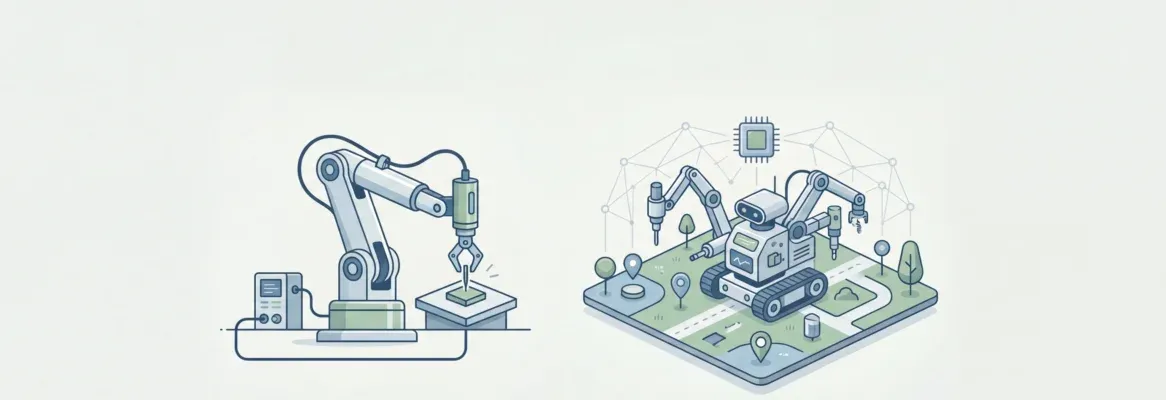
Are AI agents and agentic AI really different, or just buzzwords? Learn how one emphasizes autonomy and decision-making, while the other focuses on performing tasks within defined systems.
Is there actually a difference between agentic AI and AI agents?
Yes, there is a real difference, and it matters more than most people think. Within the first few seconds, the short answer is this.
AI agents follow instructions. Agentic AI sets goals and figures things out. That gap changes how artificial intelligence systems behave, scale, and adapt.
According to Gartner, over 33% of enterprise software will include agentic AI by 2028.
That jump explains why teams are paying close attention to AI systems and how they act.
So, let’s talk about it. No hype. No fluff. Just clarity.
What are AI Agents, Really?
So, start simple.
AI agents are software entities built to perform specific tasks. They work inside defined parameters. They respond to user inputs. They follow preset rules. Nothing mystical here.
A software program designed as an AI agent often handles well-defined tasks like ticket routing, data analysis, or acting as a customer service chatbot. The user submits a request. The system checks knowledge bases. Then it responds.
Most AI agents operate inside a programmed scope. They do not set goals. They do not question the task. They do what they were trained to do.
That’s why traditional AI agents show limited learning capabilities. Training data shapes them. Predefined rules guide them. When edge cases arise, human intervention is required.
So yes, AI agents excel at routine work. Repetitive flows. Predictable paths. They automate tasks well.
But that’s where the line starts showing.
Traditional AI Agents vs Something More
Traditional AI agents operate like checklists.
They rely on traditional AI logic. Decision trees. If-else paths. Scripted responses. This works well for single-agent setups.
Examples include:
- Virtual assistants answering FAQs
- Ticket routing tools
- Monitoring scripts
- Rule-based bots
These traditional AI agents perform specific tasks fast. They stay inside defined parameters. They need human oversight when things get weird.
Unlike AI agents built this way, newer systems aim higher.
That’s where agentic thinking comes in.
What is Agentic AI?
This is where the shift really begins. Up to this point, things feel familiar. Then, agentic AI steps in and fundamentally changes how artificial intelligence behaves.
Agentic AI refers to systems that pursue broader objectives rather than merely following assigned tasks. Agentic AI acts with genuine agency. It determines the next step based on context.
Agentic AI represents a fundamental leap in artificial intelligence systems. These systems reason. They plan. They adapt.
Instead of waiting for prompts, agentic AI operates across multi-step processes. It chooses appropriate tools. It handles complex workflows. It adjusts to dynamic environments.
Agentic AI acts independently within boundaries. Minimal human intervention becomes possible. Not zero humans. Just fewer interruptions.
So, this isn’t just smarter automation. It’s a change in mindset. Agentic AI moves from task execution to outcome ownership while remaining within clear boundaries. That small difference is what turns software into a system.
How Agentic AI Thinks Differently
So, how agentic AI actually behaves?
Here’s the shift.
AI agents respond.
Agentic AI decides.
Agentic AI uses advanced reasoning layered on top of AI models like a large language model. It evaluates risk assessment. It checks outcomes. It refines AI decisions.
Unlike traditional AI, agentic AI systems are built to achieve broader objectives. They manage complex workflows across multiple systems.
This is autonomous decision-making in action. Not chaos. Not magic. Just structured independence.
Agentic AI operates like a project manager that never sleeps. A little intense. Very focused.
Agents and Agentic AI Side by Side
Let’s pause and compare. Clean and simple.
| Area | AI Agents | Agentic AI |
|---|---|---|
| Goal setting | Fixed | Flexible |
| Scope | Programmed scope | Broader objectives |
| Learning | Limited learning capabilities | Ongoing adjustment |
| Autonomy | Low | Higher |
| Human intervention | Frequent | Minimal human intervention |
| Work style | Perform specific tasks | Handle complex workflows |
This table sums it up.
Same family. Very different personalities.
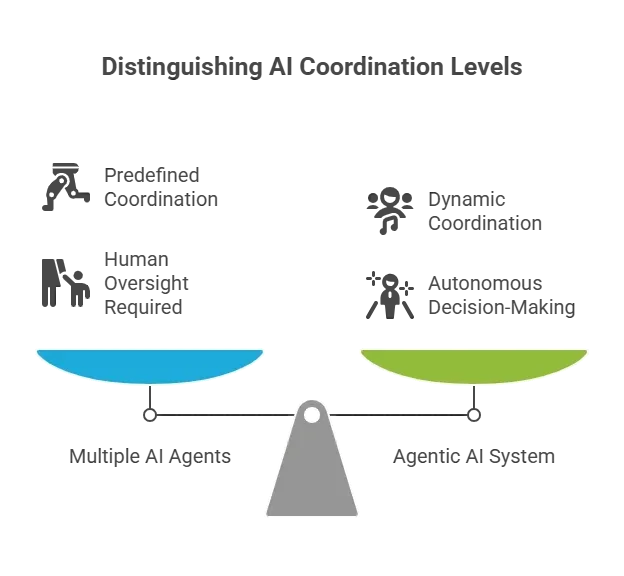
Multiple Agents vs Agentic Systems
Here’s a common confusion.
Multiple AI agents do not automatically equal agentic AI.
Where AI Agents Still Shine?
Not everything needs autonomy or big decisions. Some jobs just need to be done right, every single time.
AI agents excel at stability. Predictable environments. Repetitive tasks. Clear rules.
Examples include:
- Customer service chatbot flows
- Ticket routing
- Code quality checks
- Knowledge base searches
These AI agents operate with consistency. They reduce cost. They speed up business processes.
For well-defined tasks, they are perfect.
And that's how AI agents feel right at home. They stay reliable, predictable, and focused. Agentic AI doesn’t replace them. It simply sits one level above.
Where Agentic AI Takes Over
Now the fun part.
Agentic AI handles complex tasks where steps are unclear at the start. It manages uncertainty.
Think:
- Multi step processes across tools
- Risk management decisions
- Coordinating multiple systems
- Handling emerging challenges
Agentic AI acts across multiple systems. It adapts when inputs change. It balances risk assessment with outcomes.
This is where autonomous decision-making shines. Still guided. Still monitored. Just less hand-holding.
Community Insight From the Field
Here’s one LinkedIn quote that clearly explains the distinction and community debate:
“Most people confuse AI Agents with Agentic AI. They're not the same thing. AI Agent = Your single-task specialist. Agentic AI = Your self-managing team.”
The Role of AI Models and Data
None of this works without strong foundations.
AI models matter. Training data matters. A large language model provides reasoning ability. Knowledge bases provide grounding.
Traditional AI relies heavily on static data. Agentic AI uses feedback loops.
Artificial intelligence systems grow based on outcomes, not just inputs.
That’s the quiet shift happening right now.
Rocket.new and the Rise of Agentic Thinking
Rocket.new: Where Agents Take Off
Rocket.new sits right in the middle of this shift. It helps teams build ai agents and agentic ai systems without drowning in setup.
Rocket.new supports:
- Multi-agent orchestration
- Natural language task creation
- Workflow planning across tools
- Autonomous task execution
- Monitoring with human oversight
Rocket.new treats agents as building blocks. It supports agentic systems that achieve broader objectives, not just scripts.
Risks, Ethics, and Guardrails
Let’s not pretend everything is smooth.
Agentic AI raises ethical implications. Autonomy requires limits. Human oversight still matters.
Risk management stays central. Defined parameters stay in place. Artificial intelligence must remain accountable.
Genuine agency does not mean zero control. It means better balance.
Agentic AI vs AI Agents
The difference between agentic AI vs AI agents comes down to intent, autonomy, and scope. One follows instructions. The other pursues goals. Both matter. Both will coexist. Knowing where each fits makes all the difference.
It all comes down to fit. Rules work for some problems. Goals work better for others. Choosing the right approach makes the system feel intentional rather than forced.
Both have their place. One executes. The other directs. Knowing the difference leads to smarter systems.
Table of contents
- -What are AI Agents, Really?
- -Traditional AI Agents vs Something More
- -What is Agentic AI?
- -How Agentic AI Thinks Differently
- -Agents and Agentic AI Side by Side
- -Multiple Agents vs Agentic Systems
- -Where AI Agents Still Shine?
- -Where Agentic AI Takes Over
- -Community Insight From the Field
- -The Role of AI Models and Data
- -Rocket.new and the Rise of Agentic Thinking
- -Rocket.new: Where Agents Take Off
- -Risks, Ethics, and Guardrails
- -Agentic AI vs AI Agents