
Why are AI apps gaining traction in 2026? Success comes from smart implementation, solid planning, and developer expertise, as rising downloads show growing demand and AI’s expanding role in modern app development.
Are AI apps actually succeeding in 2026?
Yes, but only when teams use AI the right way and back it with strong planning and real developer input. The latest statistics show a sharp rise in demand for AI-powered apps across the world.
According to Statista Global downloads of artificial intelligence apps have grown rapidly in recent years, showing strong user interest and rising adoption across platforms.
This growth clearly shows that AI is not just a trend. It’s becoming a core part of how apps are built, used, and scaled by developers and companies today.
The Rise of AI in App Development
So, what’s really happening in the world of application development?
Well, data shows a clear shift. A growing number of developers now use AI tools daily. These tools help with writing code, debugging, testing, and even planning projects.
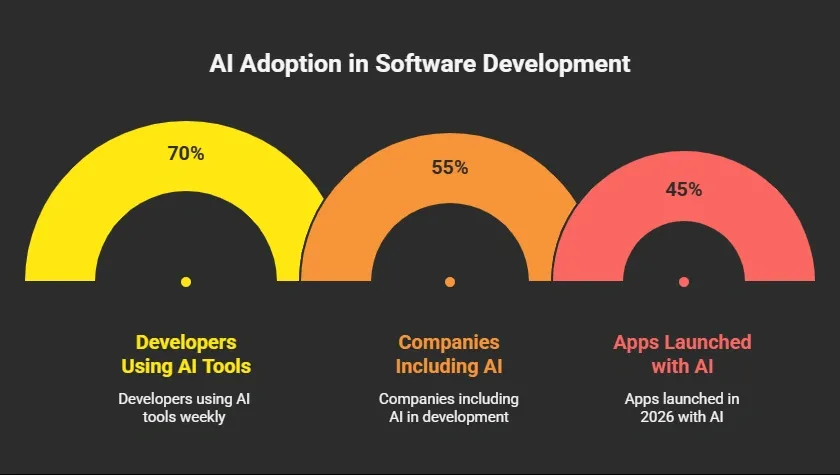
This shows a clear pattern. AI is no longer optional. It’s part of how modern software gets built.
At the same time, AI adoption is not just about speed. It’s about smarter problem-solving and better user experience. Many teams use AI to analyze data, predict behavior, and build smarter apps.
Success Rates of AI Apps in 2026
Now let’s talk about what matters. Success.
The AI build app success rate and statistics 2026 show that success is not automatic. Just adding AI does not guarantee results.
Here’s a simple table to explain:
| Factor | Success Rate Impact | Description | Example | Recommended Action |
|---|---|---|---|---|
| Use AI tools properly | +35% | AI tools enhance productivity when applied strategically | Using AI-assisted code generation for boilerplate code | Integrate AI in structured workflows rather than ad-hoc |
| Strong data quality | +30% | Clean, relevant, and well-labeled data improves AI predictions | Well-curated user behavior datasets for recommendation apps | Invest in data cleaning, labeling, and validation |
| Skilled developers | +25% | Experienced developers can guide AI and avoid mistakes | Developers reviewing AI-generated code before deployment | Train teams in AI-assisted development and best practices |
| Collaborative human-AI approach | +20% | Combining AI with human insight improves decision-making | Developers + AI tool analyzing logs for bugs | Encourage team workflows that mix AI suggestions with human review |
So, what does this mean?
Data shows that apps using structured AI workflows perform better. But random use of AI tools often leads to messy code and failed projects.
Also, many developers report that success improves when AI is used for tasks like:
-
Code generation
-
Testing
-
Predictive analytics
-
Debugging
But when teams try to replace thinking with AI, things go wrong.
How Developers Use AI Tools Today?
Next, let’s look at how developers actually use AI in real life.
Most teams don’t go all in at once. They start small and use AI tools step by step inside their development cycle. This keeps things practical and avoids messy code.
Common ways developers use AI tools include:
-
Writing new code
-
Reviewing existing code
-
Automating repetitive tasks
-
Improving security checks
Tools like GitHub Copilot and Google Gemini are now part of daily app development workflows. In fact, GitHub Copilot alone is used by millions of users across the world.
Here’s what recent developer surveys and data points suggest:
-
Around 60% use AI coding assistant features
-
Nearly 50% use AI for problem solving
-
About 45% use AI for faster task completion
So, what’s the result?
Clear productivity gains. Teams spend less time on repetitive tasks and shift toward higher value work like design, logic, and user experience.
Also, AI assisted coding helps reduce errors in code, especially for beginners. It acts like a smart second pair of eyes while building apps.
AI vs Non-AI Apps: What’s the Difference?
Then comes a common question. "Are AI powered apps really better than non AI apps?" The answer depends on use.
AI adds value in areas like:
-
Predictive analytics
-
Intelligent chatbots
-
Customer engagement
For example, apps that use AI for predictive analytics can suggest actions based on user behavior. That’s something traditional apps cannot do easily. But there’s a catch.
AI apps need:
-
Better data
-
Stronger security
-
More testing
Without these, they fail faster than regular apps. So yes, AI helps. But only when used carefully.
The Role of AI Agents and Generative AI
After that, let’s talk about one of the biggest trends. "AI agents." These are systems that can perform tasks on their own. Think of them as assistants inside your app.
Many developers now use AI agents for:
-
Managing workflows
-
Handling user queries
-
Automating processes
At the same time, generative AI and gen AI tools are changing how code is written.
Instead of writing everything manually, developers now:
-
Describe what they want
-
Let AI generate the code
-
Refine it
This process is called AI generated code.
It saves time, but also needs review. Poor quality prompts can lead to bad code. Also, large language models play a big role here. They power tools like chatbots and assistants.
AI Adoption Trends Across Companies
Now let’s zoom out a bit and look at the bigger picture. How are companies actually using AI today?
Well, the trend is clear. Data shows that AI is now part of daily application development and business operations across industries. From startups to large organizations, teams are finding practical ways to use AI tools in their workflows.
Key Usage Statistics
Here are some important data points:
-
68% of tech companies use AI in application development
-
52% use AI for predictive analytics
-
48% use AI for customer support
This clearly reflects strong AI adoption across the tech space.
Industry-Wise Adoption
Not every industry moves at the same pace, though. Some sectors are ahead, while others are more cautious.
-
Finance: High adoption due to heavy use of data and analytics
-
Healthcare: Growing steadily, with strong focus on security
-
eCommerce: Fast adoption driven by better customer engagement
Impact on Development Teams
So, what changes for teams that use AI tools?
-
Shorter development cycle
-
Better testing and fewer errors in code
-
Improved support systems for users
These improvements lead to faster development cycles and more reliable apps.
Overall, the shift is simple. Companies that use AI tools wisely are seeing better results in their projects. The combination of smart planning, good data, and the right tools is what drives real success in modern app development.
What Developers Are Saying
Let’s make this real.
Here’s a perspective from a LinkedIn post by a developer sharing their experience with AI tools like Copilot and ChatGPT:
“It’s not replacing us… but it might replace lazy coding habits.” Linkedin
This captures what many developers are actually feeling right now.
AI is helping speed things up. It makes tasks easier, improves problem solving, and supports faster app development. But at the same time, it still needs human thinking behind it. Developers still need to understand the code, fix issues, and handle security.
Rocket.new: Building Apps with Ease
Let’s bring this into something practical.
Rocket.new is a vibe solutioning platform designed to simplify app development by helping users use AI tools in a structured and guided way. Instead of guessing how to use AI, it gives developers and teams a clear path to build better apps with fewer mistakes.
It connects directly to our topic because success in AI apps depends on how well teams use AI tools. Platforms like this improve the development cycle, support better problem solving, and help companies turn ideas into working apps faster and more reliably.
Top Features
-
Prompt to App Creation: Builds apps directly from single prompts
-
Figma Import: Converts design files into live, editable layouts
-
AI-Powered Backend: Automatically handles logic, data, and workflows
-
Reusable Components: Speeds up building with ready-to-use elements
-
Command-based actions: Use / and @ to run actions and quickly scope edits.
-
Live Preview: Shows instant updates while editing
-
Custom Domain Support: Publishes projects with a branded domain
-
Code Export: Allows developers to extend or customize later
How It Aligns with AI App Success
So, how does this fit into the bigger picture?
Rocket.new directly improves the AI build app success rate and statistics 2026 by solving common problems in app development. They help developers use AI tools the right way, reduce errors in code, and create more reliable apps.
This leads to better productivity gains, smoother projects, and stronger results for business and users.
Key Trends and Future Insights
Let’s talk about the future of app development and where AI is taking things. The direction is pretty clear from current statistics and data.
More companies and developers are starting to use AI tools in smarter ways, not just for speed but for better apps and real business value.
Future Trends
-
Rise of AI agents in daily workflows: More teams will use AI agents to handle routine tasks, manage workflows, and support faster problem solving
-
Growth in AI powered apps across industries: A growing number of apps will include intelligent features, especially in finance, healthcare, and eCommerce
-
Stronger focus on security: As AI adoption increases, security will become a bigger priority in every development cycle
-
Improvement in AI models: Better AI models will help developers write cleaner code, build smarter software, and handle complex data
Data shows that AI adoption will continue to rise in the coming years. But success will still depend on skilled developers, proper use of AI tools, and strong planning.
The future of application development looks promising, but real results will always come from how well teams use AI in their projects.
Making Sense of AI App Success in 2026
The key to AI app success in 2026 isn’t just having AI, it’s using it with purpose. Developers need clear planning, clean code, and skilled teams to make AI work effectively. Rather than replacing human thinking, AI should complement it, acting as a support system that enhances problem-solving, data analysis, and development efficiency.
When applied thoughtfully, AI helps build better apps, boosts productivity, and delivers greater value to users and businesses. Success comes from combining human insight with AI capabilities, not from blindly adopting tools. In short, AI empowers developers who know how to use it strategically, making well-planned, high-quality apps the standard rather than the exception.
Table of contents
- -The Rise of AI in App Development
- -Success Rates of AI Apps in 2026
- -How Developers Use AI Tools Today?
- -AI vs Non-AI Apps: What’s the Difference?
- -The Role of AI Agents and Generative AI
- -AI Adoption Trends Across Companies
- -Key Usage Statistics
- -Industry-Wise Adoption
- -Impact on Development Teams
- -What Developers Are Saying
- -Rocket.new: Building Apps with Ease
- -Top Features
- -How It Aligns with AI App Success
- -Key Trends and Future Insights
- -Future Trends
- -Making Sense of AI App Success in 2026