
See how AI can power Rocket.new’s geographic expansion with board-ready insights, enabling smarter market selection, scalable growth strategies, and cost-efficient planning without relying on traditional strategy consulting firms.
Can you plan geographic expansion without hiring a strategy firm?
Yes, and that’s exactly what modern platforms are making possible. With AI geographic expansion analysis on Rocket.new, companies can build a structured, board-ready plan using data, AI tools, and guided workflows. It removes confusion and gives teams a clear direction from day one.
According to a report by McKinsey & Company, companies using AI in decision-making can increase productivity by up to 40%. That shift is changing how companies approach market entry, risk, and global growth in a more structured way.
This blog will help you understand how to plan expansion using AI, reduce risk, and build a clear strategy without relying on expensive consultants.
Why Geographic Expansion Feels So Hard?
So, here’s the thing. Expanding into new markets sounds exciting. But once you start, it gets messy.
You’re dealing with:
-
Unknown market conditions
-
Different consumer behaviour
-
New supply chain challenges
-
Regional laws and cultural nuances
For mid market companies, this becomes even harder. They don’t always have the budget for consulting firms or large internal teams.
Traditional methods rely on slow data collection, scattered research, and guesswork. That increases risk. A wrong move in market entry can drain resources fast.
This is where AI steps in.
What AI Changes in Expansion Planning?
Well, artificial intelligence changes the way companies approach analysis. Instead of manual research, AI tools handle automating data collection and processing large sets of market data.
Now companies can:
-
Identify patterns in consumer behaviour
-
Track economic trends and market trends
-
Analyse historical data and predict outcomes
-
Get real time insights for faster decision making
With machine learning, systems learn from past data and improve recommendations. This gives companies a more proactive approach instead of reacting late.
That means better strategic decisions and lower risk.
The Role of AI Tools in Market Entry?
So, let’s break this down in a simple way. When companies plan international expansion, they need clarity before making any big move. That’s where AI tools come in.
They turn scattered data into a structured view, helping teams make smarter decisions with less guesswork.
What Companies Need Clarity On
When entering new markets, companies focus on a few key areas:
-
Best locations to enter
-
Pricing strategies and pricing models
-
Customer acquisition costs
-
Competitor activity
Where AI Tools Get Their Data From?
To build that clarity, AI tools process detailed data from multiple sources:
-
Competitor websites
-
Job postings
-
Market reports
-
Social signals
How AI Deepens the Analysis
It doesn’t stop there.
These tools also use advanced methods like:
-
GIS technology to map regions
-
Remote sensing to understand real-world activity
-
Population density insights
-
Foot traffic patterns
All of this helps companies identify areas with strong growth potential. Instead of relying on assumptions, they move forward with data-backed confidence and a clearer market entry strategy.
A Simple View of AI vs Traditional Methods
Let’s keep it simple. When you compare traditional methods with AI-powered approaches, the difference is clear. One is slow and manual, while the other uses data to move faster and smarter.
| Factor | Traditional Methods | AI Powered Approach |
|---|---|---|
| Data collection | Manual and slow | Automated and fast |
| Analysis | Limited scope | Deep and continuous |
| Risk handling | Reactive | Predictive |
| Market entry planning | Fragmented | Structured |
| Decision making | Delayed | Real time |
Let’s keep it simple. When you compare traditional methods with AI powered approaches, the difference is clear. One is slow and manual, while the other uses data to move faster and smarter.
Rocket.new as the saviour
Rocket.new is built to help companies move from idea to execution in a clear, structured way. Instead of juggling multiple tools, the platform brings everything into one place. Inside it, Solve is the layer where planning happens.
Solve is not just about collecting ideas. It helps teams turn raw thoughts into a clear strategy using AI. That means less confusion, better alignment, and a smoother path to market entry.
How Solve Works?
So, how does it actually work?
Based on the official docs, Solve guides teams through a structured thinking process. It acts like a smart workspace where everything connects.
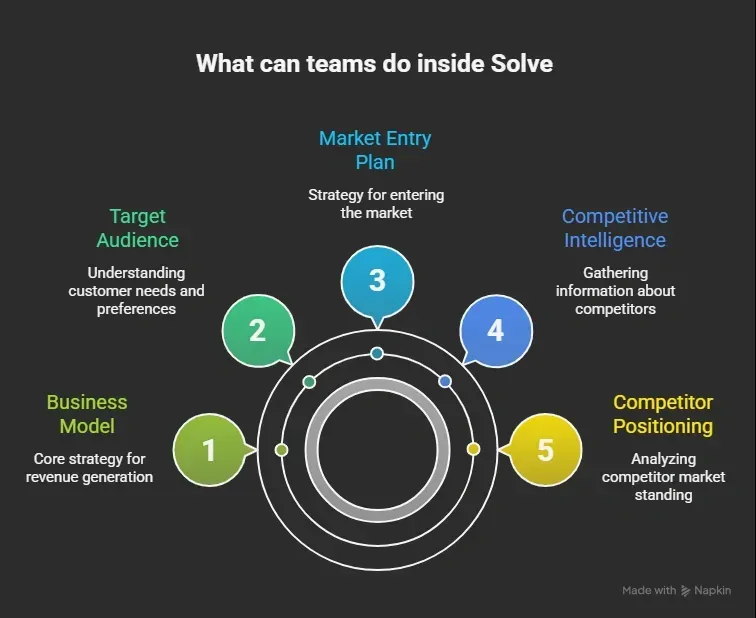 The key idea is flow. Everything is connected step by step. You don’t jump between tools or lose context. Instead, you build a complete picture in one place.
How Solve Produces a Board-Ready Plan?
Now, let’s get into how this turns into something board-ready. Solve combines a few important elements:
-
Data analysis
-
AI driven insights
-
Structured workflows
It pulls in important inputs like:
-
Market data
-
Supply chain considerations
-
Regional constraints
-
Consumer behaviour
Then it organizes everything into a clear, structured strategy.
This leads to:
-
Defined resource allocation
-
Clear expansion goals
-
Reduced risk during market entry
For mid market companies, this is a big shift. Instead of hiring expensive consultants, they can build a strong plan internally with the help of AI.
Key Features
Let’s break down the core features in a simple way.
-
AI Powered Research: Solve uses AI powered systems to handle data collection and turn it into valuable insights. This saves time and reduces manual effort.
-
Structured Planning: Teams don’t work with scattered notes. They build a clear strategy step by step, following a guided flow.
-
Competitive Intelligence: You get a full view of the competitive landscape, including insights into competitor positioning.
-
Predictive Analytics: With predictive analytics, teams can estimate outcomes and prepare before entering new markets.
-
Real Time Monitoring: Teams can track progress using real time monitoring and adjust their strategy as needed.
In simple terms, Solve turns planning into a structured process. It connects data, strategy, and execution in one platform, helping companies move into new markets with clarity and confidence.
Examples:
1. Expanding a Mid Market Brand
Let’s look at an example. A mid sized eCommerce company wants to enter Southeast Asia.
Using Solve:
-
It studies market trends and economic trends
-
Analyses foot traffic and population density
-
Reviews competitor websites and pricing
-
Checks regional laws
The system helps identify the best market entry point.
Then:
-
It suggests pilot testing in one city
-
Helps fine tune pricing
-
Optimises lead generation
-
Tracks conversion rates
This reduces risk and improves global growth.
2. Opening a Local Office
Here’s another simple example. A SaaS company is planning to set up a local office in Europe. Instead of guessing, they use AI to make informed choices from the start.
Using AI, the company can:
-
Analyse supply chain access to support operations
-
Review available talent through job postings
-
Compare customer acquisition costs across different cities
How Solve Helps
With Solve, the team can:
-
Choose the right city for the local office
-
Plan hiring for existing employees and new team members
-
Manage resource allocation in a structured way
This approach leads to smarter strategic decisions. Instead of trial and error, the company moves forward with clarity and lower risk.
Why Companies Are Moving Toward AI?
So why are more companies adopting this approach?
Because:
-
It brings cost savings
-
Helps in saving time
-
Reduces dependency on consultants
-
Improves decision making
With machine learning, systems improve over time. That means better results with each analysis.
How AI Supports Global Growth?
At the end of the day, it all comes down to growth. Companies want to expand into new markets without slowing down or taking unnecessary risk. That’s where AI makes a real difference.
What Changes with AI
-
They enter new markets faster
-
Reduce risk in expansion decisions
-
Improve resource allocation
-
Build smarter market entry strategies
This is especially helpful for mid market companies looking to scale without large budgets. AI gives them the clarity and structure needed to grow confidently.
The Bigger Picture
Let’s take a step back. The way companies approach international expansion is shifting. It’s no longer just manual effort. It’s a mix of smart systems, structured thinking, and better use of data.
What’s Driving the Shift
-
Artificial intelligence is helping process large amounts of data quickly
-
Machine learning is improving insights by learning from past patterns
-
Structured platforms are bringing everything into one connected workflow
What This Means for Companies
-
Better analysis with deeper and more accurate insights
-
Faster execution with less delay in planning and action
-
More confident strategic decisions based on real data instead of guesswork
When companies combine AI with structured planning, they reduce risk and move forward with clarity. That’s what’s changing the way expansion is done today.
AI Geographic Expansion Analysis on Rocket.new
Companies often struggle with market entry because of scattered data, unclear direction, and high risk. Traditional methods slow down decision making and increase costs, especially during international expansion. Teams spend too much time gathering information and still lack clarity.
With AI geographic expansion analysis on Rocket.new, companies use AI powered workflows to organize data, run analysis, and build a clear strategy. It connects research, planning, and execution in one platform. This helps teams reduce risk, improve resource allocation, and approach new markets with confidence, making expansion more structured and easier to manage.
What if your next market move was clear from day one? Start smarter expansion with Rocket.new.
Table of contents
- -Why Geographic Expansion Feels So Hard?
- -What AI Changes in Expansion Planning?
- -The Role of AI Tools in Market Entry?
- -What Companies Need Clarity On
- -Where AI Tools Get Their Data From?
- -How AI Deepens the Analysis
- -A Simple View of AI vs Traditional Methods
- -Rocket.new as the saviour
- -How Solve Works?
- -How Solve Produces a Board-Ready Plan?
- -Key Features
- -Examples:
- -1\. Expanding a Mid Market Brand
- -2\. Opening a Local Office
- -Why Companies Are Moving Toward AI?
- -How AI Supports Global Growth?
- -What Changes with AI
- -The Bigger Picture
- -What’s Driving the Shift
- -What This Means for Companies
- -AI Geographic Expansion Analysis on Rocket.new