
Marketing automation helps small businesses run email campaigns, capture leads, and nurture customers without extra headcount. This blog covers key features, how to choose the right platform, and what to look for at every stage of growth.
Is your small business still handling marketing manually?
The global marketing automation market is projected to hit $14.2 billion by 2025. That figure shows just how much businesses are leaning on automation to stay competitive.
With the right marketing automation software, small businesses can analyze customer data, make smarter decisions, and run campaigns without juggling too many tasks at once.
The best platforms combine email marketing, lead generation, and social media management in one place. As a result, teams can focus on growth rather than repetitive work.
What is Marketing Automation and Why Small Businesses Need It
Marketing automation is software that handles repetitive marketing tasks automatically. It sends emails, scores leads, schedules social posts, and tracks customer behavior based on rules or triggers you set once.
For small businesses, this matters because time is the scarcest resource. A team of three cannot manually follow up with every lead, send personalized emails at the right moment, and post consistently across channels. Marketing automation handles all of that in the background.
Without automation, small businesses compete at a structural disadvantage against larger teams with dedicated marketing staff. With it, a two-person operation can run campaigns that feel like they came from a team of ten.
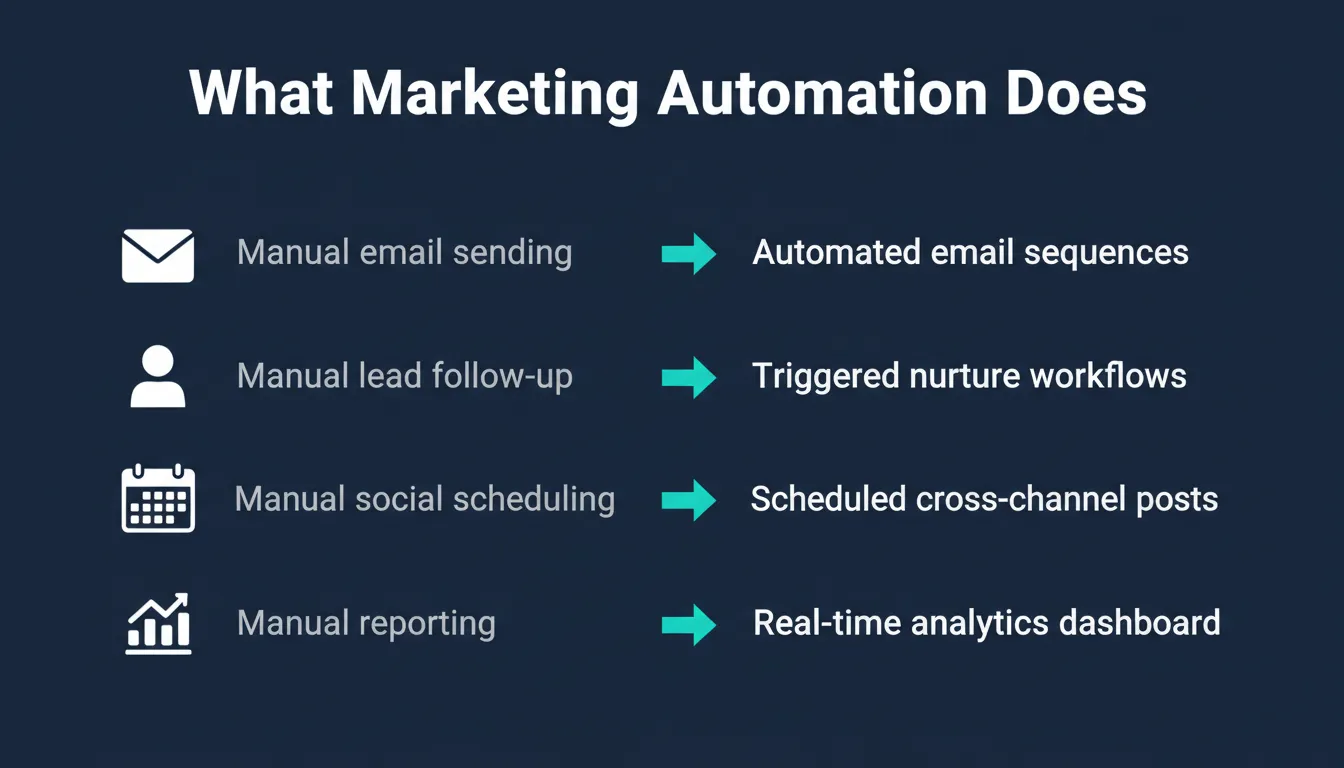
Marketing automation replaces manual, repetitive tasks with intelligent workflows that run in the background.
Key Features to Look for in Marketing Automation Platforms
Not all marketing automation tools are built the same. The features that matter most depend on your team size, budget, and growth stage. However, these capabilities consistently deliver results for small businesses.
Email Marketing and Automated Sequences
Email remains the highest-ROI marketing channel. Look for drag-and-drop builders with mobile-responsive templates, behavior-triggered sequences (welcome series, abandoned cart, re-engagement), A/B testing for subject lines and content, and deliverability tools like SPF and DKIM configuration.
Lead Scoring and Lead Nurturing
Lead scoring assigns points to contacts based on actions. These include opening emails, visiting pricing pages, and downloading content. This tells your team which leads are ready to buy and which need more nurturing.
Effective lead nurturing moves prospects through the sales funnel with relevant content at the right time. It reduces time-to-close without requiring manual follow-up at every step.
CRM Integration
Your marketing automation platform needs to connect to your CRM. Without integration, data lives in silos. Marketing sees one picture, sales sees another, and customers fall through the gaps. The best platforms either include a built-in CRM or offer native integrations with tools like HubSpot, Salesforce, or Pipedrive.
Workflow Automation and Analytics
Visual workflow builders let you map out multi-step sequences without writing code. Pair that with dashboards showing open rates, click-through rates, conversion rates, and revenue attribution. Together, you get a system that both executes and improves over time.
For small businesses looking at the broader landscape of subscription software for small business growth, marketing automation is often the highest-leverage starting point.
How to Choose the Best Marketing Automation Platform for Small Businesses
Choosing the right platform comes down to four questions.
What is your team size and technical capacity? A solo founder needs a simple, intuitive tool. A five-person team can handle more complexity. Avoid platforms with steep learning curves if you do not have dedicated technical resources.
What does your current tech stack look like? The best marketing automation platform integrates cleanly with your existing tools. Poor integration with your CRM, e-commerce platform, or analytics stack creates more work, not less.
Where do you want to be in 12 months? Choose a platform that scales with you. Migrating your entire contact database and automation workflows to a new tool is expensive and disruptive.
What is your realistic budget? Most platforms offer a trial period. Use it. Do not commit to a paid plan until you have tested the core workflows your business actually needs.
Here is how the most important features compare across the best marketing automation platforms for small businesses:
| Feature | What It Does | Why It Matters | Setup Difficulty |
|---|---|---|---|
| Email Campaigns | Automates sending and scheduling | Saves time, keeps communication consistent | Low |
| Landing Pages | Creates custom pages for lead capture | Drives lead generation and conversion | Low to Medium |
| Lead Scoring | Assigns points based on engagement | Focus sales effort on high-intent leads | Medium |
| CRM Integration | Syncs customer data across tools | Unified view of every interaction | Medium |
| Social Media Management | Schedules and tracks social posts | Consistent presence without daily effort | Low |
| Workflow Automation | Triggers sequences based on behavior | Reduces manual tasks, improves response time | Medium to High |
| Analytics Dashboard | Tracks campaign performance in real time | Data-driven decisions, faster optimization | Low |
| A/B Testing | Tests variations to find what converts | Continuous improvement without guesswork | Medium |
Platform Pricing Tiers: What Small Businesses Actually Get
Most platforms offer a trial or entry-level tier. Here is what to expect at each level:
| Plan Level | Typical Contact Limit | Monthly Cost Range | Key Features Included |
|---|---|---|---|
| Entry / Trial | 500 to 2,000 contacts | No cost | Basic email, simple automation, limited sends |
| Starter | Up to 5,000 contacts | $15 to $50 | Automation workflows, basic reporting, no send limits |
| Professional | Up to 25,000 contacts | $50 to $200 | CRM integration, advanced segmentation, lead scoring |
| Advanced / Business | 25,000+ contacts | $200 to $800+ | Multi-channel automation, custom reporting, dedicated support |
Pricing varies by platform. Verify current pricing on each vendor's official website before purchasing.
For teams exploring custom automation workflows beyond what off-the-shelf tools provide, low-code platforms can extend what marketing automation software handles natively.
Lead Nurturing and Scoring: The Engine of Marketing Automation
Lead nurturing builds relationships with potential customers at every stage of the sales funnel. It works even when they are not ready to buy yet.
Most visitors to your website are not ready to purchase on their first visit. They are researching, comparing options, and building trust. Lead nurturing keeps your business in front of them with relevant, timely content. So when they are ready to buy, you are the obvious choice.
How Lead Scoring Works in Practice
Lead scoring assigns a numerical value to each contact based on demographic fit, behavioral signals, and engagement recency. A contact who visited your pricing page three times, opened your last four emails, and downloaded a case study scores higher than someone who signed up six months ago and has not engaged since. Your sales team focuses on the first. Your automation nurtures the second.
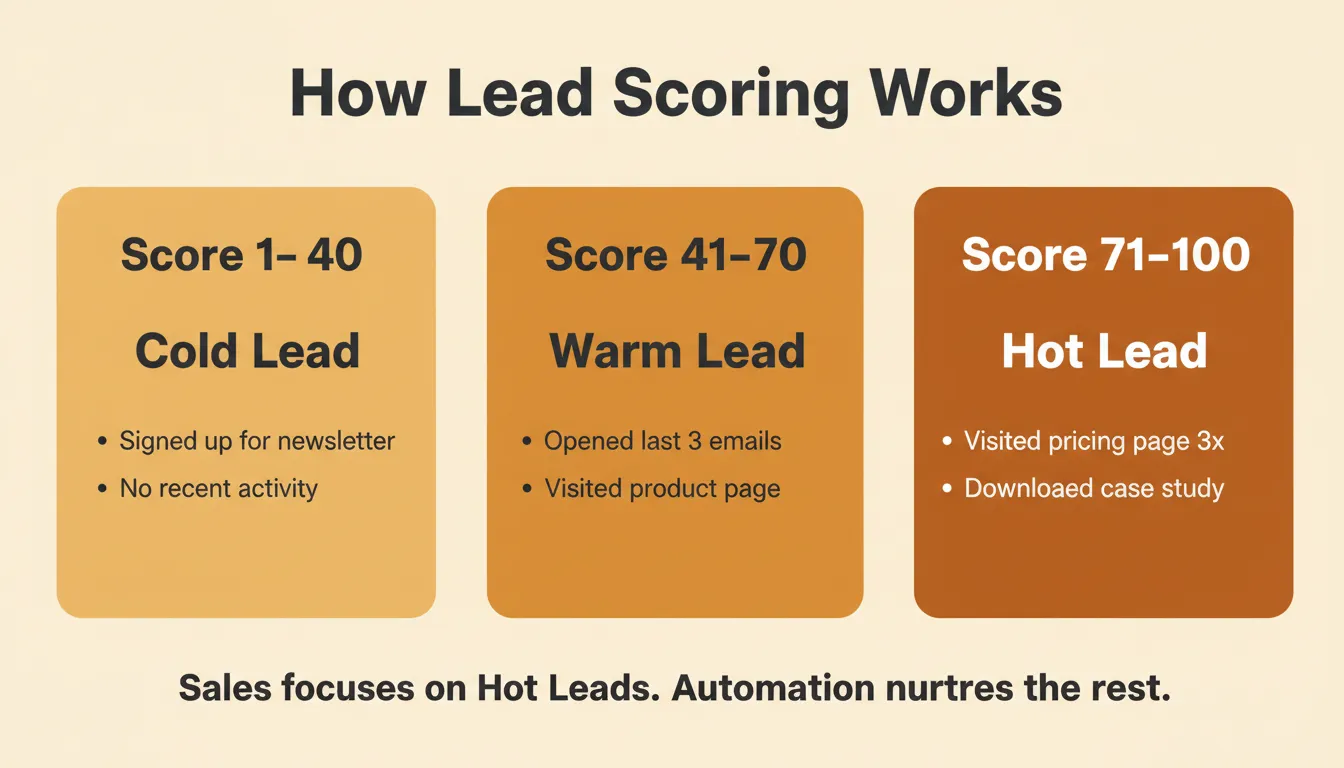
Lead scoring tiers help sales teams prioritize high-intent contacts while automation handles the rest.
Automated Email Sequences That Convert
The most effective automated sequences for small businesses include:
- Welcome series (3 to 5 emails) — introduce your brand, set expectations, and deliver immediate value
- Lead magnet follow-up — deliver the promised content, then guide toward the next step
- Behavioral triggers — send relevant content when a contact visits a specific page or takes a specific action
- Re-engagement campaigns — win back contacts who have gone quiet before removing them from your list
- Post-purchase sequences — onboard new customers, drive repeat purchases, and request reviews
The marketing automation loop: from first visit to conversion, running automatically.
Customer Relationships and Retention Through Automation
Marketing automation is not just a lead generation tool. It is a customer retention engine.
Retaining existing customers costs significantly less than acquiring new ones. According to Bain and Company, increasing customer retention by just 5% can increase profits by 25% to 95%. Automation makes retention scalable for teams without dedicated customer success resources.
Retention tactics small businesses can automate:
- Onboarding sequences — guide new customers through setup or first use, reducing churn from confusion
- Milestone emails — celebrate anniversaries, loyalty milestones, or usage achievements
- Proactive support triggers — detect when a customer has not logged in or used a feature, then send helpful content before they churn
- Win-back campaigns — automatically reach out to lapsed customers with a compelling reason to return
- Review and referral requests — ask satisfied customers for reviews or referrals at the right moment
Personalized, timely automation makes customers feel seen. That feeling drives loyalty more reliably than discounts.
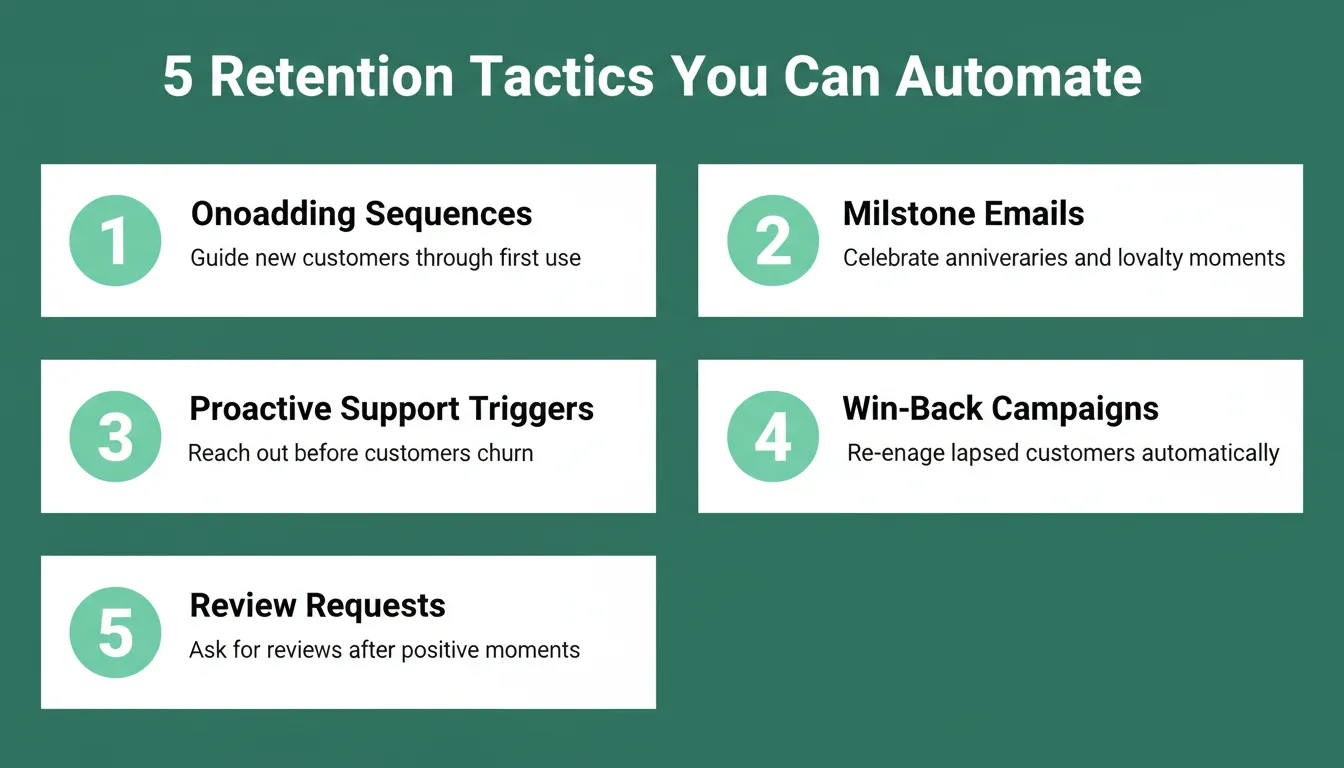
Five retention tactics that run automatically, keeping customers engaged without manual effort.
Business Growth and Revenue: What Marketing Automation Actually Delivers
The business case for marketing automation is straightforward. According to Forrester Research, companies that use marketing automation see measurable improvements in lead quality, campaign efficiency, and revenue growth. For small businesses operating on tight margins, that return matters.
What growth looks like with automation in place:
- More leads from the same traffic, thanks to better lead capture, faster follow-up, and nurture sequences
- Higher conversion rates, because personalized and timely communication outperforms generic broadcast emails
- Shorter sales cycles, as leads arrive at the sales conversation already educated and pre-qualified
- Lower customer acquisition cost, since automation reduces the manual labor cost per acquired customer
- Scalable revenue, because campaigns run whether your team is in the office or not
AI-Powered Marketing Automation: The Next Frontier
The best marketing automation platforms for small businesses increasingly incorporate AI. These tools predict the best send time for each individual contact, generate personalized email content at scale, score leads more accurately using machine learning, identify at-risk customers before they churn, and recommend next-best actions for sales teams based on behavioral signals.
AI does not replace the strategy. It makes the execution smarter and more precise.
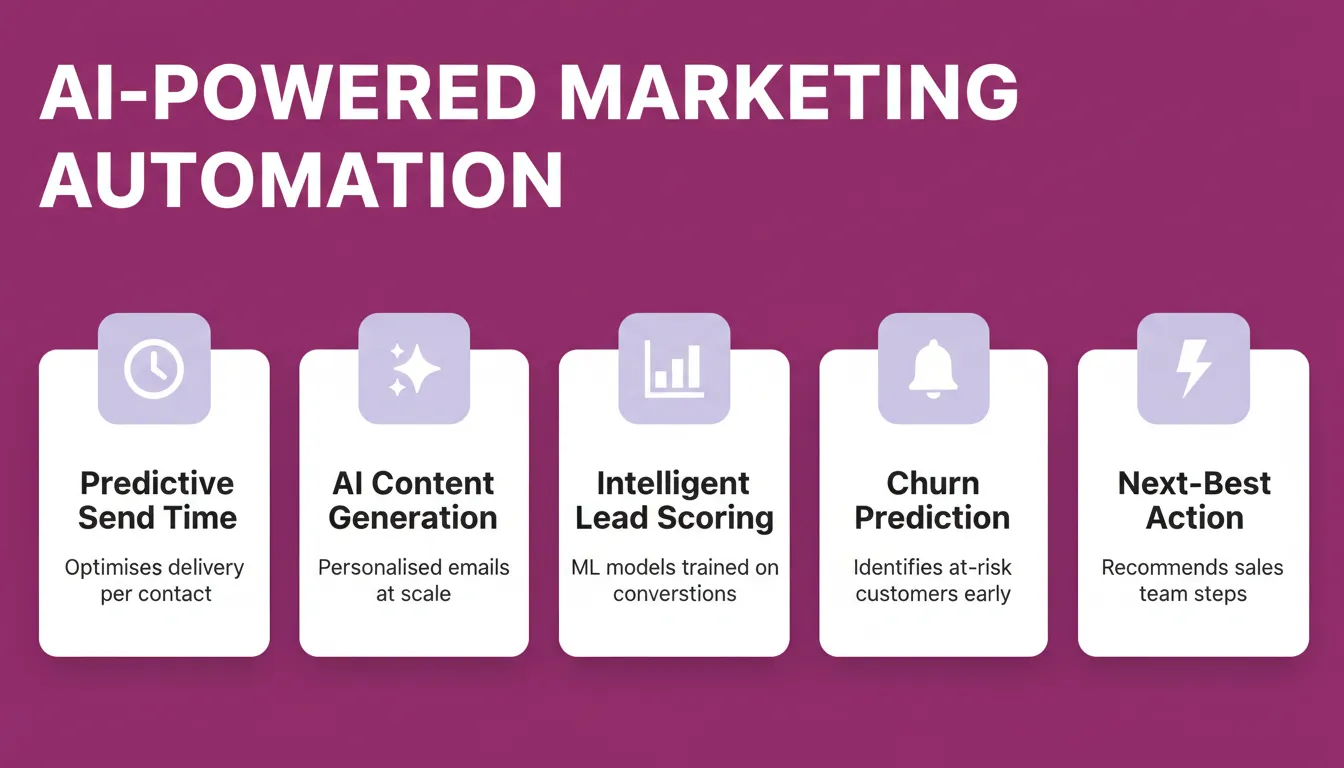
AI-powered features are increasingly standard in leading marketing automation platforms.
How Rocket Supports Your Marketing Automation Stack
Rocket is a vibe solutioning platform that helps small businesses build the digital infrastructure that makes marketing automation work better. It combines three capabilities in one place: Solve (strategic research and market validation), Build (production-ready web and mobile apps), and Intelligence (continuous competitor monitoring).
For small businesses running marketing automation, Rocket fills the gaps that off-the-shelf platforms cannot.
Build Custom Lead Capture and Landing Pages
Rocket's Build pillar generates conversion-focused landing pages from plain-language descriptions. No templates or designers are needed. Every page ships with SEO-ready structure, WCAG accessibility compliance, and performance optimization built in. Connect Mailchimp, Typeform, or Calendly directly into the build. Your lead capture then flows directly into your marketing automation platform.
Connect to Your Marketing Stack Natively
Rocket integrates with 25+ services that overlap directly with marketing automation workflows:
- Mailchimp — email campaigns and audience management
- Typeform — lead capture forms and surveys
- Calendly — appointment booking and scheduling
- Mixpanel — behavioral analytics and user tracking
- Stripe — payment flows for e-commerce and subscription businesses
- SendGrid, Brevo, MailerLite, Resend — transactional and marketing email delivery
Authenticate once and these integrations flow into every build automatically.
Validate Your Marketing Strategy Before You Build
Rocket's Solve pillar turns any business question into a structured research report. Before investing in a new campaign, a new channel, or a new automation workflow, use Solve to validate the approach. You get market sizing, competitive landscape, customer behavior patterns, and strategic recommendations in one output.
Monitor Competitors Continuously
Rocket's Intelligence pillar monitors every public platform your competitors operate on. It tracks pricing pages, product updates, social activity, and hiring signals. Then it delivers daily briefs with strategic interpretation. For small businesses competing against larger players, knowing what competitors are doing before it affects your pipeline is a genuine advantage.
For teams that want to build an email marketing tool tailored to their specific workflows rather than adapting to a generic platform, Rocket's Build pillar handles that from a plain-language description.
Best Marketing Automation Platforms for Small Businesses: Summary
The best marketing automation platforms for small businesses share four qualities. They are easy enough for a small team to operate without dedicated technical resources. They integrate with the tools you already use. They scale as your contact list and campaign complexity grows. And they deliver measurable ROI.
Start with a trial period to validate your workflows. Invest in a paid plan when automation is clearly driving pipeline. Then build the custom digital infrastructure, including landing pages, lead capture tools, and customer portals, that off-the-shelf platforms cannot provide.
With the right combination of marketing automation software and purpose-built digital tools, small businesses can run marketing operations that compete with teams ten times their size.
The Right Foundation Makes Automation Work
The best marketing automation platforms for small businesses are only as effective as the digital infrastructure behind them. As AI continues to reshape how campaigns are built and personalized, small businesses that invest in both the right automation tools and the right custom-built surfaces will have a compounding advantage over those relying on generic templates alone.
You have the strategy. Type it into Rocket.new and build the infrastructure that makes it run.
Table of contents
- -What is Marketing Automation and Why Small Businesses Need It
- -Key Features to Look for in Marketing Automation Platforms
- -Email Marketing and Automated Sequences
- -Lead Scoring and Lead Nurturing
- -CRM Integration
- -Workflow Automation and Analytics
- -How to Choose the Best Marketing Automation Platform for Small Businesses
- -Platform Pricing Tiers: What Small Businesses Actually Get
- -Lead Nurturing and Scoring: The Engine of Marketing Automation
- -How Lead Scoring Works in Practice
- -Automated Email Sequences That Convert
- -Customer Relationships and Retention Through Automation
- -Business Growth and Revenue: What Marketing Automation Actually Delivers
- -AI-Powered Marketing Automation: The Next Frontier
- -How Rocket Supports Your Marketing Automation Stack
- -Build Custom Lead Capture and Landing Pages
- -Connect to Your Marketing Stack Natively
- -Validate Your Marketing Strategy Before You Build
- -Monitor Competitors Continuously
- -Best Marketing Automation Platforms for Small Businesses: Summary
- -The Right Foundation Makes Automation Work