
Enterprise sales reps face competition in 68% of deals, yet most walk into high-stakes meetings underprepared. This post explores how product intelligence and competitive monitoring through Rocket.new helps reps build deal-specific briefs and win more enterprise meetings.
What separates a rep who wins a high-stakes enterprise meeting from one who leaves empty-handed?
Most of the time, it comes down to one thing: preparation - and specifically, the quality of product intelligence they carry into the room.
Reps who prepare well convert 40% more meetings to pipeline, according to Gong data. And yet, most enterprise teams are still cobbling together competitive briefs from last-quarter battle cards and quick LinkedIn scans the night before.
What Enterprise Sales Reps Are Really Walking Into
Enterprise deals are harder than they look on paper. Sales cycles now run 6 to 12 months, buying committees have grown, and according to Crayon's 2025 State of Competitive Intelligence, sellers face direct competition in 68% of their deals.
That last number deserves attention. In nearly 7 out of 10 deals, a competitor is in the picture. And most reps are not walking into those meetings prepared to handle it.
Good pre-meeting research takes 30 to 60 minutes per call. For a rep with six to eight meetings a day, that math simply does not work. So most do a quick scan and move on - and the deal often suffers for it.
The Hidden Cost of Unprepared Sales Teams
Let's look at what unprepared actually costs. Crayon's research found the average sales team rates itself a 3.8 out of 10 in competitive selling. That gap is costing companies between $2 million and $10 million a year in deals they could have won.
Two structural problems make this worse:
-
44% of companies lack competitor visibility within their CRM. Reps go into calls without knowing what the prospect is already evaluating.
-
52% of compete programs don't have a sales executive sponsor. Competitive intelligence gets collected, but it rarely reaches the reps who need it before the meeting.
Product intelligence - data about how customers interact with products, what features they use, where they drop off, what competitors are shipping - is rarely part of the prep workflow. That is the gap worth closing.
What Product Intelligence Actually Means for Sales Teams
Most people think of product intelligence as a tool for product managers. Analyze user behavior data, review product analytics dashboards, track product metrics, report to the team. That is accurate, but it is only half the picture.
Product intelligence is also one of the most underused assets in enterprise sales. When reps understand how customers interact with a product - what pain points they are trying to solve, what the customer journey looks like, which product features get used versus ignored - they can have a completely different kind of conversation.
Instead of pitching capabilities, they can speak directly to outcomes the prospect actually cares about. That shift from generic to specific is what closes enterprise deals.
Product Intelligence vs. Business Intelligence
Traditional business intelligence tells you what happened. Sales numbers, pipeline coverage, win/loss ratios. Useful data, but always looking backward.
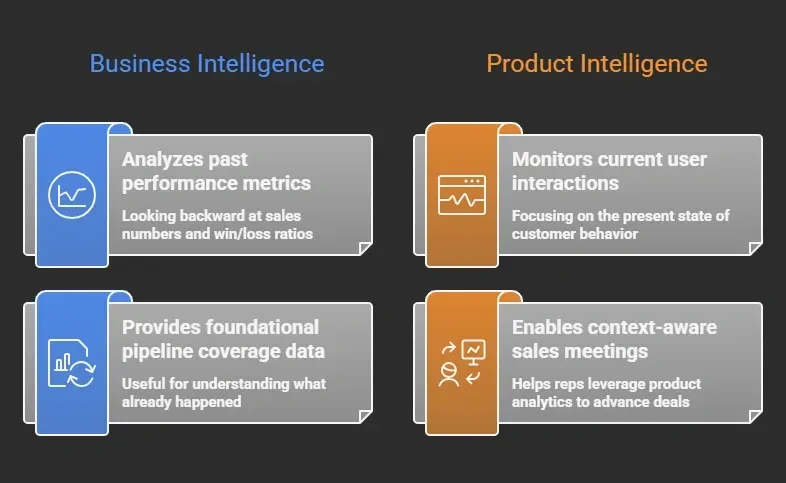 Product intelligence focuses on the present - how users interact with a product right now, what product analytics reveal, what product data shows about customer behavior. Combined with competitive monitoring, it creates a real-time picture that helps reps show up to meetings with real context.
The difference matters most in enterprise deals, where a single call can move a seven-figure deal forward or stall it for months.
How Top Reps Gather Data Before a High-Stakes Meeting
Top performers spend six times more time on pre-call research than average reps, according to MarketBetter's 2026 research. So what does that research actually cover?
The best prep touches three areas:
-
Company and product intelligence - what the competitor's product looks like today, what recent changes they have shipped, what usage data signals the prospect might be struggling with
-
Competitive intelligence - which competitors are in the deal, what analytics tools the prospect currently uses, and where switching costs are high
-
Stakeholder intelligence - who is in the room, what product decisions they own, and what outcomes matter to each decision maker
| Prep Category | What to Gather | Where to Find It |
|---|---|---|
| Company Intel | Recent product launches, messaging shifts | Competitor website, press releases |
| Product Intel | Feature adoption, customer feedback, product performance | G2, Capterra, customer interviews, focus groups |
| Competitive Intel | Pricing changes, new features, executive activity | Competitive monitoring tools, job postings, social media |
| Stakeholder Intel | Buyer roles, priorities, objection history | LinkedIn, CRM notes, call recordings |
| Market Context | Industry trends, surveys, analyst commentary | Reports, social media comments, analyst publications |
Pulling all of this from separate sources takes time most reps do not have. And when teams do collect this data, it often sits in a document that does not get refreshed before the next meeting.
From Roadmap Strategy to Real-Time Intelligence
A competitor's roadmap strategy is one of the most valuable signals in enterprise sales - and one of the hardest to read well.
Product teams use product analytics, customer data, and behavioral data to shape what gets built. They run customer interviews, collect responses from focus groups and surveys, gather customer feedback from power users, and turn all of it into a roadmap that points toward where the product is heading.
Sales reps rarely have access to a competitor's version of this thinking. The signals, though, are public - if you know where to look.
Job postings reveal where a competitor is putting resources. New engineering hires signal product development bets. Social media messaging shifts show positioning changes before they hit the website. Review platform patterns track customer satisfaction over time and surface where a competitor's product is generating real pain for its own users.
When a sales rep connects these dots before a meeting, they walk in with something rare: a specific, current view of where the competitor is strong and where they are not.
What Enterprise Sales Pros Are Saying
Enterprise sales coach Ian Koniak, a former Salesforce enterprise rep, shared this on LinkedIn:
"POV development used to take weeks: combing through annual reports, press releases, LinkedIn profiles, and company blogs just to piece something together that may or may not land." Ian Koniak on LinkedIn
That experience is still common across enterprise sales teams. The prep takes too long. The data is scattered. The brief is often stale by the time the meeting happens.
Teams solving this are not doing more manual research. They are building systems that bring product intelligence, competitive monitoring, and deal-specific context together in one place - so reps walk in prepared every single time.
Rocket.new: The Intelligence Layer Sales Teams Have Been Missing
Rocket.new was built for this problem. The Intelligence feature continuously monitors every public surface a competitor operates on - website, social media, review platforms, job postings, executive activity, news coverage - and produces a daily brief that tells you what changed and, more importantly, what it means for your business.
This is not an alerting system. It is an interpretation system.
A competitor updating their pricing page alone is noise. That same update alongside new enterprise-focused hiring, defensive responses on G2, and a social media messaging shift toward security features - that is a clear strategic signal. Rocket.new reads the signal cluster, not just the individual data point.
For enterprise sales teams, this changes what is possible before every meeting.
Four Intelligence Lenses, One Source
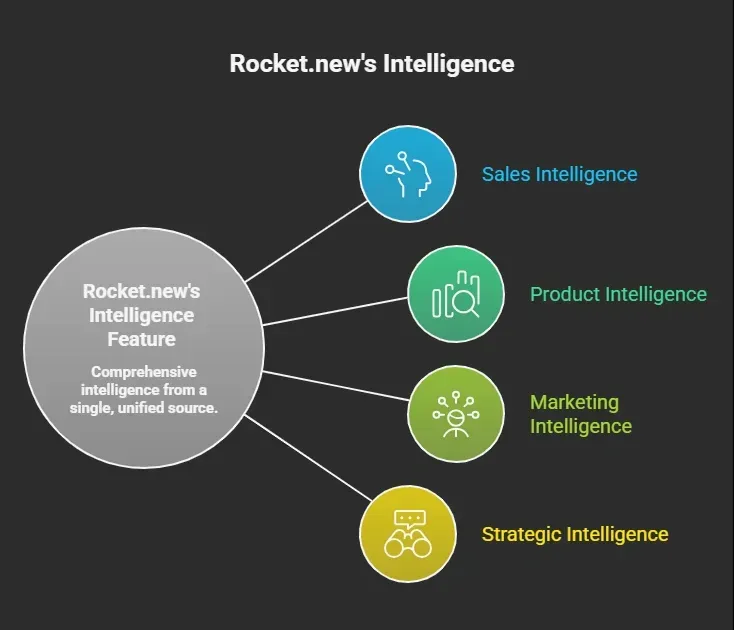
Rocket.new's Intelligence feature serves four functions from a single source:
-
Sales intelligence - deal-specific competitive briefs, updated daily
-
Product intelligence - what competitors shipped in the past 90 days, what job postings signal they are building next, and which product features are attracting or losing customers
-
Marketing intelligence - how competitors are positioning, what campaigns are active, what messaging is shifting
-
Strategic intelligence - M&A signals, enterprise positioning shifts, market entry moves detected months before formal announcements
No separate analytics tools for each function. One source, four lenses.
What Makes Rocket.new Different from Traditional Tools
Tools like Crayon and Klue collect signals. Rocket.new connects them.
The key difference is compound context architecture. Every intelligence signal - a competitor's pricing change, a new product announcement, a wave of negative reviews - stays in the project and flows into every subsequent task. When a rep opens Solve to prep a competitive brief before a deal meeting, all the product intelligence gathered over the past weeks is already there.
No re-explaining. No searching through old documents. The context builds across sessions, team members, and tasks. Traditional competitive intelligence tools also require separate subscriptions and separate workflows for sales, product, and strategy teams. Rocket.new covers all four intelligence functions from a single workspace - and that workspace connects directly to Solve, where reps generate deal-specific prep in minutes.
Key Features for Enterprise Sales Teams
Daily competitive briefs: Every morning, Rocket.new produces a structured brief for every competitor you track - what moved, what patterns are emerging, and what actionable insights your team should act on next.
Six monitored signal categories: Website changes, social media, news and press coverage, review platform customer satisfaction trends, people and hiring signals, and performance marketing - all tracked continuously.
Solve for deal prep: Reps can use Solve to generate a complete, structured competitive brief for any specific deal. Describe the opportunity, and Solve runs queries across 150+ sources to produce a deal-specific analysis with competitive positioning, objection prep, and differentiation points.
Data collection and data integration across sources: Rocket.new pulls signals from six categories simultaneously so reps do not need to run separate queries across multiple platforms. All product data flows into one shared project context.
Team-level shared memory: Every intelligence signal and Solve output lives in a shared project. When multiple team members work a deal, everyone works from the same accumulated context - the research from Monday is present when the rep prepares for Friday's call.
Customer Success Through Better Sales Intelligence
Product intelligence does not stop at the signature. When sales teams carry product analytics and user behavior data into renewal conversations, they can show customers how their usage patterns compare to similar users, and where new features could solve existing pain points.
This is the customer lifecycle value of good product intelligence - it informs every customer engagement from first contact through renewal, reducing churn and building the kind of brand loyalty that comes from customers who feel understood.
The Path to Better Win Rates Starts Before the Meeting
Product intelligence is not a tool reserved for product teams. It is a competitive asset that enterprise sales teams are only now starting to take seriously.
The competitive intelligence tools market surpassed $5.70 billion in 2025 and is on track for $19 billion by 2035. That growth reflects one thing: companies are finally investing in the preparation work that changes who wins deals.
Rocket.new gives enterprise sales teams - and the product intelligence platform layer supporting them a single place to monitor competitors, analyze signals, build deal-specific briefs, and walk into high-stakes meetings with context that is genuinely hard to match.
Table of contents
- -What Enterprise Sales Reps Are Really Walking Into
- -The Hidden Cost of Unprepared Sales Teams
- -What Product Intelligence Actually Means for Sales Teams
- -Product Intelligence vs. Business Intelligence
- -How Top Reps Gather Data Before a High-Stakes Meeting
- -From Roadmap Strategy to Real-Time Intelligence
- -What Enterprise Sales Pros Are Saying
- -Rocket.new: The Intelligence Layer Sales Teams Have Been Missing
- -Four Intelligence Lenses, One Source
- -What Makes Rocket.new Different from Traditional Tools
- -Key Features for Enterprise Sales Teams
- -Customer Success Through Better Sales Intelligence
- -The Path to Better Win Rates Starts Before the Meeting