
Rocket.new helps product teams collect and analyze competitive intelligence, uncover market gaps, benchmark rivals, and translate insights into clear product strategies, faster roadmaps, and confident decisions that drive growth.
How do product teams make better roadmap choices before a sprint even starts?
They rely on competitive intelligence and structured signals from the market, not just internal assumptions. Instead of guessing what to build, strong teams study patterns, track shifts, and understand real demand before making a move.
Better inputs lead to smarter outcomes. When teams work with clear signals, they spend less time fixing mistakes and more time building what actually matters. A focused platform like Rocket helps teams act early instead of reacting late by turning scattered data into a clear direction.
This blog will help you plan smarter, reduce guesswork, and build with confidence before the sprint even begins.
Why Product Teams Struggle Before Sprint Planning?
Most product teams don’t lack effort. They lack clarity. A typical team ends up juggling multiple tools at once. One for market research, another for analytics, a few more for ad libraries.
Then someone manually checks competitor moves while another person writes notes in separate strategy documents. It quickly turns into a scattered workflow.
What actually goes wrong
-
Signals get missed
-
Product updates feel reactive
-
Decision making slows down
-
Teams risk building the wrong thing
And honestly, that’s the frustrating part. Teams spend weeks trying to build and write code, only to realize the demand wasn’t even there. All that time and effort could have been saved with better clarity before the sprint even began.
The Shift From Guesswork to Structured Signals
So, what actually changes the game here?
It’s not more tools or more data. It’s having a clear system that brings everything into one place.
Teams don’t just need information. They need insights that actually help inform product roadmap decisions before any real work begins.
What makes the difference
-
A system that connects data, insights, and execution
-
A single workflow instead of scattered tools
-
Continuous tracking of competitor moves
-
Clear understanding of pricing models
-
Better visibility into unit economics before you build
This is where Rocket comes in as a vibe solutioning platform. It helps teams Solve, Build and Intelligence together instead of treating them as separate steps.
Instead of jumping between tools and guessing what might work, teams get one platform that gives clarity early. That means smarter planning, faster decisions, and a much better chance of building something the market actually wants. Sounds better already, right?
What Competitive Intelligence Means for Product Teams
Let’s simplify it. Competitive intelligence is not just spying on competitors.
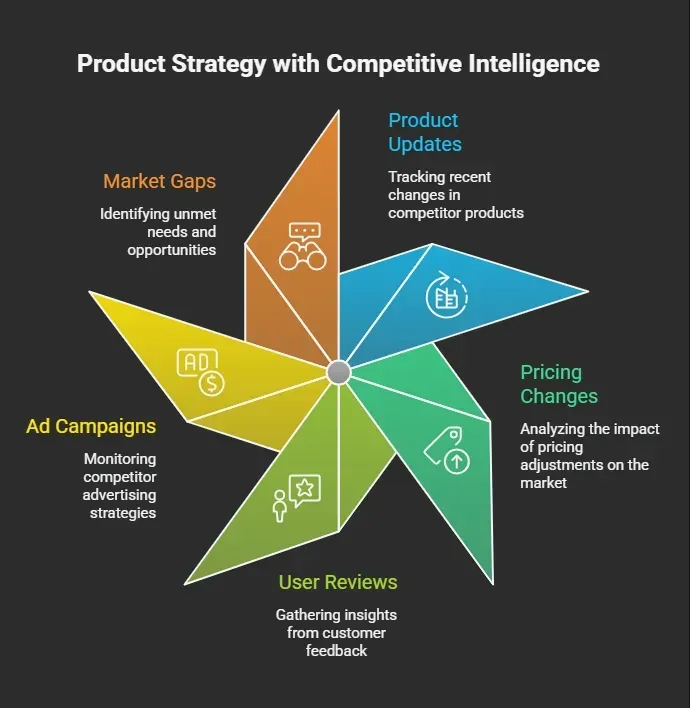 That’s where ad libraries, analytics, and market research come together. And when done right, it saves up to 80% of the time spent on manual research. Yes, saves up to 80.
Old Way vs New Way
This comparison makes it easier to see what actually changes when you move to a more connected approach.
| Approach | Old Workflow | With Rocket |
|---|---|---|
| Tools | Multiple separate tools | One platform |
| Data Access | Scattered | Real time |
| Market Research | Manual | AI supported |
| Code Effort | Heavy upfront code | Smarter build decisions |
| Decision Making | Slow | Faster and structured |
| Output | Basic documentation | Actionable insights |
The difference is pretty clear. One side is all about juggling tools and reacting late. The other gives your team clarity, speed, and better direction from the start. When everything works together in one place, you spend less time figuring things out and more time building what actually matters.
The First Vibe Solutioning Platform: Rocket.new
So, what really makes Rocket different?
It’s not about adding another tool to your stack. It’s about changing how your team moves from thinking to building.
Instead of separating insights and execution, Rocket brings everything together so work actually flows.
What makes Rocket different
-
Defines a new category as the first vibe solutioning platform
-
Connects product thinking directly with execution
-
Brings insights, strategy documents, and workflows into one place
-
Helps teams act on data instead of just reading it
-
Reduces the need to switch between multiple tools
-
Supports Flutter for building mobile apps and web apps
The real difference shows up in how your team works every day. With everything connected, decisions happen faster, and building becomes more focused. Less confusion, more clarity, and a smoother path from idea to product.
How Rocket.new Informs Roadmap Decisions?
Now let’s talk about the main idea. How rocket.new informs roadmap decisions comes down to one simple shift. It turns raw signals into clear, usable actions before your team even starts planning a sprint.
How it works
-
Gathers data from the market, including reviews, ad libraries, and pricing
-
Structures insights using AI
-
Continuously maps competitor moves
-
Highlights patterns in demand and pricing models
-
Connects insights directly with product building workflows
What your team gets before the sprint
-
Clear background for the call
-
Defined priorities
-
Better decision context
No guesswork. No last-minute confusion. Just clarity from the start, so your team can focus on building what actually matters.
How Rocket Works Behind the Scenes?
Let’s break this down in a simple way. Rocket is designed to connect intelligence with execution, so your team doesn’t just collect data but actually uses it to build better.
Instead of jumping between tools, everything works together in one system, making the entire flow smoother and easier to manage.
Here’s a simple breakdown:
1. Data Collection
Rocket pulls in data from multiple sources like:
-
Reviews
-
Ad libraries
-
Product updates
-
Pricing changes
All in real time.
2. AI Processing
AI tools analyze the data and produce structured insights.
This includes:
-
Trends in unit economics
-
Changes in demand
-
Competitor positioning
3. Insight Mapping
The platform maps everything into usable formats.
-
Strategy documents
-
Notes for decision making
-
Inputs for product roadmap decisions
4. Build Support
Here’s the interesting part. Rocket doesn’t stop at insights.
It helps teams start building.
-
Generates initial code
-
Supports product building workflows
-
Helps reduce reliance on manual processes
That means less time switching tools and more time working.
When everything connects like this, your team spends less time figuring things out and more time building with confidence. It’s a smoother process from data to decision to product.
Features That Actually Help Product Teams
Let’s keep this simple and practical. Features only matter when they actually help your team move faster and make better decisions.
Rocket focuses on what teams really need during planning and building, without adding extra complexity.
Key features
-
Continuous tracking of competitor moves
-
Built-in market research tools
-
Support for pricing and pricing models
-
Real time analytics and updates
-
AI-driven documentation
-
Support for web apps, mobile apps, and even IOT use cases
All of this works together inside one platform, so your team doesn’t have to switch between multiple tools.
When features are this focused, your team spends less time managing tools and more time building. Everything stays connected, clear, and easy to act on from start to finish.
Real Use Cases for Product Teams
So where does Rocket actually fit in?
Here are a few simple use cases:
-
Preparing background for the call before sprint planning
-
Tracking competitor moves across the market
-
Understanding pricing and unit economics
-
Planning product updates
-
Supporting product development with AI tools
All happening in one place.
Why Startups Love This Approach?
Startups don’t have time to waste. They need to build fast and release fast.
Rocket helps startups:
-
Reduce reliance on multiple tools
-
Save time on research
-
Make faster decision cycles
-
Produce better outputs with fewer resources
And since it’s free to use at entry level, it lowers the barrier for early teams.
From Insights to Action in a Single Workflow
This is where things get interesting. Most platforms stop at analytics, Rocket goes further.
It connects:
-
Insights
-
Documentation
-
Code
-
Product building
All inside a single workflow. So your team doesn’t just read insights. You act on them instantly.
A Note on Code and Product Building
Let’s address something directly. You still need to write code. That part doesn’t go away. What changes is how your team approaches it. Instead of guessing and then fixing later, you start with clarity and direction.
What changes with Rocket
-
You write code with better context
-
You avoid unnecessary effort and rework
-
You build based on real signals, not assumptions
What this leads to
-
Better product outcomes
-
Faster release cycles
-
Smarter product updates
When your team builds with clarity, the whole process feels smoother. Less confusion, fewer mistakes, and more focus on creating something that actually fits the market.
Small Details That Make a Big Difference
A few things worth noting:
-
The platform was designed to simplify complex workflows
-
Updates in April improved analytics and AI capabilities
-
It uses 80 tokens efficiently for insight generation
-
It fixes common gaps in product planning
-
It defines clear paths from insight to execution
Even small improvements like these save a lot of time.
Making Smarter Roadmap Decisions Before the Sprint Begins
Teams often rely on scattered tools, manual research, and delayed insights. That slows decision-making and increases the risk of building the wrong thing. Product teams miss early signals from the market, which leads to reactive product updates and wasted effort. Rocket changes this by bringing everything into one platform. It connects market research, competitive intelligence, and product development workflows so teams can act with clarity before the sprint even starts.
When early signals are clear, product roadmap decisions become sharper and faster. Teams work with confidence instead of assumptions and build what actually fits the market. Rocket helps turn raw data into structured actions that guide every step.
Ready to plan better before your next sprint? Try Rocket.new and start making smarter roadmap decisions from day one
Table of contents
- -Why Product Teams Struggle Before Sprint Planning?
- -The Shift From Guesswork to Structured Signals
- -What Competitive Intelligence Means for Product Teams
- -Old Way vs New Way
- -The First Vibe Solutioning Platform: Rocket.new
- -How Rocket.new Informs Roadmap Decisions?
- -How Rocket Works Behind the Scenes?
- -1\. Data Collection
- -2\. AI Processing
- -3\. Insight Mapping
- -4\. Build Support
- -Features That Actually Help Product Teams
- -Real Use Cases for Product Teams
- -Why Startups Love This Approach?
- -From Insights to Action in a Single Workflow
- -A Note on Code and Product Building
- -Small Details That Make a Big Difference
- -Making Smarter Roadmap Decisions Before the Sprint Begins