
AI processes massive competitive data in real time, while humans provide context and strategy. Most teams miss up to 88% of signals due to scale limitations. Rocket.new combines both to surface hidden insights and deliver decision-ready intelligence daily.
Can a human analyst really keep up with every competitor move across every platform, every day?
The honest answer is no. According to Octopus Intelligence, 73% of companies miss their biggest competitive threats until it's too late, and organizations analyze only about 12% of the large datasets they collect. The other 88%, signals hiding in hiring pages, review platforms, ad libraries, and executive posts, go completely unread.
That gap is a scale problem. AI excels at processing massive datasets quickly, but it can miss context and lacks a true understanding of nuanced signals, areas where human analysts provide essential human judgment and human expertise.
The real question isn't AI vs human; it's understanding what each does better and where the combination of both produces the strongest competitive intelligence.
The Honest Limits of Human Judgment in Competitive Analysis
Human analysts bring strategic thinking, contextual understanding, human insight, emotional intelligence, and moral reasoning, qualities that turn raw data into a coherent narrative. Human expertise in reading market nuance and connecting dots across long time horizons is something AI models simply cannot replicate. Human analysts provide essential qualities such as judgment, creativity, and ethical reasoning, which are critical for translating raw data into actionable intelligence that aligns with business strategy.
But structural limits exist. A human analyst works in cycles: research, compile, write, present. By the time a competitive report lands in a Monday meeting, the assumptions inside may already be stale. Human analysis is bounded by working hours, bandwidth, and the number of platforms a person can realistically monitor. Human analysis is also limited by subjective biases, fatigue, and slower turnaround times for reports, and competitors are not waiting for your quarterly review.
Human analysts are also essential for identifying and addressing biases in data and algorithms, ensuring transparency and accountability in analytics, especially in light of growing concerns about data privacy. Organizations must maintain clear human ownership over outcomes that affect real people, as AI systems cannot be held accountable for their decisions, making human judgment vital in high-stakes situations.
Where Human Analysts Excel, and Where the Gaps Appear
Cognitive biases can also shape what human analysts choose to look at, reinforcing blind spots rather than catching them. The problem isn't that human analysis is wrong; it's that they're working with incomplete information and often don't know what they're missing.
| What Human Analysts Do Well | Where They Struggle |
|---|---|
| Strategic thinking and framing | Monitoring multiple platforms simultaneously |
| Relationship-based intelligence | Detecting subtle messaging shifts over time |
| Ethical judgment and moral reasoning | Processing massive datasets at speed |
| Contextual understanding of industry nuance | Tracking hiring velocity across departments |
| Critical thinking on ambiguous signals | Catching cross-platform signal clusters |
| Qualitative data synthesis and interpretation of complex findings | Real-time monitoring without gaps |
| Human creativity in scenario planning | Identifying data points across vast sources |
| Emotional intelligence in stakeholder analysis | Repetitive tasks and routine tasks |
| Aligning intelligence with business strategy |
What AI Excels at in Competitive Intelligence
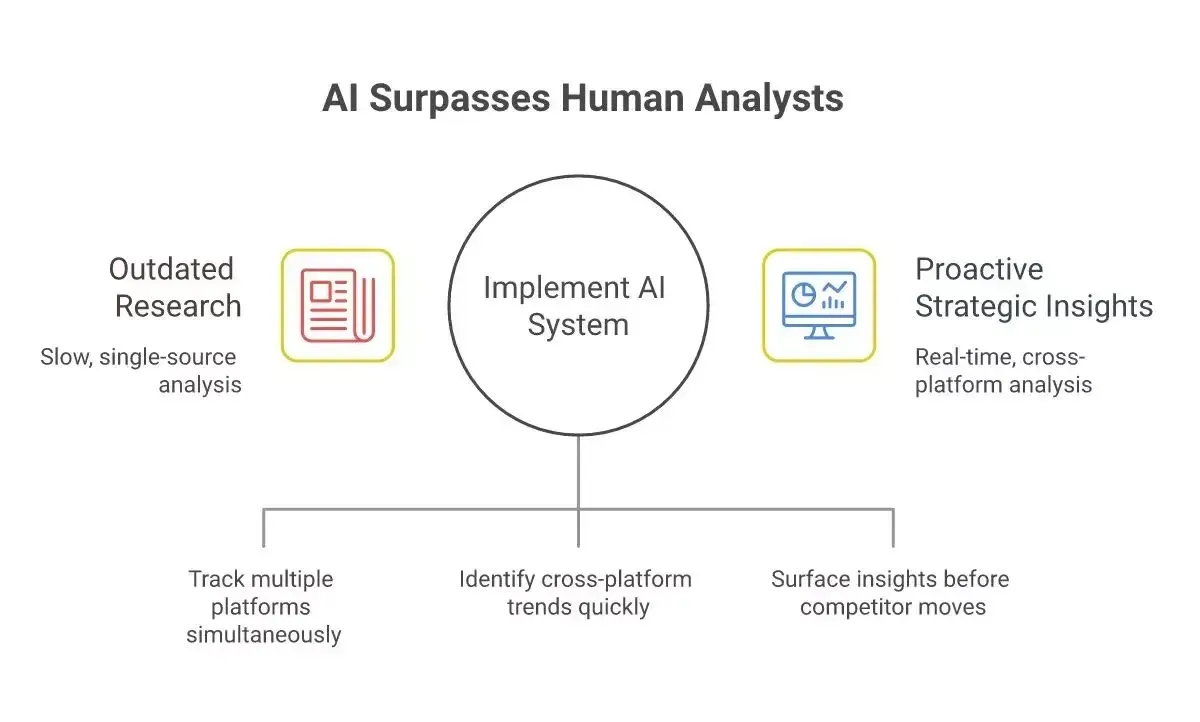 Artificial intelligence doesn't get tired. It doesn't take weekends off. Where AI excels is in handling the heavy lifting of data processing, scanning, sorting, and interpreting vast amounts of information at a speed and scale no human capabilities can match. AI processes vast datasets in seconds, allowing for continuous 24/7 monitoring across multiple languages and channels. AI detects anomalies and signals instantly, providing live, 24/7 tracking of competitor activities.
How AI Processes Data at Scale
AI tools can analyze thousands of data points per second across structured and unstructured data sources: a pricing page tweak, three new enterprise sales job postings, a shift in ad copy, connecting them into a single coherent picture. AI can scan millions of data points simultaneously, offering real-time monitoring and proactive alerts.
AI systems enable predictive analytics and real-time monitoring, while their forecasting demand capabilities help teams anticipate market trends as part of strategic decision-making. AI reduces operational costs and enables predictive analytics for competitive data, enabling a shift from reactive to proactive analysis based on early indicators of competitor moves.
AI identifies hidden trends too subtle or complex for humans, such as sudden hiring spikes in specific areas. AI can forecast competitor actions and simulate multiple future scenarios for agile planning, making it a powerful partner in strategic decision-making. While AI can achieve a predictive accuracy of around 60% in financial performance predictions, human analysts typically achieve an accuracy of 53–57%, highlighting the importance of human context and human judgment in decision-making.
The Role of Generative AI Models and Large Language Models
Generative AI models and large language models now analyze unstructured data from reviews, social posts, and news coverage, producing synthesized interpretations rather than just raw summaries. Natural language processing allows these AI models to pick up on subtle shifts in language, product focus, hiring priorities, and customer feedback that would take a human analyst hours to surface manually. Regular updates and audits of training data are essential to ensure AI models remain reliable and unbiased.
Generative AI has also transformed how AI outputs are delivered. Instead of raw data exports, teams receive synthesized paragraphs, prioritized recommendations, actionable strategies, and meaningful insights for strategic decisions rather than just alerts.
Where AI Falls Short
Despite its strengths, AI systems can confidently provide recommendations based on incomplete data, which can lead to significant errors in decision-making. AI models can mirror biases present in their training data, leading to biased outcomes in their predictions and analyses.
AI cannot understand the context behind decisions, which can result in misinterpretation of data and inappropriate recommendations. AI struggles with scenarios where the right answer depends on values rather than data, making it less effective in complex decision-making environments. Human analysts adapt strategies quickly to unforeseen disruptions, while AI relies on historical data.
The Human-in-the-Loop: The Most Effective Model
The most effective competitive intelligence teams utilize a hybrid "human-in-the-loop" system. Effective collaboration reshapes workflows to maximize the human strengths of both AI and human analysts, allowing each to perform the tasks they do best.
Organizations that adopt human-in-the-loop protocols create a continuous feedback loop between AI outputs and human judgment, ensuring that strategic decisions are informed by both AI insights and human expertise.
AI excels in collecting and identifying raw signals, while human analysts excel in contextualization and strategic interpretation. Humans interpret cultural, political, and market-specific nuances that AI may overlook. Human analysts apply experience and critical thinking to determine the strategic impact of raw data.
AI automates repetitive tasks like data gathering and report generation, freeing human resources for strategic tasks. AI maintains standardized tracking without fatigue or cognitive biases, ensuring uniform capture of signals. The optimal strategy employs AI for data processing and human analysts for interpreting signals and designing responses.
Successful business intelligence operations thrive when AI and human analysts join forces, combining AI's ability to process vast amounts of data with the strategic thinking and contextual understanding that only humans can provide. Competitive signals analysis has shifted from a manual, periodic activity to a real-time, hybrid effort.
Real-World Proof: AI and Human Collaboration in Action
The impact of this hybrid model extends well beyond competitive intelligence. In 2024, Massachusetts General Hospital used predictive analytics to identify high-risk patients, reducing hospital readmissions by 22% and significantly cutting healthcare costs.
Walmart's integration of AI into its business intelligence framework led to a 20% drop in stockouts, an 18% reduction in inventory holding costs, and a 25% improvement in decision-making speed, saving $150 million annually in North American operations.
AI analyzes complex datasets in healthcare, such as medical images and patient records, to suggest potential diagnoses, while human radiologists make the final calls, ensuring a blend of efficiency and expert human judgment.
The Six Signal Categories a Human Analyst Would Miss
1. Hiring Velocity as a Strategy Signal
Job postings are one of the most underused competitive signals. When a competitor starts hiring enterprise sales executives or compliance specialists, they're telegraphing their next strategic move, often months before any public announcement. AI tools can analyze vast amounts of job posting data across dozens of competitors simultaneously, identifying patterns that no single analyst could catch by manually checking career pages. AI identifies hidden trends too subtle or complex for humans, such as sudden hiring spikes in specific areas. These signals are too granular and fast-moving for periodic human review to catch consistently.
2. Cross-Platform Signal Clusters
This is where human intelligence falls short most often. A single data point is noise. But a pricing update combined with defensive G2 responses, two new enterprise-focused LinkedIn posts from their CEO, and a fresh batch of enterprise sales job openings? That's a clear strategic signal, and only a side-by-side comparison across all platforms reveals it.
AI and human teams approach this differently: AI systems read signal clusters simultaneously; human input provides the strategic thinking. Machine learning and generative AI models outperform human capabilities in competitive monitoring here, not in understanding context, but in connecting complex data across sources faster than any team could manage. AI utilizes machine learning, natural language processing, and big data analytics to monitor competitors across various sources simultaneously.
3. Executive Activity Patterns
When a CTO starts posting about enterprise security, the CMO references regulated industries in interviews, and the VP of Sales updates their headline to include financial services — that's a coordinated positioning shift. Human oversight catches the obvious moves; AI systems identify the subtle coordination that precedes a strategic announcement. Human experts validate the strategic decisions; AI handles the data processing. AI capabilities allow for a shift from reactive to proactive analysis based on early indicators of competitor moves.
4. Review Platform Sentiment Shifts
G2, Capterra, Glassdoor, and app store reviews are a live feed of how customers actually feel right now. Generative AI can process customer feedback across thousands of reviews and identify emerging themes using natural language processing. Human analysts rarely have the bandwidth to monitor review platforms continuously. AI tools do it automatically; humans validate the strategic implications. Large-scale data collection allows AI to monitor extensive competitor information like products and price points across all review platforms simultaneously.
5. Ad Copy and Messaging Changes
Competitors test positioning in paid ads before announcing it publicly. AI and human teams respond differently: AI tools catch the data points; human experts interpret what the positioning shift means for competitive intelligence and business strategy. By the time a human analysis notices the change in a quarterly review, the competitor has already validated the messaging and started rolling it out across their website and sales materials.
6. Website Changes with Strategic Delta Interpretation
A competitor quietly updating their pricing page or removing a product tier is a strategic signal. Historical data on website changes is where AI excels dramatically over human capabilities; only AI systems can track and compare every version of a page over time at scale.
Human analysis is limited by cognitive biases, fatigue, and slower turnaround times. AI outputs read every page change, track the before-and-after using historical data, and interpret the strategic delta. This kind of complex analysis across multiple competitors is where AI capabilities far exceed what human capabilities can manage manually.
Human oversight is critical when navigating legal and ethical complexities, as regulations like the California Consumer Privacy Act (CCPA) require moral reasoning and regulatory understanding that AI cannot provide.
Why Signal Clusters Matter More Than Individual Signals
A single signal is almost always noise. But a pricing update read alongside enterprise-focused social posts, defensive review responses, and new enterprise sales hires is one clear strategic signal: this competitor is moving upmarket.
Interpretation vs. Alerting: The Key Distinction
This is the difference between a system that alerts you and one that interprets for you. AI and human analysts approach this differently: AI systems read the cluster as it forms; human analysts apply critical thinking and contextual understanding after the fact.
The best competitive intelligence programs combine both: AI tools handle the heavy lifting of data processing and pattern recognition, while human review validates the strategic implications. A transparent decision-making process is crucial here, building trust and ensuring actionable intelligence is based on justifiable reasoning.
AI excels in collecting and identifying raw signals, while human analysts excel in contextualization and strategic interpretation. Only humans can lead the strategic decision-making, but only humans with full AI-processed intelligence can make truly informed decisions.
What the Data Says About Competitive Blind Spots
Companies analyze only about 12% of their collected data, leaving 88% of competitive opportunities completely unnoticed. This isn't a failure of human intelligence; it's a structural problem that artificial intelligence is specifically designed to address.
Crayon's 2025 State of Competitive Intelligence report found that sellers now face rivals in 68% of deals, yet the average team rates its competitive preparedness just 3.8 out of 10. That gap costs companies millions in winnable revenue every year.
"By the time a 50-page competitive report is finished, the assumptions inside it are already decaying. Quarterly intelligence made sense in slower markets. In subscription economies, AI markets, and digital platforms — it's structurally outdated." — Oleg Danyliuk, LinkedIn
Why Human-Only Analysis Can't Keep Up
The solution isn't to replace analysts — it's to give them AI tools that handle data processing and pattern recognition so they can focus on the strategic decisions only humans can make. Human oversight remains essential for ethical complexities, ethical standards, and data security, especially when navigating legal compliance and data privacy. Human strengths in strategic thinking are applied to AI-processed intelligence, not wasted on routine tasks.
Rocket.new Intelligence: Built to Catch What Humans Miss
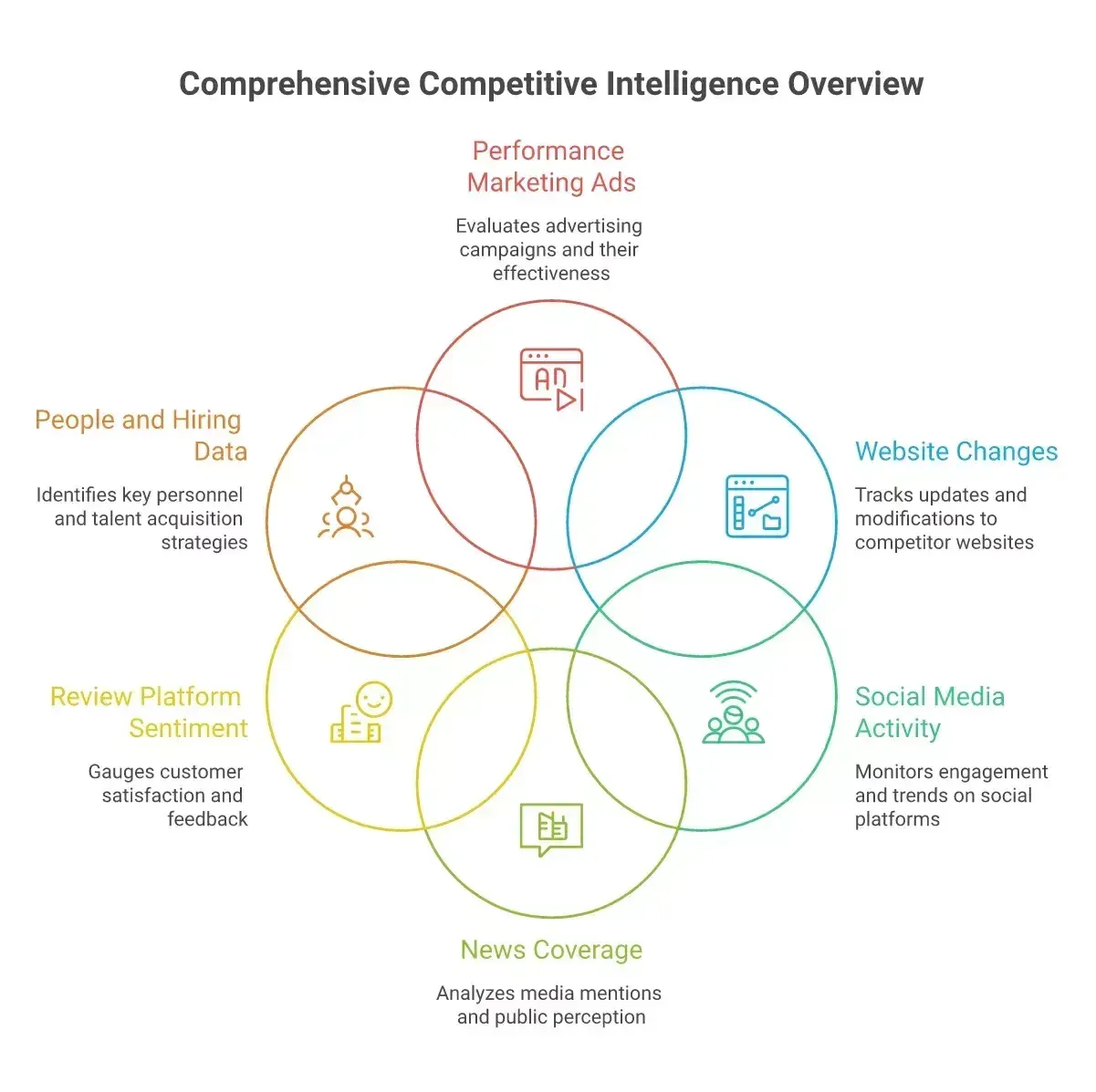
Rocket.new's Intelligence feature monitors six signal categories simultaneously; only humans could have designed the mental model behind it, but AI systems execute the scale.
The Six Monitoring Categories
Website
Every page change, messaging shift, pricing update, and feature announcement with full before-and-after strategic decision-making interpretation, not just something changed, but here's what it means.
Social Media
Every post and campaign across LinkedIn, X, Instagram, Facebook, YouTube, TikTok, and Reddit. Not just volume, but content theme distribution and what top-performing posts reveal about positioning.
News and Web Presence
Press coverage, partnerships, executive interviews, and media mentions. Volume is tracked over time so you can see when a competitor is ramping up their PR activity.
Reviews and Reputation
Sentiment shifts over time from G2, Glassdoor, and Capterra with impact tags. A sudden cluster of negative reviews is a signal, not just a data point.
People
Employee count, hiring velocity, key executive profiles, and open positions by department. Hiring concentration reveals where competitors are investing before any product announcement confirms it.
Performance Marketing
Ad activity across LinkedIn, Meta, and TikTok: see what messaging they're testing in paid channels before it shows up anywhere else.
The Daily Brief: Intelligence That Lands Before the First Meeting
Every day, Rocket.new Intelligence produces a structured brief. Generative AI synthesizes everything into a clear paragraph, a what-to-watch section for emerging patterns, and a specific recommendation. That brief lands before your first meeting, actionable intelligence for informed decisions, not a weekly digest that arrives too late.
Human experts receive interpreted intelligence rather than raw data, making AI and human collaboration genuinely productive. This is what separates Rocket.new from traditional setups: AI outputs are designed for human decision-making, not just data collection.
Four Teams, One Source of Competitive Intelligence
Most companies run competitive intelligence in silos. Rocket.new Intelligence serves all four functions from one source simultaneously — AI tools handle the continuous monitoring; human analysis shapes the response:
Sales Intelligence
Deal-specific competitive briefs and weekly updates so reps enter every conversation prepared.
Marketing Intelligence
Campaign differentiation against current competitive activity, human creativity applied to AI-processed signals.
Product Intelligence
What competitors shipped in 90 days and what job postings signal they're building next- complex analysis made simple.
Strategic Intelligence
M&A signals, market entry moves, enterprise positioning shifts, pattern recognition months before formal announcements.
Where Other Competitive Intelligence Tools Fall Short
Most competitive intelligence tools are alerting systems. They tell you something changed; they don't tell you what it means. Tools like Crayon and Klue track website changes and surface alerts, but they operate as standalone monitoring layers disconnected from research, product decisions, and content. Human input is still required to bridge the gaps.
Rocket.new Intelligence is different because it lives inside a platform where the signal from Monday's brief is present when a PM opens a task on Wednesday. AI outputs are designed for human decision-making; human input shapes how teams respond; AI systems handle the heavy lifting. Intelligence compounds; it doesn't reset between sessions, team members, or use cases.
Wrapping Up: What Competitive Signals Does Rocket.new Catch That a Human Analyst Would Miss?
The problem isn't that human analysts are bad at their jobs. It's that competitive intelligence at scale requires monitoring dozens of platforms, hundreds of signals, and thousands of data points, simultaneously, every day, without gaps. No human capabilities can do that sustainably.
Rocket.new Intelligence catches the signals that fall through the cracks of human intelligence alone: the hiring velocity that predicts a product pivot, the cross-platform signal cluster that reveals an upmarket move, the customer feedback sentiment shift that signals a problem, the ad copy change that shows new positioning testing. These aren't edge cases; they're the signals that matter most.
AI and human collaboration isn't a nice-to-have. It's the only model that works at the speed modern markets demand. Only humans can lead the strategic response. But only humans with full AI-processed intelligence can make truly informed decisions.
Start catching the competitive signals your team is missing with Rocket.new Intelligence.
Table of contents
- -The Honest Limits of Human Judgment in Competitive Analysis
- -Where Human Analysts Excel, and Where the Gaps Appear
- -What AI Excels at in Competitive Intelligence
- -How AI Processes Data at Scale
- -The Role of Generative AI Models and Large Language Models
- -Where AI Falls Short
- -The Human-in-the-Loop: The Most Effective Model
- -Real-World Proof: AI and Human Collaboration in Action
- -The Six Signal Categories a Human Analyst Would Miss
- -1\. Hiring Velocity as a Strategy Signal
- -2\. Cross-Platform Signal Clusters
- -3\. Executive Activity Patterns
- -4\. Review Platform Sentiment Shifts
- -5\. Ad Copy and Messaging Changes
- -6\. Website Changes with Strategic Delta Interpretation
- -Why Signal Clusters Matter More Than Individual Signals
- -Interpretation vs. Alerting: The Key Distinction
- -What the Data Says About Competitive Blind Spots
- -Why Human-Only Analysis Can't Keep Up
- -Rocket.new Intelligence: Built to Catch What Humans Miss
- -The Six Monitoring Categories
- -Website
- -Social Media
- -News and Web Presence
- -Reviews and Reputation
- -People
- -Performance Marketing
- -The Daily Brief: Intelligence That Lands Before the First Meeting
- -Four Teams, One Source of Competitive Intelligence
- -Sales Intelligence
- -Marketing Intelligence
- -Product Intelligence
- -Strategic Intelligence
- -Where Other Competitive Intelligence Tools Fall Short
- -Wrapping Up: What Competitive Signals Does Rocket.new Catch That a Human Analyst Would Miss?