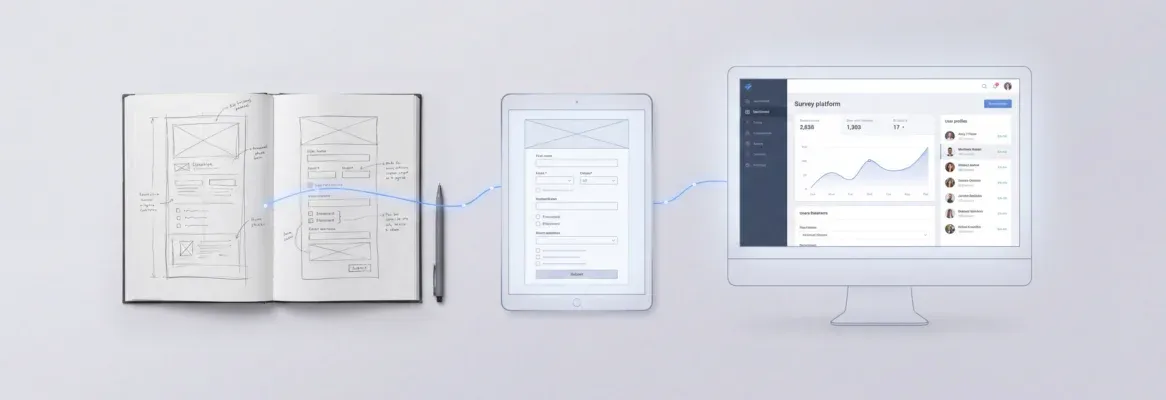
Rocket.new is the complete vibe solutioning platform combining Solve (research), Build (Next.js and Flutter apps), and Intelligence (competitor monitoring). Go from idea to deployed product without switching tools, writing boilerplate, or manually tracking competitors.
An AI product builder does more than generate code. Rocket.new is the complete vibe solutioning platform that combines strategic research (Solve), production-ready app generation (Build), and continuous competitor monitoring (Intelligence) in one place, so teams go from idea to deployed product without switching tools.
Why Does Traditional App Development Feel So Slow?
Building software the traditional way creates bottlenecks at every stage. Even experienced teams get stuck when validating ideas involves weeks of manual work, slowing teams down instead of helping them save time.
Integrating third-party services like Stripe, Supabase, or Airtable means linking separate data sources and existing systems, not just writing custom API work for each connector. Competitive awareness depends on manually refreshing competitor websites, scanning Reddit, and piecing signals together from five different tools.
The result is slow cycles, wasted effort, and products built on assumptions rather than evidence. An AI product builder collapses these bottlenecks into a single, connected workflow.
What Is an AI Product Builder and How Does It Use AI Agents?
An AI product builder is a platform that takes a product from idea to deployed app without requiring a traditional development team, often using no-code or low-code, drag-and-drop workflows to speed setup. It combines research, code generation, and market monitoring into one continuous workflow, which matters for teams stuck waiting on separate tools, handoffs, and slow release cycles.
Rocket.new is a vibe solutioning platform built for product managers, solopreneurs, front-end developers, founders, designers, sales and marketing teams, and small to medium businesses that want to launch production-ready websites or mobile apps with minimal coding.
It combines strategic research, AI app building, backend integrations, deployment, and competitive intelligence in one product, so teams can validate ideas quickly with interactive prototypes before a full launch, build the product, and track competitors without switching tools.
The platform is organized around three pillars that work independently or together.
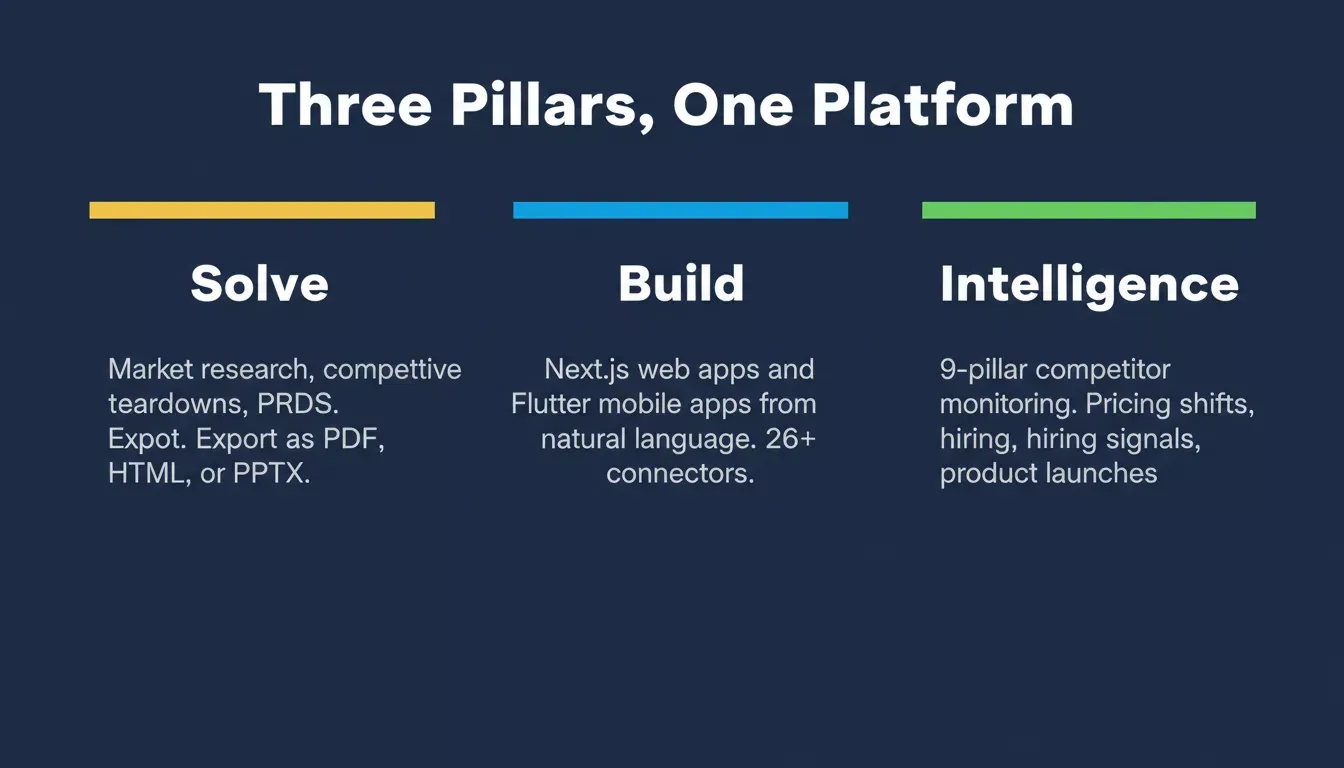
Rocket.new's three pillars: Solve for research, Build for app generation, and Intelligence for competitor monitoring.
| Pillar | What It Produces | Best For |
|---|---|---|
| Solve | Structured reports: executive summary, analysis, evidence, recommendations | Market sizing, competitive teardowns, PRDs, pricing strategy |
| Build | Deployable Next.js web apps and Flutter mobile apps | SaaS dashboards, e-commerce stores, internal tools |
| Intelligence | Personalized Intel feeds across 9 competitor signal pillars | Pricing changes, hiring signals, product launches, GTM shifts |
How Does Rocket.new's AI Product Builder Work with AI Models?
The three pillars share context and feed into each other, creating a research-to-launch pipeline. Each pillar works independently; use one, two, or all three depending on what you need.
Explore the full research-to-launch workflow to see how each pillar hands off to the next in a real product cycle.
Solve: Research Before You Build
What Does Solve Do?
Solve turns complex business questions into structured, evidence-backed reports. Type a question in plain language and get back a report assembled from multiple data sources, with an executive summary, detailed analysis, supporting evidence, and actionable recommendations, not a list of links or a chatbot summary.
Results export as PDF, HTML, or PowerPoint, ready to share with stakeholders, customers, or the wider company without reformatting. Reports can also be shared via a link directly from the platform.
Solve handles nine categories of business research: market analysis, competitive teardowns, pricing strategy, product direction, investment analysis, GTM strategy, brand positioning, technical deep-dives, and more. Learn how to frame sharper Solve questions to get the most actionable output.
How Is Solve Different from ChatGPT or Perplexity?
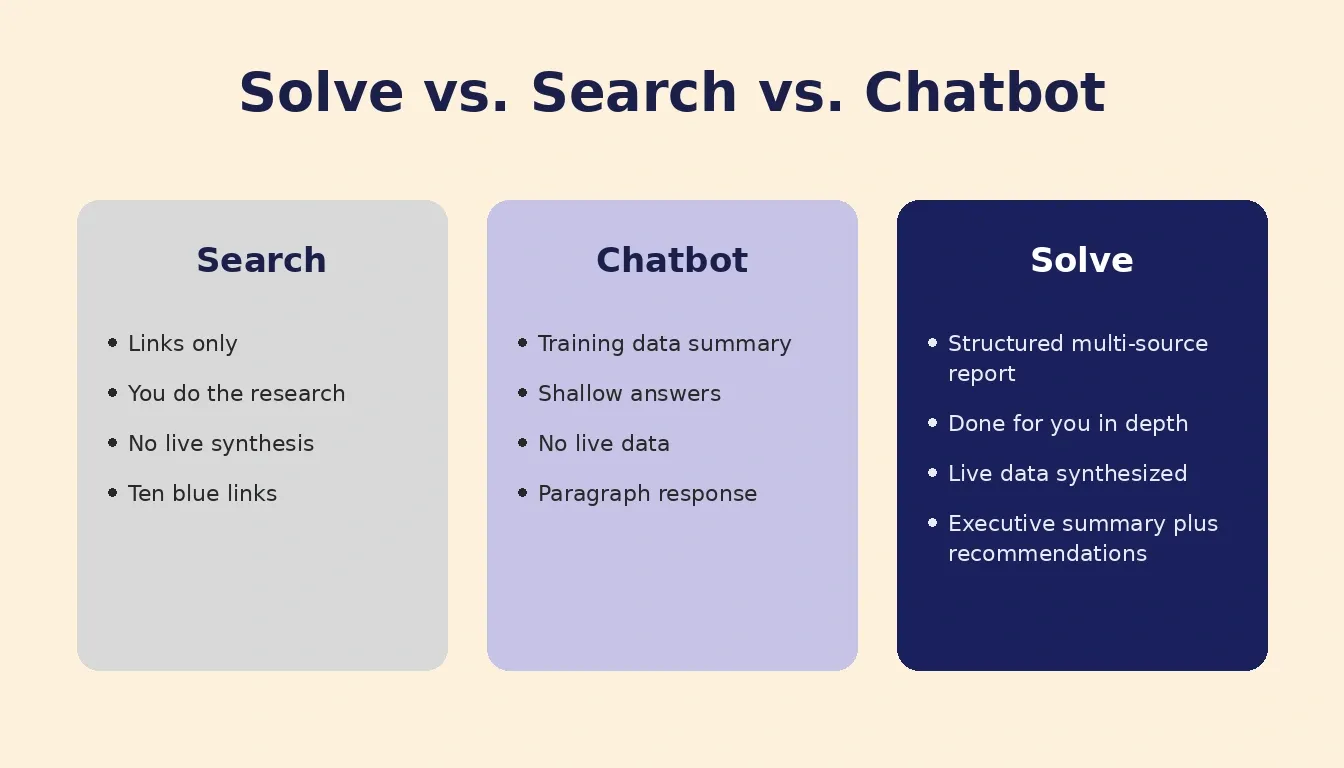
Solve produces structured, multi-source reports. Search gives links. Chatbots give shallow summaries.
| Search | Chatbot | Solve | |
|---|---|---|---|
| What you get | Links | Summary from training data | Structured, multi-source report |
| Research effort | You do the work | None, but shallow | Done for you, in depth |
| Live data | Yes, unstructured | No | Yes, synthesized |
| Output format | Ten blue links | Paragraph answer | Executive summary, analysis, recommendations |
Build: From Natural Language to Production-Ready App
What Does Build Produce?
Build generates production-ready Next.js web apps and Flutter mobile apps from natural language. It’s an AI-powered way to create custom apps: describe what you want- a SaaS dashboard, an e-commerce store, an internal tool- and Rocket.new turns that into a working app by writing the UI, logic, navigation, and backend scaffolding.
Build supports multiple starting points: from a plain-language idea, from a Figma file, from an uploaded attachment, from a GitHub repo, or from a pre-built template. The generated code is yours to download or sync to GitHub, while newer builders like Base44 emphasize app creation in minutes from natural language and apps that are instantly live and shareable; Rocket.new stays focused on deployable code and production workflows.
Realistic prototype testing also depends on real data and API support.
See how teams are building no-code AI apps in minutes to understand what is possible in a single session.
What Integrations and Enterprise Grade Security Does Build Support?
Build offers seamless API and data integrations, so teams can connect existing data sources without manual setup. No manual API setup: describe what you want in chat, and Rocket.new generates the code, UI, and logic automatically.
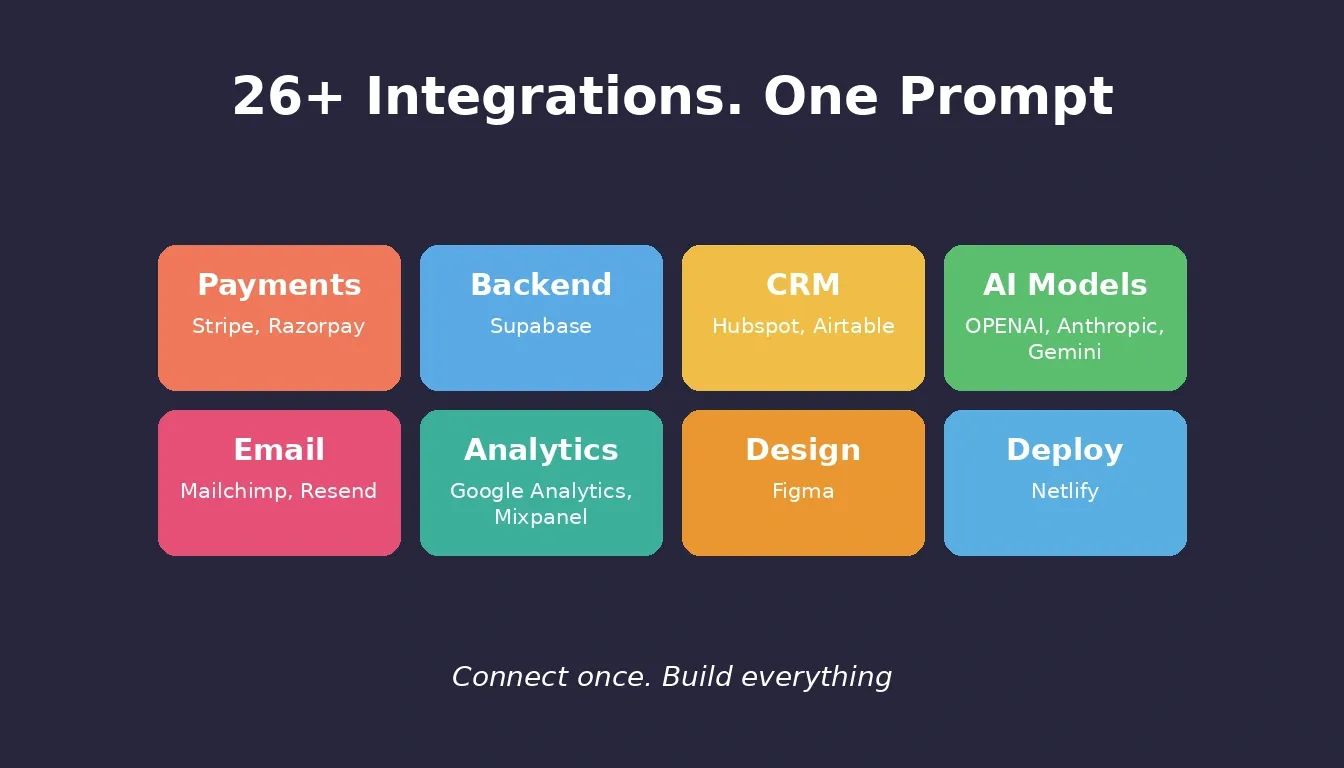
Rocket.new connects to 26+ services across payments, backend, AI, email, analytics, and more, all from a single prompt, giving teams fast access to familiar tools. Some platforms, such as MindStudio, emphasize connections to over 1,000 business applications, while Rocket.new focuses on guided integrations through prompt-driven setup; similarly, Base44 integrates with common APIs for seamless functionality.
| Category | Services |
|---|---|
| Payments | Stripe, Razorpay |
| Backend and database | Supabase (database, auth, file storage, edge functions) |
| CRM and productivity | Airtable, HubSpot, Notion, Linear, Jira, Confluence, Google Drive, Google Sheets |
| Email and messaging | Mailchimp, Resend, SendGrid, Brevo, Twilio |
| Analytics | Google Analytics (GA4), Mixpanel |
| AI models | OpenAI, Anthropic (Claude), Google Gemini, Perplexity, ElevenLabs |
| Forms and scheduling | Typeform, Tally, Calendly |
| Deployment | Netlify (one-click deploy, automatic HTTPS, global CDN) |
| Design | Figma (import designs directly into the build pipeline) |
What Can You Build With It?
- SaaS dashboards with auth, team workspaces, billing, and notifications
- E-commerce stores with product listings, cart, Stripe checkout, and order management
- Internal tools and admin dashboards where teams can create AI agents for repeated business processes, including document processing and data validation in internal workflows
- Marketing sites with custom domains
- iOS and Android mobile apps submitted directly to the App Store and Google Play
Discover how to build a complete SaaS app using Rocket.new's recommended stack of Supabase, Stripe, Resend, and Netlify, while some competing platforms also highlight over 100 templates for building AI agents and report automating over 800 tasks weekly in real organizations.
Figma to Code: A Documented, Distinctive Capability
One of Rocket.new's most concrete differentiators is its Figma-to-code pipeline. Import a Figma file, and Rocket.new converts it to a deployable React/Next.js web app or Flutter mobile app, preserving layouts, spacing, and UI components while supporting design system integration for consistent branding.
The pipeline supports web apps from Figma frames (React or Next.js output), Flutter mobile apps from Figma mobile designs, batch conversion of multiple screens, and Visual Edit to refine any element after import without writing code, so components carry through more reliably from design to code.
Read the Figma-to-code documentation for step-by-step setup instructions and design guidelines.
Why AI Product Builders Are Replacing Traditional Development
AI-assisted development is no longer experimental. Research shows that developers using AI tools complete tasks up to 55% faster. Analysts estimate generative AI could add up to $4.4 trillion annually to the global economy. Industry forecasts predict that more than 80% of enterprises will have used generative AI-enabled applications by 2026.
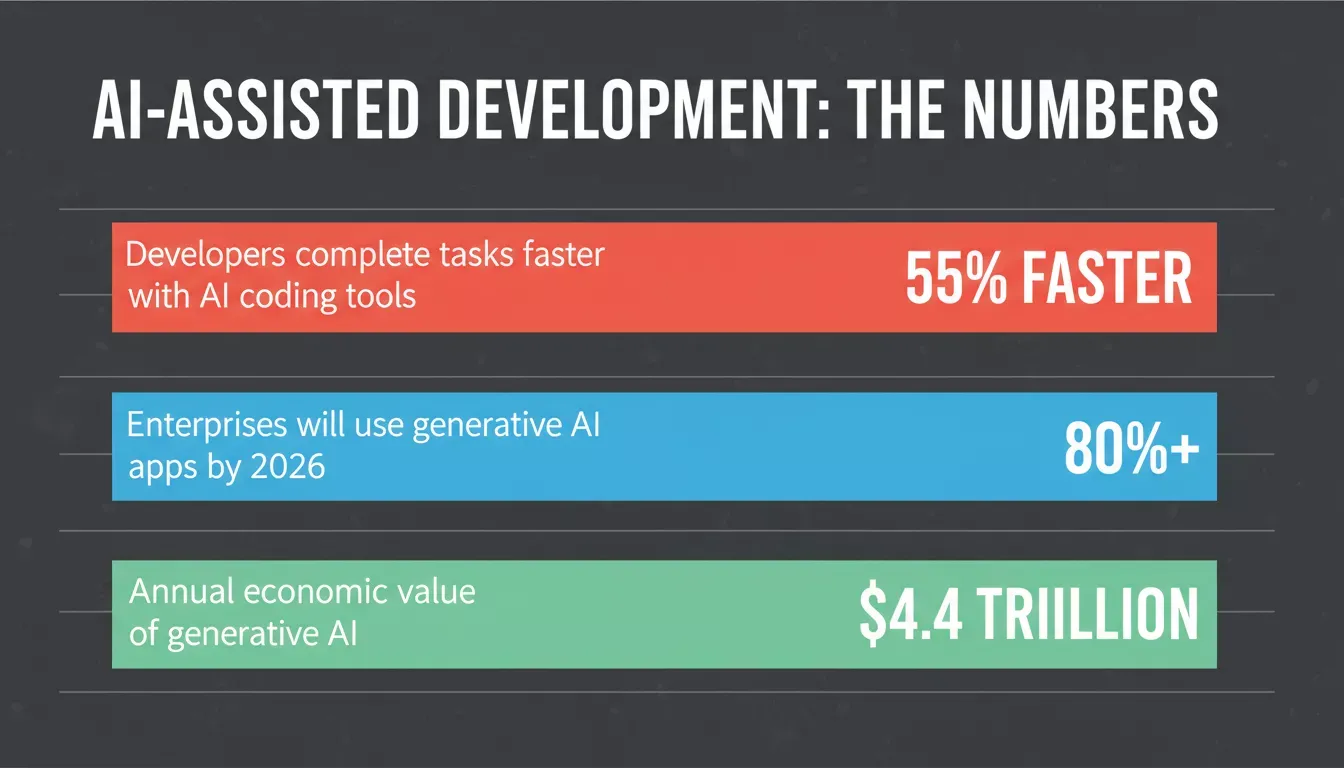
AI-assisted development is accelerating across every metric: speed, adoption, and economic impact. Modern AI product builders also need to scale reliably as usage grows, with infrastructure that handles fluctuating traffic without performance issues, while teams rely on real-time analytics to monitor performance and user interactions as they ship faster.
The shift is not about replacing developers; it is about giving every team the ability to ship faster with fewer dependencies. Platforms like Rocket.new make this practical by combining research, building, and monitoring in one place.
Understand how AI is changing product development and why teams are making the switch now.
Intelligence: Continuous Competitor Monitoring
What Does Intelligence Do?
Rocket.new Intelligence watches companies you care about across nine signal pillars and delivers personalized Intel, ranked, structured updates that surface in your feeds so you can act without hunting for information. It tracks competitor signals and user-relevant interactions in real time, helping teams move faster with AI assistance.
Intelligence is an interpretation layer, not an alerting system. When a signal appears, it is evaluated against everything else happening across every pillar simultaneously, including other signals in the same window, the company's historical patterns, and your specific business context, which improves feedback loops by showing teams which signals matter and how to respond.
It also detects absence, when something stops happening, and cross-pillar patterns, when several signals together imply a strategy shift. Learn the key concepts behind Intel Cards and personalized feeds to get the most from the Intelligence dashboard.
The Nine Pillars and Data Sources Intelligence Monitors
Intelligence monitors nine pillars simultaneously, from website changes and hiring signals to GTM campaigns and review sentiment.
| Pillar | What It Watches |
|---|---|
| Website | Messaging changes, pricing updates, feature additions |
| Social Media | Executive posts, campaign themes, audience engagement |
| News and Media | Third-party press and editorial coverage |
| GTM | Paid campaigns, SEO moves, developer marketing, community growth |
| Product and Technology | Release velocity, GitHub activity, app store updates |
| People and Hiring | Hiring velocity, leadership moves, team growth patterns |
| Business and Finance | Funding signals, partnerships, pricinand g strategy evolution |
| Reviews and Community | G2, Reddit, Hacker News, App Store sentiment |
| Traffic | Traffic patterns and acquisition signals |
How Is Intelligence Different from a Google Alert?
Intelligence monitors companies across nine pillars simultaneously, detects absence and cross-pillar patterns, and delivers personalized Intel ranked by relevance to your role and business context. A Google Alert sends raw links. Intelligence sends structured meaning.
How the Three Pillars Work Together
Each pillar works independently. When connected, they create a closed loop that keeps your product decisions grounded in real market data and supports agents working across shared workflows and systems.
Research informs building. Run a Solve task to validate your idea and understand the market. Use those findings to scope your Build task with full context already in place.
Monitoring triggers action. Intelligence surfaces a competitor change, a pricing shift, a new feature, a hiring spike. Use that signal to start a Solve analysis or update your product in Build.
Building reveals research needs. While building, you realize you need data on user preferences or market sizing. Create a Solve task, get structured findings, and apply them directly.
Context flows between pillars through Projects, shared workspaces where Solve findings, Build tasks, uploaded files, and connected services all live together.
Competitors increasingly frame this orchestration around specialized agents, where the Agent2Agent protocol allows diverse agents to communicate securely and managed deployment services such as Agent Engine or Vertex AI support serverless, auto-scaling rollout, while Agent Engine handles infrastructure management and scaling. See how competitive response workflows use all three pillars together to react fast when a competitor makes a move.
Who Is Rocket.new's AI Product Builder For?
Larger teams may also evaluate an enterprise platform based on governance, security, and collaboration needs.
| Role | Primary Use Case |
|---|---|
| Founders | Validate ideas with Solve before writing code; monitor market moves with Intelligence |
| Product managers | Run competitive teardowns, generate PRDs, track competitor hiring and product releases; some teams also need role-based permissions, audit logs, and granular permissions for multiple users |
| Designers | Import Figma files directly into Build; iterate visually without developer handoff |
| Developers | Continue existing Next.js repos in Build; connect 26+ integrations from chat, with automated guardrails such as safety filters and compliance-focused data privacy features |
| Sales leaders | Use Intelligence for deal prep: current competitor positioning, pricing moves, review sentiment |
| Marketing teams | Track competitor GTM campaigns, messaging shifts, and content gaps in Intelligence |
Enterprise buyers may also compare model flexibility, including platforms with pre-built solutions, support for hundreds of AI models, or custom model creation for faster setup.
Explore prompt starters organized by role to get your first Solve, Build, or Intelligence task running in under five minutes.
Ready to go from idea to deployed product without switching tools? Rocket.new is the complete vibe solutioning platform: research with Solve, build with Next.js or Flutter, and monitor competitors with Intelligence.
Table of contents
- -Why Does Traditional App Development Feel So Slow?
- -What Is an AI Product Builder and How Does It Use AI Agents?
- -How Does Rocket.new's AI Product Builder Work with AI Models?
- -Solve: Research Before You Build
- -What Does Solve Do?
- -How Is Solve Different from ChatGPT or Perplexity?
- -Build: From Natural Language to Production-Ready App
- -What Does Build Produce?
- -What Integrations and Enterprise Grade Security Does Build Support?
- -What Can You Build With It?
- -Figma to Code: A Documented, Distinctive Capability
- -Why AI Product Builders Are Replacing Traditional Development
- -Intelligence: Continuous Competitor Monitoring
- -What Does Intelligence Do?
- -The Nine Pillars and Data Sources Intelligence Monitors
- -How Is Intelligence Different from a Google Alert?
- -How the Three Pillars Work Together
- -Who Is Rocket.new's AI Product Builder For?