
Rocket.new Intelligence identifies competitor signals like hiring spikes, pricing changes, and executive social activity weeks or months before official announcements. Instead of scattered alerts, Rocket connects signal clusters into structured strategic insights for sales, product, marketing, and strategy teams. The result is faster decision-making, earlier market awareness, and proactive competitive positioning before rivals make their move.
Can you tell what a competitor is planning before they say anything publicly?
Most teams can't, not because the signals aren't there, but because nobody is watching for them. A competitor's job postings, website shifts, and executive social activity can reveal a strategic move weeks or months before the press release lands.
According to the Competitive Intelligence Alliance, CI team sizes have grown by 24% from previous years, because companies that track competitor moves early are winning more deals and building sharper products.
Why Teams Are Always a Step Behind Competitor Moves
Think about how competitor monitoring usually works at most companies.
Someone checks a rival's website once in a while. A sales rep brings back intel from a call. A product manager reads a blog post that got shared in Slack. The information is scattered, delayed, and incomplete.
By the time most teams react to a competitor announcement, the competitor has already moved. Customers have already read the news. The narrative has already moved. Waiting until the press release to start tracking is, effectively, losing.
West Monroe's research found that nearly 73% of leaders say their organizations lose up to 5% of annual revenue due to slow decision-making and delayed execution. That slowness often starts with competitive awareness arriving too late.
The problem isn't that competitors are hard to track. It's that most teams aren't watching the right signals, or they're watching too late.
The Signals That Move Before Announcements Do
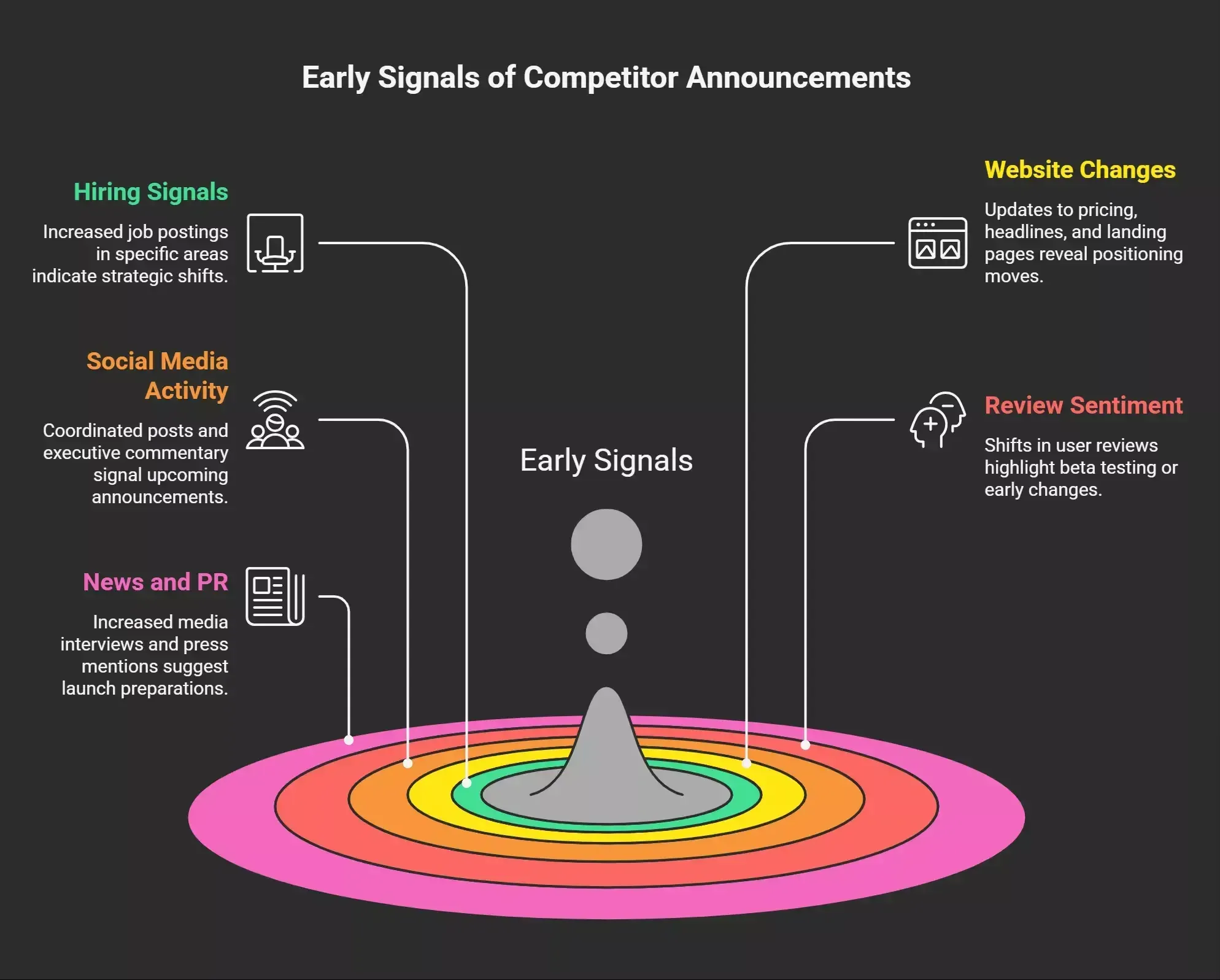
There are at least five distinct signal types that shift before a competitor makes a major announcement. Each one is publicly available. Each one tells part of a story. Together, they form a picture of what's coming.
Hiring Signals
Job postings are the most underused early indicator in competitive intelligence. When a competitor starts hiring heavily for a specific function - say, five new "AI infrastructure" engineers or a cluster of "enterprise sales" roles - they are signaling a strategic direction months before any product announcement confirms it.
A well-known example: between September 2022 and January 2023, Microsoft's job postings for AI-related roles increased by nearly 40%, while layoffs moved through other departments. Those hiring signals told the story of Microsoft Copilot months before it was announced in March 2023. Teams that tracked this hiring data had early warning to adjust their own roadmaps or messaging before the press release landed.
"Job postings often shift before public announcements, making them one of the earliest indicators of business strategy." - Competitor Hiring Analysis in 2025, Intervue.io on LinkedIn
Hiring data reveals technology direction, geographic expansion, and organizational priority shifts - all before any public confirmation.
Website and Messaging Changes
A competitor's website is a live document of their strategy. When they quietly update a pricing page, shift their homepage headline, or add a new feature landing page, those aren't cosmetic changes. They are positioning moves.
Tracking a website over time shows when a competitor pivots messaging toward a new segment, adds a product tier targeting enterprise buyers, or shifts language to respond to market pressure. Most teams miss this entirely because they're not watching the website page by page, change by change.
A monthly check isn't enough. By the time a team catches a pricing change, the competitor has already moved and customers have already seen it.
Social Media and Executive Activity
A competitor's social media isn't just marketing content. When multiple executives start posting in the same topic area in the same week, that's a coordinated signal. When a CEO shifts from general industry commentary to specific product education, something is being prepared.
LinkedIn, X, and even Reddit all surface patterns of intent before a formal announcement. Sales teams that track these shifts can prepare a complete background for the call before the news breaks publicly. Product teams can use social signals to adjust priorities while there's still time to respond.
Review Platform Sentiment Shifts
When a competitor's reviews on G2 or Capterra start showing a sudden cluster of mentions around a specific weakness - or a surge of praise for a new feature - that's a signal. Review sentiment often moves ahead of announcements because real users are already testing beta features or reacting to early changes.
News and PR Activity
A competitor hiring a senior PR agency, an executive giving more media interviews, or a spike in press mentions can all signal that a launch announcement is being prepared. News activity typically ramps up in the weeks before a major product or partnership announcement.
Early Signals at a Glance
Here's a practical summary of each signal type, what it usually means, and how far in advance it tends to appear before an announcement:
| Signal Type | What It Usually Indicates | Typical Lead Time |
|---|---|---|
| Hiring spikes in a new function | New product area or market entry | 3-6 months |
| Website pricing page changes | New tier, pricing model shift, or enterprise push | 1-4 weeks |
| Executive social posts clustering on one topic | Upcoming launch or strategic pivot | 2-8 weeks |
| Review sentiment shifting on a specific feature | Beta testing underway or feature changes live | 1-4 weeks |
| PR activity or media volume increasing | Major announcement in preparation | 4-8 weeks |
| New job titles that didn't exist before | Technology or market direction shift | 3-6 months |
Tracking these signals together, not in isolation, is how teams move faster than competitors expect.
How Sales Teams and Product Teams Move Faster with Signal Intelligence
When product teams get early warning that a competitor is preparing an enterprise push, they can adjust roadmap priorities before the announcement forces a reactive scramble. When sales teams know a competitor has moved on pricing before a deal closes, they can prepare better responses and sharper talking points. When marketing tracks competitor messaging shifts, it can pre-empt narrative competition rather than play catch-up.
The challenge is that this requires consistent, dedicated effort across many platforms. A team manually checking competitor websites, social accounts, and job boards every day would spend hours gathering fragmentary information. The risk of missing something is high. The risk of acting on delayed information is even higher.
This is where a real step-change happens - not from more manual effort, but from continuous tracking that interprets what it finds and delivers a structured brief to the right people before the day begins.
The Signal Detection Flow
Here's how early signal detection should work in practice - from the first data point to a team decision:
The step that most tools skip is the interpretation layer - connecting a cluster of signals into one clear strategic read, then making that read available to the teams who need it.
Why Scattered Tools Miss Early Competitor Signals
Most teams tracking competitors today use scattered tools. One platform for website monitoring. Another for social listening. Something else for job tracking. Each tool surfaces raw data. Nobody connects the dots.
When a competitor posts two new enterprise sales roles, updates their pricing page, and has three executives posting about enterprise security in the same week, those are not three separate events. They are one signal: the competitor has moved toward enterprise. Waiting for a press release to confirm it is weeks of lead time lost.
Scattered tools won't tell you that. They'll surface three alerts in three different inboxes and leave interpretation to a person who may not have time to piece it together. The result is teams stay in reactive mode - waiting for announcements rather than acting before them.
AI-Powered Signal Tracking: How Rocket.new Intelligence Helps Teams Stay Ahead
This is exactly the problem Rocket.new's Intelligence capability was built around.
How Rocket.new Intelligence Works
Rocket.new Intelligence monitors every public platform a competitor operates on, continuously, and interprets what the signals mean for your specific business. You add a competitor by name or URL. Rocket identifies and maps every public surface they operate on, then starts tracking across six signal categories.
Six Signal Categories
-
Website - every page change, pricing update, messaging shift, and new feature announcement, with a before-and-after comparison and strategic interpretation of what moved and why
-
Social media - every post, campaign, and engagement pattern across LinkedIn, X, Instagram, Facebook, YouTube, TikTok, and Reddit
-
News and web presence - press coverage, blog posts, partnership announcements, and executive interviews, with volume tracked over time
-
Reviews and reputation - sentiment shifts on G2, Glassdoor, Capterra, and other review platforms, tracked continuously so patterns become visible as they form
-
People - employee count, hiring velocity, new hires, exits, and open positions by department. Hiring concentration reveals where competitors are investing before any product announcement confirms it
-
Performance marketing - ad activity across LinkedIn, Meta, and TikTok
Learn more about Intelligence, refer Rocket.new docs.
The Daily Brief: Where Intelligence Meets Execution
The daily brief is where intelligence and execution meet. Every day, Rocket produces a structured brief for every competitor you track - three components: what signals moved and what they mean, what patterns to watch, and what your business should do in response. The brief lands before the first meeting of the day.
Intelligence Across Every Team
For sales teams, that means deal-specific competitive briefs and background for the call prepared before a deal is at risk. For product teams, that means knowing what competitors shipped and what their job postings signal they are building next.
For marketing teams, that means tracking current competitor campaign activity to sharpen differentiation. For strategy teams, that means pattern detection months before formal announcements.
Intelligence That Compounds Across Your Workflow
Because Intelligence lives inside a Rocket project alongside Solve and Build, the competitor signal from Monday's brief is present when a PM opens a task on Wednesday. The pricing move from last week is present when marketing writes the landing page. One platform. One flow. Intelligence compounds - it doesn't reset between sessions or team members.
Who Uses Rocket.new
Non-technical and technical teams alike use Rocket.new - from founders tracking a handful of competitors to enterprise strategy teams monitoring entire market categories. And when teams want to act on what they've learned, Build generates web apps, mobile apps, landing pages, and internal tools through code generation in one place, informed by the same competitive context.
How Rocket.new Differs from the Competition
Lovable, Bolt, v0, and Claude Code don't include competitive intelligence at all. They build what you tell them to build - starting from whatever you bring in. Rocket watches the market for you, tells you what it means, and connects that intelligence directly to what gets built next.
Catching Competitor Signals Before Announcements
Most teams are waiting for announcements. The best teams are tracking signals.
A competitor's strategy is not secret - it is scattered. It lives in job boards, website changes, executive social posts, and review platform shifts. The difference between teams that get surprised by competitor moves and teams that see them coming is not access to information. It is having a system that watches all of it, connects the signals, and tells you what to do before the press release forces your hand.
What is the earliest signal Rocket.new can catch before a competitor makes a major announcement? It's the cluster of quiet moves - a new hire here, a pricing change there, a CEO posting more about enterprise security - that moved together add up to one clear direction months before the announcement. Rocket reads those clusters every day and delivers a structured brief before your team's first meeting.
Sign up and start tracking competitor signals before announcements happen with Rocket.new Intelligence.
Table of contents
- -Why Teams Are Always a Step Behind Competitor Moves
- -The Signals That Move Before Announcements Do
- -Hiring Signals
- -Website and Messaging Changes
- -Social Media and Executive Activity
- -Review Platform Sentiment Shifts
- -News and PR Activity
- -Early Signals at a Glance
- -How Sales Teams and Product Teams Move Faster with Signal Intelligence
- -The Signal Detection Flow
- -Why Scattered Tools Miss Early Competitor Signals
- -AI-Powered Signal Tracking: How Rocket.new Intelligence Helps Teams Stay Ahead
- -How Rocket.new Intelligence Works
- -Six Signal Categories
- -The Daily Brief: Where Intelligence Meets Execution
- -Intelligence Across Every Team
- -Intelligence That Compounds Across Your Workflow
- -Who Uses Rocket.new
- -How Rocket.new Differs from the Competition
- -Catching Competitor Signals Before Announcements