
"Stop generating templates. Start engineering intent."

If you've spent any time with AI web builders lately, you've noticed a pattern. A centred hero section. A three-column feature grid with icons in circles. A pricing table that looks like every Bootstrap starter from 2014.
We call this AI Slop — technically functional, visually exhausting, and immediately recognisable as machine-generated. These designs announce themselves before a user reads a single word.
When we started building Rocket, we didn't want to build another slop generator. We wanted to build a senior-level engineer and designer in a box — one that produces Next.js and Flutter apps that look like months of professional work, not seconds of algorithmic averaging.
Here's what we found, what we fixed, and what Rocket does differently because of it.
The Engineering Problem: Regression to the Mean
Most AI code generators are prompt wrappers playing a game of averages. They pass your text to an LLM trained on the entire internet. Because the vast majority of web code on the internet is mediocre, the model's centre of gravity is mediocrity.
The trap
When you ask for a "modern dashboard," the AI draws from the most frequent patterns in its training data. It plays a game of statistical probability. A three-column grid is the safest mathematical answer to the prompt "show features." A centred hero is the safest answer to "introduce the product."
The AI isn't designing. It's averaging.
The result
You get a generic sidebar and a card grid — not because the AI lacks capability, but because that is the statistically safest output. This is regression to the mean, and it's an engineering failure, not a prompting failure.
What AI slop is actually missing
Looking closely at what generic AI output gets wrong, the same gaps appear every time. Here's what separates a template from a product:
- Micro-interactions — the hover states, loading animations, and scroll reveals that make an interface feel premium rather than static
- Typography hierarchy — guiding the eye through weight, scale, and spacing so the primary action is visually dominant
- Structural hierarchy — giving elements visual weight relative to their importance, not treating everything as equal
- Intentional white space — generous negative space that gives a design room to breathe, not just leftover pixels
- Visual identity — brand integrated into the UI's DNA, not applied on top as an afterthought
- Contextual flow — a fintech app that looks and behaves like a fintech app, not a generic web page with financial words
What Rocket Does Differently

Visual rhythm that actually breathes
Most AI builders treat white space as leftover pixels. Rocket treats it as a first-class design decision. Every layout is built on a geometric spacing scale — base unit that applies consistently from mobile to desktop, so nothing ever feels cramped or arbitrary.
Typography follows the same logic. Rocket uses mathematically sound header ratios that create genuine visual hierarchy, whether it's a Flutter screen or a Next.js dashboard. The primary action looks primary. Supporting content recedes. The eye has somewhere to go.
Context-aware, not one-size-fits-all
Rocket treats every UI as a contextual flow — not a bucket of components to assemble.
A fintech application shouldn't just look different from a creative portfolio. It should behave differently. Higher data density. More tabular typography. Stricter brand constraints. A portfolio needs airy, asymmetric layouts with expressive type. Rocket understands these distinctions and generates from them — not toward a generic middle.
The output looks like a team of senior developers and designers spent months on it, because the decisions they would have made are already baked in.
The Benchmark: 25,000+ Projects Without AI Slop
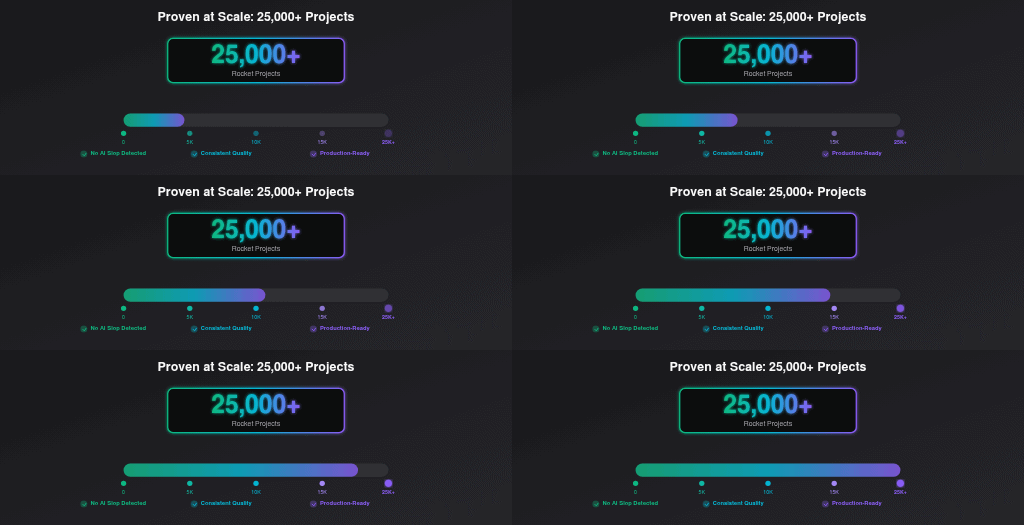
You can't claim to solve a problem without proving it at scale.
We generated over 25,000+ projects using this system before we were confident the problem was solved. Not as a marketing number — as a proof of concept for the architecture. At that scale, patterns become visible. Regressions surface. The only way to demonstrate that you've beaten regression to the mean is to show the system holds at volume.
Innovation in UI isn't about randomness — it's about intentionality. Our system doesn't default to lazy layouts or the statistically safest grid. It generates intentional, context-aware designs consistently across every generation.
Beyond Component Soup
Most AI builders treat a UI like a bucket of Lego bricks. They assemble a Navbar, a Hero, and a Footer, and call it done. The result is component soup — technically correct, lacking cohesion, rhythm, or intentionality.
In Rocket, we moved from component-based thinking to system-based thinking. Every element understands its relationship to the others. Typography scales harmoniously. Spacing is mathematically consistent. Colour choices reflect the domain and the user's context.
This is how you move from generating templates to generating architectures.
The "Slop" vs. the Rocket Generation
| The "slop" | Rocket | |
|---|---|---|
| Layout | Fixed 3-column grids, centred everything | Dynamic, asymmetric layouts with intentional flow |
| Typography | Default sans-serif, uniform weight | Curated pairings with mathematical scaling |
| Spacing | Random margins, cramped layouts | 8px geometric scale, generous white space |
| Codebase | Spaghetti HTML/CSS, needs cleanup | Production-ready Next.js & Flutter from day one |
| Design system | Nonexistent or bolted on | Enforced at generation time, baked in |
| Industry fit | One-size-fits-all templates | Context-aware archetypes per domain |
| Micro-details | Static, template-like interactions | Premium animations and hover states included |
| Feel | A template with your text | A custom product with its own identity |
What This Means for Builders and Developers
If you're a founder, designer, or engineer, you shouldn't spend hours cleaning up AI-generated output. You shouldn't need developers just to make your AI prototype production-ready.
Rocket generates apps that:
- Ship faster — production-ready from the first generation, no cleanup rounds
- Look professional — taste is engineered in, not layered on afterward
- Scale cleanly — the architecture is sound from the start
- Feel custom — context is baked into every decision
The Goal: Design That Doesn't Announce Itself
The highest compliment an AI-built product can receive is that it doesn't look like one.
Rocket has moved past the generic grid. No cleanup rounds. No manual refinement passes. No hiring a developer to make the AI output usable.
We aren't just generating code. We're generating taste. We're generating look. We're generating feel. We're generating soul. From the first generation.
This is what happens when you treat AI generation as an engineering problem, not just a prompting challenge.
Table of contents
- -The Engineering Problem: Regression to the Mean
- -The trap
- -The result
- -What AI slop is actually missing
- -What Rocket Does Differently
- -Visual rhythm that actually breathes
- -Context-aware, not one-size-fits-all
- -The Benchmark: 25,000+ Projects Without AI Slop
- -Beyond Component Soup
- -The "Slop" vs. the Rocket Generation
- -What This Means for Builders and Developers
- -Rocket generates apps that:
- -The Goal: Design That Doesn't Announce Itself