
Solve on Rocket.new replaces gut-feel pricing with live market research. It runs parallel AI agents across competitor data, pricing models, and willingness-to-pay signals, then returns a board-ready report in minutes, not weeks.
Solve on Rocket replaces gut-feel pricing with structured, real-time market research. It analyzes competitors, demand, and pricing models to deliver board-ready recommendations, turning an instinct-driven process into an evidence-based pricing decision before the meeting starts.
Key takeaways
- Pricing without live competitor data causes companies to misprice by 20% or more
- Solve runs parallel AI agent research across market dynamics, competitor tiers, and willingness-to-pay signals, then returns a structured report, not a chatbot reply
- Rocket.new's Intelligence product monitors those same competitors continuously so pricing decisions stay current
- Full Solve (board-ready, 8-12 section reports) is available on the Rocket and Booster plans; Light Solve (fast, conversational research) is available on all plans including Free
Why Do So Many Companies Still Price by Gut Feel?
What happens when a business sets its price based on what "feels right" instead of what the market actually supports?
Usually, it loses revenue. The vibe coding market is valued at $4.7 billion and is projected to reach $12.3 billion by 2027, growing at a 38% compound annual growth rate, and companies in this space make pricing calls every quarter.
Most of those calls happen with zero live competitor data. Solve on Rocket changes that by replacing instinct with structured, evidence-backed research: it runs parallel AI agents across competitor pricing, packaging, business models, and willingness-to-pay signals, then turns that market evidence into a clear pricing recommendation teams can take into a board meeting. For product teams, sales teams, and business decision-makers working in fast-moving categories like AI app building and vibe coding, that matters because pricing without live market proof can leave 20% or more on the table or push a product out of position. This section shows how the Solve process works, what goes wrong when pricing is set without current data, how Full Solve, Light Solve, and ongoing Intelligence support pricing decisions, and where Rocket.new’s own plans and pricing fit in.
The Cost of Pricing and Market Sizing Without Market Evidence
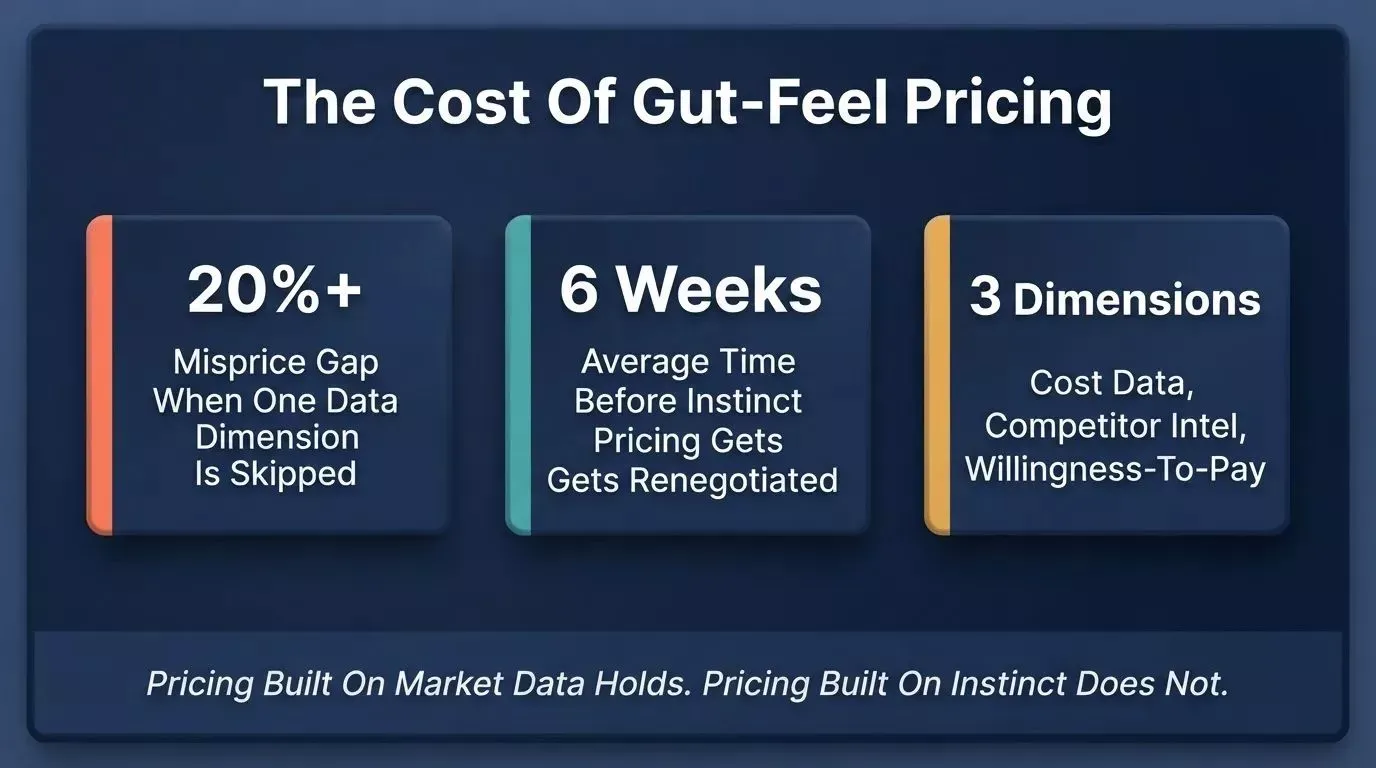
Three numbers that define the real cost of skipping market research before a pricing decision.
When teams skip competitive analysis before a pricing meeting, things start happening that cost the business real money.
Revenue gets left on the table because the price sits below what customers would actually pay. Sales teams walk into calls unable to defend pricing against competitor objections. Product teams build features that do not match what users value, because no one anchored the roadmap in market reality.
The underlying question behind most pricing failures is simple: Did anyone check what the market is actually doing?
A BCG study on pricing found that decisions work best when they combine cost data, competitor intelligence, and willingness-to-pay research. Companies that skip even one dimension tend to misprice by 20% or more. That matters whether you built an AI app for enterprise sales or a mobile app for consumers.
The fix is better research, done faster, with clear direction tied to the competitive intelligence happening in your market right now. Solve was built for exactly that. You can explore how market research and business idea validation work together on Rocket.new to reduce this risk before you commit to a number.
The 7 Steps of a Pricing Framework
Most businesses follow a structured pricing process, but manual research stalls it at the most critical step.
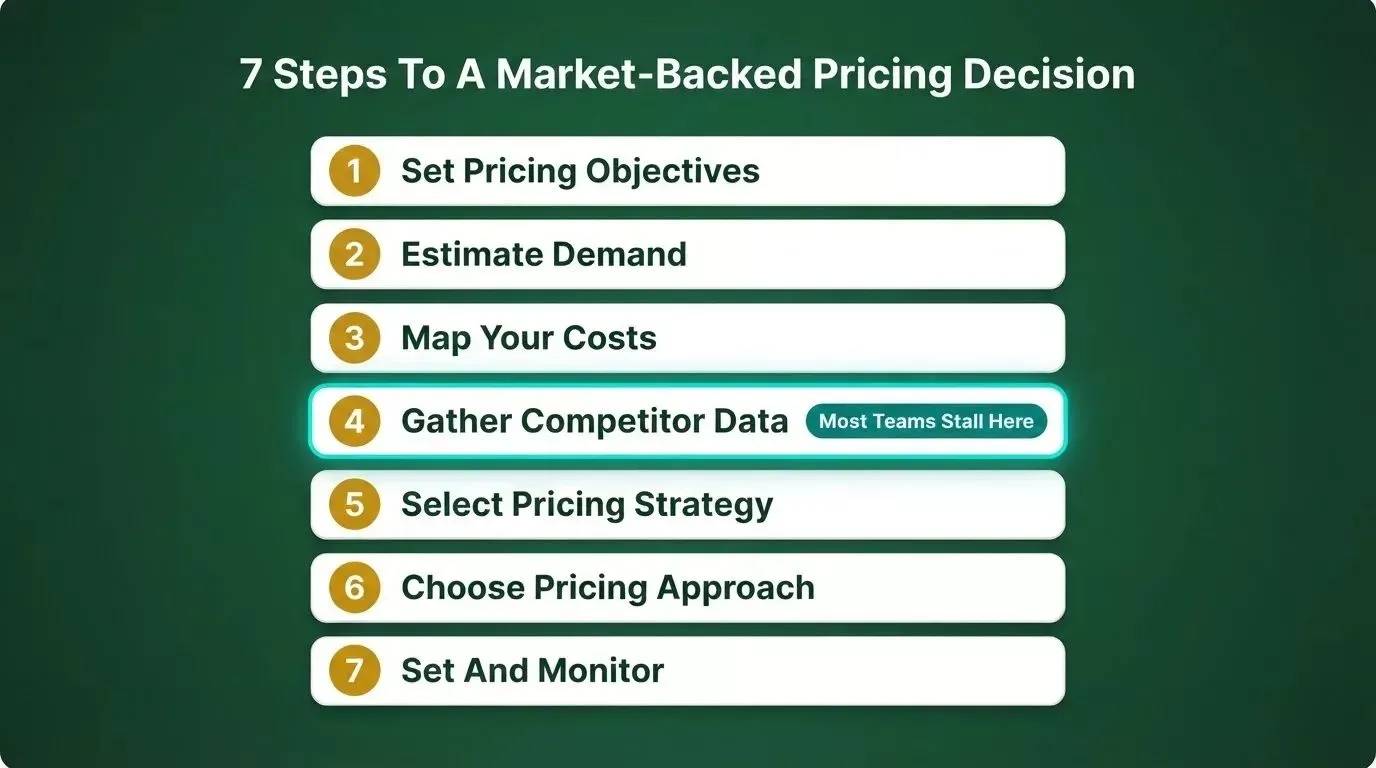
Step 4 is where most teams stall. Solve handles this step before the meeting starts.
How to Build a Pricing Decision With Market Evidence
- Set pricing objectives: maximize revenue, capture market share, or target a specific margin
- Estimate demand: size the target segment and assess price sensitivity
- Map costs: identify fixed and variable costs so your price covers expenses
- Gather competitor data: competitor pricing, regulations, and market sizing data (this is where most teams stall)
- Select a pricing strategy: skimming, penetration, or market pricing
- Choose a pricing approach: cost-based, value-based, demand-based, or freemium
- Set and monitor: launch at the initial price, then adjust based on sales data and market shifts
Most teams get stuck at step 4. Gathering competitor data and market context manually takes weeks. Solve handles step 4 at a speed that means teams complete it before the meeting, not after.
How Solve Breaks Down a Pricing Question
When you submit a pricing question to Solve, Rocket.new does not return a chatbot-style paragraph. It runs a structured research pipeline built for business-ready output.
Here is what happens:
- Solve identifies the research dimensions your question requires: market dynamics, competitive positioning, financial implications, and willingness-to-pay
- It breaks the question into parallel research streams, each running as a separate AI agent simultaneously
- Each agent pulls from live data sources, not cached training data
- Agents share a project memory so findings from one stream inform the next
- Results merge into a structured report with an executive summary, competitor breakdown, and specific recommendations
A single prompt like "Should we price our AI app at $29 or $49 per month?" triggers research across competitor pricing pages, feature comparisons, and willingness-to-pay benchmarks, all in parallel. The output is a structured, evidence-based report that product teams and sales teams can present in a board meeting. No code required.
The Solve pipeline in plain text: (1) you submit a pricing question, (2) Solve identifies the research dimensions, (3) parallel agents research each dimension simultaneously, (4) findings merge in shared project memory, (5) a structured report is generated with executive summary, competitor breakdown, model analysis, and a specific pricing recommendation.
Light Solve vs Full Solve: Free and Pro plan users run Light Solve, which delivers fast, conversational research with structured answers, visual widgets, and PDF/PPT/HTML export. Rocket and Booster plan users get Full Solve auto-routed when the prompt calls for deeper research: 8-12 section reports, findings tagged by signal strength (HIGH / MEDIUM / LOW), conflicting signals surfaced explicitly, and research across 150+ sources in parallel. A pricing strategy question typically routes to Full Solve on Rocket and Booster plans.
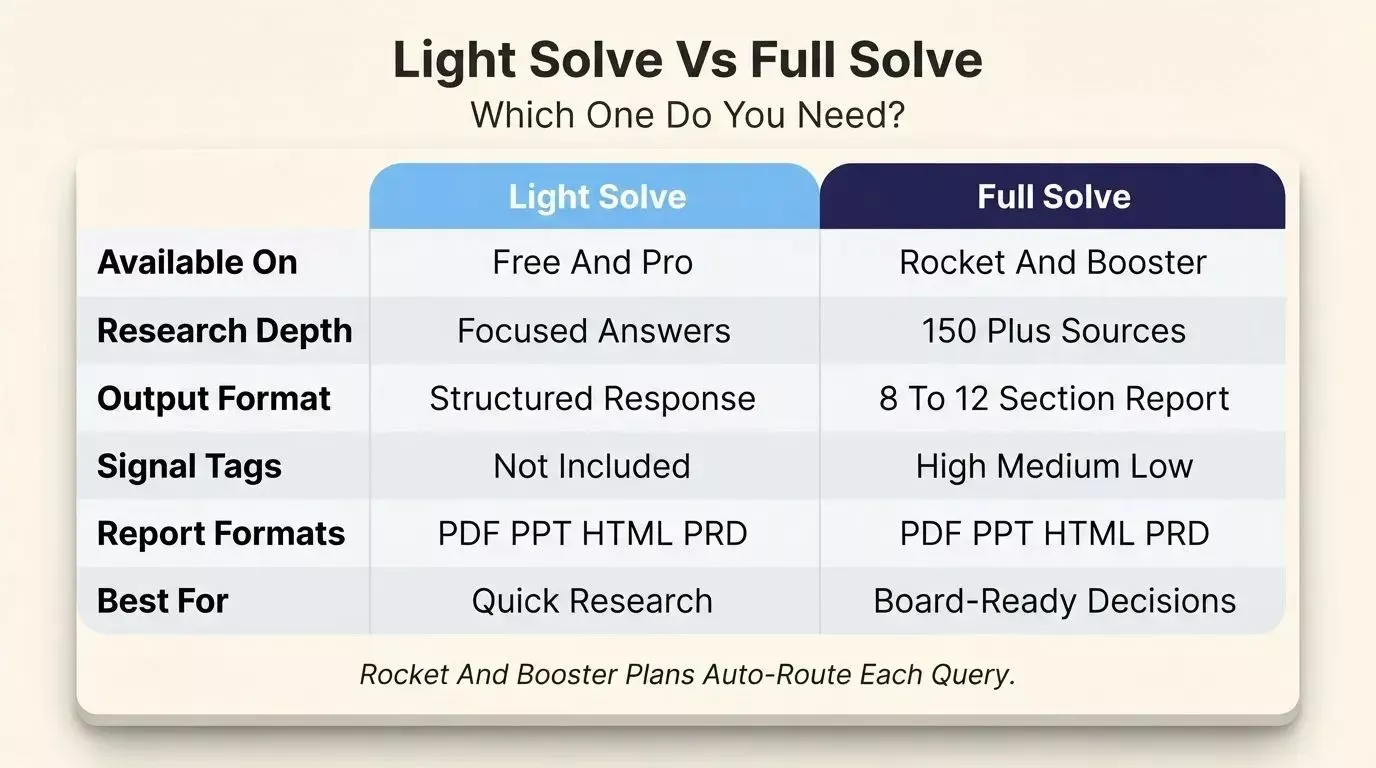
Light Solve is available on every plan. Full Solve auto-routes on Rocket and Booster when the prompt calls for deeper research.
What a Solve Pricing Report Includes
A Full Solve pricing report covers four core sections. Each section is designed to give product teams and sales teams something they can act on immediately.
| Report Section | What It Delivers |
|---|---|
| Market pricing overview | How the market prices similar products: common price ranges, dominant pricing models, and recent shifts |
| Competitor pricing breakdown | Side-by-side comparison of tiers, features, and packaging for each competitor you name |
| Model analysis | Tradeoffs between per-seat, usage-based, flat-rate, and credit-based pricing models for your specific product |
| Recommended approach | A specific pricing recommendation with reasoning connecting your market position to a revenue-generating price point |
Confidence Scoring rates each finding by signal strength (HIGH / MEDIUM / LOW) so teams know exactly where the data is solid and where uncertainty exists. Gap Analysis identifies where your planned features differ from existing offerings, revealing whether you are overpricing or underpricing relative to what the market actually delivers.
Recommendations land in a board-ready format built from customer-valued features and live market data. Sales teams need something they can reference on a call, not a 40-page PDF, but a clear view of how the pricing holds up against what competitors charge. You can read more about how Solve produces structured, actionable outputs for exactly this kind of decision.
Tracking Competitors in Real Time with Intelligence
Solve answers a pricing question once. But pricing is not a one-time decision. Competitor pricing shifts, new entrants appear, and the market moves.
That is where Rocket.new's Intelligence product picks up. Intelligence watches competitors continuously across nine signal pillars, including website changes (pricing page updates, new tiers, removed features), product and technology shifts, GTM moves, people and hiring signals, and business and finance activity.
Rocket.new's Intelligence product delivers Intel cards, which are structured reads that connect signals into meaning, not just alerts, so teams understand what a competitor's pricing change actually signals strategically, not just that it happened.
Persistent project memory keeps all research and competitor notes active across sessions. Teams are not starting from scratch every quarter. They walk into the next pricing conversation with full context on everything that changed since the last one.
For companies in fast-moving categories like vibe coding or AI app building, this continuous competitive intelligence is the difference between reacting to a price war after it starts and spotting the shift before it hits your pipeline. The competitive intelligence cycle explains how teams structure this kind of ongoing monitoring into a repeatable process.
Which Pricing Strategy Involves Setting a Low Initial Price?
That would be market penetration pricing. The idea is straightforward: set your initial price low enough to capture a large share of the market quickly, assume customers will switch from competitors because of the lower cost, and build volume first before raising prices once your user base is established.
Penetration pricing works well for mobile apps, SaaS tools, and AI platforms entering a crowded category. But it carries risk: low prices can signal low value to users and trigger competitor responses that drag the whole market down.
Solve helps teams model penetration scenarios by pulling competitor tier structures and existing price sensitivity signals. Instead of guessing whether $19/month will win share, you get a report showing what similar companies charged at launch and how their positioning changed over time.
This is where the product building process connects back to pricing. When teams use Rocket.new to build prototypes, they can test pricing signals with real users before committing to a number. Running a Solve pricing report first, then building a page to test conversion at that price point, means the cost of testing a price drops to almost nothing. Explore how vibe coding and rapid prototyping accelerate this test-and-learn loop.
What People Are Saying
"Many B2B and SaaS companies struggle with pricing because they rely on guesswork instead of data. They haven't done the work to understand what their customers truly need and what they're willing to pay for." - Madhavan Ramanujam, Senior Partner at Simon-Kucher, via Amplitude
The gap is not a lack of pricing opinions inside the business. The gap is a lack of structured market research that arrives before the decision is made. Solve was built to close that gap for teams that do not have a dedicated pricing consultant on staff.
How Rocket.new Handles Market-Driven Pricing Research
Rocket.new is an AI platform built around Solve, Build, and Intelligence on one platform. For pricing decisions, the full journey runs through all three.
Solve acts as a research engine that supports faster, more confident decisions backed by real-time competitive intelligence. It is the right platform for companies that want to move from "we think this price makes sense" to "the data from six competitor teardowns supports this price."
Rocket.new is an AI app builder that lets users describe an app idea and turn it into a functional app, speeding up the development process compared with traditional, slow methods. The vibe coding approach means teams can go from idea to working code without writing a single line. That speed matters because teams can create and test before the pricing window closes.
Here is what the platform includes:
- Solve: research engine for pricing strategy, competitive analysis, market sizing, and product direction; Light Solve on all plans, Full Solve auto-routed on Rocket and Booster
- Build: production-ready web apps (Next.js) and mobile apps (Flutter), websites, landing pages; 25,000+ templates available to browse and remix at zero credits
- Intelligence: continuous competitive monitoring across nine signal pillars; delivers Intel cards framed to your role and strategic questions
- Collaboration: unlimited team members on all paid plans; three-level role-based access (Admin, Creator, Viewer); per-user credit allocation
Different tasks consume varying amounts of credits, so teams should focus credits on the complex research and build tasks that matter most.
Current Rocket.new Plans and Free Plan Options
Pricing verified against docs.rocket.new. Rocket.new updates plans periodically; see the live pricing page for the latest.
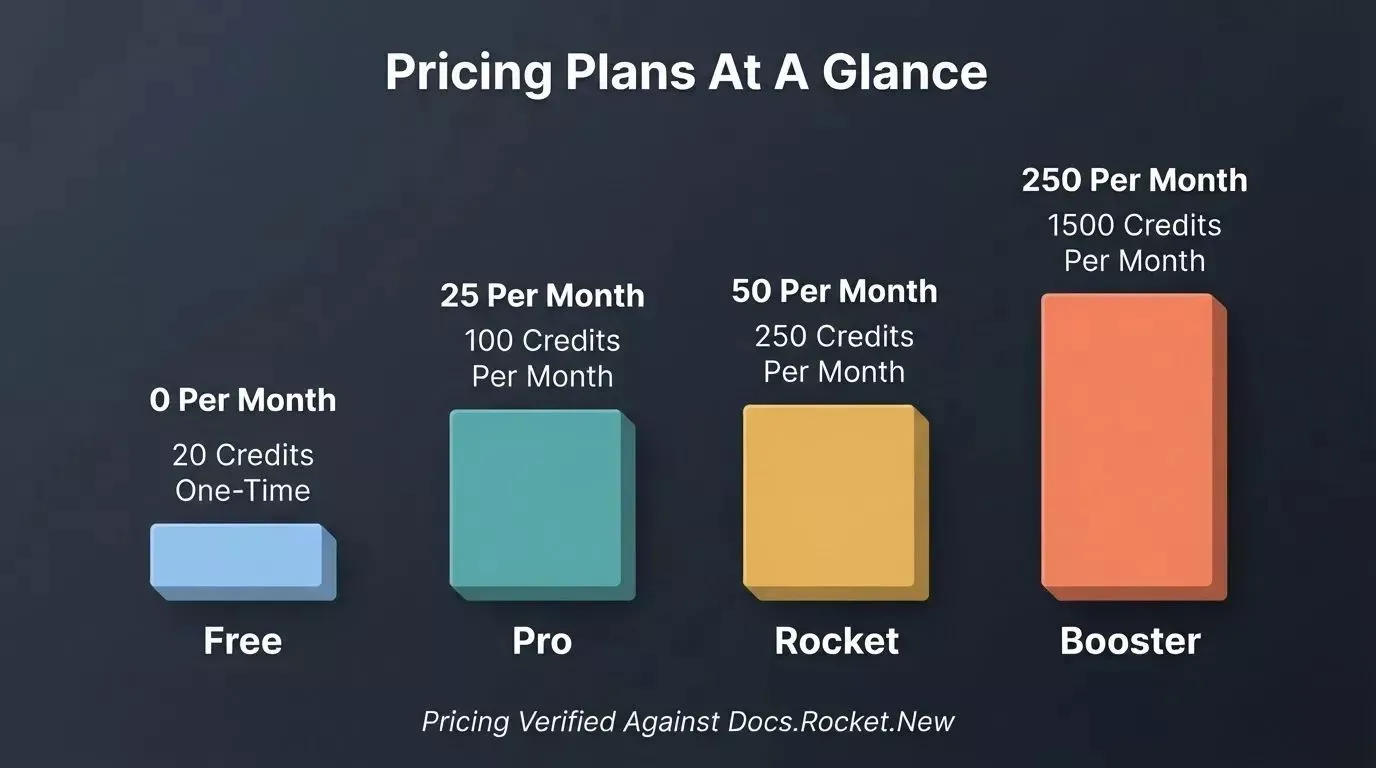
Credit allocations scale with plan tier. Rocket and Booster plans include Full Solve and Intelligence.
| Plan | Monthly Cost | Monthly Credits | What It Covers |
|---|---|---|---|
| Free | $0 | 20 (one-time) | Build + Light Solve |
| Pro | $25 | 100 | Build + Light Solve |
| Rocket | $50 | 250 | Build + Full Solve (auto-routed) + Intelligence |
| Booster | $250 | 1,500 | Build + Full Solve (auto-routed) + Intelligence + premium support |
A quick breakdown: Free and Pro cover lighter workflows, while Rocket and Booster unlock Full Solve and Intelligence. Annual billing saves 20% across all paid plans. Both Rocket.new and Emergent.sh use credit-based pricing, but Rocket.new offers more predictable long-term value because its plans include hosting and unlimited team members. Additional credits can be purchased on top of any subscription. For pricing research specifically: the Rocket plan ($50/month) is the build plan entry point for teams that want Full Solve for pricing work, which routes to deep pricing strategy reports with signal-strength tagging, competitor teardowns, and board-ready output.
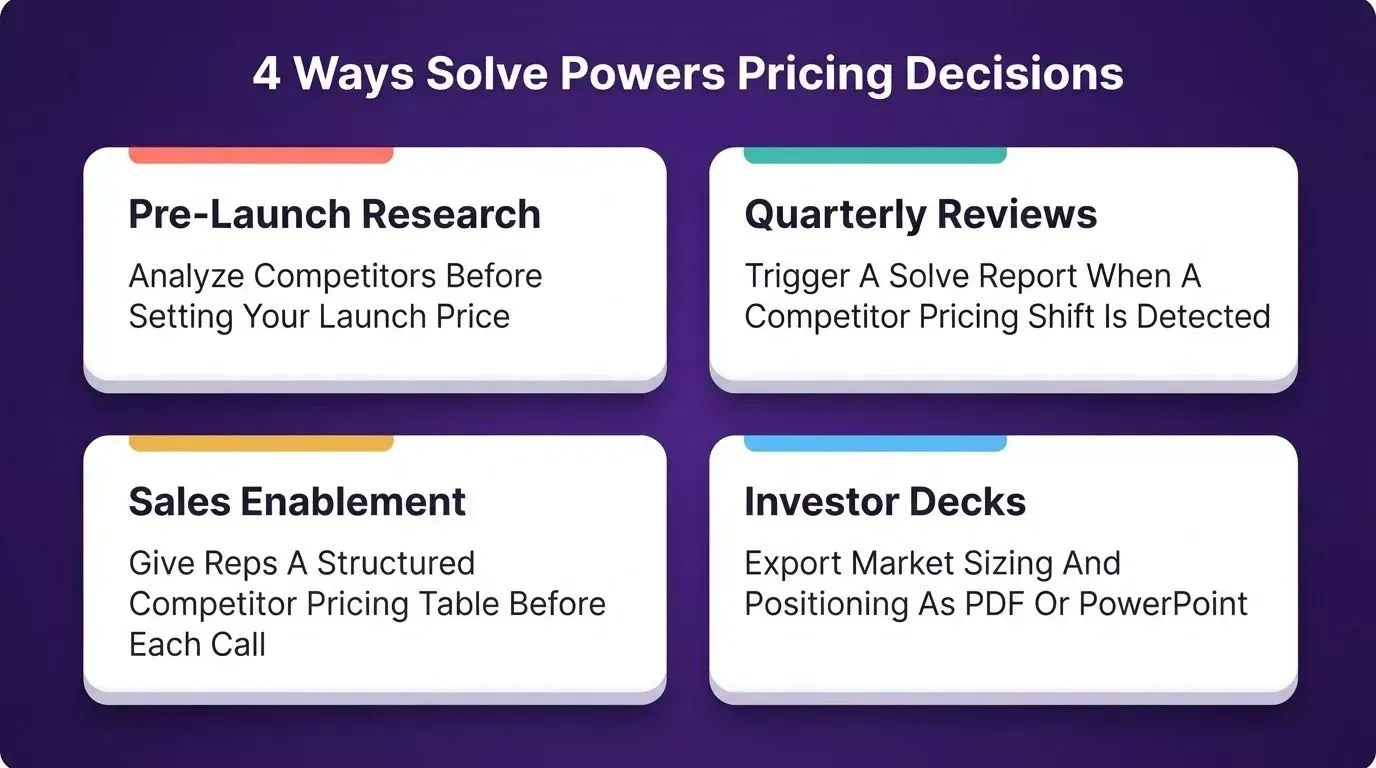
Four repeatable workflows where Solve replaces manual research with structured, evidence-backed pricing intelligence.
- Pre-launch pricing research: run a competitive analysis across four competitors before setting your AI app's launch price, then build a page to test conversion at that price point
- Quarterly pricing reviews: use Intelligence to track competitor pricing shifts in real time, then trigger a Solve report when something changes
- Sales enablement: give sales teams a structured report with competitor pricing tables they can reference during client conversations
- Investor decks: pull market sizing, revenue benchmarks, and competitive positioning into a single Solve report, then export as PDF or PowerPoint for board review
Pricing With Evidence Is the Only Approach That Scales
A simple way to see how Solve on Rocket.new informs a pricing decision with evidence from the market instead of internal instinct is that it replaces the whiteboard brainstorm with a research pipeline that pulls live data, breaks questions into parallel research streams, and produces structured reports with signal-strength scoring.
For companies in vibe coding, AI app building, or any category where pricing shifts quarterly, that shift matters. Pricing built on market data holds. Pricing built on gut feel gets renegotiated six weeks after launch.
Start pricing with real market data. Sign up for Rocket.new and run your first evidence-based pricing report today.
Table of contents
- -Why Do So Many Companies Still Price by Gut Feel?
- -The Cost of Pricing and Market Sizing Without Market Evidence
- -The 7 Steps of a Pricing Framework
- -How to Build a Pricing Decision With Market Evidence
- -How Solve Breaks Down a Pricing Question
- -What a Solve Pricing Report Includes
- -Tracking Competitors in Real Time with Intelligence
- -Which Pricing Strategy Involves Setting a Low Initial Price?
- -What People Are Saying
- -How Rocket.new Handles Market-Driven Pricing Research
- -Current Rocket.new Plans and Free Plan Options
- -Pricing With Evidence Is the Only Approach That Scales