
A complete guide to the best free market research tools available for small businesses and startups. Covers Google Trends, SurveyMonkey, Pew Research Center, SimilarWeb, Statista, and how Rocket.new helps teams act on their research findings by building products fast.
What if the competitive insights that big companies pay thousands for were sitting right in front of you completely free?
They are. Free market research tools have come a long way, and the right combination of them can give startups and small businesses a real edge.
According to Market.us Scoop, the global market research industry generated over $82 billion in revenue in 2022 - but you don't need to contribute to that figure to get meaningful insights for your own business.
The right free tools cover everything from spotting industry trends to gathering customer feedback and running competitive analysis, all at zero cost.
Why Conduct Market Research at All?
Let's start with the basics. Market research is the process of gathering data about your target market, potential customers, and competition. The U.S. Small Business Administration puts it well:
"Market research blends consumer behavior and economic trends to confirm and improve your business idea."
Without research, you're guessing. With it, you reduce risk and make smarter business decisions before spending money on development, marketing, or hiring.
Good market research covers:
-
Demand: Is there real interest in your product or service?
-
Target market: Who are your actual potential customers?
-
Competition: Who else is solving this problem, and how?
-
Competitor pricing: What do customers currently pay for similar options?
-
Industry trends: Where is the market heading?
Here's what makes this even more relevant now: according to Market.us Scoop, an estimated 60% of market research is conducted online. That shift has opened the door for free online tools to do what used to require expensive research firms.
And yet, the same data shows that 26% of market researchers still cite budget limitations as a barrier. Free tools are a direct answer to that problem.
What Makes a Free Market Research Tool Worth Using?
Not every free tool delivers. Some give you raw data with no context. Others show enough to spark curiosity, then lock the useful parts behind a paywall.
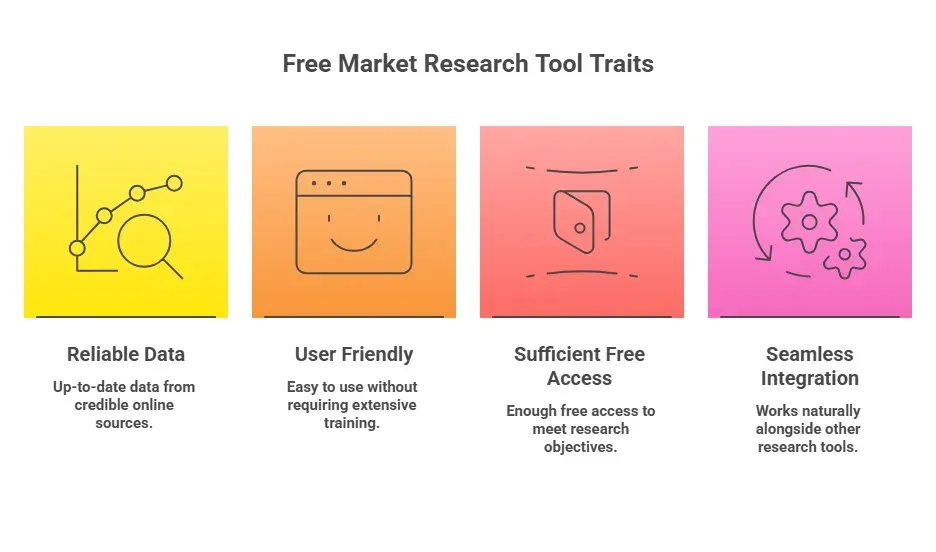
The best free market research tools share a few key traits:
-
Reliable, up-to-date data from credible online sources
-
User friendly enough to start without training
-
Enough free access to genuinely meet your research objectives
-
Works naturally alongside other research tools
 The sections below cover the best options, organized by use case.
The Best Free Market Research Tools, by Category
Google Trends - Spotting What People Are Actually Searching
Google Trends is one of the most underrated free market research tools available - and it requires no account at all. Type any keyword into the search bar and you get data on how search interest has shifted over time, broken down by region and time period, with related queries included.
For small business owners and founders, this is a real game changer.
You can:
-
See whether interest in your product or service is growing or fading
-
Compare multiple terms side by side to spot which one has more traction
-
Identify seasonal patterns in consumer behavior patterns
-
Find geographic hotspots where your target customer base is most active
Google Trends does not show raw search volume numbers, but the relative data is more than enough to track market trends and validate ideas before investing in them.
Google Forms and SurveyMonkey - Launch Surveys to Get Real Feedback
Surveys are one of the most direct ways to conduct market research, and both Google Forms (100% free) and SurveyMonkey (free plan available) let you launch surveys without spending anything upfront.
Google Forms lets you create unlimited surveys and collect unlimited responses from your target customers. SurveyMonkey's free plan limits you to 10 questions per survey useful for quick pulse checks on customer satisfaction or product ideas.
These tools work well when you want to:
-
Validate ideas with potential customers before committing to a build
-
Gather customer satisfaction data after a product launch
-
Understand demographics and preferences within your target market
-
Test messaging or pricing with a small group before going wide
For any research objectives centered on data collection directly from your audience, these are solid, zero-cost starting points.
Pew Research Center and SBA.gov - Trusted Public Data at No Cost
Sometimes the best research is research that already exists. The Pew Research Center offers a large free library of reports covering public opinion polling, social trends, media, and consumer behavior patterns across various industries. Their filters make finding relevant statistics straightforward without commissioning original studies.
The U.S. Small Business Administration provides access to government databases covering demographics, economic indicators, employment statistics, and business classifications - all free, all from reliable sources.
These are particularly useful for:
-
Building target customer profiles with solid demographic information
-
Getting industry-level statistics without paying for a research report
-
Understanding broader market trends across various industries
SimilarWeb and Ubersuggest - Free Tools for Competitive Analysis
Understanding your competition is a non-negotiable part of market research. SimilarWeb's free plan gives you basic website traffic data for any site, showing where a competitor's audience comes from and how much traffic they receive. Ubersuggest (by Neil Patel) has a free tier offering keyword data, traffic estimates, and basic competitor insights.
For a small business doing initial competitive analysis, this combination is enough to build a clear and useful picture of the market analysis landscape.
You can use these to:
-
See which search terms drive the most traffic to competitor websites
-
Identify content or product gaps in the market
-
Analyze competitor pricing pages and most-visited content
-
Track campaign effectiveness of competitors over time
Statista and AI Tools - Statistics and Speed
Statista aggregates data from thousands of sources across various industries. While deeper reports require a subscription, the preview data on the free plan covers enough ground for most market research needs - including market size figures, survey statistics, and consumer behavior trends.
AI tools like ChatGPT or Perplexity are also becoming popular additions to the free market research toolkit. They do not replace primary data collection, but they are useful for synthesizing research, summarizing reports, and generating initial frameworks for data analysis.
How the Market Research Process Works
Most market research follows a clear sequence. Understanding it helps you pick the right tools at the right stage and build toward actionable insights rather than raw data that goes nowhere.
-
Define your research objectives clearly before picking any tools
-
Decide between primary research (surveys, interviews) and secondary research (existing reports, government data)
-
For secondary research: use Pew Research Center, SBA.gov, or Statista to gather existing data on your target market
-
For primary research: launch surveys using Google Forms or SurveyMonkey to collect customer feedback directly
-
Analyze findings and identify gaps in what you know
-
Use Google Trends to track search interest around your keyword or product category
-
Run competitive analysis with SimilarWeb or Ubersuggest to see how competitors are performing
-
Compile actionable insights and use them to make your business decisions
What Founders Are Saying About Manual Research
Rajesh P, a co-founder, shared something on LinkedIn that resonates with a lot of people doing market research on a budget:
"I wasn't spending most of my time on strategy or building the product. I was spending it on manual research. Checking competitor pricing. Reading dozens of customer reviews. Auditing pages for SEO issues. None of it was intellectually hard - it was just time-consuming repetition. The worst part? It never ends. Every week the same tabs, the same copy-paste, the same spreadsheets."
This is the reality for most small business owners and startups. Free tools reduce that time significantly. But turning the research into a working product is where many teams still get stuck - and that's where the next section comes in.
From Research to Product: How Rocket.new Closes the Gap
Free market research tools give you data. Rocket.new helps you act on it.
Rocket.new is an AI-powered app builder that takes you from research to working product without writing a single line of code. Once your market research reveals an opportunity a gap in the market, an underserved customer segment, a product your surveys confirm people want Rocket.new helps you ship it fast.
Build Without Waiting on Developers
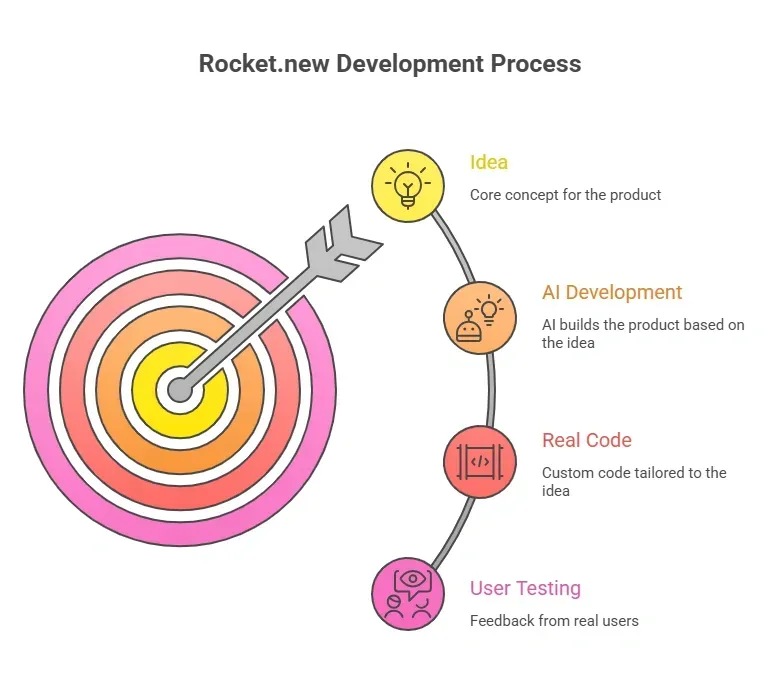
Traditional development takes weeks. With Rocket.new, you describe your idea and AI builds it. That means you can test your research findings with a real product in front of real users in a fraction of the usual time. No templates, no compromises - real code built around your specific idea.
Turn Survey Findings Into Real Products
Market research tells you what customers say they want. A real product shows you what they actually do. Rocket.new lets you build functional apps quickly so you can test assumptions with real user behavior - not just survey responses. The gap between insight and product has never been smaller.
From Research to Launch in Days
Whether you're building a landing page to test demand, a data collection tool to gather more customer feedback, or a full MVP, Rocket.new's AI generates it fast. Small business teams without developer resources can move from research to a working product in days rather than months.
Rocket.new vs. Traditional App Builders
| Feature | Traditional No-Code Builders | Rocket.new |
|---|---|---|
| Speed to working product | Days to weeks | Hours |
| Technical knowledge needed | Medium | None |
| AI-generated custom code | No | Yes |
| Customization depth | Template-based | Fully custom |
| Backend logic included | Limited | Yes |
| Cost to start | Free to low | Free to start |
Standard no-code platforms lock you into templates. Rocket.new generates real code built around your specific idea, so what you build reflects what your research actually found - not what a template was designed for. That difference matters when your product needs to match a precise user need you discovered through research.
Getting the Most Out of Free Market Research
The biggest challenge with free market research is not finding tools - it's using them with intention. A few practices that help:
-
Start with a specific question. "What pain points do freelance designers have with client invoicing?" will yield far more useful data than "what do people want?" Specific research objectives lead to specific, actionable insights.
-
Layer your tools. No single free tool gives you a complete picture. Pair Google Trends for search behavior with a survey for direct feedback and SimilarWeb for competitor data to get a fuller view of your target audience.
-
Check public data first. Before building surveys, check whether Pew Research Center, the SBA, or Statista already has the answer. Their free libraries are vast and often overlooked by small business owners.
-
Let data lead to action. Research that does not change a decision is just reading. Each insight should point to a clear next step - whether that confirms your product direction, adjusts your target market, or signals a strategic planning pivot.
The Right Free Market Research Tools for the Job
Market research does not need to be expensive to be good. The global market research industry is worth billions because insights matter but those insights do not require a big budget when you know where to look.
Free market research tools like Google Trends, SurveyMonkey, the Pew Research Center, SimilarWeb, and Statista give small businesses access to real data from reliable sources. Used together, they cover search trends, customer feedback, public statistics, and competitive analysis a complete research toolkit at zero cost.
The gap is not in the data. It's in what you do with it. Once your free market research points to a clear opportunity, the next step is building something your target customers can actually use. Rocket.new helps you get there without waiting on a development team so your research turns into a real product, fast.
Table of contents
- -Why Conduct Market Research at All?
- -What Makes a Free Market Research Tool Worth Using?
- -The Best Free Market Research Tools, by Category
- -Google Trends - Spotting What People Are Actually Searching
- -Google Forms and SurveyMonkey - Launch Surveys to Get Real Feedback
- -Pew Research Center and SBA.gov - Trusted Public Data at No Cost
- -SimilarWeb and Ubersuggest - Free Tools for Competitive Analysis
- -Statista and AI Tools - Statistics and Speed
- -How the Market Research Process Works
- -What Founders Are Saying About Manual Research
- -From Research to Product: How Rocket.new Closes the Gap
- -Build Without Waiting on Developers
- -Turn Survey Findings Into Real Products
- -From Research to Launch in Days
- -Rocket.new vs. Traditional App Builders
- -Getting the Most Out of Free Market Research
- -The Right Free Market Research Tools for the Job