
This blog walks through how founders can compress the traditional SaaS MVP journey from months to days using the Rocket.new validation loop combining market research, no-code building, and real user feedback in one connected system.
Most founders start with a spreadsheet. They size the market, model revenue, and calculate what a small slice of a billion-dollar opportunity could look like.
That part feels good. The hard part comes next - getting a real product in front of real users before months of development time and tens of thousands of dollars have already walked out the door.
According to a 2026 analysis by SMELighthouse, 43% of startups shut down because they built something nobody wanted - and only 40% of founders conduct any formal market validation before they start writing code.
The global SaaS market is on track to hit $465 billion in 2026. Most of the companies chasing that number will not survive long enough to matter.
Why Most Founders Get the Order Wrong
There is a specific feeling that comes with a new idea. It is convincing. You have done the market research, read the reports, and modeled the numbers. The case looks solid on paper. So you hire a development team, or wire up a tech stack yourself, and you start building.
Eighteen months later, you have a product. You also have a smaller market than you thought, a different type of customer than you expected, and a runway that is draining faster than your user base is growing.
This is the pattern that catches most startups. The problem is not a lack of market research. It is that market research answers the wrong question. It tells you a problem exists. It does not tell you whether enough people will pay to fix it in the exact way you are planning to fix it.
A founder in r/SaaS summed it up after shutting down his SaaS after 18 months:
"What I got wrong: built for a persona I'd created from research rather than from conversations. The persona was plausible but the actual market was smaller and less willing to pay than the persona suggested. By the time real customer feedback corrected my assumptions, I'd already built too much in the wrong direction and the cost of pivoting exceeded the remaining runway."- r/SaaS community post
That is the trap. And it is remarkably consistent across startups that fail.
The Real Cost of Traditional MVP Development
The lean startup method gives founders a better framing: build, measure, and learn. Get something in front of real users fast. Watch what they actually do - not what they say they would do in a survey. Use that data to decide what to build next.
The catch is that for most non-technical founders, "build fast" still meant 3 to 6 months of development time and a significant cash outlay before learning anything real.
What Minimum Viable Product Development Actually Costs
Based on 2025 pricing data from UX Continuum, here is what traditional MVP development looked like before AI-assisted builders changed the situation:
| MVP Type | Cost Range | Timeline |
|---|---|---|
| Simple MVP | $8,000 - $18,000 | 4-8 weeks |
| Medium MVP | $18,000 - $35,000 | 8-12 weeks |
| Complex MVP | $35,000 - $60,000 | 12-16 weeks |
That means even the most stripped-down path to a working app took at least a month, with a real cash cost before a single real user had clicked anything. By the time you had product data, the budget was already committed to a direction. Scope creep set in. Teams built on top of assumptions that real user feedback would have corrected weeks earlier.
The problem is not ambition. It is timing.
The Build, Measure, Learn Loop - and What Breaks It
The lean startup build-measure-learn cycle is theoretically simple:
1Build → Measure → Learn → (repeat)
In practice, the loop breaks at the "Build" step. If building takes 12 weeks and costs $30,000, most early-stage founders only get one or two iterations before they run out of time or money. And if the first iteration was based on the wrong assumptions - which 43% of the time it is - there is no budget left to course-correct.
What the loop actually needs is speed and low cost at the Build stage. The rest of the cycle - measuring real users, learning from that data, making decisions - founders can do reasonably well. The bottleneck has always been getting to a working product quickly enough to learn something before the runway ends.
Rocket.new: From Market Research to Live MVP in a Week
Rocket.new is built around a different order of operations. Instead of moving from market sizing to a development team to a minimum viable product, it treats research, building, and tracking as one connected system - each stage feeding the next, with no lost context between them.
The platform covers three connected stages:
Stage 1 - Solving the Core Problem
Describe any market problem, product idea, or decision. Rocket.new's Solve capability returns structured market analysis, competitor research, a clear recommendation for what to build, and a full product brief - ready to present or take directly into Build.
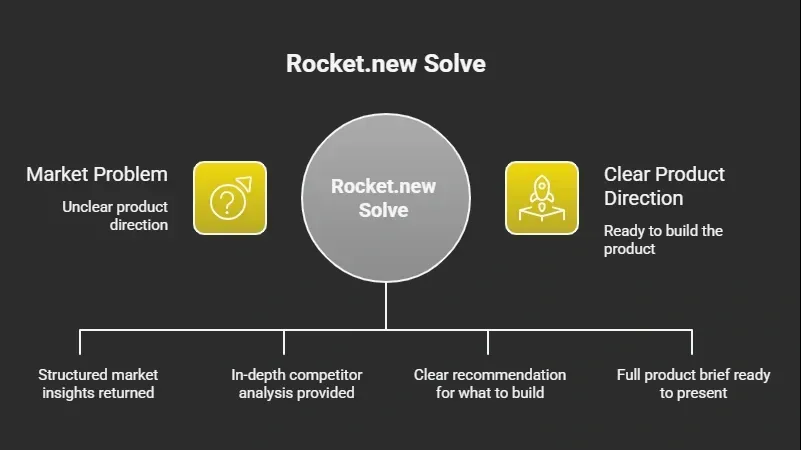 This is not generic research. It is grounded in your specific idea and context. The output is the kind of structured thinking that used to take days of calls with consultants or weeks of desk research.
Stage 2 - Core Features Without Writing Code
Take the brief directly into Rocket.new's Build capability. Because the platform carries the full context of your Solve output, there is no re-explaining, no lost decisions, no starting over. You describe the core features that need to work, and Rocket.new generates a production-grade web app, mobile app, landing page, or SaaS product from natural language prompts - with one-click deployment to staging and production environments.
Non-technical founders do not need to write a single line of code. The backend code, the database structure, the deployment pipeline - all handled by the platform.
Stage 3 - Tracking Early Users and Competitors After Launch
After launch, Rocket.new monitors your competitors continuously. Pricing changes, product launches, messaging shifts, hiring signals - it surfaces what matters and connects it to your context. Your market keeps moving after you ship. Rocket.new keeps you informed about what moves next.
Non-Technical Founders: You Can Ship Without a Development Team
The traditional barrier for non-technical founders was clear: you either needed to write code, hire someone who could, or use a no-code platform that capped what you could actually build. None of those options were fast.
Rocket.new changes that without cutting capability. What you supply is the problem you are solving and the core features that need to work. What you get back is a working app. No development team. No tech stack decisions. No waiting on contractors.
When you can spin up a working app in a week, you can test whether early adopters actually sign up, put real user feedback in front of your core assumptions before committing budget, and pivot quickly if real users interact differently than your market research suggested.
Early Adopters vs. Landing Page Signups - What Actually Validates Demand
There is a meaningful difference between someone signing up for a waiting list and someone clicking through a working app. Both matter, but they tell you different things.
A landing page signup tells you: the problem resonates and the messaging works.
Real users interacting with your product tell you: whether the solution you built actually solves the problem in the way you thought it would.
The Rocket.new validation loop gives you both. You can ship a landing page to validate demand early in the week, then deploy a working MVP for early users to interact with by the end of it. The usage analytics from that first week are worth more than any number of customer discovery calls.
Here is what the week looks like in practice:
| Day | Activity |
|---|---|
| Day 1-2 | Run market research with Rocket Solve - get a structured brief |
| Day 3-4 | Build working MVP with core features in Rocket Build |
| Day 5 | Deploy landing page, share with early adopters |
| Day 6-7 | Watch usage analytics, collect real user feedback, decide next step |
Where Competitors Fall Short
Other AI builders - tools like Lovable, Bolt.new, and Bubble - generate code fast. But they skip the thinking stage entirely. You type a description, they start building. If the market does not want what you described, they will still build it - perfectly and quickly.
Rocket.new is the only platform that connects the research and decision stage to the build stage with shared context. Your market analysis does not live in a separate document. It informs what gets built. And your post-launch competitor tracking does not require setting up a separate tool. It is part of the same system.
For early stage founders who need to validate demand before committing serious resources, that connection matters more than raw building speed.
From Market Sizing to a Live MVP: The Real Takeaway
Most SaaS products do not fail because of bad code or a weak development team. They fail because founders built something nobody wanted badly enough to pay for - and most did not find that out until it was too late to change course at reasonable cost.
From market sizing for SaaS to a live MVP in a week is not a feature. It is a different approach to the order of operations. Research the market. Decide what to build. Ship it. Watch what real users actually do. Adjust. Repeat.
The Rocket.new validation loop compresses that learning cycle from months to days. For non-technical founders and early-stage teams who want to test a product idea before committing serious resources, that is the starting point not a stretch goal.
Table of contents
- -Why Most Founders Get the Order Wrong
- -The Real Cost of Traditional MVP Development
- -What Minimum Viable Product Development Actually Costs
- -The Build, Measure, Learn Loop - and What Breaks It
- -Rocket.new: From Market Research to Live MVP in a Week
- -Stage 1 - Solving the Core Problem
- -Stage 2 - Core Features Without Writing Code
- -Stage 3 - Tracking Early Users and Competitors After Launch
- -Non-Technical Founders: You Can Ship Without a Development Team
- -Early Adopters vs. Landing Page Signups - What Actually Validates Demand
- -Where Competitors Fall Short
- -From Market Sizing to a Live MVP: The Real Takeaway