
Discover how to transform an MVP building specification into a fully live product using Rocket.new. This guide covers planning, development, testing, deployment, and launch strategies to help startups move from idea to execution faster.
What actually separates a great product idea from a live product people keep coming back to?
Most founders assume it is the code. In reality, the gap between a raw product idea and a live product almost always comes down to how well you planned before you built anything. A clear MVP building spec your product specification document is what keeps the entire team aligned, cuts wasted development time, and gets you to real user feedback faster.
According to CB Insights data cited by Founders Forum, 42% of startups fail because they build something nobody needs. That is a painful stat because it is entirely preventable. A minimum viable product (MVP), backed by a focused product specification, is how you avoid becoming part of that number.
What Is a Minimum Viable Product (MVP)? And Why It Is Not Just a Basic Website
A minimum viable product MVP is the simplest version of your product that still delivers real core value to your target users. It is not just a basic website or a landing page dressed up in new colors. It is a functional product - stripped down to its core features - that lets real users interact with your idea and give you honest, early user feedback.
The goal of an MVP is not to impress everyone from day one. The goal is to test your most important assumptions about your business idea with minimal effort and cost before you commit to building a complex system.
Think of it this way: instead of spending six months building a full product, you ship a focused first version in six weeks. Real users tell you what works. You iterate. That cycle is what MVP development is built on.
The global MVP development market was valued at USD 288 million in 2024 and is projected to grow to USD 541 million by 2031, at a CAGR of 9.5%. That growth tells you how mainstream the MVP approach has become across product teams in every industry.
It helps to understand what separates an MVP from related product concepts:
| Concept | Primary Goal | Typical Timeline |
|---|---|---|
| Minimum Viable Product (MVP) | Validate demand with core functionality | 4-12 weeks |
| Minimum Marketable Product (MMP) | Sell to a broader market with a polished core | 3-6 months |
| Minimum Lovable Product (MLP) | Create a delightful user experience from the start | 4-8 months |
| Prototype / Wireframe | Clickable mockup for concept testing | Days to 2 weeks |
Each serves a different stage. An MVP is your fastest route to early user feedback and real-world validation of your product idea.
The Real Cost of Skipping a Product Specification Document
Here is where most product teams go wrong: they skip the product specification document and jump straight into building.
The pain points that follow are predictable. Developers build features that do not solve the core problem. Designers have no clarity on user flows. Stakeholders have different ideas of what the product should do. And the entire team spends weeks going in circles, burning budget and goodwill simultaneously.
A focused product specification is your north star. It documents what you are building, why you are building it, who you are building it for, and exactly which core features belong in the first version - and which do not.
Over 70% of startups now leverage MVP frameworks before full product development, reducing initial costs by up to 45%. Teams that skip the product specification document rarely see those kinds of savings.
The temptation to skip the spec is real, especially when you are moving fast. But the cost shows up later - in re-work, misaligned expectations, and a product that misses its target audience entirely.
Crafting Effective Product Specifications: What Goes In
Crafting effective product specifications does not need to be a lengthy process. A focused, effective product specification document should cover these key elements:
Product Vision
Start with the product vision. What is the core value this product delivers? Who is the target market? What pain points does it solve, and for which customer segments? Keep this to two or three sentences. If you cannot describe the product vision clearly, you are not ready to build.
User Personas and User Segmentation
Define your user personas. These are semi-fictional profiles of your target users - their pain points, motivations, and what success looks like from the user's perspective. A solid product specification document includes two to three user personas, each grounded in actual market research and interviews with potential users. User segmentation matters here too - different customer segments may need slightly different approaches to the same core problem.
User Stories
User stories translate what users need into buildable requirements. They follow a simple format: "As a [user type], I want to [do something] so that [outcome]." User stories are the backbone of any good MVP development process. They keep the entire team focused on solving real problems for real users rather than building features in the abstract.
Core Features and Feature Prioritization
This is where the MoSCoW method is useful.
It stands for:
-
Must have - core features that make the product functional for target users
-
Should have - important features, but not blocking the launch
-
Could have - nice to have features to add after the MVP goes live
-
Won't have - explicitly out of scope for this version
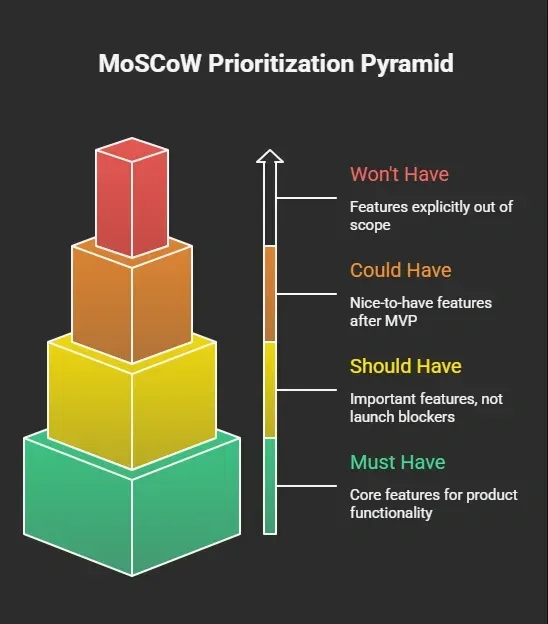 Feature prioritization through MoSCoW cuts feature creep before it starts. It forces the product team to make honest trade-offs between what belongs in the MVP and what can wait for future development. If it is not solving a core problem for your target users right now, it does not belong in the spec.
Technology Stack and System Architecture
The technical specification for your MVP should outline the technology stack and system architecture at a high level. This does not need to go deep into code. It just needs to give developers a shared understanding of what they are building with. Include notes on platform compatibility, operating systems, front-end and back-end choices, and any version control system your team will use.
Quality Assurance and Testing Strategy
The product specification document should include a basic testing strategy. This covers user acceptance testing, integration testing, and quality assurance standards. Define what "done" looks like before development starts, not after. Quality benchmarks set in the spec phase save enormous re-work in the development process.
Key Elements of an Effective Product Specification: Quick Reference
| Section | Purpose | Who Owns It |
|---|---|---|
| Product Vision | Aligns the team on goals and core value | Founder / PM |
| User Personas | Identifies target users and real pain points | UX / Research |
| User Stories | Translates user needs into buildable tasks | PM / Dev |
| Feature List (MoSCoW) | Defines scope and priorities clearly | PM |
| Technical Specification | Guides architecture and technology stack | Lead Dev |
| Testing Criteria | Sets quality assurance benchmarks | QA / PM |
| Release Plan | Maps the development timeline and milestones | PM / Dev Lead |
From Spec to Live Product: The MVP Development Process
Once you have a solid product specification document in place, the MVP development process follows a predictable flow. Here is what it typically looks like end to end:
The lean startup approach - build, measure, learn - applies at every stage of this flow. You are not trying to build the perfect product. You are trying to build the right product, then refine it based on what real users actually do.
A few things to keep close during MVP development:
Feature creep is one of the most common failure modes. Once development starts, there will be pressure to add features that were not in the spec. Keep a product roadmap for those ideas, and stay disciplined about what belongs in the current version. Every extra feature added mid-build costs more than it looks like on the surface.
Real users matter more than internal assumptions. Get your MVP in front of real users as fast as possible. Early user feedback from actual potential users reveals the gaps that no internal review will catch. Customer feedback at this stage shapes every decision that follows.
User acceptance testing is non-negotiable. Before you call it live, run user acceptance testing with a small group from your target audience. This surfaces usability issues that no developer or designer sees after staring at the product for weeks.
Average MVP development timelines have dropped from 18 weeks to just 6 weeks for teams using modern cloud-native architectures and low-code platforms. That compression means more teams can test their assumptions faster - and kill bad ideas before they become expensive ones.
What the Builder Community Is Saying
The shift toward faster MVP development is not just a trend in the data - it is playing out in real product teams every day. Saurabh Giri, a product builder who shared his experience on LinkedIn, put it bluntly:
"Rocket.new spits out FULL, ready-to-launch apps - backend, UI, integrations - straight from a single prompt. No platform I've used gets you closer to the 'push a button, ship a product' dream... Rocket is powering launches in 180+ countries, with 400,000+ users and 10K+ paying customers. No-code was supposed to be democratizing. Rocket is making it real. My verdict: If you want to skip the 'demo zone' and actually launch, Rocket.new is the secret weapon." Saurabh Giri, LinkedIn
That "demo zone" distinction is worth pausing on. Many MVP tools help you produce something that looks like a product but cannot actually ship to production, handle real users simultaneously, or grow with your business. That gap is exactly where most MVPs stall.
Why Most MVPs Stall Before Going Live
A lot of MVPs never make it to launch. Here are the most common reasons:
1. Technical limitations hit a wall.
Many popular MVP tools produce a front-end that looks great but a back-end that cannot scale. Once the prototype needs to handle real users simultaneously or support more complex system architecture, teams hit hard limits and face a full rebuild.
2. Budget constraints run out.
When a product specification document is vague, development estimates are wrong. Scope creep burns through the budget before the product is stable enough to test with users. Tight budgets require tight specs - full stop.
3. Non-tech-savvy users on the product team create gaps.
Many founders are not developers. When there is no shared understanding of the technology stack or core functionality between the business and the development team, miscommunication adds weeks of re-work to the development timeline.
4. Feature creep buries the core value.
Adding features mid-build is the fastest way to destroy a well-planned MVP development effort. Products that try to do everything at launch end up doing nothing well. The user experience suffers, and so does the first round of user feedback.
5. No validation strategy.
Teams that build without a clear testing strategy find out too late that users do not actually want what they built. A validation strategy - including user acceptance testing, defined testing criteria, and measurable goals - is part of the spec, not an afterthought.
90% of startups fail overall, and many of those failures trace directly back to poor product specification and rushed MVP development without proper validation.
The real gap is not technical ability. It is the bridge between a well-written spec and a platform that can turn it into a live, production-ready product quickly.
From Spec to Live: Launching Your MVP on Rocket.new
This is where Rocket.new closes the loop between product specification and a live product.
Traditional MVP development flows require a development team, weeks of environment setup, separate tools for front end and back end, and a DevOps layer to manage deployment. For non-technical founders or lean product teams working with budget constraints, that complexity is often what kills an MVP before it launches.
Rocket.new takes the full MVP development stack and wraps it into a single, prompt-driven platform - from product specification to live product.
Core Features That Support the Spec-to-Launch Journey
Prompt-to-App Generation
You describe your product idea - including the core functionality, user interface requirements, and feature descriptions from your product specification document - and Rocket.new generates a complete, full-stack working app. This includes the front end, back end, and the third-party connections your product needs.
This is not just code snippets. It is a production-ready product that you can put in front of real users on day one.
Visual Builder and Live Editing
After generation, Rocket.new provides a visual builder to refine the user interface, adjust layouts, and update logic - without writing code by hand. This makes the product accessible to non-tech-savvy users on the product team while giving technical founders full control when they want it.
Figma to Working App
If your product specification document includes wireframes or mockups from Figma, Rocket.new can take those designs and convert them directly into a functional product. This eliminates the handoff gap between designers and developers - one of the most common sources of delay in the development process.
Scalable Back End from Day One
One of the biggest technical limitations with most MVP tools is a demo-grade back end. Rocket.new builds with a scalable system architecture from the start, so your MVP can handle real users simultaneously and grow with your product - without forcing a full rebuild when you hit traction.
Multi-Model AI
Rocket.new uses a combination of models - including Anthropic, OpenAI, and Gemini alongside DhiWise's in-house technology - to produce smarter, more context-aware results for your specific product vision and use case.
Where Traditional Tools Fall Short
Traditional no-code and low-code platforms come with real technical limitations when it comes to production readiness:
-
Walled-garden back ends that cannot scale beyond their own platform infrastructure
-
Limited customization once you outgrow the starter template
-
No clear path from MVP to a full production deployment environment
-
Vendor lock-in that makes migration costly and time-consuming
Rocket.new is built for the full journey - from mvp building spec to live product - not just for fast demos.
Use Cases Where Rocket.new Delivers
-
SaaS MVPs where login functionality, user segmentation, and payment processing need to be live quickly
-
Marketplace apps that need a front end, back end, and user-facing interface working together from day one
-
Internal tools where business logic is complex but the budget for a custom development team is limited
-
Mobile-first products that need platform compatibility across devices and operating systems
Your Pre-Launch Checklist
Before you declare the MVP live, run through this:
-
Does every feature in the build match the core features from your product specification document?
-
Have you run user acceptance testing with at least five real users from your target audience?
-
Is the user interface usable without explanation or guidance?
-
Is the back end stable enough to handle users simultaneously without failure?
-
Do you have a plan to gather user feedback and customer feedback in the first two weeks?
-
Have you defined which metrics will tell you whether the MVP is working?
If the answer to any of these is no, go back and fix it. Launching fast is smart. Launching broken is just expensive.
From MVP Building Spec to Live Product - The Short Version
The path from mvp building spec to live product is shorter than most founders believe - but only if you do the spec work first. Skipping the product specification document is where most products go off track before a single line of code is written.
A clear spec defines the product vision, maps out user personas, lists the core features, and gives the development team - or the platform - a solid foundation to build from. Without it, you are building on guesswork.
With the right spec and the right platform, the MVP development process becomes predictable, fast, and focused on real user needs from day one. Rocket.new is built for exactly this transition: taking a well-structured product idea and turning it into a live, production-ready product without the overhead of traditional software development.
Table of contents
- -What Is a Minimum Viable Product (MVP)? And Why It Is Not Just a Basic Website
- -The Real Cost of Skipping a Product Specification Document
- -Crafting Effective Product Specifications: What Goes In
- -Product Vision
- -User Personas and User Segmentation
- -User Stories
- -Core Features and Feature Prioritization
- -Technology Stack and System Architecture
- -Quality Assurance and Testing Strategy
- -Key Elements of an Effective Product Specification: Quick Reference
- -From Spec to Live Product: The MVP Development Process
- -What the Builder Community Is Saying
- -Why Most MVPs Stall Before Going Live
- -From Spec to Live: Launching Your MVP on Rocket.new
- -Core Features That Support the Spec-to-Launch Journey
- -Where Traditional Tools Fall Short
- -Use Cases Where Rocket.new Delivers
- -Your Pre-Launch Checklist
- -From MVP Building Spec to Live Product - The Short Version