
Most roadmap decisions fail before the meeting even starts due to poor preparation. Rocket.new Intelligence helps product teams unify competitive signals, customer feedback, and usage data into structured insights. This transforms roadmap sessions from opinion-based debates into fast, evidence-driven decisions.
What if the most important part of your roadmap planning session happens before anyone enters the room?
That's the shift product teams are starting to make. The session itself, the slides, the sticky notes, and the prioritization debate are only as good as the intelligence that feeds them. And right now, most product teams walk in with last quarter's assumptions, a handful of support tickets, and whatever the sales team mentioned in Slack.
According to research cited by Pragmatic Institute, product managers spend less than one-third of their time on strategic work. Not because strategy doesn't matter, but because the prep work required to do it well is scattered, slow, and rarely done before the meeting starts.
This blog breaks down exactly how product teams can validate ideas and prioritize initiatives by integrating market intelligence with technical feasibility and other things that happen before a roadmap planning session.
Effective stakeholder alignment requires clear communication of the product vision and strategy, which helps in obtaining buy-in and support from various teams within the organization. This approach encourages agile, data-driven methodologies that ensure alignment with customer needs and business objectives.
The Meeting That Decides Everything (and the Prep That Usually Doesn't Happen)
Most product roadmap sessions are framed as decision meetings. But if you've sat in enough of them, you know what they actually are: alignment meetings where people argue about decisions that should have been made already.
Aligning product roadmaps with organizational goals ensures that all stakeholders are working towards a common vision, which enhances collaboration and reduces conflicts.
Product Managers can attach internal documents to rank backlog items based on actual market fit rather than internal assumptions. The estimated effort has been debated. What's missing is the right context, the real signals that would make the prioritization obvious rather than political.
Why Most Product Roadmaps Start on Shaky Ground
The problem isn't that product teams don't care about data. It's that collecting the right data before a session takes time that most teams don't have.
A typical pre-session prep cycle looks like this:
-
Someone pulls support tickets from the last quarter
-
Someone else summarizes customer feedback from a few interviews
-
The sales team forwards a few competitive objections they heard in deals
-
A PM searches for what competitors have shipped recently
-
Everyone shows up with different versions of the picture
Each of those inputs is useful on its own. Together, they're incomplete. Because they were gathered from multiple tools by different people in different ways, nobody in the room is working from the same understanding of what's actually happening in the market.
The Real Cost of Going in Blind
The cost isn't just a bad session. It's a bad product roadmap.
When product teams make roadmap choices without structured insights, they tend to build what's loudest, not what's most valuable. The features that get prioritized are the ones that got mentioned most recently, not the ones that reflect real user behavior or real competitive pressure.
That's how product teams end up shipping things customers don't use. And it's how competitors get ahead while your team is still debating the backlog.
What Product Teams Actually Need Before a Roadmap Session
The gap isn't knowledge; it's access and synthesis. According to Pendo, 75% of product managers say data is important for decision-making, but only 30% are very satisfied with their access to it.
That gap, between knowing data matters and actually having it ready, is where most roadmap planning falls apart.
Product managers and their teams need three things before a session:
-
Competitive signals that show what's shifting in the market right now
-
Customer feedback patterns that go beyond one-off support tickets
-
Usage data and leading indicators that show what users are actually doing
Getting all three, synthesized, in one place, before the session starts, that's the standard most teams are not meeting.
"Roadmaps vs Plans was the second top challenge product managers faced in 2024, right behind product strategy itself. Teams know what they want to build. They struggle to ground it in something real before committing to a direction."- Ant Murphy, product coach and newsletter author with 150,000 readers, antmurphy.me
Competitive Signals, Not Just Internal Assumptions
Internal assumptions are the enemy of a good product roadmap. They feel like knowledge because they come from people who know the product well. But they're often a quarter or two behind what's actually happening with competitors and customers.
Real competitive signals come from watching what competitors are doing continuously, not from a one-time research sprint before the session. A competitor's pricing page update, a new job posting for an enterprise sales role, a shift in their social messaging, each of those is a signal. Together, they tell a story about where that competitor is heading before any formal announcement confirms it.
Customer Feedback Patterns, Not One-Off Tickets
A single support ticket is noise. A pattern across 40 tickets, three interview transcripts, and a cluster of G2 reviews is a signal.
The difference between the two is synthesis. Most product teams have access to customer feedback from multiple sources. What they lack is a way to read those sources together, to see the pattern that runs across all of them rather than reacting to each one in isolation.
Customer comments and user feedback only become useful for roadmap planning when they're read as a whole, not as individual data points.
Usage Data and Leading Indicators
Product usage data tells you what users are doing. Leading indicators tell you what they're about to do, or stop doing.
Before a roadmap session, product teams need to know which features are being used and which are being ignored. They need to know where users are dropping off and what that drop-off pattern suggests about unmet needs. That's the kind of structured insight that turns a prioritization debate into a prioritization decision.
The Three Signals That Should Shape Every Product Roadmap
Not all signals are equal. Before a roadmap planning session, product teams should be looking at three specific categories of intelligence, and they should be looking at them together, not separately.
Signal 1: What Competitors Are Doing Right Now
Competitor activity is the most time-sensitive signal. A pricing change, a new feature announcement, a shift in messaging- these things happen between sessions. If your team only checks in on competitors once a quarter, you're already behind.
The goal isn't to react to every competitor's move. It's to know about them early enough to factor them into your roadmap choices rather than scrambling to respond after the fact.
Signal 2: What Customers Are Saying Across Multiple Sources
Customer feedback lives in too many places. Support tickets, NPS responses, sales call notes, review platforms, community forums, customers are telling you what they need, but they're telling you in fragments across multiple sources.
Research from Bain and Company shows that 80% of companies believe they are customer-centric, but only 8% of customers agree. Also, companies adopting AI have seen product development efficiency jump by 25-30%, according to Bain and Company. That gap exists precisely because companies are listening to individual feedback rather than reading the pattern across all of it.
Before a roadmap session, the question isn't "what did customers say?" It's "what are customers consistently saying, and what does that mean for what we build next?"
Signal 3: What the Data Reveals About User Behavior
User behavior is the most honest signal you have. Users don't tell you what they want — they show you. They show you by using certain features repeatedly and ignoring others. They show you by dropping off at specific points in your product. They show you by the paths they take that you didn't design.
Usage data and user behavior patterns should be part of every pre-session brief. They're the ground truth that keeps roadmap planning honest.
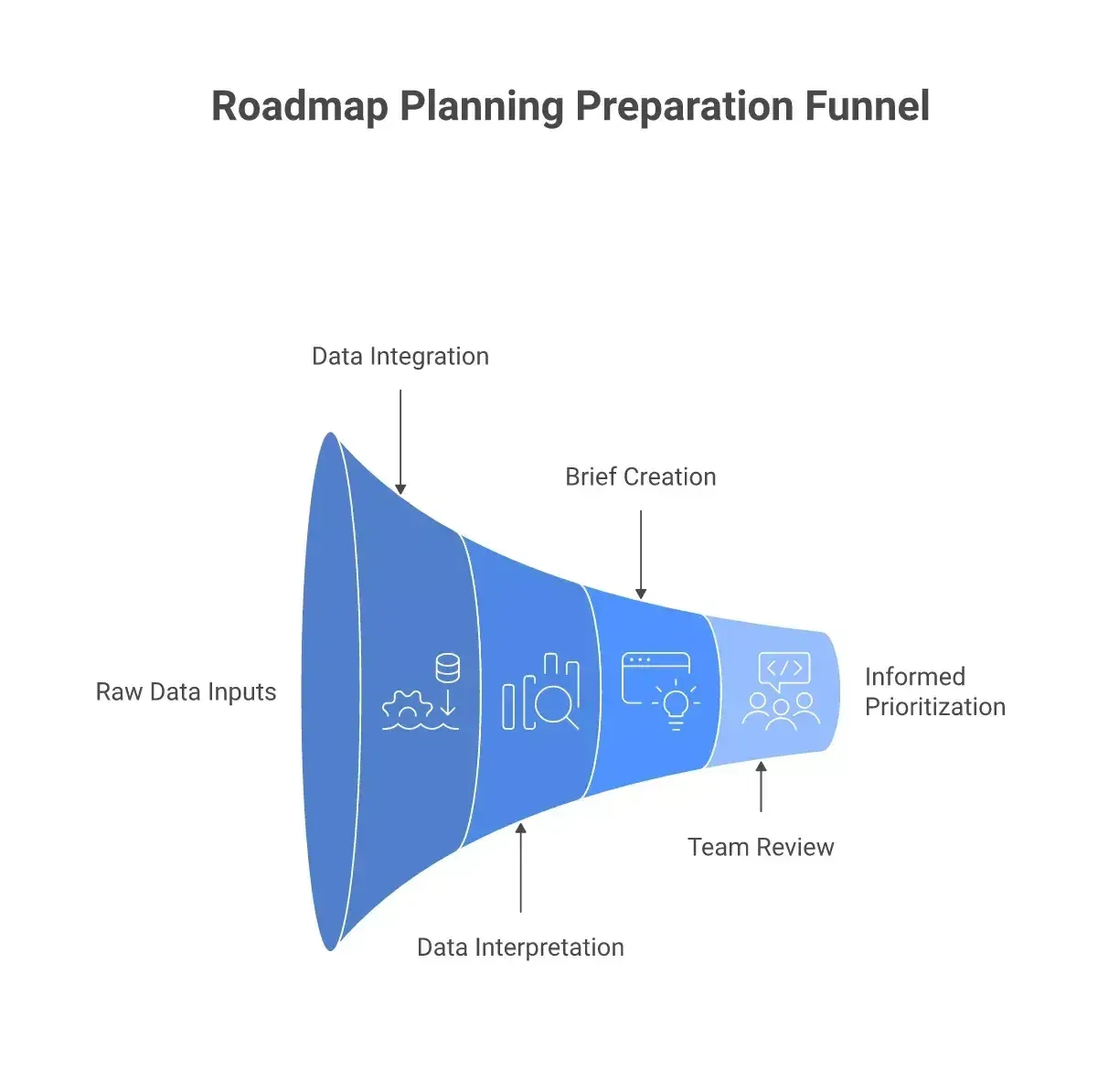
From Signal to Structured Insights: The Pre-Session Flow
The challenge isn't collecting signals. It's turning them into structured insights that a product team can actually use in a session.
Here's what that flow looks like when it works:
Competitor Signals + Customer Feedback + Usage Data → Intelligence Layer → Structured Brief → Roadmap Session → Prioritized Decisions → PRD / Next Sprint
The intelligence layer is the part most teams are missing. Raw signals don't become roadmap choices on their own. They need to be interpreted, connected, and structured into something the team can act on.
Turning Raw Intelligence Into Roadmap Choices
A structured brief before a roadmap session does three things:
-
It replaces opinion with evidence, so the session is about which direction to take, not whether the direction is real
-
It surfaces shifting priorities that the team might not have noticed, a competitor move, a customer pattern, or a usage drop that points to a problem worth solving
-
It gives stakeholders the right context to make decisions rather than push their own assumptions
When product teams walk into a session with a structured brief in hand, the conversation changes. It moves from "I think we should build X" to "the data suggests X is the highest-value move right now, here's why."
How AI-Driven Product Teams Are Changing Roadmap Planning
The shift toward AI-driven product management is already underway. According to Gartner, 61% of product managers are already using AI or machine learning in their work. The teams doing it well aren't just using AI tools to write faster; they're using them to think better before the work begins.
Faster Decision Cycles With Predictive Analytics
AI tools that surface predictive analytics give product teams a different kind of pre-session intelligence. Instead of looking backward at what happened last quarter, they can look at leading indicators that point to what's coming next.
That shift, from reactive to anticipatory, is what separates product teams that adjust quickly from teams that are always a step behind. Faster decision cycles don't come from moving faster in the session. They come from arriving with better information.
Getting Stakeholder Buy-in With Real Data
One of the most time-consuming parts of roadmap planning isn't the prioritization; it's the buy-in. Getting the executive team, the sales team, and engineering aligned on a direction takes longer when the direction is based on internal assumptions rather than real data.
When product teams bring structured, AI-driven intelligence into the session, buy-in gets easier. Not because the data is always conclusive, but because it gives everyone a shared starting point. The debate shifts from "whose opinion is right" to "what does the evidence suggest?"
So the question becomes: what does that intelligence system actually look like in practice?
How Rocket.new's Intelligence Changes What Happens Before the Session
This is where the gap between knowing what you need and actually having it gets closed.
Rocket.new is the world's first Vibe Solutioning platform, where product teams research what to build, build it, and monitor what matters, all in one place. Its Intelligence pillar is built specifically for the kind of continuous, pre-session intelligence that most product teams are trying to piece together from multiple tools.
The difference is not just what Intelligence monitors. It's what it does with what it finds.
Continuous Competitive Monitoring and Not a One-Time Report
Most competitive intelligence tools give you alerts. Rocket.new's Intelligence gives you interpretation.
There's a real difference. An alert tells you something changed. Interpretation tells you what that change means for your product strategy, and what you should do about it.
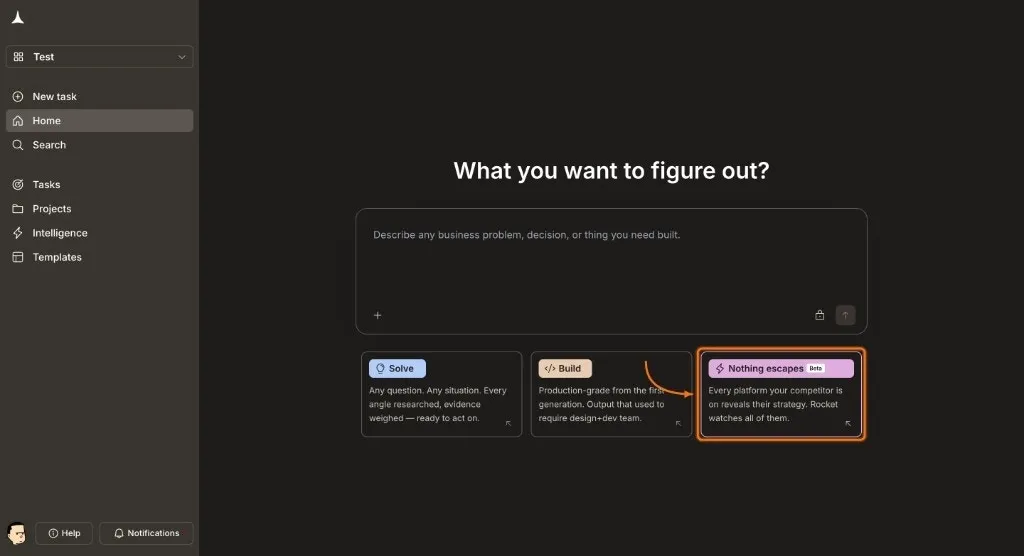
Six Signal Categories Tracked Automatically
Rocket.new's Intelligence monitors six categories per competitor, continuously:
-
Website: every page change, pricing update, messaging shift, and new feature announcement
-
Social Media: posts, campaigns, and engagement patterns across LinkedIn, X, Instagram, Facebook, YouTube, TikTok, and Reddit
-
News and Web Presence: press coverage, blog posts, partnership announcements, and executive interviews
-
Reviews and Reputation: G2, Glassdoor, Capterra, and other platforms; sentiment shifts tracked over time
-
People: headcount, hiring velocity, new roles, and executive activity; hiring concentration reveals where competitors are investing before any product announcement confirms it
-
Performance Marketing: ad activity across LinkedIn, Meta, and TikTok
Each of these is a signal. Together, they form a picture. When a competitor updates their pricing page, starts running enterprise-focused ads, and posts three LinkedIn articles about security compliance in the same week, that's not three separate signals. That's one clear strategic move. Rocket.new reads the cluster, not the individual change.
Competitive intelligence can save product teams up to 80% of the time spent on manual research by providing structured insights that inform product roadmap decisions.
The Daily Brief That Lands Before the First Meeting
Every day, Rocket.new produces a structured brief for every competitor: what moved, what it means, and what your team should consider doing about it. That brief lands before the first meeting of the day.
By the time a roadmap planning session arrives, product teams using Rocket.new aren't scrambling to catch up on competitor activity. They've been reading a daily brief for weeks. The intelligence is already in the room.
Solve: Turning Business Questions Into Structured Decisions
Intelligence tells you what's happening. Solve tells you what to do about it.
Rocket.new's Solve pillar takes any business question and delivers a complete, structured solution. Questions like:
-
"Should we prioritize this feature for enterprise customers?"
-
"What are the top three pain points our competitors are failing to address?"
-
or "How should we scope the next sprint given what we know about the market?"
The output isn't a summary. It's a full analytical deliverable: verdict, key findings with evidence, competitive landscape, risk matrix, and an execution path. Product managers can use it to write PRDs, scope backlog items, and prepare the brief that goes into the roadmap session.
That brief then feeds directly into the roadmap, and this is where structure matters most, because what gets planned shapes what gets built. With all these generating solutions quickly allows teams to gather early user feedback to decide on feature viability.
The Problem With Traditional Roadmaps
The traditional product roadmap typically lists features and release dates, providing clear visibility for sales and marketing teams, but often leads to unrealistic expectations due to its fixed nature.
When the market shifts, and it always does, teams locked into a feature-date roadmap find themselves delivering the wrong things on time rather than the right things when ready.
Theme Roadmaps: Strategic Focus Over Feature Lists
One evolution beyond the traditional model is the theme-based roadmap, which replaces specific features with strategic focus areas. This gives product teams the freedom to explore solutions without prematurely committing to a particular feature, keeping options open as research evolves.
The trade-off is that sales and marketing teams, who often need concrete deliverables to plan campaigns and conversations, may find theme roadmaps too vague to work from effectively. Solve bridges this gap by generating structured findings that give product teams strategic clarity while still producing tangible, shareable outputs that other departments can act on.
Outcome-Based Roadmaps: Accountability Without Rigidity
Outcome-based roadmaps take themes a step further by attaching measurable metrics, holding product teams accountable for delivering specific results rather than specific features. This preserves the exploratory freedom of theme roadmaps while adding a layer of performance accountability.
However, visibility challenges for other departments remain, as cross-functional teams still struggle to see what is concretely coming and when. The structured deliverables Solve produces, with evidence-backed findings and a clear execution path, give outcome-based roadmap owners the substance they need to communicate progress and intent across the organization.
Now-Next-Later: Planning Honestly Across Time
Perhaps the most honest roadmap format is the Now-Next-Later framework, which acknowledges a simple truth: certainty decreases the further out you plan. Teams commit firmly to what they are currently building, signal directional intent for what comes next, and leave the later column free of fixed dates. This format reduces the pressure to over-promise while keeping stakeholders oriented.
When Solve continuously feeds fresh market intelligence and structured analysis into each planning cycle, the Now-Next-Later roadmap stops being a static document and becomes a living, evidence-driven decision surface, updated as the market moves, not just as deadlines approach.
From Backlog Items to PRDs in One Shared Context
The Solve output doesn't disappear after export. It becomes the foundation of everything that follows inside the project.
The PRD generated by Solve is present when the developer opens the build task. The competitive brief is present when the landing page is written. The intelligence gathered before the session doesn't get lost in a document nobody reads; it lives in the project, connected to every task that follows from the decisions made in the session.
Context and Projects: Where the Intelligence Lives
Most AI tools start from zero every session. Rocket.new is built on the opposite architecture.
A Rocket.new Project is a persistent workspace. Add your competitive research, customer interview transcripts, strategy memos, and product briefs once, and every task that follows already knows everything. The tenth task knows everything the first nine established, plus everything brought in at the project level.
No Re-Explaining. No Re-Uploading. No Handoff Loss.
The most expensive moment in any collaborative product work is the context loss at the handoff.
The strategy team does research in one tool, produces a brief, hands it to the product in a document, the product reads 60% of it and writes a PRD from memory, hands it to engineering in a ticket, and the engineer misses two nuances. Three handoffs. Three context compressions. One product roadmap that reflects a fraction of the thinking that went into it.
In Rocket.new, the market research, the strategy brief, the PRD, and the build task are in the same project. So the platform allows teams to quickly generate working frontend and backend code from natural language prompts for feature ideas and more.
Every step inherits the full context of every prior step. The handoff is not improved, it is eliminated.
What Rocket.new Do That Other AI Tools Cannot
| Capability | Standalone Tools (Crayon / Klue) | General AI (ChatGPT / Perplexity) | Rocket.new Intelligence |
|---|---|---|---|
| Competitive monitoring | Yes - alerts only | No | Yes - interpretation + action |
| Connected to build | No | No | Yes - same project context |
| Structured decisions | No | Partial | Yes - via Solve |
| Daily brief | Some | No | Yes - before first meeting |
| Team shared context | No | No | Yes - compounding across tasks |
Tools like Crayon and Klue produce reports. General AI assistants respond to questions. Rocket.new produces decisions, and those decisions connect directly to what gets built.
Data-driven product teams are 2.9x more likely to launch products that meet their business goals. Rocket.new is built to make that kind of data-driven decision-making the default, not the exception.
Better Roadmap Planning Starts Before the Room Fills Up
The roadmap session isn't where decisions get made. It's where decisions get confirmed — or argued over. The intelligence that should have shaped those decisions either exists before the room fills up, or it doesn't exist at all.
Most product teams are good at running the session. They're less good at the prep that makes the session worth having. Scattered tools, fragmented customer feedback, one-off competitive research, and internal assumptions that feel like data — these are the inputs that produce roadmaps built on shaky ground.
How does a product team use Rocket.new's Intelligence before a roadmap planning session? They use it to arrive with a complete picture: continuous competitive signals interpreted into daily briefs, customer feedback synthesized across multiple sources, and structured decisions from Solve that connect directly to the backlog. The session becomes a confirmation of what the data already suggested — not a debate about whose opinion is right.
That's the difference between a product roadmap that reflects the market and one that reflects the meeting.
👉Start using Rocket.new Intelligence to walk into every roadmap session with decisions already backed by data.
Table of contents
- -The Meeting That Decides Everything (and the Prep That Usually Doesn't Happen)
- -Why Most Product Roadmaps Start on Shaky Ground
- -The Real Cost of Going in Blind
- -What Product Teams Actually Need Before a Roadmap Session
- -Competitive Signals, Not Just Internal Assumptions
- -Customer Feedback Patterns, Not One-Off Tickets
- -Usage Data and Leading Indicators
- -The Three Signals That Should Shape Every Product Roadmap
- -Signal 1: What Competitors Are Doing Right Now
- -Signal 2: What Customers Are Saying Across Multiple Sources
- -Signal 3: What the Data Reveals About User Behavior
- -From Signal to Structured Insights: The Pre-Session Flow
- -Turning Raw Intelligence Into Roadmap Choices
- -How AI-Driven Product Teams Are Changing Roadmap Planning
- -Faster Decision Cycles With Predictive Analytics
- -Getting Stakeholder Buy-in With Real Data
- -How Rocket.new's Intelligence Changes What Happens Before the Session
- -Continuous Competitive Monitoring and Not a One-Time Report
- -Six Signal Categories Tracked Automatically
- -The Daily Brief That Lands Before the First Meeting
- -Solve: Turning Business Questions Into Structured Decisions
- -The Problem With Traditional Roadmaps
- -Theme Roadmaps: Strategic Focus Over Feature Lists
- -Outcome-Based Roadmaps: Accountability Without Rigidity
- -Now-Next-Later: Planning Honestly Across Time
- -From Backlog Items to PRDs in One Shared Context
- -Context and Projects: Where the Intelligence Lives
- -No Re-Explaining. No Re-Uploading. No Handoff Loss.
- -What Rocket.new Do That Other AI Tools Cannot
- -Better Roadmap Planning Starts Before the Room Fills Up