
Rocket.new eliminates traditional development handoffs by using shared project memory across research, planning, and code generation. Its three layers, Solve, Build, and Intelligence, turn strategy and competitor insights directly into working apps. The result: faster development, fewer context losses, and smarter, continuously evolving products.
The plan is done. Competitors are mapped. Why still re-brief a developer from scratch?
Rocket reads your plan, market research, and competitor notes into project memory, then builds web apps and a mobile app from it.
A single unplanned context switch can cost a developer up to 20% of cognitive capacity, which is the handoff tax most teams pay. The platform collapses that tax entirely. Upload a plan, PRD, or Figma and the AI-powered system logs each finding as durable project knowledge.
Build runs code generation from that memory while Intelligence keeps track of competitor moves.
Why Handoffs Break App Development?
Most teams still run a relay: research to product, product to design, design to developers. Each handoff sheds thinking, and developers end up guessing.
- A ticket rarely carries the market sizing logic behind it.
- A Figma comment cannot replay why a competitor's pricing page failed.
- A kickoff meeting tries to rebuild the plan as "background for the call" but strips the nuance.
Weeks vanish into debugging, progress stalls, and teams keep waiting on another briefing. The root cause is not slow execution. It is good execution of the wrong thing, because the thinking never made it into the build.
What Already Knowing Your Strategy Actually Means
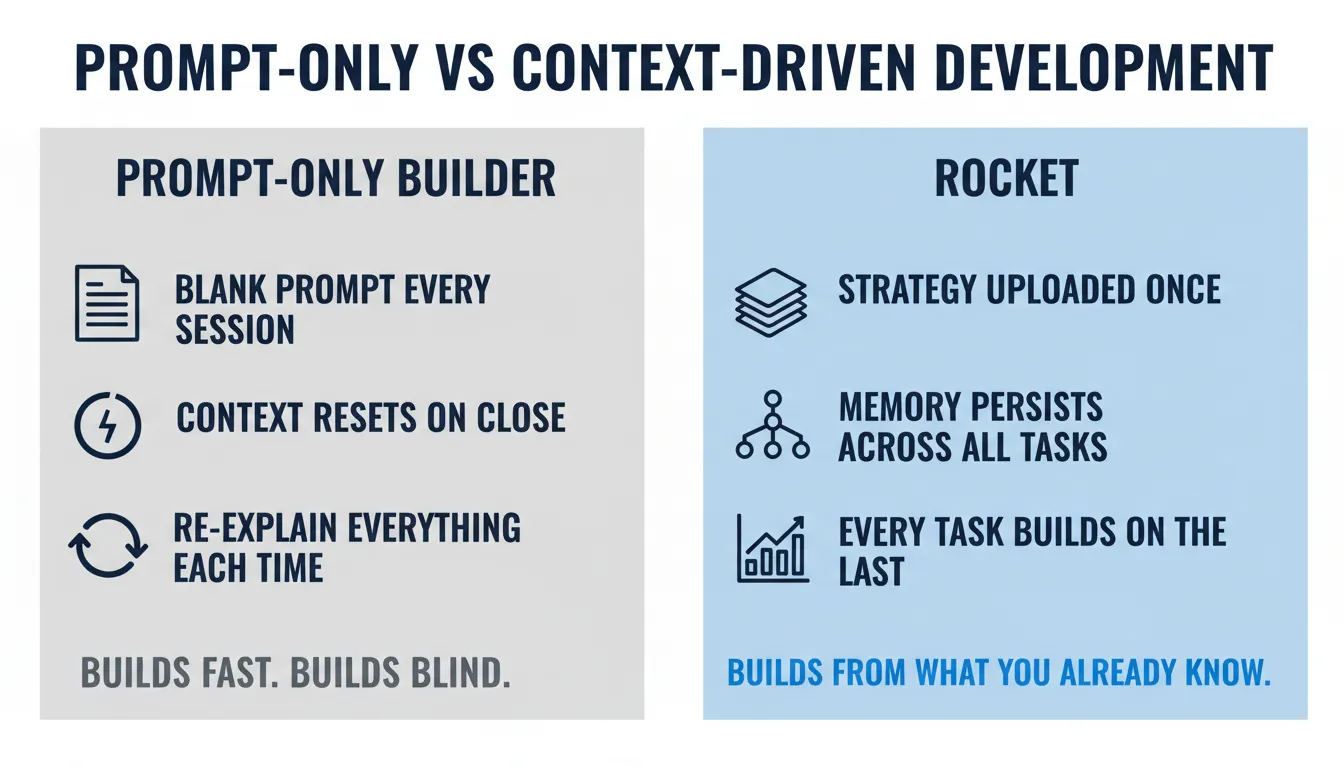
Most AI app builders start from a blank prompt every session. Context disappears when the tab closes. The next session re-explains everything the last one figured out.
Rocket uses project memory, a persistent knowledge base at the project level, not the session level. Every uploaded document, every Solve report, every Build decision stays accessible to every subsequent task. A competitive teardown from last month is as available as one from this morning.
This is the structural difference. It is not a feature. It is a different answer to the question of who runs the operation.
How the Platform Turns Research Into Working Code
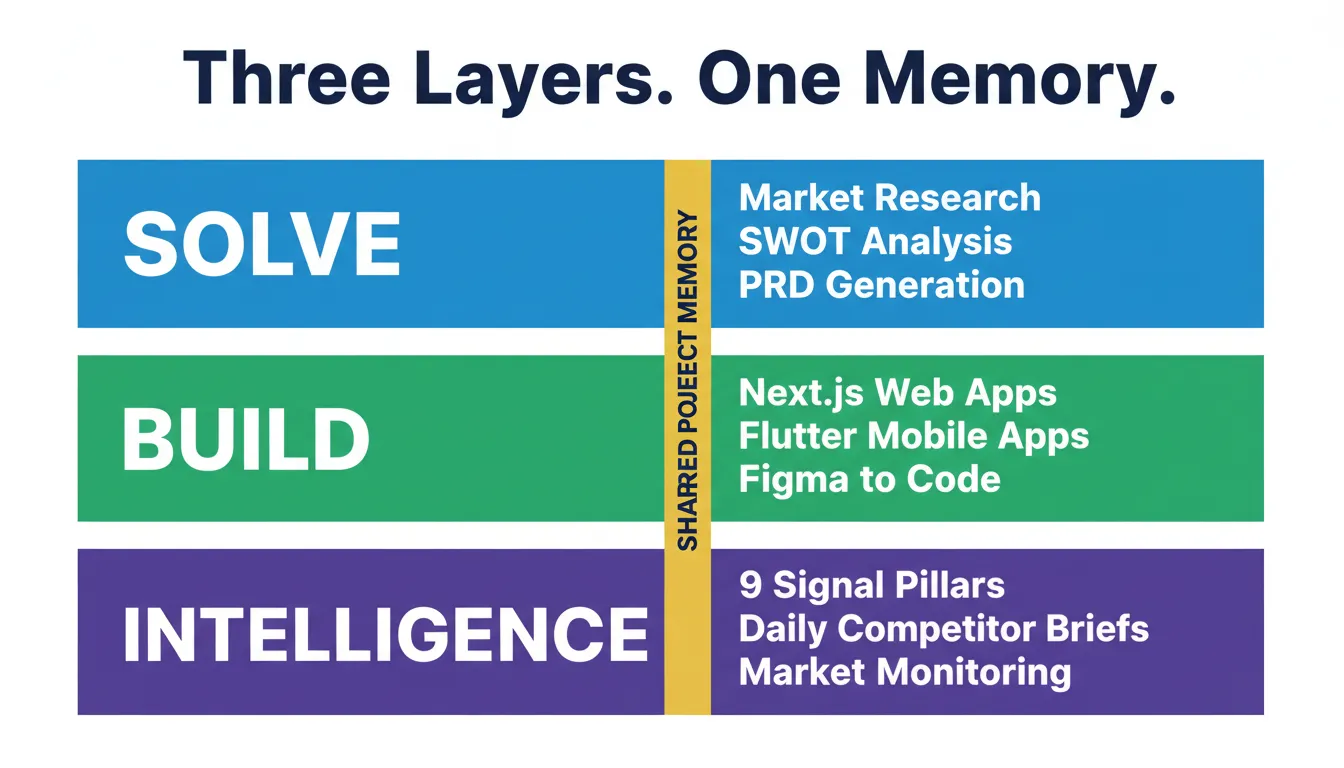
Rocket enables teams to build software in days instead of months by providing a unified workspace that integrates planning and building processes. Uploads, comments, and findings connect three layers the docs describe.
Solve: Turning Questions Into Structured Briefs
Solve is Rocket's research engine. Type a business question in plain language and get back a structured, evidence-backed report, not a chatbot response, but a deliverable you can present to any room.
Solve breaks each question into component dimensions, runs parallel research streams simultaneously, then synthesises findings into an executive summary with supporting evidence and recommendations. Every report becomes part of your project memory, available to every Build and Intelligence task that follows.
What Solve produces:
- SWOT analysis, market sizing (TAM/SAM/SOM), and competitive teardowns
- Pricing strategy benchmarks and product direction recommendations
- PRDs generated from strategy memos and customer research
- Board-ready reports exportable as PDF or PPTX
Solve is distinct from search or chatbots. Search returns links. Chatbots return summaries from training data. Solve returns a structured, multi-source report with live data, analysis, and actionable recommendations built from your specific context.
Build: Code Generation From Memory, Not Prompts
Build picks up the Solve findings and runs code generation. No re-explaining the concept.
- Generates Next.js web apps and Flutter for iOS and Android, with auth, database, and one-click publish.
- Accepts prompts, Figma imports, or starter templates, and reuses project memory to reduce repeated context loading.
When Build encounters a complex architectural decision or an error loop, the Advisor Agent activates. This is a senior architect sub-agent running on Claude Opus that diagnoses root causes, evaluates architectural options, and makes decisions so the coding agent never gets stuck and you never debug AI-generated errors manually. The Advisor never writes code. It returns structured analysis, root causes, and numbered implementation steps, then the coding agent executes.
Build also ships with WCAG 2.1 AA accessibility compliance, GDPR and CCPA privacy defaults, built-in analytics, and Core Web Vitals performance monitoring, all without additional configuration.
Intelligence: Competitive Signals That Feed Back Into Build
After that, Intelligence watches the market. It keeps a log of competitor moves and adds a short comment on every signal worth acting on.
- Daily comment briefs map pricing changes and feature launches.
- Every signal triggers a Solve task or Build edit with a short comment.
By using a unified workspace for all three, Solve, Build, and Intelligence, Rocket allows teams to continuously adjust their ideas based on real-time feedback during the app development process, enhancing clarity and reducing wasted effort.
The Solve-Build-Intelligence Loop
The three layers share one memory. A Solve finding informs a Build decision, and an Intelligence signal can reshape both. Research feeds code generation. Deployed apps generate competitive signals. Intelligence reshapes both research priorities and build decisions, continuously.
The Handoff Tax vs. The Rocket Way
Traditional development loses context at every boundary between tools and people. Here is exactly where that happens and what Rocket does instead.
| Stage | Traditional Workflow | Rocket Workflow |
|---|---|---|
| Market research | Separate tool, manual notes | Solve: structured report in minutes |
| Competitive analysis | Manual spreadsheet, quarterly | Intelligence: continuous, 9 pillars |
| Planning | Handoff doc, context lost | Findings flow into project memory |
| Design to code | Figma plus developer handoff | Figma import, component-level fidelity |
| Code generation | Developer re-briefed each time | Build reads project memory automatically |
| Iteration | New sprint, new briefing | @-mention past tasks, context retained |
The compounding advantage: every task on Rocket builds on every task before it. The research you ran last Tuesday is available when your team starts building today. That is what cross-task context means in practice.
What Ships From a Rocket Project
Every build produces production-ready, deployable output, not a prototype or a demo.
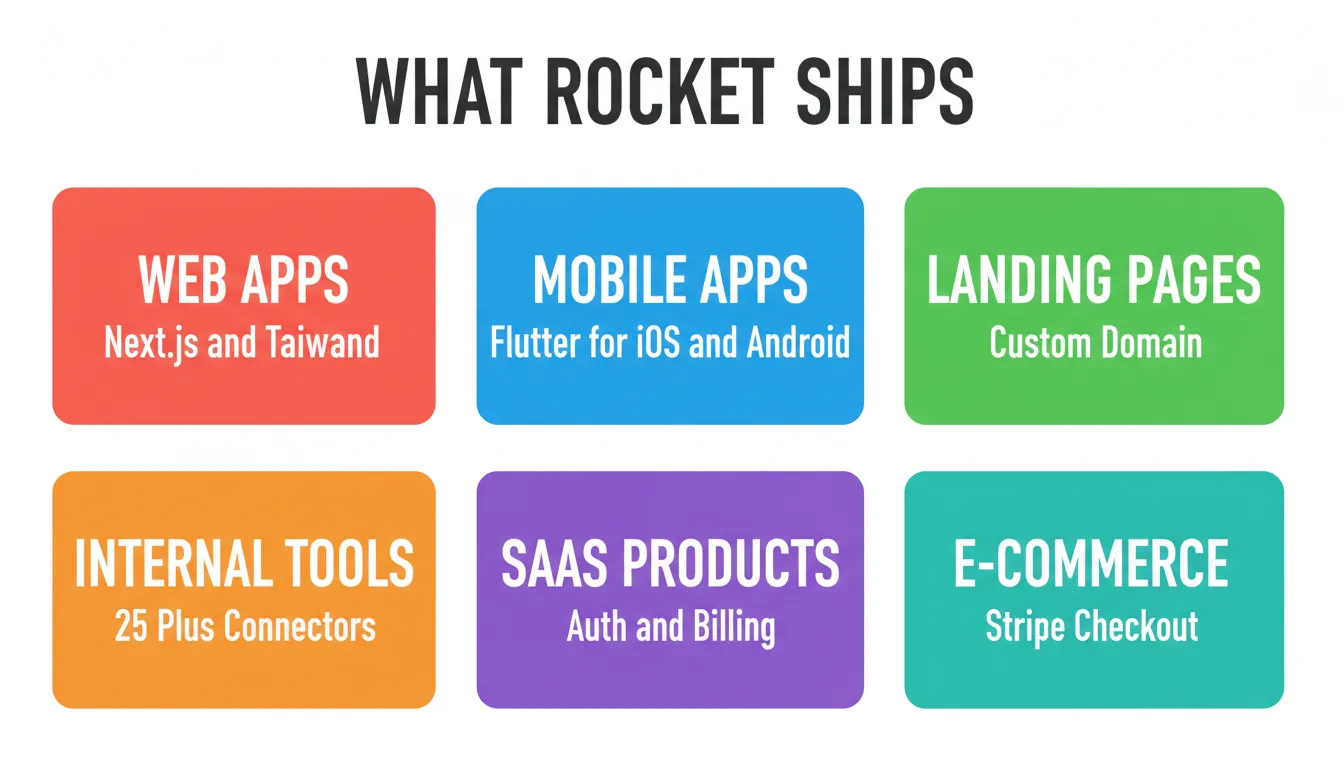
| Output | Stack | Deployment |
|---|---|---|
| Web apps | Next.js 15, Tailwind CSS | One-click publish, custom domain |
| Mobile apps | Flutter (iOS and Android) | App Store, Google Play, APK |
| Landing pages | Next.js | Custom domain, Netlify CDN |
| Internal tools | Next.js with connectors | Staging and production |
| SaaS products | Full-stack Next.js | Subscriptions, team workspaces |
| E-commerce stores | Next.js with Stripe | Product catalog, cart, checkout |
Real-World Use Cases
The Solo Founder With Validated Research
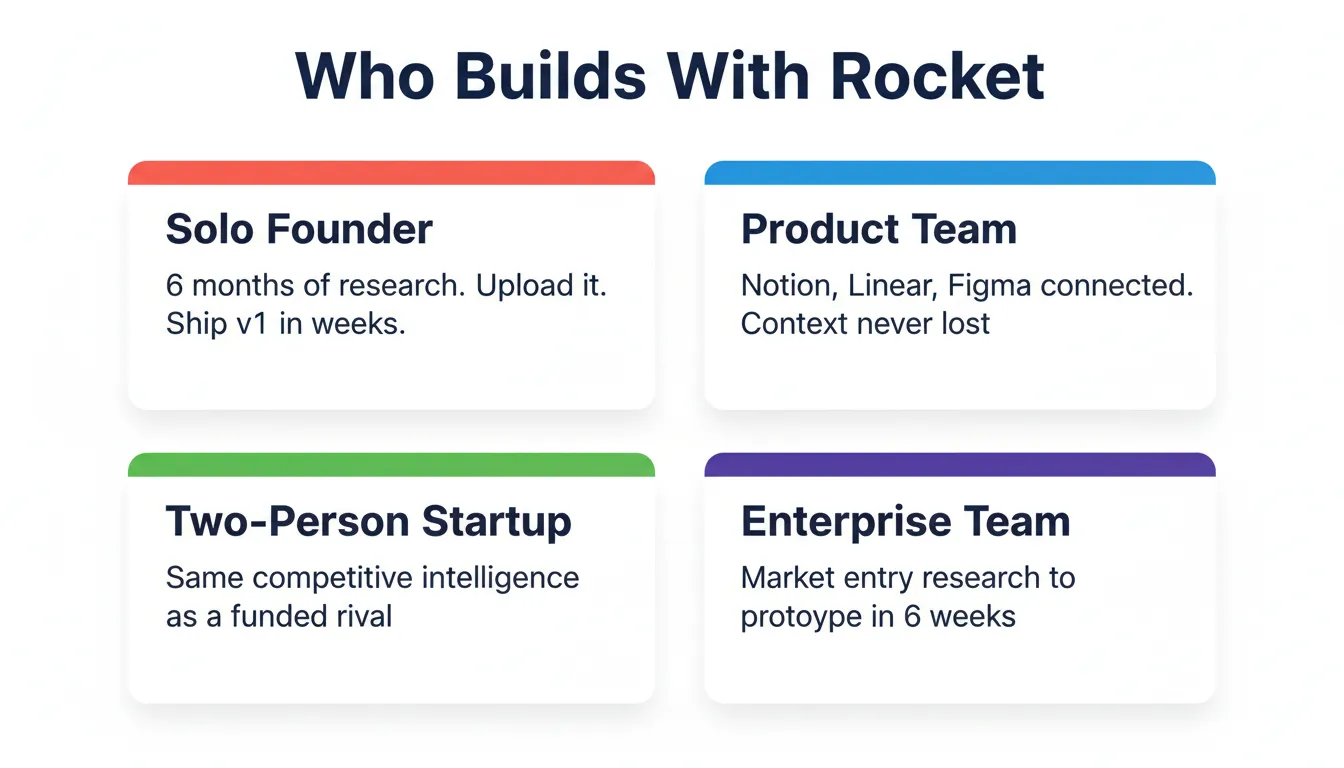
A founder has six months of customer discovery: a research document, a competitor teardown, and a rough Figma wireframe. Without Rocket, they hire a dev shop, spend two weeks re-explaining the research, and watch the first sprint produce something misaligned.
With Rocket: upload the research, run a Solve task to generate a PRD prioritising the most underserved pain points, import the Figma file into Build, and ship v1 in weeks, not months. Intelligence then monitors competitors daily so the product evolves with the market, not behind it.
The Product Team With Fragmented Context
A 12-person product team uses Notion for specs, Linear for tickets, and Figma for design. Context is fragmented across tools. With Rocket's Launchpad connector, Notion pages and Linear tickets become live context for every Solve and Build task. When a competitor launches a new feature, Intelligence surfaces it as a strategic signal and connects it to the current build sprint automatically.
The Two-Person Team Competing Against Funded Rivals
A two-person startup cannot afford a research team or a full engineering team. Intelligence gives them the same competitive visibility as a funded competitor's analyst team. Solve gives them the same research depth as a hired consultant. Build gives them the same engineering output as a small dev team, and the shared memory means neither founder ever re-explains context to the other, or to the AI.
The Enterprise Team Entering a New Market
An enterprise product team needs market sizing, regulatory analysis, competitive positioning, and a prototype within six weeks. Solve handles the market sizing and regulatory research. Build generates an internal prototype using those findings as context. Intelligence monitors the key competitors identified in the Solve report. The Solve report exports as a board-ready PDF. Six weeks instead of six months.
The Context Engineering Advantage
The concept underlying Rocket's approach has a name in the AI research community: context engineering. As Michael Schwartzman, who spoke at GitHub Connect Israel on spec-driven development, explained:
"Prompt engineering alone is not enough. Context engineering is the basis for spec-driven development. Together they deliver reliable AI coding: context feeds the model only what matters at the right time, while the spec becomes the source of truth for code, tests, and docs." Michael Schwartzman
Rocket operationalises context engineering at the platform level. Your strategy document is not a prompt. It is a persistent spec that every AI task references. Your competitor research is not a one-time query. It is a live intelligence feed that reshapes your build priorities in real time.
Most AI tools help you build faster. None of them tell you what to build. That is the problem Rocket was built to solve.
Intelligence: Nine Pillars of Competitive Monitoring
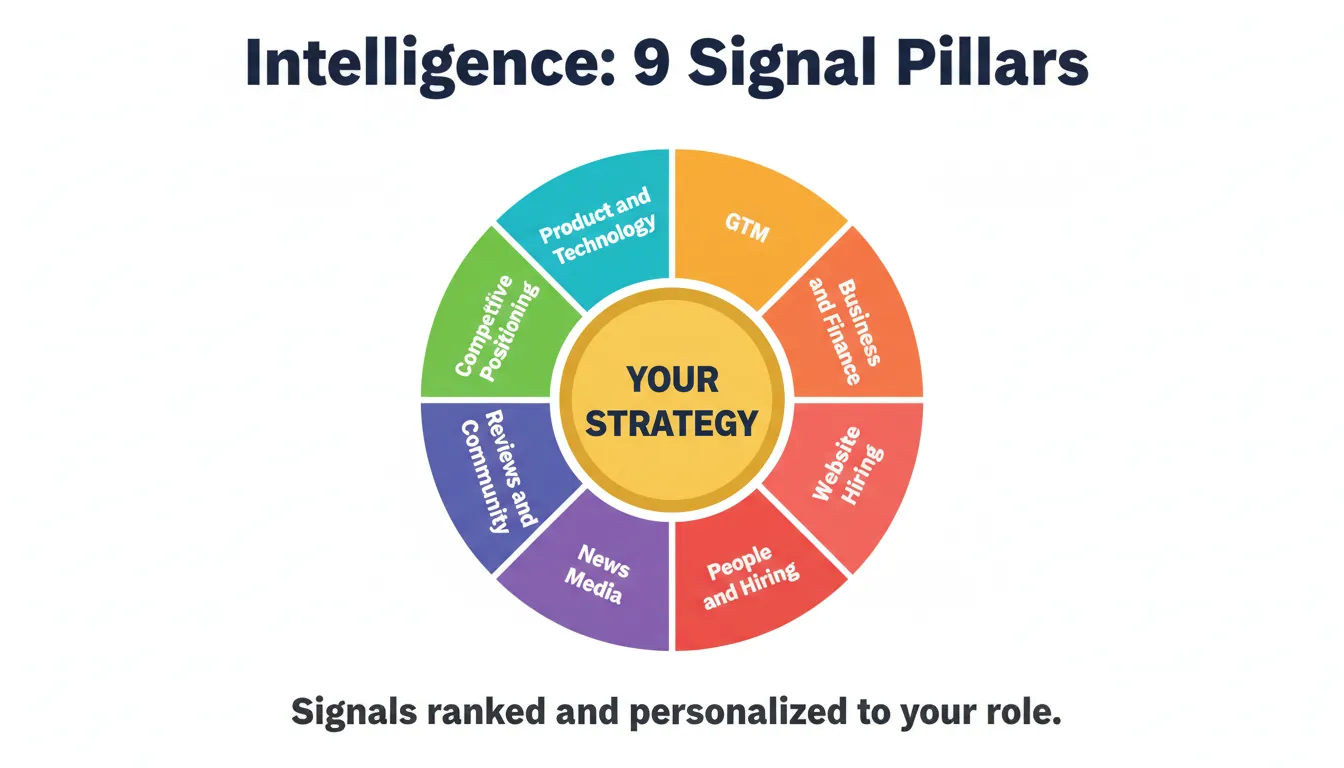
Intelligence is an interpretation layer, not an alerting system. When a signal appears, it is evaluated against everything else happening across every surface simultaneously: other signals in the same window, the company's historical patterns, and your specific business context.
The nine pillars Intelligence monitors per company:
- Product and Technology - feature launches, GitHub activity, app store updates
- GTM - paid campaigns, SEO moves, creator partnerships, PR
- Business and Finance - funding, pricing changes, partnerships
- People and Hiring - hiring velocity, leadership changes, team growth
- Website Intelligence - messaging changes, pricing page updates
- Reviews and Community - G2, Reddit, Product Hunt, app store sentiment
- Social Media - executive posts, content strategy shifts
- News and Media - third-party press coverage
- Competitive Positioning - repositioning signals, market entry moves
Absence is also a signal. When a competitor stops posting, stops hiring, or stops updating their pricing page, Intelligence detects that too. Silence can be as strategically significant as activity.
What Else Rocket Covers
Redesign: Reimagining Existing Products
Beyond building from scratch, Rocket includes a Redesign capability. Paste a URL, pick a redesign command, and get a rebuilt page. This is useful for teams iterating on existing products or redesigning competitor-inspired interfaces without starting from a blank canvas.
25+ Connectors: Building From Your Existing Stack
Rocket connects to 25+ third-party services with a single prompt, covering Stripe, Supabase, HubSpot, Notion, Airtable, GitHub, Google Workspace, Linear, Jira, and more. You do not rebuild your stack around Rocket. Rocket reads your existing stack and builds from it. The full connector library covers payments, CRM, databases, AI providers, email, and scheduling.
The Vibe Solutioning Platform: The Full Arc
Rocket is the world's first Vibe Solutioning platform. Vibe Solutioning is the practice of thinking rigorously before building, and building from that thinking, all in one platform. Research. Decide. Build. Operate. Grow. One system. One shared context that makes every action smarter than the last.
This is distinct from vibe coding, which starts at line one. Vibe Solutioning starts before it, with the question of what to build and why.
Team Collaboration Inside the Work
Rocket's collaboration layer lets teams share projects, assign roles, and work from the same accumulated intelligence. There is no separate project management tool, no context-loading step, no "let me get you up to speed" meeting. The intelligence compounds across every team member, not just the person who ran the last research task.
Build From What You Already Know
The question "how does Rocket.new build an app when it already knows your strategy" points to a fundamental shift in how software gets built. The old model separated thinking from building. Context degraded at every boundary between tools and people.
Rocket collapses those boundaries. Research, building, and competitive intelligence share one memory. Strategy becomes code. Competitive signals become product decisions. The team that ships fastest is not the one with the most developers. It is the one with the best context.
1.5 million people have tried Rocket across 180 countries. The research is done. The strategy is clear. Start building on Rocket and ship your first version this week.
Table of contents
- -Why Handoffs Break App Development?
- -What Already Knowing Your Strategy Actually Means
- -How the Platform Turns Research Into Working Code
- -Solve: Turning Questions Into Structured Briefs
- -Build: Code Generation From Memory, Not Prompts
- -Intelligence: Competitive Signals That Feed Back Into Build
- -The Solve-Build-Intelligence Loop
- -The Handoff Tax vs. The Rocket Way
- -What Ships From a Rocket Project
- -Real-World Use Cases
- -The Solo Founder With Validated Research
- -The Product Team With Fragmented Context
- -The Two-Person Team Competing Against Funded Rivals
- -The Enterprise Team Entering a New Market
- -The Context Engineering Advantage
- -Intelligence: Nine Pillars of Competitive Monitoring
- -What Else Rocket Covers
- -Redesign: Reimagining Existing Products
- -25+ Connectors: Building From Your Existing Stack
- -The Vibe Solutioning Platform: The Full Arc
- -Team Collaboration Inside the Work
- -Build From What You Already Know