Rocket.new eliminates traditional development handoffs by using shared project memory across research, planning, and code generation. Its three layers, Solve, Build, and Intelligence, turn strategy and competitor insights directly into working apps. The result: faster development, fewer context losses, and smarter, continuously evolving products.
The plan is done. Competitors are mapped. Why still re-brief a developer from scratch?
The Short Answer: Rocket.new reads your plan, market research, and competitor notes into project memory, then builds web apps and a mobile app from it.
A single unplanned context switch can cost a developer up to 20% of cognitive capacity, which is the handoff tax most teams pay. The platform collapses.
- Upload a plan, PRD, or Figma; the AI-powered system logs each finding as durable project knowledge.
- Build runs code generation from that memory while Intelligence keeps track of competitor moves and comments on shifts.
Why Handoffs Break App Development
Well, most teams still run a relay: research to product, product to design, design to developers. Each handoff sheds thinking, and developers end up guessing.
- A ticket rarely carries the market sizing logic behind it.
- A Figma comment cannot replay why a competitor's pricing page failed.
- A kickoff meeting tries to rebuild the plan as "background for the call" but strips the nuance.
Weeks vanish into debugging, progress stalls, and teams keep waiting on another briefing.
Rocket.new enables teams to build software in days instead of months by providing a unified workspace that integrates planning and building processes. Uploads, comments, and findings connect three layers the docs describe.
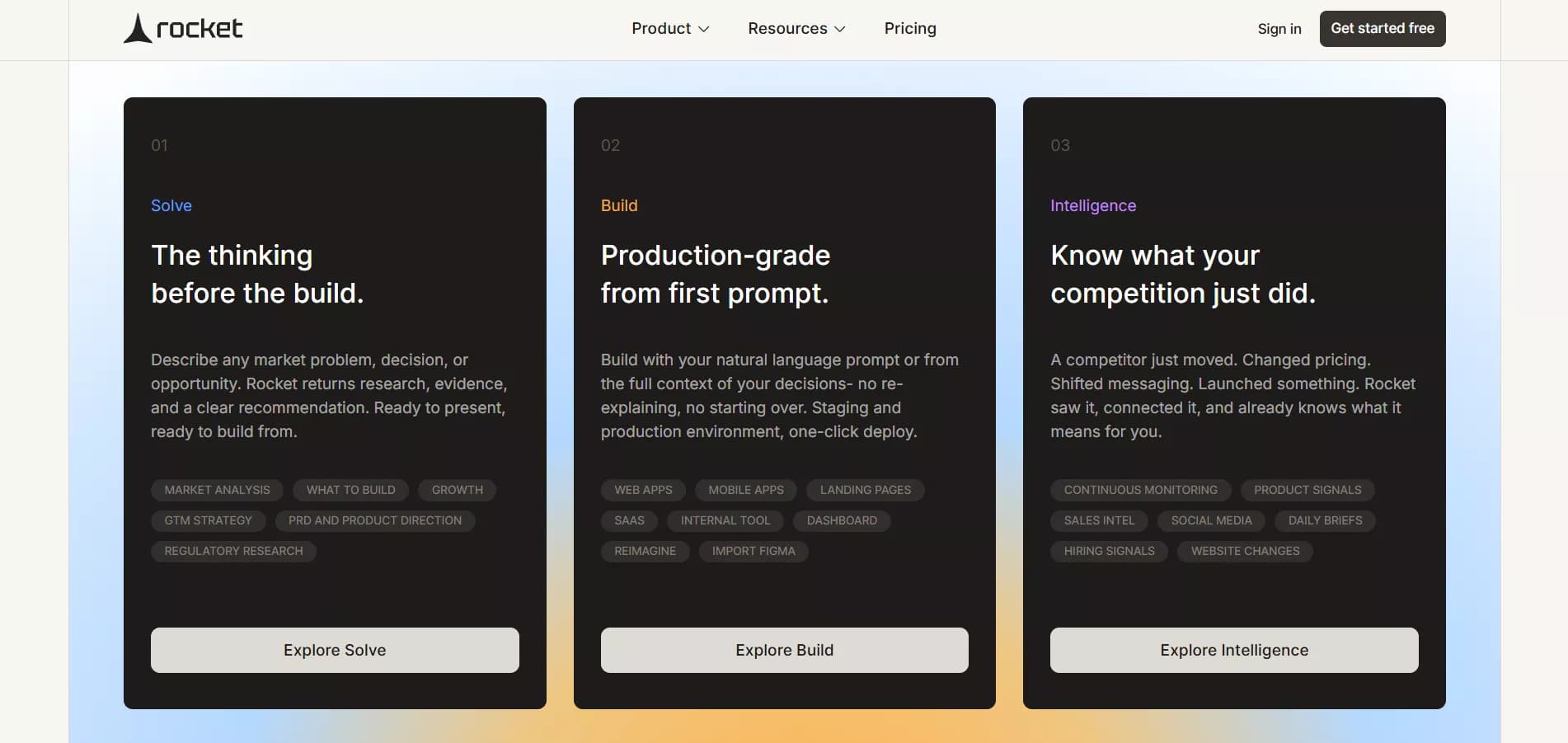
Solve Captures The Findings
Solve is the research engine. Drop in a question, deck, or dataset, and it returns a brief to build from. This way, the platform eliminates the 'context rot' that occurs when moving from research documents to a separate coding environment, preserving findings from planning through code generation.
- Runs SWOT, problem validation, and market sizing as structured reports.
- Accepts URLs, attachments, and @-mention comments from other tasks, so every comment becomes usable context.
Build Handles Code Generation
Then Build picks up the findings and runs code generation. No re-explaining the concept.
- Generates Next.js web apps and Flutter for iOS and Android, with auth, database, and one-click publish.
- Accepts prompts, Figma imports, or starter templates; saves up to 80% tokens by reusing project memory.
After that, Intelligence watches the market. It keeps a log of competitor moves and adds a short comment on every signal worth acting on.
- Daily comment briefs map pricing changes and feature launches.
- Every signal triggers a Solve task or Build edit with a short comment.
By using a unified workspace for all three: Solve, Build, and Intelligence, Rocket.new allows teams to continuously adjust their ideas based on real-time feedback during the app development process, enhancing clarity and reducing wasted effort.
The three layers share one memory. A Solve finding informs a Build decision, and an Intelligence comment can reshape both.
- Solve answers one question at a time.
- Build the app from that answer.
- Intelligence comments when the market moves.
What Ships From A Project
Outputs the platform can publish, based on its own docs:
| Output | Stack | Where it ships |
|---|
| Web apps | Next.js, Tailwind | One-click publish, custom domain |
| Mobile app | Flutter (iOS, Android) | App Store, Google Play |
| Landing pages | Next.js | Custom domain |
| Internal tools | Next.js with connectors | Staging and production environment |
Every build carries version history, component-level editing, and rollback fix.
Community voices keep circling back to one point: the quality of an AI build tracks the quality of the memory around it. Michael Schwartzman, who spoke at GitHub Connect Israel on this topic, commented:
"Prompt engineering alone is not enough. Context engineering is the basis for spec-driven development. Together they deliver reliable AI coding: context feeds the model only what matters at the right time, while the spec becomes the source of truth for code, tests, and docs." - Source: Michael Schwartzman
His comment maps onto the vibe solutioning platform practice. The spec is your plan. The memory is every structured finding plus every competitor comment. Developers understand the scope, act on real signals, and create the build from that context.
How Rocket.new Handles Strategy-Driven App Development
The vibe solutioning builder ships finished thinking as software. In this world, one platform handles research, code generation, and competitive intelligence with shared memory across every team member.
Core Features:
- Vibe solutioning platform design with one shared memory across tasks.
- 25k+ templates library, free to use.
- Flutter mobile app output and Next.js web apps.
- Built-in collaboration with comment threads.
- Three products, one platform: Solve, Build, Intelligence.
Use Cases:
- A solo founder uses a competitor teardown to create a usable prototype and keep track of rivals through Intelligence comment briefs.
- Product teams upload research and Figma; Build generates a mobile app with auth wired in, tested against criteria.
- A startup runs a PRD through Solve and ships v1 in four weeks, keeping scope tight, managing complexity, and holding focus on the core loop.
Who This Fits
- Solo founders who did the thinking and want the output.
- Product teams that need to launch without losing focus, even when writing code hits challenges.
- Startups on a tight budget that cannot wait weeks for a dev shop.
- Enterprises keep knowledge across every team member via competitive intelligence.
If research, plan, and competitor notes exist, it builds directly from them. That makes sense. Teams ship faster.
From Research To A Shipped App
The real question is how does Rocket.new build an app when it already knows your strategy, your research, and your competitors.
The answer: the platform uses each finding to prepare a structured brief, logs it, and carries it from research to code generation to ship. That ability compresses strategy-to-ship from months to weeks. The call to action section below has the next step.
Start Building With Your Existing Intelligence
- Connect your research, upload your plan, sync your Figma.
- Solve maps the gaps; Build handles code generation for web apps or a mobile app.
- Intelligence tracks and comments on competitor moves while you ship.
Start building on Rocket.new