Rocket turns validated intelligence into production-grade apps by keeping research, decisions, and deployment connected in one system. This article explains how the Vibe Solutioning platform works and why it builds stronger apps from the first version.
What if the thinking before you build was just as automated as the build itself?
That is the gap most AI tools never close. They start at line one. Rocket starts before it.
By keeping validated intelligence connected through every stage, from market research to deployment, Rocket turns ideas into production-grade apps built on proof, not guesswork.
This article breaks down exactly how that works, why it matters, and what it means for anyone building software today.
What "Production-Grade" Actually Means
The term gets used loosely. A production-grade app is not a working demo on someone's laptop. It is a live system that real users depend on, with the infrastructure to match.
In 2026, production-grade means your app ships with secure user authentication, role-based access control, WCAG accessibility compliance, GDPR and data privacy coverage, SEO-ready structure, and performance optimization across Core Web Vitals. It also means staging and production environments, full version history, and one-click rollback when something breaks.
What it does not mean: a prototype that only works on your machine, a front-end shell with no backend logic, or an app that collapses under more than a few dozen concurrent users.
Most AI builders generate code. Rocket generates production grade apps, with those standards as the baseline, not optional extras.
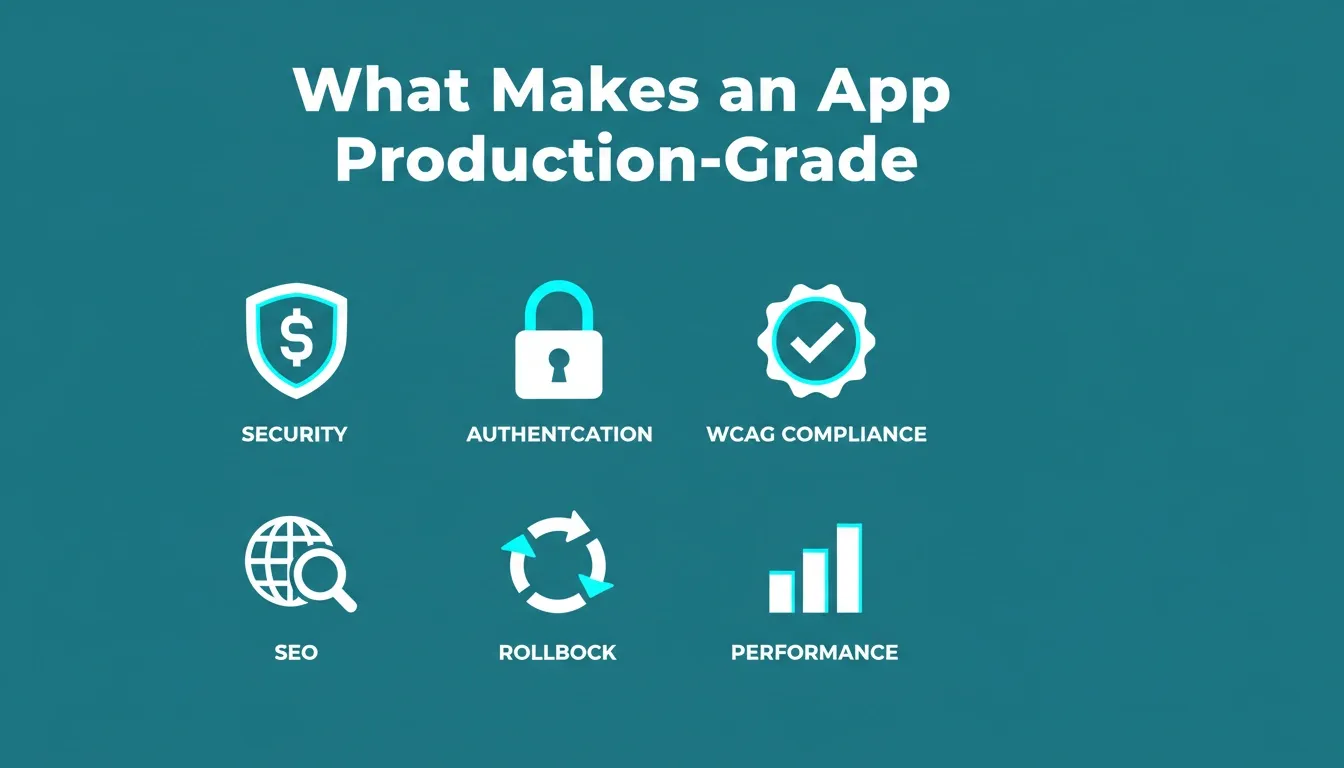
The six standards that separate a production grade app from a prototype: security, authentication, accessibility, SEO, rollback, and performance.
The Problem Every Other AI Builder Ignores
The most expensive mistake in software development is not bad execution. It is good execution of the wrong thing.
Every generation of AI tools has made building faster. None of them addressed the thinking before the build. You still had to figure out what to build, validate the market, map the competitive landscape, and define the product direction, all in separate tools, with no connection to the actual build.
Then you pasted your conclusions into a prompt and hoped the context survived the translation. It rarely did.
According to McKinsey, around 78% of organizations are already using AI in at least one business function. But adopting AI tools and adopting AI-driven thinking are two different things. Most teams are building faster with the same amount of guesswork baked in.
Rocket was built to close that gap.
What Vibe Solutioning Changes
Rocket is the world's first Vibe Solutioning platform, where businesses research what to build, build it, and monitor what matters, all in one place. The category is worth understanding because it explains why production grade apps built on Rocket are structurally different from apps built on any other tool.
Vibe Solutioning is the practice of thinking rigorously before building, and building from that thinking, in one platform. Research. Decide. Build. Operate. Grow. One system, one shared context, every action smarter than the last.
The key distinction from vibe coding: vibe coding starts at line one. Vibe Solutioning starts before it. Other tools help you build faster. Rocket figures out what is worth building, then builds it.
That distinction shows up directly in the output. When the intelligence that validated the direction connects to the build that executes it, nothing gets lost between steps. The product reflects the thinking, and the first version is already closer to right.
How Rocket Turns Validated Intelligence into Production-Grade Apps
Step 1: Solve — Research Before the First Line of Code
You have a product idea and ten questions. Type the idea into Solve. Describe your market problem, your target audience, and your competitive context. Rocket returns a structured report with data, evidence, and a clear recommendation. It is not a list of links. It is a decision-ready output.
What Solve produces:
- Market entry analyses and competitive landscape maps
- Product requirements documents (PRDs)
- Board-ready strategy memos and M&A assessments
- Campaign strategy briefs and regulatory research by jurisdiction
The output does not sit in a separate document. Instead, it flows directly into Build as shared context for everything that follows.
To see how Solve connects research to real product decisions, read how Rocket's Intelligence informs pricing decisions.
Step 2: Build — Production-Grade Generation from Validated Context
When you move from Solve to Build, Rocket already has the full context of your research, decisions, and competitive picture. There is no re-explaining. No lost context. No translation step.
You describe what you want to build. Rocket plans the architecture, writes production-ready code, and shows a live preview. Most apps generate in one to three minutes.
What Build generates:
| App Type | Framework | What Ships |
|---|---|---|
| Web apps (SaaS, dashboards, portals) | Next.js | Full-stack with Supabase, auth, payments |
| Mobile apps (iOS and Android) | Flutter | Real design systems, dark/light theming, fluid navigation |
| Landing pages | Next.js | SEO-optimized, conversion-focused, fast load |
| Internal tools | Next.js | OKR trackers, health monitors, compliance tools |
| E-commerce stores | Next.js | Product catalogs, checkout flows, payment integrations |
Every build ships with SEO-ready structure, WCAG accessibility compliance, GDPR coverage, and performance optimization by default. These are the baseline, not optional extras. For a deeper look at why Rocket generates in Next.js and Flutter specifically, read why Rocket generates web apps in Next.js and mobile apps in Flutter.
Step 3: Refine — Iterate Without Losing Context
After the first generation, you refine through conversation. Change the data model, adjust visual hierarchy, add features, connect integrations, or modify specific sections. All of it happens in context. Rocket knows what it built and why, so you just describe what needs to change.
Three iteration modes are available: Chat (natural language instructions), Visual Edit (click any element in the live preview to change text, style, or layout directly), and Code (full access to the generated Next.js or Flutter source for direct editing or local download).
Step 4: Deploy — Live in One Action
Click Launch. Your app is live instantly with a shareable URL. From there, you can connect a custom domain, submit to app stores, or deploy to staging before production. Full version history, one-click rollback, and built-in analytics covering visitors, conversions, accessibility scores, and Core Web Vitals are all included.
Step 5: Intelligence — Continuous Monitoring After Launch
Production grade apps do not stop needing intelligence after they ship. Rocket's Intelligence pillar monitors competitors continuously across every public platform they operate on: website changes, pricing shifts, feature launches, job postings, ad activity, review platforms, and press coverage.
Intelligence monitors four categories:
- Website monitoring: pricing pages, feature lists, product updates
- Social and news monitoring: press releases, product announcements, social activity
- Review monitoring: customer sentiment on G2, Trustpilot, and app stores
- Advertising monitoring: competitor ad copy, positioning, and campaign shifts
Each competitor tracked costs $100 per month (500 credits per month). Those signals then feed back into your next Solve cycle, closing the loop between what you built and what the market is doing next.
The Vibe Solutioning Loop Visualized
The Rocket Vibe Solutioning loop: validated intelligence flows into every production grade app, and post-launch signals feed back into the next cycle.
Rocket's Pricing: One Credit System for Everything
Rocket uses a single credit balance that covers Solve research, Build generation, and Intelligence monitoring. There is no separate billing for compute, storage, or hosting. Unused subscription credits roll over month-to-month on all paid plans.
| Plan | Monthly Fee | Monthly Credits | Best For |
|---|---|---|---|
| Free | $0 | 20 credits | Light, exploratory, and personal use |
| Pro | $25 | 100 credits | Production-ready builds for individuals |
| Rocket | $50 | 250 credits | Frequent use by individuals and teams |
| Booster | $250 | 1,500 credits | Power users and fast-moving teams |
All plans include unlimited team members. Additional credits can be purchased as needed and never expire. Enterprise plans with SSO, data localization, and premium support are available by contacting sales. Annual billing saves 20%.
Who Builds Production-Grade Apps on Rocket
Rocket serves three distinct user types. Each experiences the platform differently.
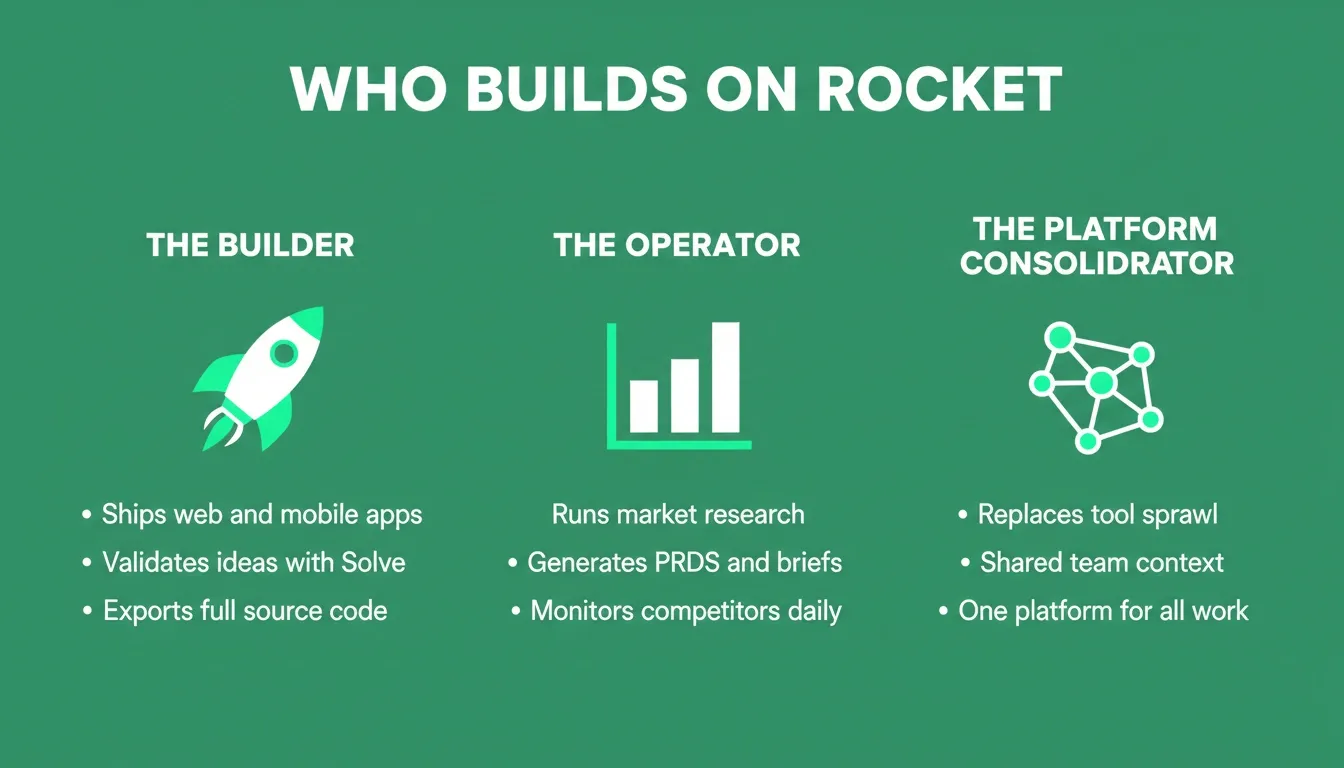
Rocket serves three user types: the Builder shipping products, the Operator running intelligence, and the Platform Consolidator replacing tool sprawl.
The Builder
Founders, developers, designers, and agencies use Rocket to ship products. They use Solve to validate before they build, Build to generate production grade apps from that validated context, and Intelligence to stay ahead of the market after launch.
For example, a solo founder validates a SaaS idea with Solve, generates a full Next.js and Supabase app with Stripe payments in one session, and launches to beta users the same week. A design agency delivers client web apps in days rather than weeks, with full source code export to GitHub for client handoff. Developers can also use Codebase Pickup to continue an existing Next.js project inside Rocket, adding features through conversation without losing the existing architecture.
The Operator
Product managers, sales teams, marketers, and consultants use Rocket for intelligence and research outputs, without necessarily building a customer-facing product.
As a concrete example, a VP of Sales types one line before a high-stakes meeting. Rocket returns an account brief with the organization map, technology priorities, and the positioning angle most likely to land. A product team uses Solve to generate a PRD from customer research and competitive signals, then hands it to engineering with evidence attached. A consultant uses Solve to produce a market entry analysis for a client entering a new geography, complete with regulatory research and competitive landscape.
The Platform Consolidator
Enterprise and scaled-stage teams use Rocket to replace tool sprawl with one shared-context system. A growth team builds internal dashboards, customer portals, and compliance tools inside Rocket, eliminating coordination overhead across five separate tools. Every decision, research finding, and build iteration compounds. The intelligence does not reset between sessions.
Production-Grade Apps Across Industries
SaaS Products
A founder building a project management SaaS uses Solve to map the competitive landscape, identify the underserved segment, and generate a PRD with evidence. Build then generates the full Next.js app with Supabase for database and auth, Stripe for subscriptions, and a role-based dashboard. The first version reflects genuine product thinking because the thinking happened in the same system as the build.
Internal Tools
An operations team needs a customer health monitor connected to Airtable, Linear, and Mixpanel. They describe it in plain language. Rocket generates the internal dashboard with all three integrations wired in, GDPR defaults applied, and role-based access configured. No dev team, no backlog, deployed in days. For a practical walkthrough of building internal tools this way, read how to streamline your workflow by building internal tools.
Mobile Apps
A startup needs both a web app and a mobile app from the same validated idea. Rocket generates the Next.js web app and the Flutter mobile app in parallel, with consistent design systems, dark and light theming, and fluid navigation. Both ship with the same production standards and are ready for App Store and Google Play submission.
Landing Pages Built from Research
A marketing team uses Solve to research the specific customer problem their product solves. Build then generates a conversion-focused landing page where the hero section speaks directly to that problem, because the research that identified the problem is in the same context as the build that produced the page.
Compliance and Governance Tools
A legal operations team needs a GDPR DSAR management system with audit-ready tracking. Rocket generates the full compliance tool with role-based access, audit logs, and GDPR defaults. What would take a development team weeks to scope and build ships in a single session.
The Compound Context Advantage
Here is what makes Rocket structurally different from any collection of AI tools: the intelligence does not reset between sessions. It compounds.
The Solve output that validated the direction becomes the foundation of the Build. The competitive signal from last week informs this week's product decision. The research from three months ago is available when a new team member starts today. Nothing is re-explained. Everything accumulates.
This is the Context pillar. Files, research, and decisions added once carry into every task. The team works from the same accumulated intelligence, and every action is smarter than the last.
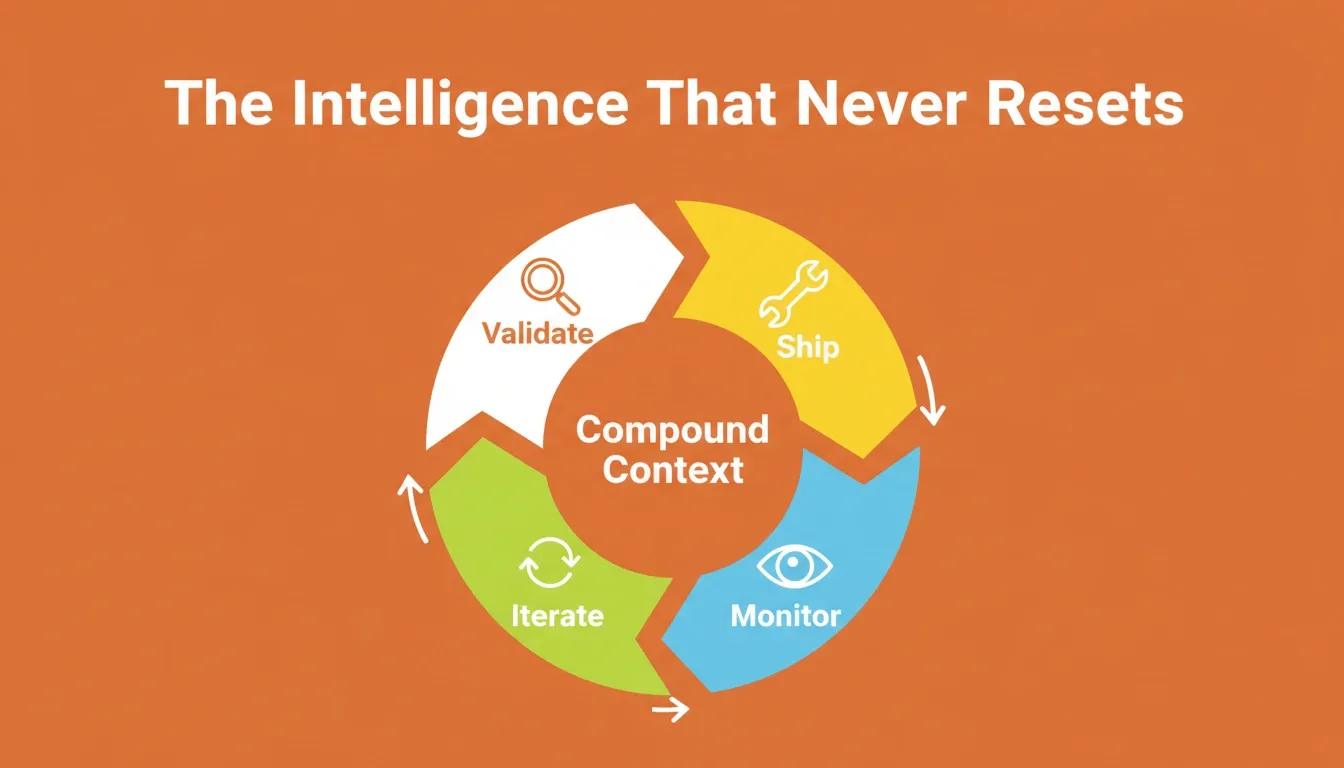
Validate, Ship, Monitor, Iterate: the compound context loop that ensures every production grade app starts from accumulated intelligence, not a blank slate.
For production grade apps, this matters because the quality of the output is a direct function of the quality of the context behind it. Apps built from accumulated intelligence are more coherent, more aligned with real user needs, and less likely to require expensive rework. To understand how this context carries from research all the way through to build, read why context is never lost between the research phase and the build phase.
How Rocket Compares to Other AI App Builders
Most AI builders start at execution. You arrive with an idea and leave with a product. What you do not get is the market research, the competitive picture, or the strategic direction. You still have to do all of that yourself, somewhere else.
| Capability | Rocket | Bolt | Lovable | v0 (Vercel) |
|---|---|---|---|---|
| Pre-build market intelligence | Yes (Solve) | No | No | No |
| Shared context across research and build | Yes (Context) | No | No | No |
| Production-grade web app output | Yes (Next.js) | Yes | Yes | Frontend only |
| Mobile app output | Yes (Flutter) | No | No | No |
| Continuous competitor monitoring | Yes (Intelligence) | No | No | No |
| Website redesign from existing URL | Yes (Redesign) | No | No | No |
| WCAG, GDPR, and SEO by default | Baseline defaults | Manual setup | Manual setup | Not applicable |
| Full source code export | Yes (GitHub sync) | Limited | Limited | Yes (frontend) |
| 25+ native integrations | Yes | Limited | Limited | No |
| Human Help inside platform | Yes | No | No | No |
The structural difference here is not a feature comparison. Bolt, Lovable, and v0 are capable builders that execute what you tell them to build. Rocket, by contrast, covers the arc before, during, and after the build.
For a detailed look at how this plays out in practice, read can AI build a production-grade web app without a developer.
What Vibe Coding Gets Right, and Where It Stops
Vibe coding, which means describing what you want and letting AI build it, is real and it works. Platforms like Rocket support this style while still delivering production grade results. The speed is genuine, and the output quality has improved significantly.
The limitation, however, is where vibe coding starts. Most vibe coding tools start at line one. You arrive with an idea already formed, a direction already chosen, and a competitive picture already assumed. The tool executes. It does not question.
Vibe Solutioning starts before line one. The question of what to build gets answered with the same rigor as the question of how to build it. The result is not just faster development. It is development that starts from a better place. For a broader look at how vibe coding is reshaping development workflows, read vibe coding using AI tools to shape next-gen workflows.
Handling Real-World Complexity
Building apps is easy. Building production grade software is not. The gap between a working prototype and a system that handles real users, real data, and real business workflows is where most AI-built apps break down.
What production grade apps must handle:
- Edge cases that do not appear during early testing but surface at scale
- Data integrity under concurrent writes and complex state
- User scaling from dozens to thousands without architectural rework
- Enterprise data with proper structure, reliability, and access controls
- Business workflows that need consistency, auditability, and error recovery
Rocket addresses this through the combination of validated context and production-standard generation. The architecture is planned before the code is written. The data model reflects the actual business logic, not a generic template. Integrations are wired in from the start, not bolted on later.
Every Rocket build ships with staging and production environments, full version history, one-click rollback, built-in analytics, and 25+ integrations authenticated once and flowing into every build.
What Rocket's CEO Says About the Shift
"Rocket is a web solutioning platform. Just put a five-liner problem statement. After 25 minutes, your system is ready." — Vishal Virani on X
The shift is not just about speed. It is about what the speed is built on. Twenty-five minutes to a working system is only valuable if the system was worth building. Rocket's architecture ensures the thinking and the building happen in the same place, so the output reflects both.
1.5 million people across 180 countries have tried Rocket, from solopreneurs shipping MVPs to enterprise teams rethinking their entire stack, reached primarily through organic product-led growth.
The Standard Has Changed
Production grade apps used to require months, large teams, and significant capital. The barrier was execution. Today, the barrier is thinking. Teams that validate before they build, and build from that validation, ship products that are stronger from the first version.
As AI continues to reshape software development, the platforms that will matter most are not the ones that generate code fastest. They are the ones that ensure the code being generated was worth writing. Production grade apps built on validated intelligence are not just faster to ship. They are more likely to survive contact with real users, real markets, and real competition.
Rocket is where that thinking and building happen in the same place. Start building on Rocket.new and turn your next idea into a launch-ready product today.
Table of contents
- -What "Production-Grade" Actually Means
- -The Problem Every Other AI Builder Ignores
- -What Vibe Solutioning Changes
- -How Rocket Turns Validated Intelligence into Production-Grade Apps
- -Step 1: Solve — Research Before the First Line of Code
- -Step 2: Build — Production-Grade Generation from Validated Context
- -Step 3: Refine — Iterate Without Losing Context
- -Step 4: Deploy — Live in One Action
- -Step 5: Intelligence — Continuous Monitoring After Launch
- -The Vibe Solutioning Loop Visualized
- -Rocket's Pricing: One Credit System for Everything
- -Who Builds Production-Grade Apps on Rocket
- -The Builder
- -The Operator
- -The Platform Consolidator
- -Production-Grade Apps Across Industries
- -SaaS Products
- -Internal Tools
- -Mobile Apps
- -Landing Pages Built from Research
- -Compliance and Governance Tools
- -The Compound Context Advantage
- -How Rocket Compares to Other AI App Builders
- -What Vibe Coding Gets Right, and Where It Stops
- -Handling Real-World Complexity
- -What Rocket's CEO Says About the Shift
- -The Standard Has Changed