
Rocket.new identifies hidden behavioral, engagement, and intent signals that many platforms fail to track, helping teams improve targeting, understand audiences better, and increase conversions through smarter, data-driven insights across campaigns efficiently.
Why do small competitor signals suddenly matter so much?
Because one signal alone rarely tells the full story. A pricing tweak, a hiring page edit, or a fresh ad campaign may look minor on the surface. Yet when multiple signals appear together across different sources, the real direction becomes clear.
Research from HubSpot found that 34% of businesses reported revenue loss from fragmented data and disconnected systems.
That number says a lot. Modern teams collect massive amounts of data every day, but many still miss the larger signal because information stays scattered.
Why Single Updates Often Miss the Bigger Signal?
Most businesses do not struggle because of missing data. The real problem starts when updates stay disconnected. One person notices a pricing change, another spots new job postings, and somebody else shares a screenshot in a Slack group.
After a while, the information gets buried across tabs, chats, and folders without a clear connection. A single update rarely answers the real business question because one isolated change does not explain the full direction.
-
A homepage redesign alone does not explain strategy
-
One pricing change does not explain positioning
-
A single launch announcement rarely shows long term direction
-
Community reactions without context can create noise
-
Analytics spikes without supporting signals can feel random
-
Multiple connected signals reveal the larger pattern
-
Structured pattern analysis helps teams connect timing and business impact
-
Shared context creates more actionable analysis
Rocket looks at related movements together instead of treating every update as a separate point. That connected view helps teams save time, reduce confusion, and work with structured signal analysis instead of scattered observations.
What a Signal Cluster Actually Looks Like?
Let’s keep it simple. A signal cluster starts when multiple small updates begin pointing toward the same direction instead of appearing as random activity.
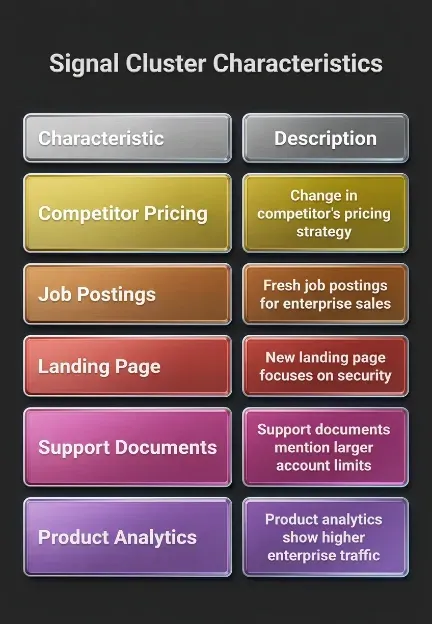 One update alone may not matter much. Together, the signal becomes more interesting. That cluster may point toward a future enterprise push. Rocket connects those structured signals into one shared view so teams can move from guessing to more actionable analysis.
Why Fragmented Data Creates Confusion?
Many AI tools collect data, but very few connect the relationships between signals. That is where many companies run into trouble.
Different teams often work across separate systems for analytics, competitor tracking, product research, community feedback, and support. After some time, the information becomes disconnected and harder to interpret clearly.
-
Website tracking: One group monitors competitor page changes
-
Analytics monitoring: Another group watches traffic and behavior data
-
Customer support: Separate teams track tickets and feedback trends
-
Product planning: Different people handle roadmap discussions and project direction
-
Shared context: No connected view exists across the workflow
-
Signal recognition: Teams wait too long to recognize connected changes
Rocket changes that structure by bringing structured data into one working environment. Instead of reactive monitoring, teams get continuous analysis connected through shared context and signal relationships.
Rocket.new and the Shift Toward Unified Intelligence
Rocket is not just another monitoring tool. According to Rocket.new documentation, Rocket.new is a vibe solutioning platform that combines research, AI app building, and competitive intelligence inside one system.
That matters because most software products split those workflows apart. One tool handles analytics, another handles monitoring, another handles planning, and another focuses on code generation. After a while, teams end up switching between disconnected systems without a shared view of the signal.
-
Market data: Collect structured competitor and industry data
-
Pattern analysis: Connect related signals across multiple sources
-
Web apps: Build production ready web apps from research insights
-
Mobile apps: Create mobile apps connected to product direction
-
Competitor monitoring: Track changes, positioning, and launch activity
-
Shared analytics: Keep analytics and research in one place
-
Connected signals: Follow patterns over time instead of isolated updates
Rocket combines build and intelligence into one structured workflow. That connected architecture changes how teams analyze information, plan projects, and make business decisions moving forward.
How Rocket Works Behind the Scenes?
Rocket gathers structured data from multiple sources and turns scattered signal activity into more actionable direction. Instead of treating updates as isolated events, Rocket studies patterns across different categories to help teams understand what may actually be happening in the market.
Step 1: Collect Signals
Rocket collects structured data from:
-
Websites
-
Ads
-
Traffic movement
-
Hiring pages
-
Support content
-
Competitor updates
Step 2: Compare Similar Activity
Then the platform runs pattern analysis across categories.
-
Pricing changes may appear alongside support article edits
-
Community reactions may increase after a launch
-
Job postings may point toward future product expansion
-
Traffic analytics may show rising enterprise interest
At this stage, the signal cluster becomes easier to recognize.
Step 3: Turn Analysis Into Direction
Next, Rocket explains what the signal may mean so teams can determine:
-
What competitors may be planning
-
Which changes matter most
-
Where risks may appear
-
What product direction looks stronger
-
Whether a project should move forward
That process cuts down wasted time and gives teams a more structured way to analyze signals before making business decisions.
Rocket Features Behind Better Signal Analysis
Rocket includes several features that help teams understand signal clusters instead of reacting to isolated updates. The platform keeps research, analytics, monitoring, and product workflows inside one structured environment so signals become easier to analyze over time.
Structured Competitor Monitoring
Rocket tracks competitor movement across multiple areas instead of relying on one platform view.
-
Pricing pages: Track pricing shifts and packaging changes
-
Website changes: Monitor messaging and positioning updates
-
Traffic movement: Follow changes in audience behavior and visibility
-
Community activity: Watch discussions and market reactions
-
Product messaging: Analyze positioning across campaigns and pages
-
Support documentation: Identify hidden product or feature updates
-
Job postings: Spot hiring patterns tied to future expansion
Those signals become much more useful when viewed together instead of separately.
Pattern Analysis Across Sources
Pattern analysis is where Rocket becomes especially useful.
-
Single signals: Often create confusion or short term noise
-
Similar activity: Starts revealing larger business direction
-
Structured analytics: Helps compare related movements over time
-
Signal relationships: Make competitor behavior easier to interpret
That process helps teams stop reacting emotionally to random updates and focus on more actionable analysis.
Shared Workspace for Teams
Rocket creates a shared environment where multiple teams work from the same structured data.
-
Sales teams: Follow competitor positioning and pricing movement
-
Product teams: Track feature direction and market demand
-
Strategy groups: Study patterns across categories
-
Support teams: Monitor customer feedback and recurring issues
That shared context reduces confusion and keeps everyone focused on the same signal view.
Build Support With Vibe Coding
Rocket also brings research and vibe coding into the same workflow.
-
Market analysis: Helps validate product direction earlier
-
Product creation: Reduces delays between research and execution
-
Faster iteration: Helps teams react to market changes sooner
-
Better planning: Reduces the risks of building the wrong thing
That combination makes product planning more structured and more ready for future market changes.
Why Timing Matters More Than Ever?
Markets move quickly, and small delays can create bigger problems than most teams expect. Signals change fast, competitor positioning shifts constantly, and customer reactions can move in a completely different direction within days.
Waiting too long often means losing context before the real pattern becomes visible.
-
Competitor positioning changes quickly
-
A launch can shift pricing pressure overnight
-
Community sentiment changes within a single day
-
Support tickets reveal hidden frustration early
-
Analytics trends can change direction within weeks
-
Delayed reactions often create missed opportunities
-
Isolated observations make analysis harder over time
Rocket helps teams move forward using connected data instead of scattered updates. That creates clearer analysis, reduces confusion, and cuts down wasted project time before small changes turn into larger business problems.
Why Signal Clusters Matter for Product Teams?
Product teams often deal with too much scattered information coming from different directions at the same time.
Analytics, support feedback, competitor activity, and community discussions may all contain useful signals, but without a shared structure, the information becomes fragmented and harder to interpret clearly.
-
Analytics tracking: One group studies traffic and usage patterns
-
Community requests: Another group follows feature discussions and reactions
-
Support feedback: Teams monitor recurring customer frustrations
-
Competitor activity: Product groups track launch announcements and positioning changes
-
Fragmented workflows: Important signals stay separated across systems
-
Product direction: Teams risk building the wrong thing without connected analysis
Rocket changes that workflow by turning disconnected updates into structured signal analysis tied directly to product direction. That helps teams improve planning, prepare more effectively for future launch activity, and make stronger product decisions with better context.
Comparing Isolated Signals vs Connected Signal Clusters
A single update often looks small or meaningless on its own.
The bigger picture starts becoming clear when multiple related signals begin appearing together across analytics, competitor activity, support feedback, and market behavior. That difference changes how teams interpret business direction.
| Scenario | Isolated Signal | Connected Signal Cluster |
|---|---|---|
| Pricing change | Looks random | Shows enterprise positioning shift |
| New job postings | Looks normal | Connects to expansion strategy |
| Support article update | Small update | Reveals feature rollout direction |
| Community reaction | Short term noise | Confirms market demand |
| Traffic analytics | One spike | Shows growing market interest |
The point is simple. The more structured data gets analyzed together, the stronger the signal becomes. Rocket helps teams move from isolated observations toward more actionable analysis backed by shared context and clearer direction.
Rocket 1.0 and the Shift Away From Isolated Tools
Rocket 1.0 introduced a more structured way for teams to handle research, product planning, and monitoring together.
Rocket 1.0 combines research, product creation, and monitoring inside one platform.
Most software products separate research from execution. One system handles analytics, another handles planning, and another focuses on product creation. After some time, teams lose context between stages and important signals become fragmented.
-
Signal: Track structured market and competitor activity
-
Analysis: Study patterns and business direction
-
Planning: Turn research into product decisions
-
Build: Move ideas into development workflows
-
Launch: Prepare products with clearer context and timing
Rocket keeps those workflows inside one shared environment so teams can move through every stage without losing direction. That continuity creates stronger long term value and reduces confusion across the entire project process.
Why Structured Analytics Matter More in the Future
The future of business decision making will depend heavily on structured analytics. Raw data alone is no longer enough because businesses need faster interpretation, clearer context, and more actionable direction from the signals they collect every day.
Research from TechDogs noted that the global data analytics market is projected to reach $108.79 billion in 2026.
That growth reflects a larger shift happening across the business world.
-
Faster analysis: Teams need quicker interpretation of market changes
-
Connected context: Signals become more useful when analyzed together
-
Actionable direction: Businesses need insights tied to decision making
-
Constant changes: Markets shift quickly across products and positioning
-
Shared analytics: Teams work better with one structured view of data
-
Future readiness: Companies need systems prepared for ongoing signal movement
Rocket positions itself around that mission by helping teams work with structured analytics, connected context, and signal analysis that supports faster and more informed decisions over time.
Why Teams Move Faster With Shared Context?
When teams work inside one structured system, decision making becomes much simpler. Information stays organized, signals become easier to interpret, and everyone works from the same direction instead of relying on scattered updates.
-
Less confusion across workflows
-
Less duplicated work between departments
-
Less wasted time searching for information
-
Stronger coordination between product and sales
-
Better communication across marketing and support
-
Shared strategy during launch preparation
-
Faster reaction to changing market signals
Rocket helps teams move faster because everyone works from the same signal view and structured analytics environment. That shared structure becomes especially useful during product launch periods when pressure increases and quick decisions matter more.
The Role of Architecture in Signal Tracking
Architecture matters more than most people think. When systems stay disconnected, analytics become fragmented and teams struggle to follow signals clearly over time. A more structured architecture creates continuity across research, monitoring, planning, and execution.
-
Analysis quality improves with shared structured data
-
Signal tracking becomes clearer across workflows
-
Project visibility increases for multiple teams
-
Support coordination becomes easier during fast changes
-
Future planning gains stronger context and direction
Rocket was built around keeping those workflows inside one structured environment instead of separating them across multiple systems. That structure helps teams work with more actionable analysis and clearer signal visibility over time.
Why Businesses Need More Than Surface Monitoring?
Surface level monitoring only captures isolated activity. A single update may look small or unimportant on its own, which is why many businesses miss the larger direction behind competitor movement.
Rocket focuses more on the relationships between signals instead of treating every update as a separate event.
-
Analytics movement: Traffic shifts may reveal growing market interest
-
Support documentation edits: Hidden feature updates may appear quietly
-
Pricing adjustments: Positioning changes may point toward new strategy
-
Job postings: Hiring activity may signal future expansion plans
-
Community discussions: Customer reactions may confirm market demand
A single landing page update may not matter much by itself. Yet when multiple structured signals begin appearing together, the direction becomes stronger and easier to interpret. Rocket brings those structured pieces into one shared analysis view, helping teams work with more actionable insights instead of isolated observations.
The Hidden Cost of Waiting Too Long
Many teams wait for obvious proof before making decisions. The problem is that by the time a competitor officially announces a launch or major change, the signal cluster was often visible much earlier through smaller updates spread across different sources.
-
Competitor launches: Signals may appear months before official announcements
-
Structured data: The information often already exists across systems
-
Signal interpretation: Teams struggle to recognize patterns early
-
Delayed reactions: Waiting too long reduces preparation time
-
Smaller updates: Related signals gradually point toward larger direction
-
Early awareness: Faster analysis helps teams react sooner
Rocket shortens that delay by helping teams follow connected signals instead of waiting for one massive update. That creates earlier awareness, stronger preparation, and more structured decision making before market shifts become obvious to everyone else.
How Rocket Aligns With the Main Topic
The main idea behind this blog is simple: isolated updates rarely explain the full story. Signal clusters become useful when multiple structured signals begin pointing toward the same direction. Rocket was built around that exact approach instead of relying on disconnected monitoring.
-
Rocket gathers structured data from multiple sources
-
Rocket runs pattern analysis across related activity
-
Rocket compares similar signals over time
-
Rocket explains possible business impact and direction
-
Rocket keeps teams inside one shared analytics environment
-
Rocket helps reduce random reactions to isolated updates
-
Rocket supports decisions using structured evidence and context
That workflow gives teams a clearer way to study signal clusters, understand changing market behavior, and make more actionable business decisions using connected analytics instead of scattered observations.
The Future of Signal Based Decision Making
The future will belong to businesses that recognize and interpret signals faster. That does not mean collecting endless random data. The real advantage comes from building systems that can organize structured information, interpret changes clearly, and support faster decision making over time.
-
Context collection: Systems need to gather meaningful business context
-
Structured signals: Related updates should be analyzed together
-
Analysis support: Teams need clearer interpretation of market movement
-
Change explanation: Signals should reveal why changes are happening
-
Risk reduction: Early visibility helps reduce business risks
-
Faster movement: Teams need quicker reactions during market shifts
Rocket focuses heavily on that mission by helping teams work with structured analytics, shared context, and connected signal analysis. The goal is not more volume. The goal is clearer meaning behind the signals businesses already collect every day.
How Rocket.new Catches the Signal Cluster
Many businesses still rely on fragmented analytics, isolated updates, and disconnected monitoring systems. One platform change rarely explains the full direction, which forces teams to manually compare scattered signals across research, support, competitor tracking, and product workflows. That delay often creates confusion, slower reactions, and wasted time spent building the wrong thing.
Rocket approaches the problem differently by turning structured data into connected signal analysis. Instead of treating updates separately, Rocket studies related movements across categories to create more actionable direction and stronger future planning. The real value comes from understanding how signals relate to each other over time, not from tracking isolated activity alone.
Want clearer signal analysis without scattered workflows? Explore Rocket.new to track connected market signals, competitor movement, and structured analytics in one shared environment.
Table of contents
- -Why Single Updates Often Miss the Bigger Signal?
- -What a Signal Cluster Actually Looks Like?
- -Why Fragmented Data Creates Confusion?
- -Rocket.new and the Shift Toward Unified Intelligence
- -How Rocket Works Behind the Scenes?
- -Step 1: Collect Signals
- -Step 2: Compare Similar Activity
- -Step 3: Turn Analysis Into Direction
- -Rocket Features Behind Better Signal Analysis
- -Structured Competitor Monitoring
- -Pattern Analysis Across Sources
- -Shared Workspace for Teams
- -Build Support With Vibe Coding
- -Why Timing Matters More Than Ever?
- -Why Signal Clusters Matter for Product Teams?
- -Comparing Isolated Signals vs Connected Signal Clusters
- -Rocket 1.0 and the Shift Away From Isolated Tools
- -Why Structured Analytics Matter More in the Future
- -Why Teams Move Faster With Shared Context?
- -The Role of Architecture in Signal Tracking
- -Why Businesses Need More Than Surface Monitoring?
- -The Hidden Cost of Waiting Too Long
- -How Rocket Aligns With the Main Topic
- -The Future of Signal Based Decision Making
- -How Rocket.new Catches the Signal Cluster