
Learn how Rocket.new uncovers competitor pivots before they become public through AI-driven monitoring, behavioral insights, and strategic signal analysis that help businesses react faster and stay ahead in changing markets.
What If You Knew Your Competitor’s Next Move Before Launch?
Most businesses find out what their competitors are doing the same way everyone else does - a press release, a blog post, or a product launch email landing in the inbox. By then, the pivot is already live. The team is already hired. The market positioning has already shifted.
The global competitive intelligence tools market hit $5.70 billion in 2025 and is projected to reach $19.18 billion by 2035 because businesses know this problem is real. What most businesses are still figuring out is how to actually solve it before competitors announce anything.
This blog explores how modern competitive intelligence platforms like Rocket.new help teams discover hidden market signals, track competitor movement, and make faster product decisions with connected AI workflows.
Competitors Leave Clues Long Before the Press Release
Competitors rarely announce strategy changes the moment they happen. Most shifts leave behind small signals long before the public launch ever appears.
Early Signals Businesses Often Miss
-
New hiring roles and department expansion
-
Changes in website messaging and positioning
-
Enterprise-focused sales or marketing recruitment
-
New ad creatives and campaign direction on social platforms
-
Product roadmap hints hidden inside job descriptions
-
Geographic expansion through localized hiring activity
-
Team restructuring and leadership movement
These signals usually appear months before official product launches, pricing changes, or market repositioning announcements.
The companies that stay ahead are not simply reacting faster they are tracking the right signals across hiring, marketing, product, and customer facing channels before competitors make their next move public.
What Job Postings Actually Tell You?
Here's what makes job postings such a powerful early signal: competitors can stay quiet about a strategy shift for months - but they cannot hire without posting jobs.
Patrick Spychalski, a GTM consultant with over 22,000 LinkedIn followers, put it bluntly in a recent post:
"Job postings have more hidden gold than any other signal, and almost nobody is using them properly... The job descriptions are a GOLD MINE. For large companies, you can essentially dissect everything that's happening within a business from job descriptions. Internal expansions, new initiatives, technology changes, overall hiring plans, and so much more. If you combine insights from several listings into one analysis, you pretty much have an x-ray into an org."- Patrick Spychalski, LinkedIn
The Microsoft Copilot story is a clear illustration. Between September 2022 and January 2023, Microsoft's AI-related job postings increased by nearly 40% - even while layoffs were hitting other departments.
Hiring signals are just one layer. But most businesses miss them entirely because no one has time to manually track job boards for every competitor, every week.
Why Single-Signal Alerting Does Not Work?
Most competitive intelligence platforms are built around isolated alerts. One notification for a pricing update. Another for a LinkedIn post. Another for a product launch announcement.
The problem is that standalone signals rarely explain what is actually happening.
-
Pricing Update: A pricing page change alone is just a website edit. It becomes meaningful when it appears alongside enterprise hiring activity, new positioning language, and changes in customer targeting.
-
Hiring Activity: New job postings are not simply recruitment updates. They often reveal expansion plans, product direction, infrastructure investments, and upcoming strategic priorities months before launch.
-
Social Messaging Shifts: Changes in social content and ad messaging usually indicate repositioning efforts. Competitors begin testing messaging publicly long before fully committing to a market move.
-
Review Platform Responses: Defensive replies on G2 pages, feature comparison updates, and customer objection handling can reveal where competitors feel pressure inside the market.
The Real Problem:
Tools like Crayon and Klue are useful for surfacing individual updates and building battlecards. But most platforms still leave the interpretation work to product and strategy teams.
The real intelligence appears when multiple signals happen together at the same time. That combination creates context, direction, and pattern recognition something manual analysis struggles to keep up with as competitors move faster across multiple channels simultaneously.
How Rocket.new Reads Competitor Signals?
Rocket.new's Intelligence feature is built around signal clusters, not individual alerts. Add a competitor by name or URL, and Intelligence automatically maps every public surface they operate on across six categories:
| Signal Category | What It Monitors |
|---|---|
| Website | Page changes, messaging shifts, pricing updates, product announcements |
| Social Media | Posts and campaigns across LinkedIn, X, Instagram, Facebook, YouTube, TikTok, Reddit |
| News and Web Presence | Press coverage, blog posts, partnerships, media mentions, volume over time |
| Reviews and Reputation | G2, Glassdoor, Capterra - sentiment shifts tracked with impact tags |
| People | Employee count, hiring velocity, open positions by department, executive activity |
| Performance Marketing | Ad activity across LinkedIn, Meta, and TikTok |
The People category deserves particular attention. Rocket.new Intelligence monitors open positions by department and hiring velocity in real time. Hiring concentration reveals where competitors are investing well before any product update or announcement confirms it.
When a competitor starts posting five new enterprise sales roles in a region where they have had no presence, that is not background noise that is a strategic signal worth acting on.
Every day, Intelligence produces a structured daily brief for every competitor tracked. That brief includes:
-
Signals and insight: A synthesized paragraph connecting everything that moved
-
What to watch: Emerging patterns before they become obvious
-
Recommendation: What your business should consider doing next
This brief is ready before the first meeting of the day. Product teams, sales teams, and marketing teams all start the day with context not with a backlog of raw alerts to sort through.
Connecting Competitor Signals
Competitive intelligence becomes valuable when multiple signals start forming a clear pattern instead of appearing as isolated updates.
-
Enterprise hiring activity increases
-
Website messaging shifts toward larger customers
-
Social content changes positioning direction
-
Pricing and feature packaging get updated
-
Customer reviews reveal new market focus
Single alerts only show that something changed. Connected signals explain what competitors are planning and help teams make faster, smarter decisions before the market shift becomes obvious.
One Connected Platform
Most businesses manage competitive intelligence across multiple disconnected tools one for social monitoring, another for job postings, another for reviews, ads, and research tracking.
That creates fragmented workflows, missing context, and slower decision making.
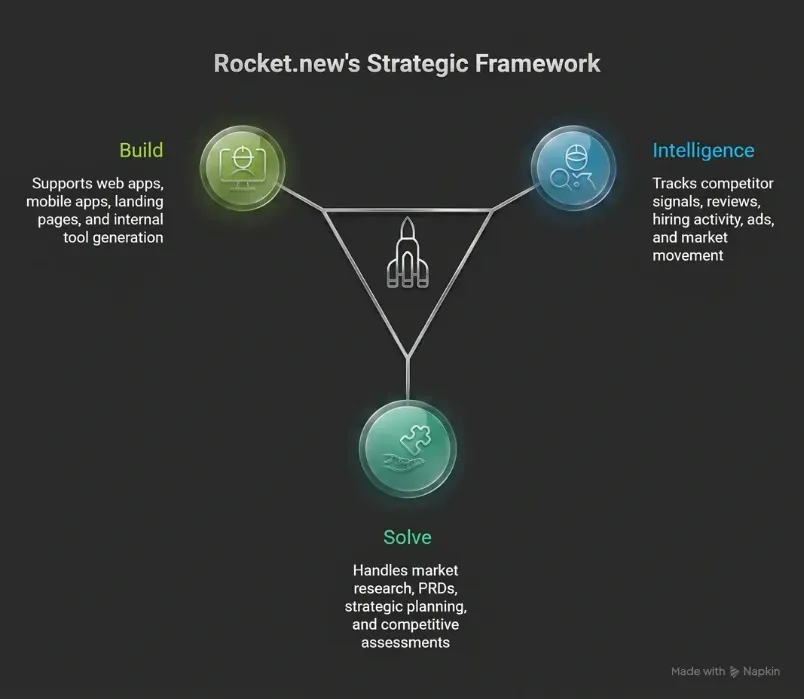 Together, these systems create a connected workflow where intelligence directly influences research, planning, and product execution.
Why It Matters
-
Competitor signals remain connected across workflows
-
Research context carries forward between sessions
-
Product, marketing, and strategy teams stay aligned
-
Faster decisions happen with shared intelligence
-
Teams spend less time switching between disconnected platforms
Rocket.new turns competitive signals into structured decisions instead of isolated alerts. Intelligence connects directly to the research and builds that follow, creating one AI-powered workflow instead of another standalone monitoring tool.
Rocket.new Intelligence vs Standalone CI Tools
| Capability | Crayon / Klue | Rocket.new Intelligence |
|---|---|---|
| Signal monitoring | Yes | Yes, Six categories |
| Signal cluster interpretation | No | Yes, Daily brief |
| Hiring velocity and open positions | Limited | Full by department |
| Connected to research (Solve) | No | Yes, Same project |
| Connected to build (web apps and mobile) | No | Yes, Same platform |
| Daily brief with recommendations | No | Yes |
| Background for the call (sales briefs) | Partial | Yes, Integrated |
| One shared project across teams | No | Yes, One system |
Rocket.new connects intelligence, research, and product execution into one workflow instead of separating them across disconnected tools.
Stay Ahead of Competitors Not Just Informed About Them
Competitive intelligence is not about collecting more alerts. It is about understanding competitor moves before they become obvious and making faster decisions with that information.
Most standalone tools stop at monitoring. Rocket.new connects intelligence directly to research, planning, and product execution inside one workflow. Competitive briefs feed into Solve tasks, research informs builds, and teams stay aligned across strategy, product, and marketing without losing context between tools.
The result is faster execution, clearer decision-making, and earlier visibility into competitor pivots before they appear in public announcements.
Explore how Rocket.new turns competitor signals into actionable intelligence, connected workflows, and faster product decisions from one shared AI platform.
Table of contents
- -Competitors Leave Clues Long Before the Press Release
- -Early Signals Businesses Often Miss
- -What Job Postings Actually Tell You?
- -Why Single-Signal Alerting Does Not Work?
- -The Real Problem:
- -How Rocket.new Reads Competitor Signals?
- -Connecting Competitor Signals
- -One Connected Platform
- -Why It Matters
- -Rocket.new Intelligence vs Standalone CI Tools
- -Stay Ahead of Competitors Not Just Informed About Them