
This blog breaks down why most startup teams waste time on disconnected market research, what quantitative signals actually matter, and how Rocket.new's Vibe Solutioning platform connects research, building, and competitive intelligence in one shared context so founders can ship the right things faster.
What if the research phase is the part that's actually slowing you down?
Most founders get stuck in a loop. Scanning competitor websites. Pulling together pricing models. Reading job postings for signals. Compiling notes into docs that no one looks at again. And somehow, they never quite reach the moment where they feel ready to build.
The data tells a stark story. According to CB Insights, 42% of startups fail because they built something the market simply did not need. That is not a building problem. That is a research problem - specifically, research that never gets properly connected to the build.
The founders who ship fast and build the right things are not doing less research. They are doing it differently. And "differently" means connecting the research to the build in one place, with shared context that stays current.
The Research Trap That Keeps Founders Stuck
Talk to any startup co-founder who has shipped a few products and you will hear a version of this story. They spent weeks on a market analysis, built what they thought the market wanted, and found out the hard way their read was off.
The problem is rarely the quality of the research. It is the way most teams run it - in isolation, across separate tools, with findings that never quite make it into the product decisions that matter.
One person on the team does a competitor analysis in a Google Doc. Another pulls pricing data in a spreadsheet. Someone else reads reviews on G2 and saves screenshots to Notion. The team meets on a Tuesday, makes a few decisions, and two weeks later half of that research is outdated - and the build has already started based on the original, stale read.
This is the trap. Not knowing too little. Running research in a way that never connects to execution.
What Quantitative Market Research Actually Means for Founders
Most market research advice is written for enterprise teams with months to spare. For early-stage startups, what matters is reading the right signals fast - and knowing what they mean.
The most useful quantitative signals are publicly available and constantly updated:
-
Job postings: When a competitor starts hiring a mobile engineering team, that is a signal about where they are building next - months before any announcement confirms it.
-
Pricing models: When a platform shifts from flat pricing to per-seat tiers, or gates a feature behind a higher plan, the market is telling you what customers will pay for.
-
Review patterns: Tested user feedback on G2, Capterra, and app stores is free. Patterns in negative reviews point directly to gaps worth building around.
-
Website changes: Messaging pivots on competitor landing pages reveal repositioning. A single line change on a pricing page can signal an entire strategy shift.
-
Social content: When a competitor's content pivots to a new problem category, they have already done the market analysis. The shift itself is the signal.
The challenge for most teams is that these signals are scattered across different platforms. Tracking them manually takes time. And even when the research gets done, it rarely makes it into a shared context that the whole team builds from. The guesswork just comes back in a different form.
The Over-Research Cycle Most Teams Are Stuck In
This loop is familiar to every startup team. Research is happening, but it is scattered across tools and sessions. By the time the team starts building, some of those competitor signals are already outdated. And knowing that the cycle will repeat does not make it easier to break.
The teams that move faster have found a way to collapse this loop doing the research and the building in the same place, with the same shared context running through both.
Why Most AI Tools Miss the Point
The vibe coding wave has changed what founders can ship. Tools like Lovable, Bolt, and v0 are good at exactly that - taking a prompt and turning it into a working product quickly. Most ai tools in this category have genuinely shifted what is achievable in a short sprint.
But building fast is only useful if you are building the right thing. And that is where most ai tools stop short.
The code generation is solid. The design outputs are improving. But the market research, the competitive intelligence, the strategic analysis - you still have to run all of that somewhere else, in a different tool, and carry the findings back into the session by hand.
On top of that, most platforms do not carry context between sessions. The pricing analysis your co-founder ran last Tuesday does not exist when a new team member opens a build session this Thursday. There is no accumulated knowing. Every session starts from scratch, which means every session rebuilds context that should already be there.
This is the gap that founders feel but do not always name. The outputs are fast. The thinking before the build is still missing.
The Research Signals That Tell You Whether Something Is Worth Building
Before writing a single line of code, the most valuable question any founder can ask is whether what they want to build is actually worth building - and what the market has already tested and signaled about that space.
Here is a quick framework for the quantitative signals that give a real answer:
| Signal Type | What to Track | What It Tells You |
|---|---|---|
| Job postings | Engineering hires, new role types | Where competitors are investing next |
| Pricing models | Tier changes, feature gating, per-seat shifts | How the market values specific features |
| Review data | Recurring complaints, rating trends | Tested user pain points and product gaps |
| Website changes | Messaging updates, new pricing tiers | Strategy pivots and repositioning moves |
| Social patterns | New content themes, campaign pivots | Validated problem exploration by competitors |
| Ad activity | New campaigns, angle changes | What is working well enough to keep spending on |
Running this analysis manually is possible. Keeping it current is harder. Connecting it to the actual build - without re-explaining context every time - is where most teams lose the thread.
How Rocket.new Connects Research, Building, and Intelligence
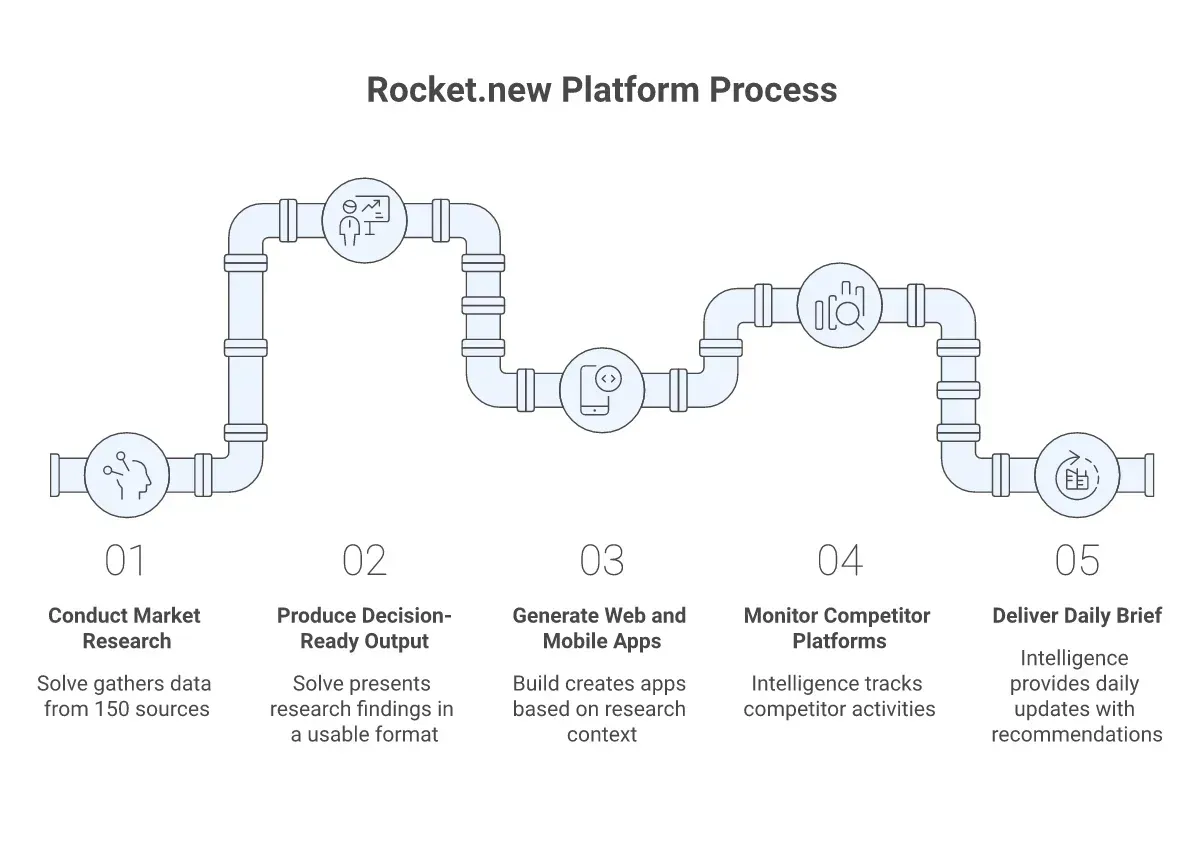 Rocket.new Three Pillars
This is exactly what Rocket.new was built to address.
Rocket.new is the world's first Vibe Solutioning platform. Backed by Salesforce Ventures and Accel, Rocket 1.0 ships with seven capabilities: Solve, Build, Intelligence, Redesign, Context, Collaborate, and Support - all connected through a shared context architecture so the thinking before the build and the build itself happen in the same place.
Where most platforms start at the build step, Rocket 1.0 starts before that.
Solve - Market Analysis Without the Rabbit Hole
Rocket 1.0's Solve capability takes any business question - market sizing, competitive assessment, pricing strategy, feature scoping - and runs thousands of queries across 150+ sources simultaneously. Within 60 to 90 minutes, what would have taken a research team days is complete: a structured output with findings, evidence, signal strength ratings, a risk matrix, and a direct recommendation.
This is not a document that gets filed and forgotten. The Solve output becomes the foundation of every build that follows. The market analysis done in Solve is present when the team opens Build the next day. The competitive brief is present when the landing page is written. Nothing re-explained. Everything compounds.
Rocket.new connects research to execution in a way that no separate toolchain can replicate - because the output of one step becomes the starting point for the next.
Build - Code Generation That Starts from Context
Rocket 1.0's Build capability generates production grade web apps in Next.js and mobile apps in Flutter. Real design systems, SEO-ready structure, WCAG accessibility compliance, and 25+ integrations built in from the start - these are defaults, not optional extras.
What separates Rocket.new's Build from other platforms is what it starts from. Because the market research from Solve lives in the same shared context as the Build, the code generation reflects actual product strategy, not just the prompt. Founders can refine as they go - adjust features, change the data model, add integrations - all in context, without re-explaining the problem from scratch.
Intelligence - Track Competitors Without the Manual Work
Rocket 1.0's Intelligence module monitors every public platform a competitor operates on - websites, social media, job postings, review platforms, and advertising - continuously - and delivers a daily brief with signals, interpretations, and recommended next steps.
When a competitor updates their pricing, starts running new ads, or shifts their messaging, Rocket.new catches it. When job postings reveal a new area of product investment, Intelligence flags it. Teams running Rocket.new are not spending hours tracking competitors manually. That work runs in the background, and the tested insights land before the first meeting of the day.
What Makes Rocket.new Different
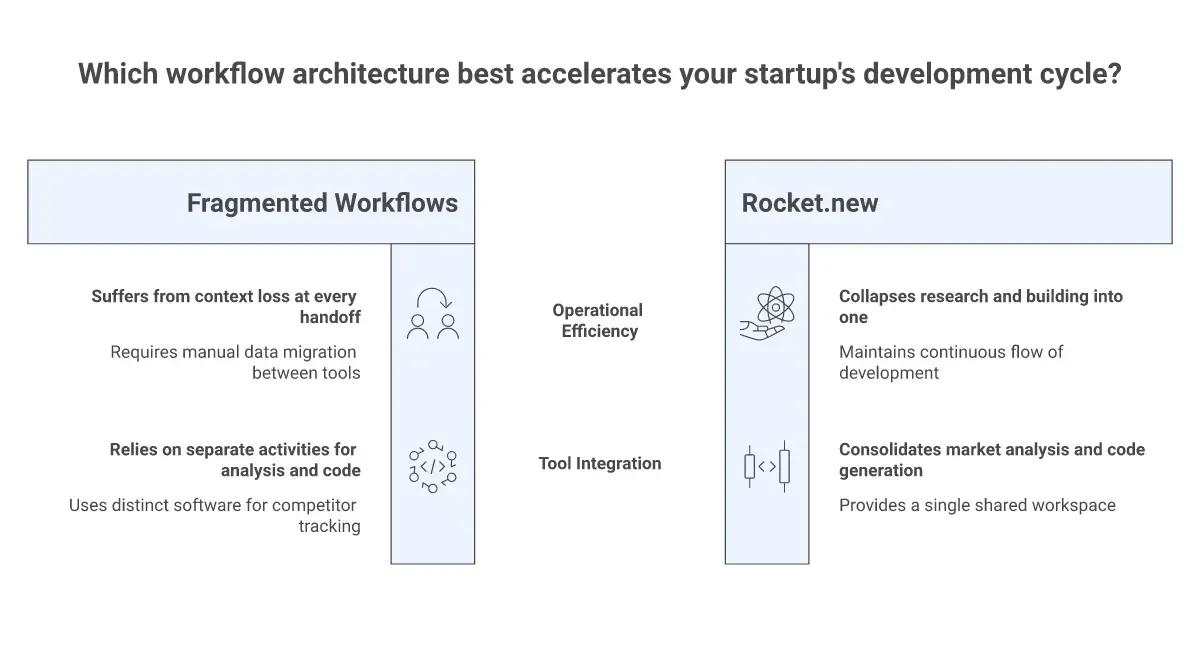 Research-to-Build Gap
Here is a direct comparison:
| Capability | Lovable / Bolt / v0 | Rocket 1.0 |
|---|---|---|
| Market research | Manual, separate tools | Solve - structured, 150+ sources |
| Competitive intelligence | Not included | Intelligence - continuous monitoring |
| Shared team context | Session-level only | Persistent across all tasks and team members |
| Code generation | Yes | Yes - Next.js and Flutter |
| Daily competitor briefs | No | Yes, with recommendations |
| Research-to-build connection | Manual handoff | Connected through shared context |
The positioning Rocket 1.0 operates from is direct: "They build what you tell them to build. Rocket figures out what's worth building - then builds it."
1.5 million people across 180 countries have tried Rocket, reached primarily through organic product-led growth. Rocket.new helps teams shift from guesswork to conviction - because the market analysis and the build are based on the same shared context.
A builder in the r/vibecoding community described their experience this way:
"I use GPT to first create a very extensive PRD, and then feed that into rocket.new. It does a really solid job of analyzing everything, and then generates a to-do list where you can pick which screens to create."- r/vibecoding community member
Build What's Worth Building
The 42% startup failure rate tied to poor market fit does not come from founders who skipped research entirely. It comes from teams where the research and the build were never truly connected - where the knowing never made it into the building.
Quantitative market research matters. But only if it reaches the people making product decisions, in the same context, at the moment those decisions are being made. That is exactly what Rocket 1.0 was built for - one platform for the research, the build, and the ongoing competitive intelligence that keeps both working together. Research less, ship more. Not by cutting corners, but by doing the thinking in the same place as the execution.
Table of contents
- -The Research Trap That Keeps Founders Stuck
- -What Quantitative Market Research Actually Means for Founders
- -The Over-Research Cycle Most Teams Are Stuck In
- -Why Most AI Tools Miss the Point
- -The Research Signals That Tell You Whether Something Is Worth Building
- -How Rocket.new Connects Research, Building, and Intelligence
- -Solve - Market Analysis Without the Rabbit Hole
- -Build - Code Generation That Starts from Context
- -Intelligence - Track Competitors Without the Manual Work
- -What Makes Rocket.new Different
- -Build What's Worth Building