
Solve on Rocket.new transforms build vs buy decisions into structured, evidence-backed reports using live data from 150+ sources. Parallel AI agents analyze market, pricing, competition, and feasibility to deliver clear recommendations. Teams align faster and move from research to execution without losing context.
Should Your Team Build or Buy?
A Business Question Worth Getting Right
-
Build custom: Full control over outcomes, but slower and resource-intensive.
-
Buy off-the-shelf: Speed and convenience, but potentially less flexibility.
Both options have trade-offs, yet all too often, the underlying research is thin.
Building custom AI solutions offers complete control and the potential for competitive differentiation, but it requires significant upfront investment and advanced data capabilities.
According to a 2026 Product School report, global AI spending exceeds $200 billion annually, but much of it doesn’t drive meaningful impact. The issue isn’t the budget; it’s the quality of the research before committing funds.
This is the gap Solve on Rocket.new aims to close.
Why Building the Wrong Thing is So Expensive
Most product failures stem from misdirection rather than execution.
Research from Standish Group, cited by Today in 2025, shows ~64% of delivered software features are barely used.
Teams often build for a request, not a validated need, and errors compound:
-
Wrong build: Years of maintenance overhead.
-
Wrong buy: Matching a misfit tool and wasting engineering resources on workarounds.
"The priciest mistake is committing to any path before thorough research."
Acquisition Strategies for Generative AI: What Teams Need to Know
Before committing to any path, organizations can acquire generative AI solutions through three main strategies: buying an off-the-shelf model, boosting an existing model with proprietary data, or building a custom solution from scratch.
1. Buy: Speed Over Differentiation
Purchasing an off-the-shelf generative AI model allows organizations to adopt technology quickly without investing in model development. However, this speed comes at a cost, limited differentiation from competitors and growing dependence on vendors for updates, pricing, and reliability.
2. Boost: Customization Within Boundaries
Boosting generative AI solutions involves enhancing a vendor's model with proprietary data, which can improve accuracy but requires strong data governance and may increase operational costs. While this middle-ground approach can yield better results than a pure off-the-shelf buy, it demands strong data governance practices and often drives up operational costs over time.
3. Build: Full Control, Full Commitment
Building a custom generative AI solution from scratch offers complete control over outcomes and the strongest potential for competitive differentiation. The trade-off is significant; this path requires substantial investment, advanced internal capabilities, and long-term resource commitment.
Why Getting This Decision Right Matters
Choosing the wrong acquisition strategy doesn't just waste budget; it compounds over time through maintenance overhead, vendor lock-in, or costly rebuilds. This is exactly the kind of high-stakes, multi-variable decision that Solve on Rocket.new is designed to support, bringing structured, evidence-backed, live-data research to a question that too many teams answer with gut instinct alone.
Where Engineering & Strategy Teams Differ
Both groups care about build-vs-buy, but rarely share the same data or perspective.
Engineering priorities:
-
Error risk and technical debt
-
Maintenance/customization
-
Feasibility and scalability
-
Code quality
-
Development overhead
-
Vendor lock-in
Strategy priorities:
-
Time to market
-
Competitive positioning
-
Pricing/vendor risk
-
Alignment to business goals
-
Customer/market data
| What Engineering Weighs | What Strategy Weighs |
|---|---|
| Error risk and technical debt | Time to market |
| Maintenance and customization costs | Competitive positioning |
| Technical feasibility and scalability | Pricing and vendor risk |
| Code quality and long-term build path | Business goals alignment |
| Development overhead | Customer and market data |
Solve generates a single report that addresses both engineering and strategy priorities from the same live data, which makes sense, given that both teams are ultimately solving the same business problem."
How "Vibe Solutioning" Improves Research
Traditionally, research means:
-
Gathering data from tabs
-
Summarizing into slide decks
-
Debating sources
-
Handoffs multiply confusion
-
Accuracy degrades with every step
Vibe solutioning reverses this:
-
Rigorous thinking before building shapes what gets built.
-
Most AI tools return a summary, Solve returns a structured, actionable plan readable and actionable by all.
Alon Goren, CEO of AnswerRocket, notes:
“The traditional build vs. buy equation for enterprise software just got rewritten. Now you buy evergreen pieces—authentication, database, infrastructure, and build where you’re unique.” - LinkedIn
Solve delivers this clarity at scale, grounded in real context and live market data.
How Solve on Rocket.new Runs the Analysis for Business Question
So let's find out how does Solve on Rocket.new generates a build-vs-buy analysis that both engineering leaders and strategy teams can trust?
When you ask a business question like “Should we build a custom analytics layer or buy a reporting tool?”
Solve does not just respond with a summary or one AI output. Instead, the platform uses parallel AI agents to pull real-time data from over 150 sources, including competitor websites and job listings.
The Output:
A structured report (8–12 sections) such as:
-
Executive summary
-
Market sizing
-
Competitive teardowns
-
Pricing comparisons
-
Build vs. Buy risk matrix
-
Clear, weighted recommendations
Each finding is signal-tagged so teams know how much weight to give it.
Parallel AI Agents = Depth
Most AI tools answer once and move on. Solve splits your question into parallel research streams, each handled by a dedicated agent, showing:
-
What sources were researched
-
The evidence found
-
Confidence in each finding
Final results are merged:
-
One signed-off, shareable, structured document
-
Much higher quality than single-pass AI
Shared Context and No Information Loss
Context loss is common:
-
Research in one tool
-
Strategy written elsewhere
-
Engineering starts with handoffs
Research results are saved as a living data layer to prevent the loss of strategic intent during the transition from planning to development.
By keeping research and the build together in Rocket.new (via shared context), nothing resets between phases. No re-explaining. Code generation becomes faster and more accurate.
Competitive Intelligence Baked-In
Most build-vs-buy reports rely on static research. By the time a decision is made, the market may have changed. Solve always pulls live data, so each deliverable includes:
-
Latest competitor pricing & product positioning
-
Recent moves/updates by competitors
-
Gaps in the market and customer demand
How others solved the same build-vs-buy challenge. This live intelligence fundamentally raises the quality of decision-making.
When Vibe Coding Meets Strategy: Use Cases
Research shows 60–70% of “vibe coding” users aren’t sure what to build at the start.
Solve closes this gap for:
-
Startup founders: Competitive teardown and market analysis before building
-
Enterprise teams: Pre-sprint stakeholder alignment with shared, actionable research
-
Engineering leaders: Analysis covering both feasibility and fit
-
Strategy teams: Full build-vs-buy assessments carried straight into the build, no rework or tool switching
👉Check out this LinkedIn post by Visal Virani
Every use case yields a structured, shareable report, present, PDF, or hand-off in Rocket.
When AI Tools Alone Aren’t Enough: Build from the Right Foundation
Standalone AI like ChatGPT or Perplexity = general summaries, not decisions or actions.
Teams still have to:
-
Interpret research
-
Connect it to decisions
-
Carry it through to building and delivery
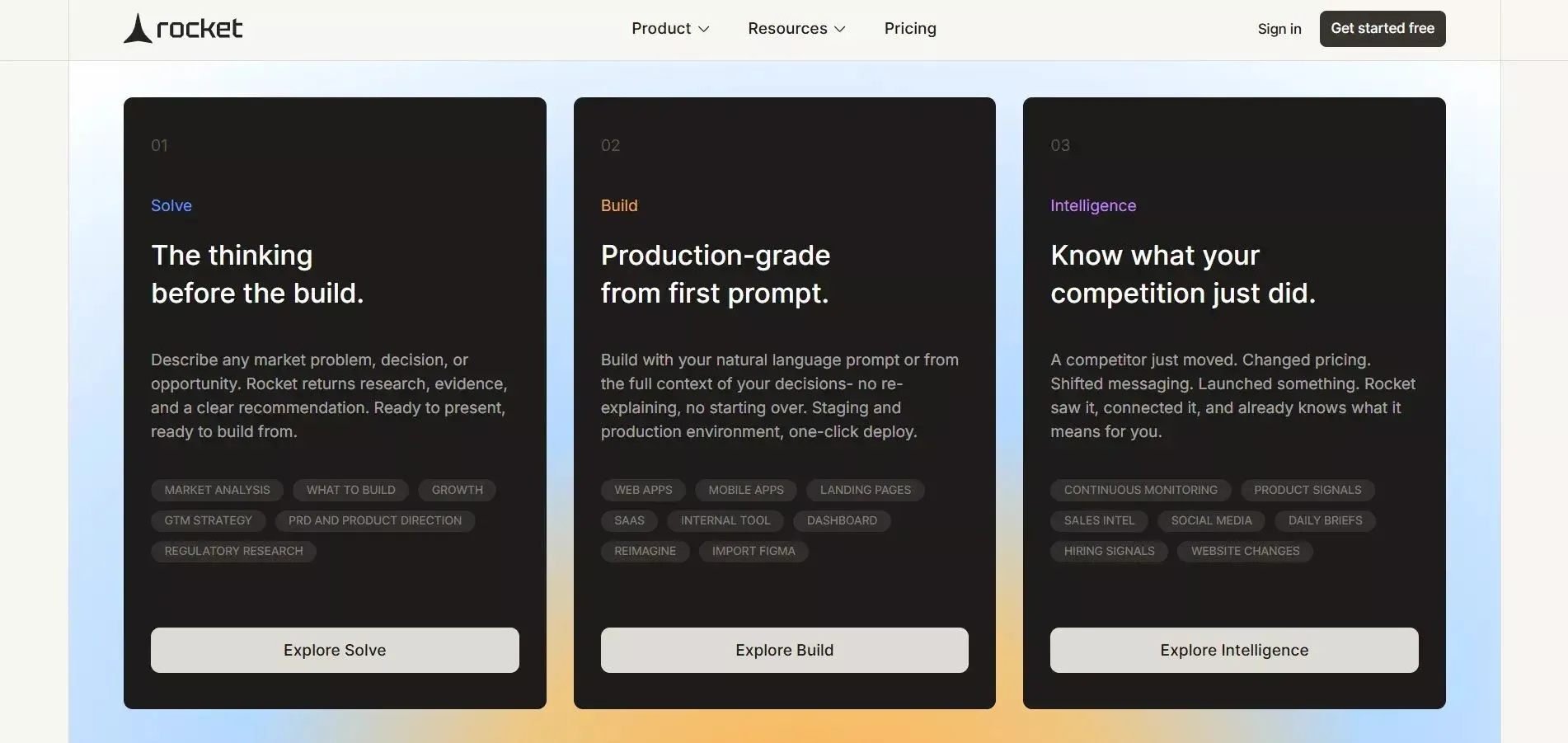
Rocket.new is a vibe solutioning platform with three integrated products in one place:
-
Solve – Generates build-vs-buy analysis for any business question; provides structured, multi-source, recommendation-rich reports in hours.
-
Build – Turns research into ready code (Next.js for web, Flutter for mobile, with real design systems, theming, and navigation). Uses the same research context to cut waste and speed up builds.
-
Intelligence – Rocket.new's platform integrates ongoing market monitoring to keep build-vs-buy decisions valid over time.
“The AI tool market made a fundamental mistake; it built tools. Tools require you to be the system. Rocket is the system.”
-
Perplexity finds info.
-
ChatGPT responds to queries.
-
Rocket produces decisions & builds from them.
The Right Build-vs-Buy Analysis Starts Before Code
The core problem is not cost, it’s research.
-
Teams often have fragmented data, misaligned stakeholders, or lose context between research and build.
-
Solve does parallel, structured research, produces signal-scored, evidence-backed findings, and carries that shared context directly into the build process, so research turns straight into execution.
For companies where this decision means the difference between shipping value or building waste, that’s exactly what Rocket delivers.
Make smarter build vs buy decisions with data-backed clarity, try Solve on Rocket.new today.
Table of contents
- -Should Your Team Build or Buy?
- -Why Building the Wrong Thing is So Expensive
- -Acquisition Strategies for Generative AI: What Teams Need to Know
- -1\. Buy: Speed Over Differentiation
- -2\. Boost: Customization Within Boundaries
- -3\. Build: Full Control, Full Commitment
- -Why Getting This Decision Right Matters
- -Where Engineering & Strategy Teams Differ
- -Engineering priorities:
- -Strategy priorities:
- -How "Vibe Solutioning" Improves Research
- -How Solve on Rocket.new Runs the Analysis for Business Question
- -The Output:
- -Parallel AI Agents = Depth
- -Shared Context and No Information Loss
- -Competitive Intelligence Baked-In
- -When Vibe Coding Meets Strategy: Use Cases
- -When AI Tools Alone Aren’t Enough: Build from the Right Foundation
- -The Right Build-vs-Buy Analysis Starts Before Code