
Rocket.new helps strategy teams replace scattered data with structured insights before quarterly planning sessions. Continuous competitor monitoring, customer feedback synthesis, and AI-generated strategy briefs improve decision-making speed and accuracy. Teams using Rocket.new enter planning sessions with shared context, prioritized initiatives, and data-backed confidence instead of assumptions.
What happens when a strategy team walks into a quarterly planning session without structured data?
Decisions stall. Priorities shift based on opinions, not evidence.
According to Pendo research, 75% of product managers say data matters for decision making, but only 30% are satisfied with their access to it.
That gap between needing data and actually having it is where most teams lose time, context, and confidence before planning sessions even begin.
Why Most Teams Struggle Before Quarterly Planning
The Data Access Problem
-
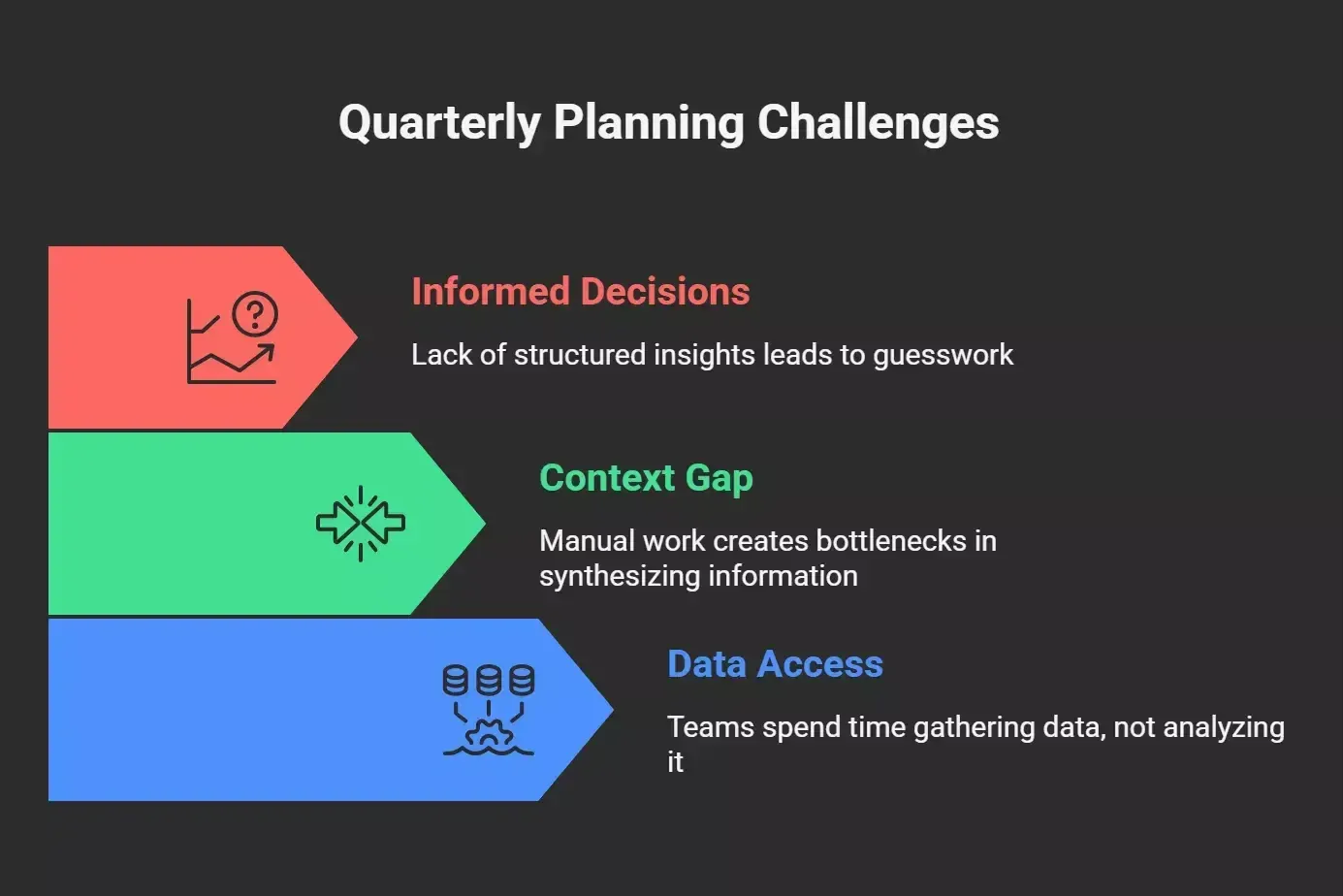
Product teams spend more time gathering data than analyzing it. Quarterly reports often rely on stale spreadsheets and recycled slide decks from the previous cycle.
-
Sales team members have context about customers that never makes it into planning documents. Customer feedback sits in support tickets, CRM notes, and call recordings, scattered across multiple tools.
-
Product managers know what customers are asking for but lack structured insights connecting those requests to market shifts or competitor activity.
The Context Gap
-
When teams need to synthesize competitive signals, customer feedback, and usage data together, the manual work of pulling from multiple sources creates bottlenecks.
-
Most teams try to do a competitive research sprint one or two weeks before planning. That leaves gaps because real competitive signals come from continuous monitoring, not one-time research.
-
The full context of what competitors did over the past 90 days gets compressed into a few bullet points on a slide, and informed decisions become guesses.
The Real Cost of Walking in Without Preparation
Missed Opportunities and Slower Growth
-
When teams skip pre-planning research, they miss signals that competitors have already acted on. A pricing shift from a competitor goes unnoticed. A surge in customer complaints about a specific feature gets buried in a backlog.
-
Growth depends on catching these signals early. Product teams that track competitor activity and customer feedback in real time spot openings that others miss.
-
The difference between a strong quarter and a wasted one often comes down to whether the team had the right data at the right moment.
The Conversation That Never Happens
-
Quarterly planning is a conversation, not a presentation. But without structured data, the conversation defaults to whoever has the loudest opinion or the most recent anecdote.
-
When product managers bring evidence, the conversation shifts. Leadership asks different questions. The sales team adds context that matters. Other departments contribute instead of sitting quietly.
-
Product-Led Growth is a methodology where customer acquisition, expansion, conversion, and retention are driven by the product itself. Companies following this approach often use usage-based pricing, which matches pricing to actual customer value. For these companies, quarterly planning is where product, growth, and customer experience converge. Without data, those conversations stall.
How Service Delivery Ties into Planning
-
Service delivery quality directly affects customer retention and growth. If customers are churning because of service gaps, that pattern needs to show up in the planning session.
-
Research shows that organizations using product-led growth strategies experience faster feedback loops, letting them build products that better match market demands and customer expectations.
-
Aligning employee experience with customer experience matters here. Companies that connect these two see stronger results from their planning process because the people delivering service understand the customers receiving it.
What Strategic Work Looks Like in Practice Before Planning
Gathering Competitor Activity
-
Tracking what competitors ship, how they price, and where they hire gives product teams a picture of market direction.
-
A sales team rep notices a competitor offering a new free tier. A product manager spots a competitor's job posting for "AI integration engineer." These signals, when connected, tell a story about where the market is heading.
-
Without a system that collects these signals automatically, teams rely on a quick search or anecdotal reports from sales calls. That approach leaves gaps and missed opportunities.
Synthesizing Customer Feedback
-
Customer feedback arrives through support tickets, NPS surveys, sales call transcripts, social messaging channels, and review sites. The volume is not the problem. The lack of structure is.
-
Product teams that synthesize this feedback into structured insights before planning can identify patterns: which features customers ask for most, where the customer journey breaks down, and what drives churn.
-
Mapping the customer journey before planning reveals where customers drop off, where they find the most value, and where the product fails to meet expectations. That map becomes a roadmap input.
-
Research from Bain and Company shows that 80% of companies believe they are customer-centric, but only 8% of customers agree. That disconnect matters during quarterly planning, when decisions about what to build and where to invest directly shape customer experience.
-
Companies adopting a PLG strategy often use usage-based pricing, letting customers pay based on actual usage. This creates a direct link between customer satisfaction and revenue, making quarterly reports a reflection of how well the product serves customers.
Turning Signals into a Strategy Brief
-
Before a roadmap session, product teams need to synthesize competitive signals, customer feedback patterns, and usage data to create structured insights that inform prioritization decisions.
-
The traditional model looks like in practice: a product manager spends two to three weeks pulling data from multiple sources, building a deck, and presenting it to a room that asks follow up questions nobody can answer on the spot.
-
A better process delivers a strategy brief with research, evidence, and a clear recommendation, ready to present to leadership and ready to act on.
How AI Tools Are Changing Pre-Planning Research
The Shift from Reactive to Anticipatory
-
According to Gartner, AI agents and AI-ready data are the two fastest-advancing technologies on the 2025 Hype Cycle for Artificial Intelligence. That shift matters for product teams doing pre-planning research.
-
AI tools that surface predictive analytics allow product teams to shift from reactive to anticipatory decision-making. Instead of reviewing what happened last quarter, teams can model what is likely to happen next quarter.
-
Companies adopting AI have seen product development efficiency jump by 25 to 30%, which means faster decisions and less manual work in preparing for planning sessions.
What Generative AI Adds
-
Generative AI can summarize customer feedback from hundreds of sources into a single metric or pattern. It can flag competitor activity from news, social media, and job postings automatically.
-
The problem with too many tools is that each one gives a partial view. Product managers end up switching between six or seven platforms, trying to piece together a full picture.
-
AI tools work best when they operate inside a single platform that holds the full context of past decisions, current data, and competitor signals.
Where Most AI Tools Leave Gaps
-
Most AI tools handle one slice of the problem: competitive research, customer feedback analysis, or data visualization. Few connect all three.
-
This leaves product teams doing manual work to bridge the gap between tools. A competitive intelligence report sits in one app. Customer feedback data sits in another. The roadmap lives in a third.
-
Small teams and many enterprises face the same challenge: too many tools, not enough connection between them.
Building a Pre-Planning Workflow That Actually Works
Step 1: Set Up Continuous Monitoring
-
Continuous monitoring of competitor activity replaces the old model of doing a deep dive once per quarter.
-
Track competitor signals like pricing shifts, hiring patterns, product launches, and ad spend changes from multiple sources.
-
When a competitor shifts messaging or launches a new feature, your team should know within hours, not weeks.
Step 2: Structure the Data
-
Raw data is noise. Structured data is a plan. Product managers need a process that turns competitor activity, customer feedback, and market data into structured insights.
-
The right data, organized by theme (pricing, features, positioning, market expansion), gives each team member the context they need.
-
A scoring formula that weighs impact, urgency, and differentiation gap helps prioritize initiatives before planning begins.
Step 3: Build the Strategy Brief
-
A strategy brief should include: competitive analysis, customer feedback patterns, usage data highlights, and a clear recommendation on what to build next.
-
Using the right platform, teams can generate a strategic brief in 60 to 90 minutes, including competitive analysis and execution paths.
-
That brief becomes the shared context layer during quarterly planning. Every person in the room works from the same evidence. No more guessing. Just valuable insights that focus the conversation on what to build, not what data to trust.
Step 4: Communicate Progress and Get Buy-In
-
Product teams that communicate progress with data get faster buy-in from leadership and other departments.
-
Share the brief with the sales team, client teams, and cross-functional teams before the planning session. Let them add context and flag gaps.
-
This process builds trust. When the strategy team presents data-backed priorities, there is less debate about what matters and more focus on how to execute.
What This Looks Like in Practice Across Teams
For Product Managers
-
Product managers get structured insights on competitor moves, customer pain points, and market gaps, all in one place. The focus shifts from gathering data to interpreting it.
-
Instead of spending two weeks on manual work, they review a pre-built brief and focus on strategy and problem-solving. The valuable insights are already extracted and organized.
-
The result: faster decisions, more value delivered per quarter, and less time lost to data gathering.
For the Sales Team
-
A sales team armed with real-time data on competitor pricing and messaging wins more deals. They know what objections to expect and how to position against competitors.
-
Competitive intelligence flows directly into sales enablement, so reps walk into calls with current information, not last quarter's battlecards.
-
This support for the sales process directly ties to service delivery improvements and growth targets.
For Other Departments
-
Marketing uses competitor Ads and content signals to adjust campaigns.
-
Support teams use customer feedback patterns to anticipate and address common issues during the onboarding process.
-
Leadership uses the strategy brief to make informed decisions on budget allocation and headcount, with data behind every recommendation.
| Team | Pre-Planning Input | Outcome |
|---|---|---|
| Product managers | Competitor signals, customer feedback, usage data | Prioritized roadmap backed by evidence |
| Sales team | Real-time competitor pricing and positioning data | Higher win rates, better objection handling |
| Marketing | Competitor ad spend, content gaps, social messaging data | Targeted campaigns, better positioning |
| Support | Customer feedback trends, service delivery patterns | Faster issue resolution, proactive communication |
| Leadership | Full context strategy brief with scoring | Faster decisions on budget and growth priorities |
The Value of a Single Platform for Pre-Planning
Why Switching Between Multiple Tools Fails
-
Every time a product manager switches between a research tool, a feedback tool, and a roadmap tool, context gets lost.
-
Save time by keeping all competitive research, customer data, and planning artifacts in one workspace.
-
The platform that holds persistent memory of past signals and decisions gives teams full context, not just what was gathered this week.
What a New Platform Needs to Do
-
Connect competitive research to customer feedback to roadmap decisions, automatically.
-
Support decision-making with structured data, not raw dumps.
-
Build workflows that other departments can access, so the strategy team is not the bottleneck.
What People Are Saying
The shift toward AI-powered competitive intelligence before quarterly planning is not theoretical. Teams are already changing how they prepare.
"I use AI really frequently for competitive analysis and market insights. So, trying to understand what our competitors in the consumer wearable space are doing and looking at new market entries. I'll really use that to get a general sense of the market landscape and of competitive trends and then hone in on specific use cases there." - Bryn Harrington, Product Marketing Lead at Oura, via Competitive Intelligence Alliance
That quote captures just what most product teams experience: AI is already part of the competitive research workflow, and the teams using it are moving faster than those still relying on manual methods.
How Rocket.new Handles Intelligence Before Quarterly Planning Sessions
So let's find out, how does a strategy team use Rocket.new's Intelligence before a quarterly planning session?
Rocket.new was built for the exact problem this post describes: getting from scattered data to structured decisions before a planning session, without switching between six different tools. Rocket connects the thinking (research and analysis), the building (turning decisions into prototypes and products), and the tracking (watching what competitors do next), all in one system with one shared context.
-
Vibe-solutioning platform: Describe a market problem, and Rocket returns research, evidence, and a recommendation. No prompt engineering required.
-
25,000+ templates library, free to use: Start from a template that matches your use case. Rocket adapts it to your brand, stack, and goals.
-
Saves up to 80% tokens: Companies that use Rocket to collect and synthesize competitive intelligence save up to 80% of the time spent on manual research by getting structured insights delivered automatically.
-
Supports Flutter (mobile) and Next.js (web): When insights lead to action, build the product right inside Rocket, for mobile or web.
-
Collaboration features built in: Share briefs, tag teammates, and collect feedback from the sales team, client teams, and leadership before the planning session.
-
3 Products, One platform: Solve, Build, and Intelligence: Solve handles the thinking before the build. Build turns decisions into production-grade apps. Intelligence watches competitors continuously.
How Rocket Intelligence Works for Pre-Planning
-
Rocket's Intelligence tracks competitor signals like pricing shifts and hiring patterns from over 150 sources. It automates the collection of competitor data from websites, social media, and ad activities for real-time tracking.
-
The early warning system identifies significant competitor moves that require a strategic response to support decision-making before planning sessions.
-
Rocket can synthesize multiple competitor signals into a single strategic signal, helping product teams identify market gaps and feature priorities.
Practical Benefits for Strategy Teams
-
Competitive research on autopilot: Replace one-time research sprints with continuous monitoring. Rocket provides a continuous intelligence flow for quarterly planning by replacing static reporting with data-backed insights.
-
From insight to action, no tool-switching: Rocket's capabilities convert insights into actionable plans and prototypes without needing to switch to separate tools.
-
Predictive roadmapping: The platform uses intelligence from competitor job postings and ad spend shifts to identify where the market is heading before planning begins.
-
Persistent memory: Rocket stores all past signals and decisions in one workspace, so no valuable context is lost between quarters. Product teams and the sales team both access the same data.
Arriving at Planning with Confidence, Not Guesswork
How does a strategy team use Rocket.new's intelligence before a quarterly planning session?
By replacing scattered data, manual work, and opinion-driven priorities with continuous monitoring, structured insights, and a shared context layer that every team member can access.
Aligning product roadmaps with organizational goals keeps stakeholders working toward a common vision and reduces conflicts. The teams that walk into planning with evidence, not assumptions, make faster decisions, deliver more value, and stay ahead of competitor activity quarter after quarter.
Sign up, and turn competitor signals and customer feedback into actionable quarterly plans with Rocket.new Intelligence.
Table of contents
- -Why Most Teams Struggle Before Quarterly Planning
- -The Data Access Problem
- -The Context Gap
- -The Real Cost of Walking in Without Preparation
- -Missed Opportunities and Slower Growth
- -The Conversation That Never Happens
- -How Service Delivery Ties into Planning
- -What Strategic Work Looks Like in Practice Before Planning
- -Gathering Competitor Activity
- -Synthesizing Customer Feedback
- -Turning Signals into a Strategy Brief
- -How AI Tools Are Changing Pre-Planning Research
- -The Shift from Reactive to Anticipatory
- -What Generative AI Adds
- -Where Most AI Tools Leave Gaps
- -Building a Pre-Planning Workflow That Actually Works
- -Step 1: Set Up Continuous Monitoring
- -Step 2: Structure the Data
- -Step 3: Build the Strategy Brief
- -Step 4: Communicate Progress and Get Buy-In
- -What This Looks Like in Practice Across Teams
- -For Product Managers
- -For the Sales Team
- -For Other Departments
- -The Value of a Single Platform for Pre-Planning
- -Why Switching Between Multiple Tools Fails
- -What a New Platform Needs to Do
- -What People Are Saying
- -How Rocket.new Handles Intelligence Before Quarterly Planning Sessions
- -How Rocket Intelligence Works for Pre-Planning
- -Practical Benefits for Strategy Teams
- -Arriving at Planning with Confidence, Not Guesswork