
A practical guide to calculating total addressable market (TAM) for startup founders. Covers the three main methods: top down, bottom up, and value theory, plus the TAM SAM SOM framework, common calculation mistakes, and how Rocket.new helps founders validate their market and ship faster.
Do you know if there are actually enough customers out there to make your idea worth building? That question - and knowing the answer fast - is exactly what separates founders who ship from founders who spiral.
How to calculate TAM (Total Addressable Market) sounds like a finance class exercise. But for founders moving fast, it's one of the most practical things you can do in a morning.
According to Wise Business, 35% of startups fail simply because there was no real market for what they built. Not because of bad code. Not because of poor design. No market.
This blog walks through what TAM is, why it matters, how to calculate it without getting paralyzed by spreadsheets, and how Rocket.new helps founders do the whole thing faster.
What Is Total Addressable Market (TAM)?
TAM stands for Total Addressable Market - the maximum revenue your business could generate if you captured every single customer who could ever buy your product or service.
Think of it as the full ceiling of the opportunity. TAM is not what you'll capture this year. It's not even what you'll capture in five years. It's the theoretical total demand that exists for your product category across your defined market.
TAM is almost always expressed in revenue terms:
TAM = Total Number of Potential Customers x Annual Revenue Per Customer
A focused, defensible TAM number tells investors you understand your market. A vague or inflated one tells them you don't know your customers yet.
Why TAM, SAM, and SOM All Matter
TAM alone doesn't tell the full story. Founders use three connected metrics together: TAM, SAM, and SOM. Each one zooms in a little closer.
| Metric | Full Name | What It Answers |
|---|---|---|
| TAM | Total Addressable Market | What's the full size of this opportunity? |
| SAM | Serviceable Addressable Market | What portion of TAM can we realistically reach? |
| SOM | Serviceable Obtainable Market | What can we actually capture in the next 1-3 years? |
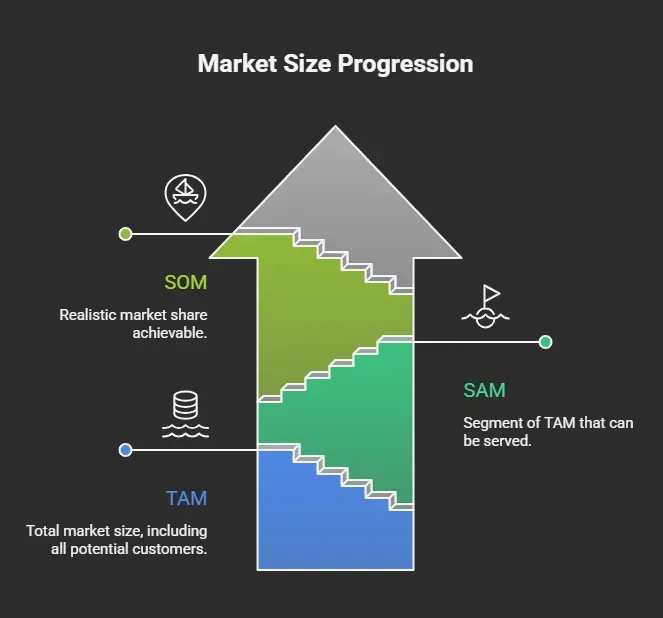 TAM is your market size ceiling. If you're building a project management SaaS for construction firms in the US, your TAM includes every construction company in the US that could theoretically pay for your product.
SAM is the segment of TAM you can actually serve. You might only serve mid-size firms with 50+ employees because your pricing doesn't work for sole traders or large enterprises. That narrows it down considerably - but makes it real.
SOM is your realistic share. Most early-stage startups capture 1-5% of their SAM in the first few years. SOM is the number your pitch deck actually lives or dies on.
Investors care about all three. TAM proves the market is worth entering. SAM shows you know who buys from you. SOM shows you've done the math on what's actually achievable with the resources you have.
How to Calculate TAM: The 3 Main Methods
There are three ways to calculate total addressable market. The right one depends on your data, your market maturity, and your product type.
Top Down Approach
The top down approach starts with a big industry number and filters down to your specific slice.
You grab a market report from Gartner, Statista, or IBISWorld. Say it tells you the US project management software market is worth $7.2 billion. You then apply filters: your sector only, your geography only, your customer size range only. Each filter narrows the number to something that resembles your actual market.
The upside: It's fast. Published research does the heavy lifting.
The downside: Those reports rarely carve up the market the way you need. Investors treat top down numbers as a rough sanity check, not proof that you understand your customer.
Bottom Up Approach
The bottom up approach is the one investors prefer at early stage. You count your potential customers and multiply by your average revenue per customer.
Example:
-
You're building HR software for US tech startups with 10-100 employees
-
There are approximately 85,000 such companies in the US
-
Your annual subscription price is $3,600 per year
-
TAM = 85,000 × $3,600 = $306 million
Now you can defend every assumption. You know your pricing. You've counted your customer segments. When an investor asks how you arrived at that number, you walk them through each step.
Value Theory Approach
The value theory approach works when you're building something genuinely new where no direct comparable exists. Instead of counting existing customers or referencing industry reports, you estimate what customers would pay based on the value you create.
If your software saves a financial analyst 8 hours a week, and their time costs $80 per hour, you're creating roughly $33,000 in annual value per user. You might price at 10% of that value - $3,300 per year. Multiply by the number of analysts who face this problem and you have your TAM.
This needs more assumptions than the others. Use it when your product genuinely doesn't fit any existing category.
What TAM Research Actually Looks Like For Founders
For most early-stage founders, TAM research is less about building a perfect model and more about validating assumptions quickly before committing months of engineering time to the wrong idea.
A 2025 LinkedIn piece by Md Irfan Habib captured an investor sentiment that keeps coming up in pitch meetings:
"I care more about SOM than TAM. TAM is for storytelling. SOM is for survival."- Investor quote via Plutonapps / LinkedIn Pulse, May 2025
That's the core tension. Founders either overinflate TAM with lazy top-down math or they get so lost in building the perfect market model that they never ship anything.
According to the Founders Forum Group's 2025 startup statistics guide, 42% of startups fail because they built something with no real market demand behind it. Not because they didn't know how to code. Not because they ran out of time. They just didn't validate the market before they started.
The founders who ship faster aren't skipping market research. They're running it smarter.
A Practical TAM Calculation Walkthrough
Say you're building a time-tracking SaaS for freelance designers in the US. Here's how a bottom up calculation would look step by step.
Step 1 - Define your customer segment precisely
Not "all freelancers." Freelance graphic designers and UI/UX designers in the US who bill clients and need to track hours for invoicing.
Step 2 - Find the total number of potential customers
Using Bureau of Labor Statistics data and LinkedIn audience estimates, there are approximately 350,000 freelance graphic designers and UX designers operating in the US.
Step 3 - Apply realistic filters for SAM
Not all of them would pay for dedicated time-tracking software. Filter for realistic targets - let's say 40% of the 350,000. SAM = 140,000 potential customers.
Step 4 - Set your annual revenue per customer
Your pricing is $12/month or $120/year.
Step 5 - Calculate
-
TAM: 350,000 × $120 = $42 million
-
SAM: 140,000 × $120 = $16.8 million
-
SOM (targeting 5% of SAM in year 1-2): 7,000 × $120 = $840,000
That SOM of $840K is your real revenue target. It's the number that guides your go to market strategy, your marketing and sales efforts, and your pricing strategies for the next 12-18 months.
Common TAM Calculation Mistakes Founders Make
Claiming global TAM when you're only operating in one country. If you can't actually serve customers in Germany yet, don't include them in your total addressable market.
Starting with the "1% of a huge market" logic. Saying "the global project management market is $7 billion and we'll capture 1%" is not a TAM calculation - it's wishful thinking. Investors see it immediately.
Confusing TAM with market share. TAM is the ceiling of what's possible. You're not going to capture all of it - no company does.
Not updating it. Market conditions shift. A TAM you calculated in 2023 may look very different in 2025 as new competitors enter, regulations change, or customer behavior shifts. Revisit it at least annually.
Using industry reports without adjusting for your specific niche. Market reports cast wide nets. Filter them aggressively before using those numbers.
Growth Strategy and TAM: How Investors Actually Read These Numbers
When you walk into a pitch meeting with a well-constructed TAM, SAM, SOM framework, you're showing that you understand who your potential customers are, why they would pay for your product, what your realistic revenue ceiling looks like, and how you plan to allocate resources to reach that market.
A realistic $50 million TAM backed by solid assumptions almost always beats a vague $5 billion TAM built on guesswork. Investors would rather back someone chasing 10% of a defined $100 million market than 0.01% of a trillion-dollar category they can't pin down.
TAM analysis also shapes your business strategy in ways that matter beyond fundraising. If your TAM is smaller than you thought, you might need to expand your target market - adding adjacent customer segments, entering international markets, or broadening your product roadmap.
Launch Faster, Validate Smarter: How Rocket.new Helps Founders Ship
Most founders doing TAM research are also building a product at the same time. Spending three weeks on a market research exercise while your product sits unbuilt is exactly the wrong trade-off. But shipping without any market validation is how you end up in that 42%.
Rocket.new was built for this tension.
The Solve Feature - Your Market Research Co-Pilot
Rocket.new's Solve takes any business question and delivers a complete, structured analysis. For founders calculating TAM, that means you can ask Rocket:
-
"How large is the market for time-tracking software for freelancers in the US?"
-
"Who are the potential customers for an AI-powered inventory management tool for small restaurants?"
-
"What would a bottom up TAM calculation look like for a B2B SaaS targeting HR teams at companies with 50-200 employees?"
Rocket synthesizes publicly available data, surfaces market dynamics, and gives you a structured starting point in minutes - not days. The output is structured analysis you can actually use in a pitch deck or business plan.
Intelligence - Continuous Competitive Monitoring
Understanding your total addressable market isn't just about counting potential customers. It's about understanding who else is going after them.
Rocket.new's Intelligence feature monitors every public platform your competitors operate on - continuously. That means you're not doing manual competitive landscape research every few months. You're getting live signals about what market segments are contested, where your competitors are expanding, and where the gaps in the market actually sit.
This shapes how you define your SAM. If three well-funded competitors already own a customer segment, your realistic serviceable addressable market for that segment is much smaller than the raw numbers suggest.
Build - Validate With a Real Product, Not a Slide
Here's the fastest way to validate your TAM assumptions: build something and see who buys it.
Rocket.new's Build generates production-ready web apps in Next.js and mobile apps in Flutter from a plain-language description. Most apps take 1-3 minutes to generate. You can have a working prototype in front of your first potential customers the same day you finish your TAM research.
That real-world feedback loop is worth more than any industry report. Actual customers telling you they would (or wouldn't) pay for your product is the ground-truth version of market validation.
Compare that to tools like Bolt, Lovable, or v0 - they build what you tell them to build. Rocket.new figures out what's worth building, gives you the intelligence to validate the market, and then builds it from that foundation.
Stop Over-Researching, Start Shipping
How to calculate TAM is one of those questions that should take you a few focused hours - not a few weeks. The total addressable market framework exists to give you a directional answer fast, not a perfect answer eventually.
Run a bottom up calculation. Stress-test it with a top down check. Define your SAM by filtering for who you can actually reach. Set a realistic SOM based on your resources and go to market strategy. Then ship something and see what the real market tells you.
Rocket.new is built for exactly this: the part of building a company where you need to think clearly, validate quickly, and move before the moment passes. The founders who win aren't the ones who built the best TAM model. They're the ones who built something real while everyone else was still in a spreadsheet.
Table of contents
- -What Is Total Addressable Market (TAM)?
- -Why TAM, SAM, and SOM All Matter
- -How to Calculate TAM: The 3 Main Methods
- -Top Down Approach
- -Bottom Up Approach
- -Value Theory Approach
- -What TAM Research Actually Looks Like For Founders
- -A Practical TAM Calculation Walkthrough
- -Common TAM Calculation Mistakes Founders Make
- -Growth Strategy and TAM: How Investors Actually Read These Numbers
- -Launch Faster, Validate Smarter: How Rocket.new Helps Founders Ship
- -The Solve Feature - Your Market Research Co-Pilot
- -Intelligence - Continuous Competitive Monitoring
- -Build - Validate With a Real Product, Not a Slide
- -Stop Over-Researching, Start Shipping