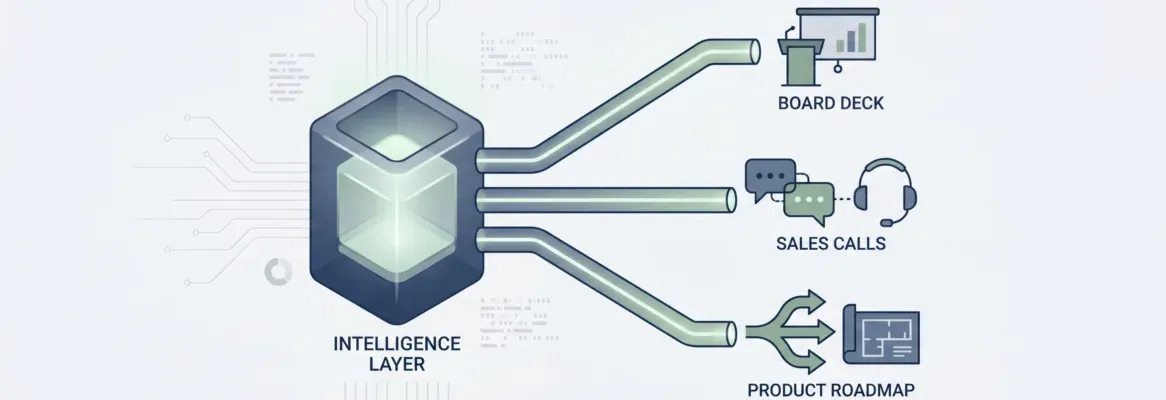
An intelligence layer that synchronizes insights across boardrooms, sales teams, and product roadmaps, enabling aligned decisions, faster execution, and a unified strategic direction powered by real-time, actionable data.
What if your board insights could sharpen every sales call?
That is the core idea behind a true board intelligence layer - a single source of business insights that feeds multiple functions at once, without anyone restarting research from scratch.
According to NACD's 2024 Board Practices and Oversight Survey, only 13% of directors rate their board packs as "extremely effective". The problem is not that teams are not working hard. It is that the intelligence they need is not flowing where it should.
This blog will show you how to build a board intelligence layer that connects insights across teams, improves decision-making, and turns every piece of research into a company-wide advantage.
Why Board Intelligence Still Feels Like a One-Off Job?
Most organizations treat board materials as a quarterly project.
Someone on the finance or strategy team spends weeks before board meetings pulling reports, stitching together slides, and chasing down the latest numbers. Then the meeting happens, the board deck gets filed, and the cycle starts over three months later.
This approach has three obvious problems:
-
The data is often stale by the time board members see it
-
Insights stay locked inside the board deck and never reach sales or product
-
Every quarter, someone rebuilds the same documents from scratch
Board management software has helped streamline the logistics - scheduling, document sharing, secure access for board members and board directors. The global board management software market was valued at $3.83 billion in 2025 and is expected to reach $7.35 billion by 2033 at a CAGR of 8.5%. That growth signals real demand for better governance and board operations. But market growth alone does not close the intelligence gap.
The gap is not about having a secure board portal or better meeting agendas. It is about what the board actually sees when they sit down - and what happens to those insights after the meeting ends.
Onboarding Your Board to a Shared Intelligence Model
Before a board intelligence layer can deliver real value, one question needs answering: how do directors actually onboard to it? This is not a technical rollout it’s an organizational shift in how boards consume and use intelligence.
Key Realities to Address
-
Boards are used to static reporting: Most boards are structured to review finalized reports, not interact with living intelligence systems.
-
The process hasn’t evolved with the data: Even when data is available, it still flows through the same old cycle prepared by finance, reviewed in a portal, discussed once, then archived.
-
Intelligence becomes inactive: After meetings, insights often sit in folders instead of continuing to inform decisions across teams.
-
Adoption depends on familiarity: AI-driven outputs must fit into existing board materials. If the format feels foreign, adoption drops no matter how powerful the system is.
-
Continuity is the real unlock: A shared intelligence layer allows every member to access evolving insights without losing historical context, making onboarding smoother for both current and new directors.
Onboarding works when the shift feels natural. A shared intelligence layer doesn’t replace how boards operate it enhances it, turning static reports into continuous, accessible intelligence that evolves with the business.
The Three Audiences That Need the Same Board Intelligence
Board directors, the sales team, and the product team all want answers to the same underlying questions. They just frame them differently.
| Audience | Their Question | What They Really Want |
|---|---|---|
| Board directors | Are we on track? | Revenue growth signals, risk flags, competitive context |
| Sales team | Why choose us now? | Market positioning, competitor weaknesses, key performance indicators by segment |
| Product team | What should we build next? | Customer pain points, competitor feature gaps, usage trends |
When these three groups pull their answers from different research pipelines, decisions drift out of alignment. When they pull from the same board intelligence layer, they naturally move in the same direction.
What a Shared Intelligence Layer Does for Board Management
A shared intelligence layer is not a single dashboard everyone logs into once a week. It is a living body of context - historical data, competitor signals, customer insights, market trends - that updates continuously and makes itself available across functions.
In practice, it does four things:
-
Monitors publicly available competitor signals pricing changes, product launches, hiring patterns, and platform activity that board directors need to stay ahead
-
Synthesizes data into decisions, not just reports so a product manager and a board member can each get an answer without needing a data analysis specialist in the room
-
Carries context forward, so the competitive brief from last week is still present when this week's sales deck is being built
-
Generates scenario analysis on demand - so board directors can stress-test assumptions and the product team can pressure-check roadmap bets at the same time
This is different from traditional board management software. Most board management tools do a great job of organizing and distributing board materials, setting up meeting agendas, running secure board meetings, and managing documents with multi factor authentication inside a secure board portal. What they do not do is generate the intelligence inside those materials.
Security matters here too. Any AI model or platform handling confidential board information needs strong security controls - encryption, access management, audit trails. Good board intelligence does not bypass board responsibilities around compliance and oversight. It operates within them.
What Gets in the Way of Real Board Intelligence
Many companies attempt to build a shared intelligence layer but most run into the same set of blockers. These are not technology failures. They are structural gaps in how intelligence is created, shared, and governed.
Key Obstacles
-
The Tool Problem: Most AI tools are built for single functions strategy, sales, or product. Each generates insights in isolation. Instead of creating a unified intelligence layer, this leads to fragmented outputs where teams must constantly translate and rebuild context across systems.
-
The Context Problem: Even when teams use AI, continuity is missing. Insights don’t persist across workflows. Research done earlier in the week doesn’t carry into later decisions, forcing teams to start from scratch. This disconnect means boards, sales, and product teams often operate on different versions of reality.
-
The Oversight Problem: Board-level intelligence must meet governance standards. Compliance,
audits, and financial accountability shape how insights are used. AI outputs without oversight frameworks risk being unusable or worse, non-compliant with board expectations.
Industry Perspective
As highlighted in NACD's 2025 Governance Outlook Directors’s 2025, one director noted that “technology literacy is becoming as important as financial literacy” for boards. This underscores a critical shift: intelligence systems must align with how boards operate—not just how AI tools function.
Real board intelligence doesn’t fail because of a lack of data or tools. It breaks down when systems don’t connect, context doesn’t persist, and governance isn’t built in. Solving these three challenges is what turns scattered insights into a true intelligence layer.
How Rocket.new Acts as a Thought Partner Across Every Function
Rocket.new is built on a different architecture. Its Intelligence pillar continuously monitors every public platform a competitor operates on and makes those signals available inside a shared context that every team can use.
How It Works Across Teams
-
For the Board Deck: Solve, Rocket’s decision intelligence feature, turns a business question into a structured answer with findings, evidence, and clear recommendations. Board materials are built on data-backed insights, not assumptions, and the output feeds directly into board decks.
-
For Sales Calls: The Intelligence pillar gives sales teams real-time competitive talking points. When a competitor shifts pricing or launches a feature, sales knows before the next conversation.
-
For the Product Roadmap: The same signals highlight feature gaps and opportunities. Product decisions start from a shared market view instead of siloed reports.
Traditional tools manage what boards receive. Rocket shapes the thinking behind it.
Board Intelligence That Drives Every Decision
Most boards enter meetings with data, not intelligence relying on historical reports instead of forward-looking insights. Without a continuous flow of AI-driven signals, decisions are based on snapshots, not what’s actually shaping the next quarter.
A strong board intelligence layer changes that. The same system that powers board decks should inform sales, product, investor updates, and compliance. When it works, every team operates from a shared source of truth leading to faster decisions, sharper execution, and better alignment across the organization.
Want to turn your board insights into a company-wide advantage? Explore how Rocket.new builds a true intelligence layer that powers every decision.
Table of contents
- -Why Board Intelligence Still Feels Like a One-Off Job?
- -Onboarding Your Board to a Shared Intelligence Model
- -The Three Audiences That Need the Same Board Intelligence
- -What a Shared Intelligence Layer Does for Board Management
- -What Gets in the Way of Real Board Intelligence
- -Industry Perspective
- -How Rocket.new Acts as a Thought Partner Across Every Function
- -Board Intelligence That Drives Every Decision