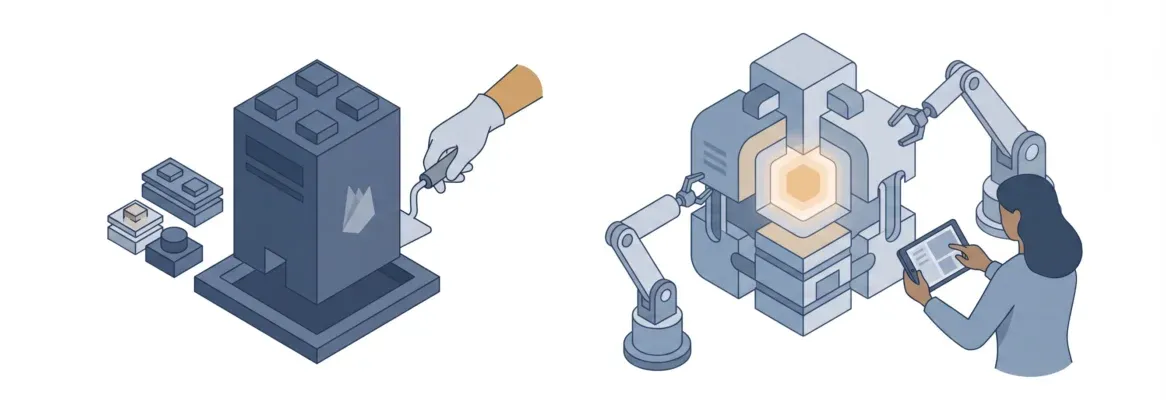
Rocket.new builds full-stack apps from prompts with no coding required. Windsurf AI is a developer-focused tool for AI-assisted coding inside existing projects. Choose Rocket.new for speed and deployment, Windsurf for control and deep code customization.
Which tool actually gets you from idea to a deployed app the fastest? That depends almost entirely on who is doing the building.
According to the 2025 Stack Overflow Developer Survey, 84% of developers now use AI tools in their workflow, and 51% of professional developers reach for them daily. Both Rocket.new and Windsurf AI have serious traction.
One is an AI-first code editor that generates production-ready code with context-aware AI assistance. The other is one of the most capable AI app builders today, converting natural language prompts into a deployed app without you writing a single line. The gap is what you are building.
What These Two AI Tools Actually Do
Before any feature comparison, it helps to see what job each tool was designed to do.
Windsurf is an AI-powered development environment built around Cascade, a feature that tracks your codebase across files, runs terminal commands, and acts as an AI assistant while you code. It is built for developers. You need to know how to code to get value from it.
Rocket.new works from a different starting point. It is one of the AI app builders that generates complete web applications, including frontend, backend logic, and deployment, from a text description. No code required.
Rocket.new and Windsurf are AI tools serving different people with different goals.
What Windsurf AI Brings to the Table
Windsurf was built by Codeium and acquired by Cognition AI in December 2025 for roughly $250 million. It ranks among the top AI coding tools for developers on real codebases in 2026, with an agentic IDE built around multi-file code generation and terminal automation.
-
Its Cascade feature reads your full codebase and makes coordinated changes across files in a single step, providing genuine context awareness.
-
Model context protocol (MCP) support lets you connect custom services and external tools into Cascade.
Windsurf AI's architecture is based on the VS Code interface, making it familiar to developers.
What Windsurf Offers Professional Developers
Windsurf gives developers a focused set of AI features that compound into real-time savings during heavy coding sessions:
-
Cascade acts as an AI assistant across your full codebase, enabling multi-file code generation and refactoring
-
It supports multiple programming languages, including JavaScript, TypeScript, Python, Go, Rust, and Java
-
Terminal integration keeps everything in one window
-
The free plan includes 25 monthly prompt credits, unlimited tab completions, and unlimited inline edits
-
The Pro tier gives 500 monthly credits with access to GPT-4o, Claude, and Gemini models
-
Code writes to disk in real time, so you preview results in your dev server before accepting changes
-
Windsurf AI functions well in a VS Code environment and offers access to Git, SSH, and remote servers.
-
Windsurf analyzes pull requests and suggests improvements based on clean code practices, enhancing code quality.
Windsurf fits best for building deeply customized applications where developers want AI-assisted coding, not full automation, with manual control over every architectural layer.
Where Windsurf AI Runs into Real Limits
Windsurf is not an app builder. It generates code inside a project you are already running. Server configuration, deployment, and infrastructure decisions stay entirely on the developer's plate.
-
Tools throttle usage in heavy coding sessions on lower-paid plans.
-
The tool also carries a real barrier to entry for anyone without a coding background, since directing Cascade still requires developer judgment.
What Rocket.new Brings to App Building
Rocket.new launched in mid-2025 with $15 million from Salesforce Ventures and Accel, crossing 400,000 users within three months. It combines models from Anthropic, OpenAI, and Google Gemini with its own deep learning systems to handle full-stack generation from a single prompt.
About 80% of Rocket.new users build serious applications, not just landing pages. That includes fintech tools, B2B platforms, and internal tools. The platform treats full-stack generation as its core function.
Core Features Driving App Building on Rocket.new
Rocket.new is built for speed:
-
Prompt to app: describe your idea in natural language prompts and get a live app with real data flow and backend services ready
-
Figma import: convert design files into live, editable layouts without manual slicing
-
Visual editor: adjust layouts and components inside the platform without touching code
-
Pre-built templates: 25,000+ covering web apps, mobile apps, and dashboards
-
AI-powered backend: backend logic, authentication, and real-time syncing come built in from the first generation
-
Custom domains: publish your app under your own branded domain on paid plans
-
Code export: download the generated code and push it to GitHub to extend functionality later
-
Multiple platforms: supports Flutter for mobile and Next.js for web from the same session
Where Rocket.new Pulls Ahead of Code Editors
For founders and lean teams who need to ship fast, Rocket.new removes the barriers that Windsurf does not address. You do not configure a server manually. You do not choose a framework, write authentication logic, or set up deployments. Rocket handles the full stack end-to-end.
Users report that generated apps ship with data handling and user authentication already in place. The platform saves up to 80% tokens compared to other AI app builders by avoiding full context regeneration on every prompt.
Feature Comparison: Rocket.new vs Windsurf AI
Here is how Rocket.new and Windsurf compare across the features that matter most.
| Feature | Rocket.new | Windsurf AI |
|---|---|---|
| Primary user | Non-developers, founders, small teams | Professional developers |
| Full-stack generation | Yes, prompt to deployment | No, code assistance only |
| Natural language input | Core workflow | Via Cascade prompts |
| Code export | Yes, GitHub push available | Yes, full codebase access |
| In-app editor | Yes, built-in | Not available |
| Free plan | Yes, token-limited | Yes, 25 monthly credits |
| Paid plans start at | $25/month | $15/month |
| Enterprise pricing | Available | $60+/user/month |
| MCP support | No | Yes |
| Deployment | Built-in, one-click | Manual via Vercel or GitHub |
| Internal tools | Natively supported | Requires custom code setup |
| Custom domains | Yes, on paid plans | No |
| Unlimited users | On higher plans | Teams and Enterprise plans |
This feature comparison shows the split clearly. Windsurf offers precision and granular control for complex codebases. Rocket.new offers end-to-end speed with minimal setup for anyone who wants to deploy without the infrastructure overhead.
Building Full Stack Apps: What Each Tool Delivers
Full-stack building means different things depending on who is using the term.
Full Stack Applications With Windsurf AI
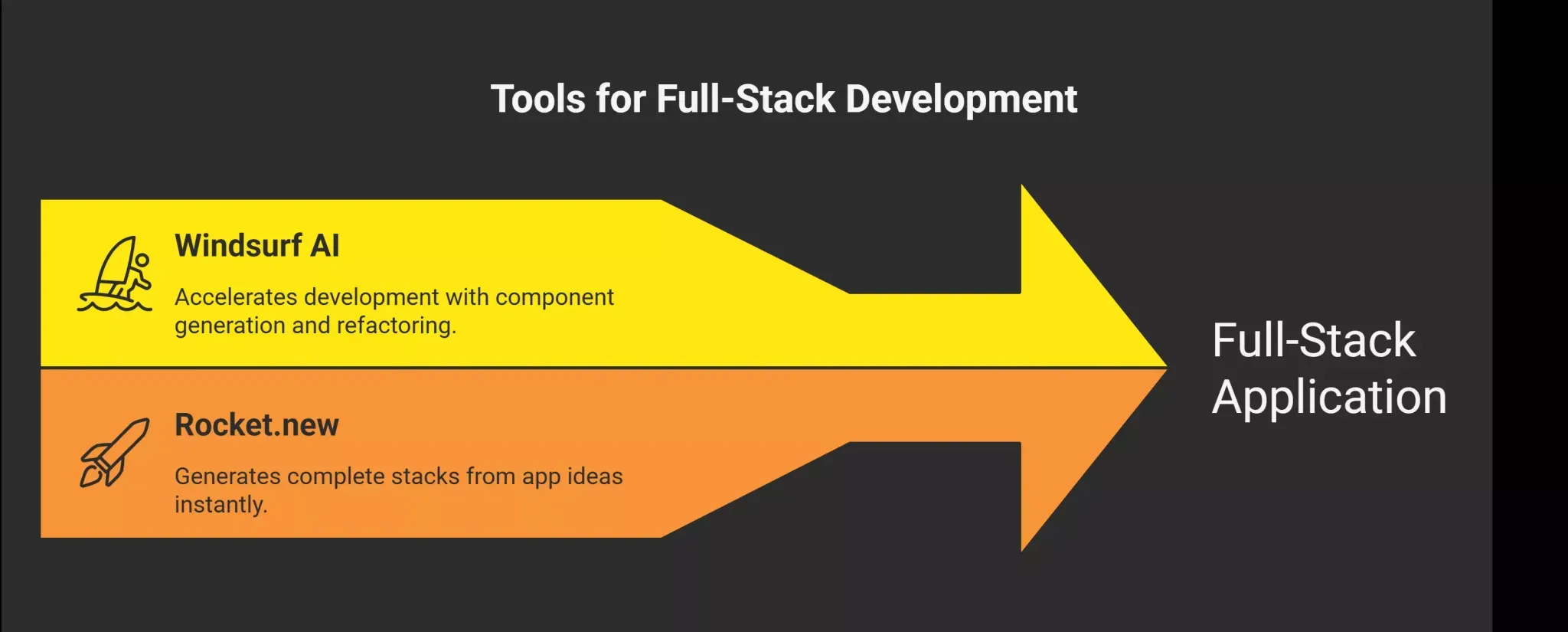
When developers use Windsurf to build full-stack apps, they are still writing the application themselves. Cascade speeds up individual steps, generating components, refactoring files, and running tests, but the developer still architects the database, manages server infrastructure, and handles deployment manually.
Full-stack applications with Windsurf come together faster than pure hand-coding, but they are not the same as having an AI app builder generate the complete stack. More control over architecture comes with more time on setup.
Full Stack Application Development With Rocket.new
Rocket.new takes the full stack in a completely different direction. Describe an app idea and Rocket generates the full stack, including database structure, backend logic, API connections, authentication, and a deployable output, all in one session.
This makes Rocket useful for data-driven applications: dashboards, CRM portals, and internal tools. Generated apps are not quick prototypes. They launch applications with real data handling and user management functionality from day one.
Founders and agencies reach for Rocket.new when they need a working app to live fast. Windsurf is the go-to choice when precision matters more than speed.
Pricing, Free Tier, and Paid Plans Breakdown
Pricing models differ in structure, not just cost.
Windsurf Pricing and Free Tier
Windsurf's free tier gives 25 monthly prompt credits, unlimited tab completions, and unlimited inline edits. It is a real free plan for early experimentation, though heavy sessions will exhaust credits quickly.
Paid plans scale with usage:
-
Pro: $15/month for 500 prompt credits with premium AI model access
-
Teams: $30/user/month with centralized billing and admin tools
-
Enterprise: starts at $60/user/month with SSO, RBAC, and on-premise options
Windsurf's transparent pricing scales predictably. Developers on the Pro tier get meaningful AI features without enterprise-level spend.
Rocket.new Pricing and Free Plan
Rocket.new uses a token-based model where every generation step draws from your token balance. The free plan provides limited tokens for testing ideas before subscribing.
Paid plans scale with volume:
-
Free plan: Rocket.new offers a free plan that includes 1 million tokens for generating and testing real features.
-
Personal: $25/month ($20/month billed annually) for 5M monthly tokens, suited to solo builders
-
Rocket Plan: $50/month for 10.5M tokens, covering roughly 4-5 client projects monthly
-
Booster: $100/month for teams building multiple apps per month, with unlimited users on higher tiers
Unused tokens roll over month to month. Many users report that iteration draws tokens faster than expected, since every AI app generation step consumes from the balance. Treating Rocket.new as a build-first tool keeps costs predictable.
Internal Tools, Web Apps, and Data-Driven Applications
This is where the use case split is most visible in practice.
Building Internal Tools and Backend Logic
Rocket.new and Windsurf both handle internal tools, but through entirely different processes. With Windsurf, a developer sets up server logic manually, writes authentication, connects databases, and deploys the system. The AI speeds each step, but the developer architects every layer.
With Rocket.new, internal tools are one of the platform's strongest use cases. Users describe building admin dashboards, client portals, and service management tools from single prompts in under an hour. Authentication, user roles, and backend logic come built in. Teams without engineering resources save weeks by using Rocket.new here instead.
Data-driven applications with role-based access and external API connections fall within Rocket's core range. The platform's AI features handle each integration automatically.
Web Apps, Landing Pages, and Multi-Step Tasks
Web apps and landing pages are where Rocket.new produces the most immediate results for people who don't code. Describe the app, the target user, and the key features, and Rocket outputs a deployable result in minutes.
Multi-step tasks like adding authentication flows, connecting payment services, or building user dashboards happen through follow-up prompts in the same session.
With Windsurf, building web applications still requires writing code. The AI accelerates writing, but the developer remains responsible for the complete architecture. Apps with involved backend logic are achievable, but only by experienced developers who can direct Cascade precisely.
What Builders Are Saying About Both Tools
Feedback from people who built with both platforms follows a consistent pattern.
"Rocket is genuinely impressive. I used it to build a complex, multi-feature application with real data models, authentication flows, and business logic,and it delivered far beyond what I expected from a prompt-driven platform. The speed is obvious, but what stood out was how structured the output was: clean architecture, sensible defaults, and a strong grasp of real-world product requirements. Rocket.new materially compressed weeks of work into hours and cut our development budget by 80%." - Andrew T. Reilley III, Trustpilot
User feedback from Windsurf community threads highlights strong multi-file reasoning from Cascade. The friction is predictable: tools throttle usage on lower-paid plans during sustained sessions.
Hands-on testing from developers who tried both platforms lands in the same place. Rocket.new is better for shipping apps fast. Windsurf is better for writing precise, AI-assisted code inside an existing codebase. The two tools are rarely in direct competition because the people who need one rarely need the other.
How Rocket.new Handles Full Stack App Generation With AI
Rocket.new is a vibe solutioning platform built specifically for full-stack app generation from natural language. It is the entire design premise.
Here is what Rocket.new delivers as an AI-powered app builder:
-
Vibe solutioning platform: the full workflow from research to deployment runs through ai powered generation
-
25,000+ templates library: covering web apps, mobile apps, and dashboards, ready to customize
-
Saves up to 80% tokens: Rocket's architecture avoids regenerating full context on every prompt
-
Flutter and Next.js support: builds AI app outputs for mobile and web from the same session
-
Collaboration built in: small teams work on the same project without additional integrations
Use cases where Rocket.new creates the biggest impact:
-
Founders building MVPs: get a working app in front of investors without hiring a developer
-
Agencies building for clients: turn briefs into live app deliverables in hours, not weeks
-
Non-developers building internal tools: create dashboards and portals without waiting on engineering
-
Developers skipping boilerplate: use Rocket to generate the initial stack, export the code, and build on top of it afterward
Rocket.new also delivers AI-powered apps with real backend capabilities. Rocket's AI generates database connections, user authentication, and data handling that work in production from day one.
Picking the Right Tool for Your App
The choice reduces to one question: are you writing code, or do you want the AI to build the entire app?
Choose Windsurf If
You're a developer who wants speed, deeper project understanding, AI-assisted coding, and greater control over your codebase.
Its Cascade feature, multi-language support, and MCP integrations make it ideal for engineers who need precision within existing workflows.
Choose Rocket.new if
You're a founder, product manager, or non-developer, or a developer who wants to launch a full-stack app without managing server infrastructure.
It takes you from a prompt to a live app, handling backend setup, custom domains, and user management in a single session, something Windsurf was never designed to do.
Rocket.new is accessible to beginners and non-developers looking to build with AI, while Windsurf is aimed at experienced developers. Both tools handle AI features well, but they operate in different lanes:
-
Windsurf = AI assistance inside your codebase.
-
Rocket.new = AI that generates the whole application from a description.
The Verdict on Rocket.new vs Windsurf for App Building
Is Rocket.new better than Windsurf AI for building apps with AI? For most people asking that question, yes. Rocket.new does what Windsurf cannot: it builds full-stack apps, handles server configuration automatically, and gets you to a working app without writing code.
Windsurf is the stronger platform for developers writing code daily who need deep, contextual AI support. These two tools solve genuinely different problems, and choosing the right one comes down to knowing which problem belongs to you.
Table of contents
- -What These Two AI Tools Actually Do
- -What Windsurf AI Brings to the Table
- -What Windsurf Offers Professional Developers
- -Where Windsurf AI Runs into Real Limits
- -What Rocket.new Brings to App Building
- -Core Features Driving App Building on Rocket.new
- -Where Rocket.new Pulls Ahead of Code Editors
- -Feature Comparison: Rocket.new vs Windsurf AI
- -Building Full Stack Apps: What Each Tool Delivers
- -Full Stack Applications With Windsurf AI
- -Full Stack Application Development With Rocket.new
- -Pricing, Free Tier, and Paid Plans Breakdown
- -Windsurf Pricing and Free Tier
- -Rocket.new Pricing and Free Plan
- -Internal Tools, Web Apps, and Data-Driven Applications
- -Building Internal Tools and Backend Logic
- -Web Apps, Landing Pages, and Multi-Step Tasks
- -What Builders Are Saying About Both Tools
- -How Rocket.new Handles Full Stack App Generation With AI
- -Picking the Right Tool for Your App
- -Choose Windsurf If
- -Choose Rocket.new if
- -The Verdict on Rocket.new vs Windsurf for App Building