
Most builders skip market research and pay for it later. This guide walks through the TAM, SAM, SOM framework, top-down vs bottom-up market sizing, and how Rocket.new's Solve and Intelligence features turn what used to take weeks into a 90-minute structured research report with competitive monitoring built in.
Does Your Idea Actually Have a Market?
That's the question most builders skip. They have the vision, they start coding, and somewhere between "this is a great idea" and "why is nobody signing up" the answer arrives too late.
The direct answer: market research and market sizing are not bureaucratic exercises. They are the difference between building something people pay for and building something that collects dust. According to Founders Forum Group, 42% of startups collapse because they misread market demand - creating products nobody wants or needs.
This guide walks you through the fast-track method: how to size a market quickly, research it properly, and use Rocket.new to do it without a research team or weeks of spreadsheet work.
 Cover Image
Why Market Sizing Matters Before You Write a Single Line of Code
Most builders treat market research as something to check after the build. But waiting until after you ship is like checking the weather after you've already started your hike.
Market sizing research gives you a number - and that number does a few important things. It tells you whether the market is large enough to support a real business. It shows potential investors that you understand the market opportunity. And it helps you direct resources toward segments that actually have demand.
If you're raising money, market size is on every investor's checklist. According to Waveup, who reviewed over 500 pitch decks, 70% of VC rejections cite "market size unclear" as the reason on first-pass.
The good news: you don't need a consulting firm to figure this out. You need the right framework.
The Framework Every Builder Should Know: TAM, SAM, and SOM
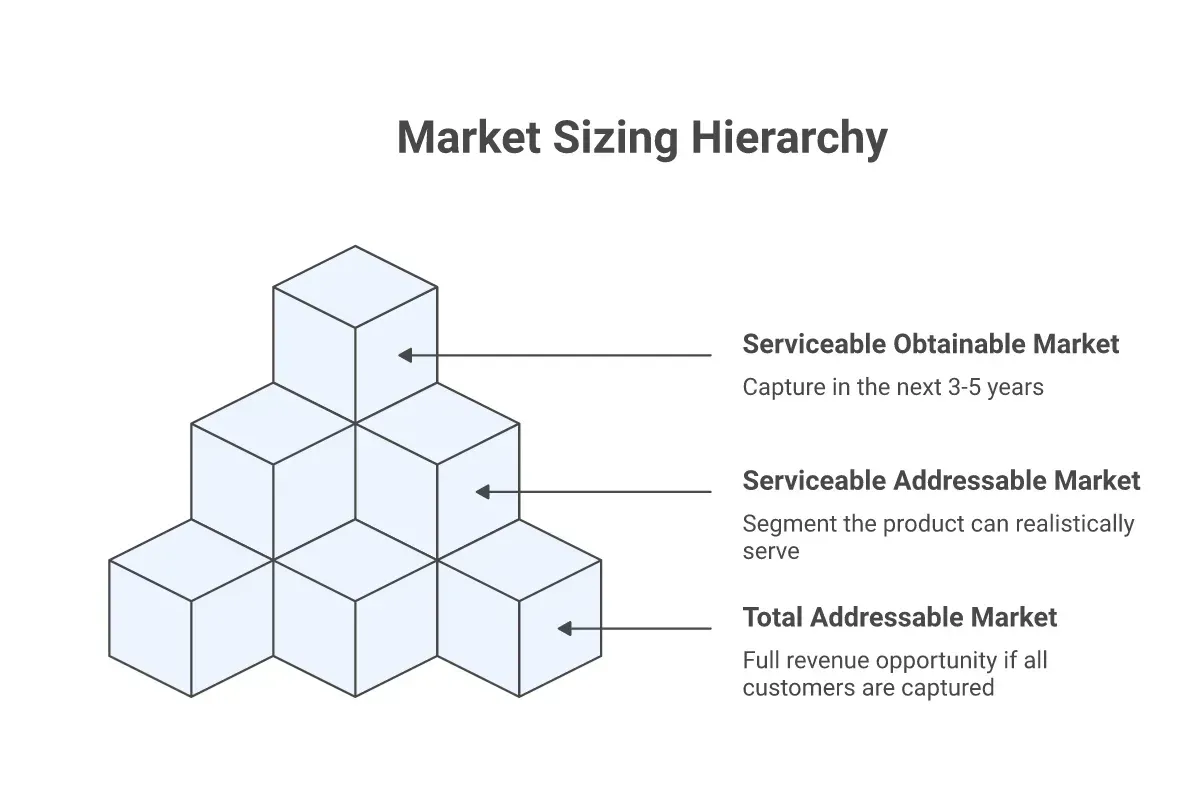
This is the foundation of any solid market sizing exercise. Think of it as three concentric circles, each one smaller and more focused than the last.
| Metric | What It Means | How to Calculate |
|---|---|---|
| TAM (Total Addressable Market) | Total market demand if you had 100% market share | Industry reports x average price per customer |
| SAM (Serviceable Addressable Market) | The slice of the market your product can actually serve | TAM filtered by geography, use case, customer type |
| SOM (Serviceable Obtainable Market) | What you can realistically capture in 3-5 years | SAM x your realistic win rate |
 TAM SAM SOM Pyramid
The total addressable market is your ceiling. The serviceable obtainable market is your near-term target. Get both right, and you have a market sizing story that holds up in a pitch room - and in a product planning meeting.
A note on SOM: stating "1% of TAM" with no math behind it is a red flag for investors. Build it bottom up from real numbers - your pipeline, your average contract value, and your reachable customer count.
Top-Down vs Bottom-Up Market Sizing
There are two main approaches to calculating market size, and each one tells a different part of the story.
Top-Down Market Sizing
The top-down approach starts with the big number - a published statistic from an industry report, government data, or trade association research - and narrows it down.
You take the overall market size, apply filters for your geography, customer segment, and product scope, and arrive at your SAM and SOM.
Top-down market sizing is fast. It's useful for getting a rough picture of the total opportunity. But it relies heavily on secondary data, which can be broad, outdated, or too generic for your specific situation.
Bottom-Up Market Sizing
Bottom-up market sizing starts from your specific reality and builds up.
If you're building a project management tool for construction companies, you'd count the number of relevant construction companies in your target region, estimate what percentage would buy your product, and multiply by your average price.
1Bottom-Up Calculation:
2Market Size = Number of Target Customers x Average Price x Purchase Frequency
Bottom-up is more credible because it's grounded in actual customer behavior and real market data. Most investors prefer it. It forces you to think through who you're actually selling to - not just how large a category sounds.
The best market sizing research uses both methods. Use top-down for your TAM. Use bottom-up for your SOM. Then sense check one against the other. If they're wildly different, something in your assumptions needs revisiting.
A Step-by-Step Guide to Market Research for Builders
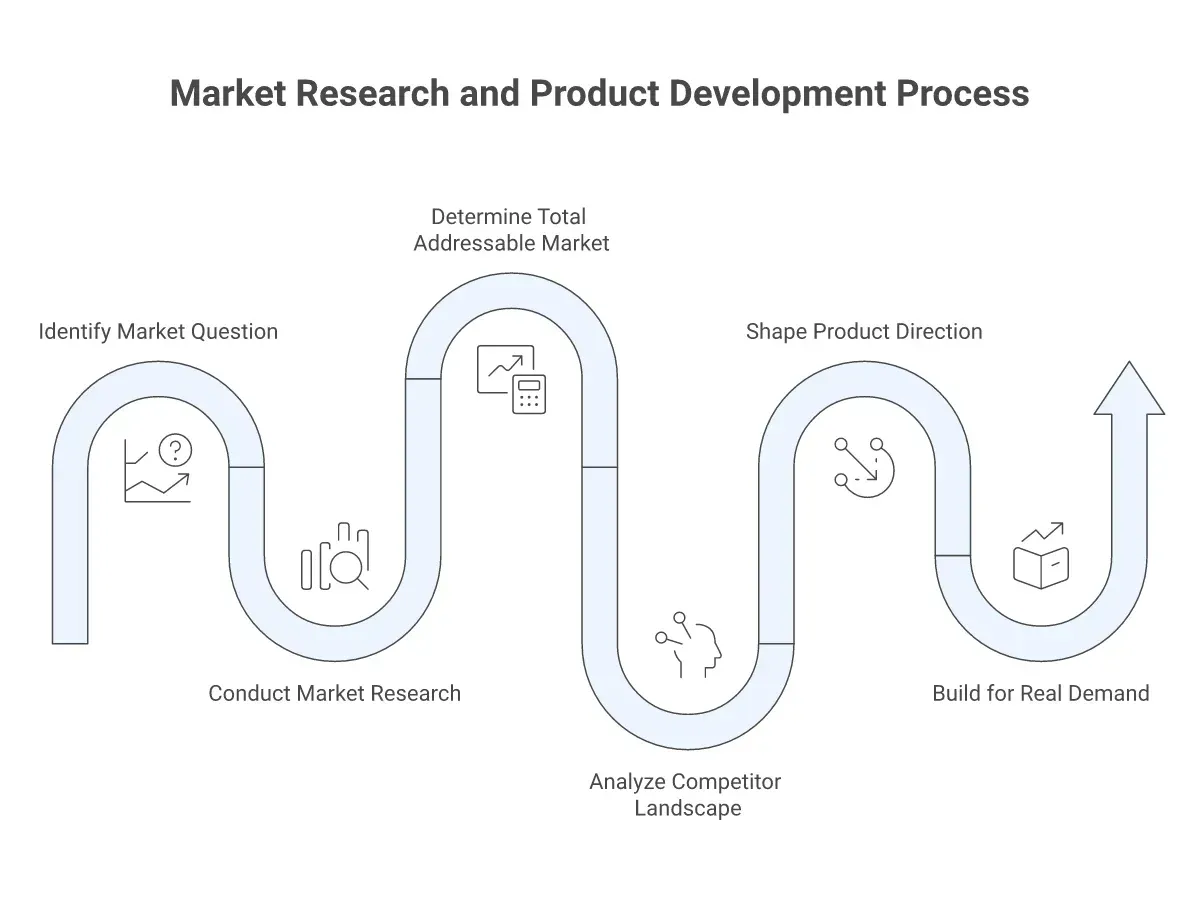
Here's a practical flow for conducting market research without burning two weeks on it.
Step 1 - Define Your Target Market
Before you can size anything, you need to know who you're sizing for. Get specific: geography, company size, job title, industry, and problem type. "Small businesses" is not a target market. "Independent construction companies in the US with 10-50 employees doing commercial projects" is.
Step 2 - Secondary Research to Start
Secondary research means using existing data - what researchers call secondary data. Good sources include:
-
Industry reports from Gartner, Statista, and IBISWorld
-
Government statistics and census data
-
Trade associations and industry bodies
-
Published statistics from research firms
This secondary research gives you your market dynamics context and anchors your top-down market size estimate.
Step 3 - Primary Research to Validate
Primary research means talking to actual potential customers. Customer interviews, surveys, or direct conversations give you primary data that secondary sources simply cannot replicate.
Ten customer interviews can tell you more about real demand than three weeks of secondary research. Primary research also gives you early signals on pricing, willingness to pay, and which customer segments feel the pain most sharply.
Step 4 - Calculate and Sense Check
Run your market size calculation using both methods. Use your secondary research for the top-down approach and your primary data for the bottom-up approach. If your TAM says $5 billion and your SOM says $80 million, that's a realistic picture of a real market. If the numbers are wildly off, review your assumptions.
Competitive Analysis: Reading the Room Before You Enter It
Market research is not just about size. It's about who else is already in the room.
A solid competitor analysis answers:
-
Who are your direct and indirect competitors?
-
What market share do they currently hold?
-
What are their customers saying on review platforms?
-
What are they actively building or signaling next?
This is where market intelligence goes beyond a one-time research report. Competitors pivot. New entrants appear. Pricing changes. A competitive analysis done in month one may be completely outdated by the time you launch in month six.
Most builders run a competitor analysis once and never revisit it. That's a gap that consistently costs market share.
"The single most common mistake we see: inflating TAM with a 'we're a $1T market' claim and no credible bottom-up SOM. VCs don't buy top-down stories alone - they buy bottom-up realism backed by pilot data. In our work across 500+ pitch decks, the founders who closed rounds fastest built SOM from actual pipeline math, not from a '1% of TAM' hand-wave."- Waveup Finance Team, waveup.com/blog/tam-sam-som
Rocket.new: Where Market Research and Building Live Together
Most tools solve one part of the problem. A research tool gets you data. An AI builder generates code. A monitoring tool tracks competitors. You still have to carry the context between them - re-explaining your market, re-uploading your research, re-briefing the tool every time.
Rocket.new is built differently. It's the world's first Vibe Solutioning platform, designed so that the market research, the product decision, and the build all happen in the same place, with the same shared context carrying through every step.
Solve: A Market Sizing Report in 60 to 90 Minutes
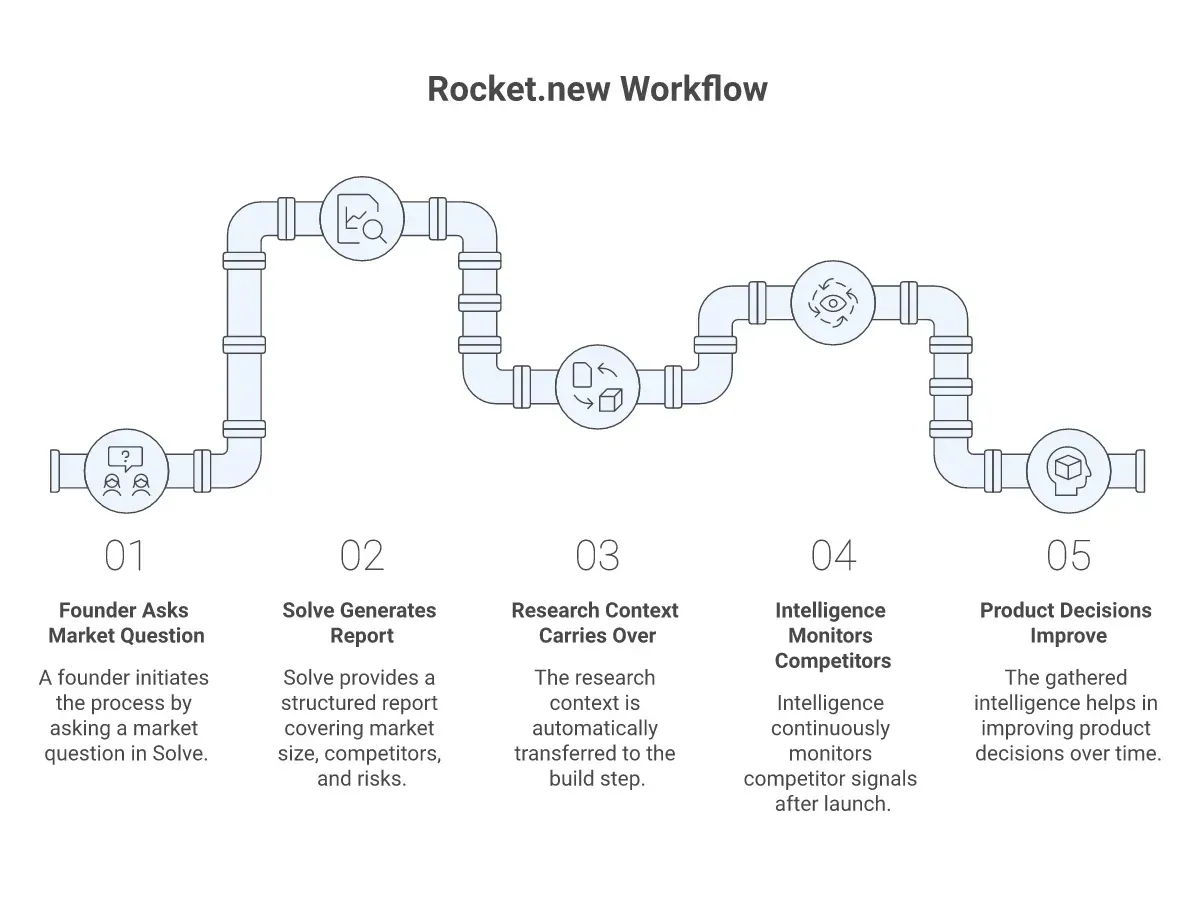
Rocket.new's Solve takes any business question - "How big is the US market for B2B project management tools aimed at construction companies?" - and produces a complete, structured research report within 60 to 90 minutes.
Solve runs parallel queries across 150+ sources simultaneously. The output covers market sizing, the competitive picture, risk factors, and clear recommendations. Every finding is tagged by signal strength. Sources are cited. Conflicting data is called out, not smoothed over.
What used to take a research team days, Solve completes in a single session.
Context That Compounds
Here's what makes Rocket.new different from standalone research tools: the output from Solve lives inside your project. When you open Build the next day, the market research is already there. Your market size calculations, your competitor teardown, your customer problem framing - all of it carries forward automatically.
No re-uploading. No re-briefing. Every step inherits the full context of every previous step. The handoff between research and building is gone.
Intelligence: Competitive Monitoring on Autopilot
Rocket.new's Intelligence monitors every public platform your competitors operate on - their website, social media, job postings, customer reviews, news coverage, and ad campaigns - continuously, without manual effort.
Every morning, you receive a structured daily brief covering what moved, what the signal means strategically, and what your business should do about it. That's live market dynamics tracking built into your workday.
Tools like Lovable, Bolt, and v0 help builders generate code faster. They don't research whether the direction is right before building begins. They don't track what competitors are doing after you ship. Rocket.new covers all three phases.
 Rocket.new Workflow
The Rocket.new Workflow for Market Research
| Step | Rocket.new Feature | Output |
|---|---|---|
| Research the market | Solve | Market sizing report: TAM, SAM, SOM |
| Analyze the competitive picture | Solve | Competitor teardowns with gap analysis |
| Monitor competitors over time | Intelligence | Daily briefs with strategic recommendations |
| Build the product | Build | Production-ready web or mobile app |
| Track post-launch signals | Intelligence | Live competitor move alerts |
Build for a Market That Actually Wants You
Market research and market sizing are not boxes to check before the real work starts. They are the real work. The most expensive mistake in any product development process is building the right product for the wrong market - or the wrong product for a real one.
A proper market sizing research exercise, done before the build begins, saves months of expensive rework. It tells you who to build for, how large the opportunity is, and where the gaps in your competitive picture actually sit.
Rocket.new gives builders the fast-track method: market research through Solve, live competitive monitoring through Intelligence, and a build environment that carries all of that context forward automatically. One platform. One shared context. No handoff tax.
Table of contents
- -Why Market Sizing Matters Before You Write a Single Line of Code
- -The Framework Every Builder Should Know: TAM, SAM, and SOM
- -Top-Down vs Bottom-Up Market Sizing
- -Top-Down Market Sizing
- -Bottom-Up Market Sizing
- -A Step-by-Step Guide to Market Research for Builders
- -Step 1 - Define Your Target Market
- -Step 2 - Secondary Research to Start
- -Step 3 - Primary Research to Validate
- -Step 4 - Calculate and Sense Check
- -Competitive Analysis: Reading the Room Before You Enter It
- -Rocket.new: Where Market Research and Building Live Together
- -Solve: A Market Sizing Report in 60 to 90 Minutes
- -Context That Compounds
- -Intelligence: Competitive Monitoring on Autopilot
- -The Rocket.new Workflow for Market Research
- -Build for a Market That Actually Wants You