
A market research report template gives founders the structure to turn raw data into clear decisions. This blog covers what a good template includes, the step-by-step research process, and how Rocket.new connects research findings directly to the product you build.
Is your market research actually changing how you build - or is it just sitting in a folder somewhere?
A well-built market research report template is the difference between building something people want and spending months shipping features nobody asked for.
According to a 2026 survey of 500 founders by SegmentOS, 72% of new products still fail within 18 months of launch - not from lack of effort, but from poor or unstructured validation.
The starting point is always research. The missing piece is usually structure.
Why Founders Misread the Market (and How a Template Fixes It)
A 2025/2026 review of startup statistics found that 42% of startups fail due to misreading market demand. Most of those founders did some form of research. The problem wasn't effort - it was how they gathered information.
Without a clear research report template to organize findings, even good customer conversations turn into vague notes. Insights never reach the team. Data gets collected and then ignored. The market research process breaks down before it can actually drive a decision.
A structured market research template forces you to ask the right questions, collect the right data, and create a complete picture of your market - one your whole team can study, share, and build from.
What a Market Research Report Template Should Cover
Think of a market research report as the organized story of your research project. It turns scattered data collection into a document your team can review, download, and use to plan the next steps.
Here's a solid market research report format covering the core sections every research report needs:
Market Research Report Template: Core Sections at a Glance
| Section | What It Covers | Why It Matters |
|---|---|---|
| Abstract / Executive Summary | Top findings in 2-3 paragraphs | Gives stakeholders a complete picture fast |
| Research Objectives | The questions you set out to answer | Keeps the report focused on clear goals |
| Methodology | How information was collected | Makes findings credible and repeatable |
| Target Market Profile | Ideal customer details - demographics, behaviors, needs | Grounds strategy in real audience data |
| Competitor Analysis | Who competes, how they price, where they fall short | Identifies gaps and opportunities |
| Key Findings | What the data says | The core of every research report |
| Trends and Patterns | Emerging signals in the market | Helps identify what's coming |
| Recommendations | Actionable strategies for next steps | Turns research into a plan |
| Appendix | Notes, survey questions, raw data | Supports the methodology |
A good free market research template will cover most of these sections. The goal is to create a format your team can fill in consistently, project after project - whether you export it as a PDF to share with investors or keep it live in your workspace.
The Market Research Process: Step by Step
Following a structured process makes the research report useful from the moment you start gathering information.
Here's how a full market research analysis typically flows:
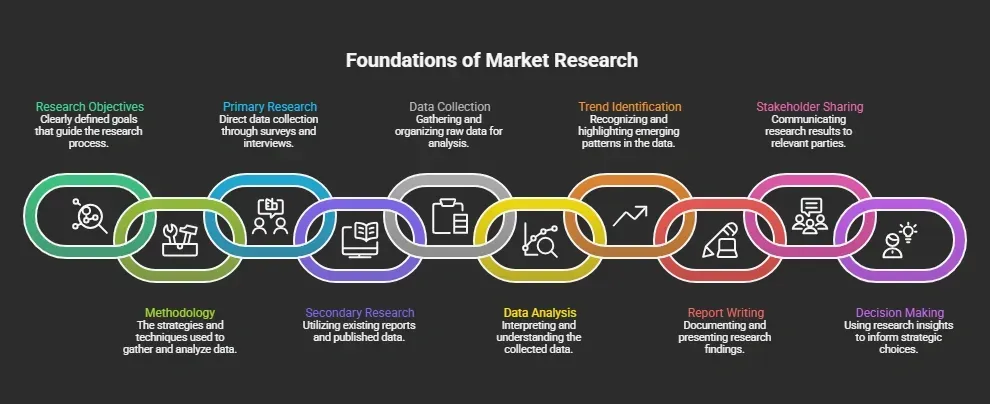 This step-by-step flow applies whether you're a solo founder studying target markets for your first product or a team running a full market research analysis before a major launch.
Data Collection Methods Worth Including in Your Report
The research report is only as useful as the data collected to fill it. Here are four data collection approaches founders get the most value from:
Primary research - Surveys, one-on-one interviews, focus group testing. You gather information directly from your ideal customer or target audience. This is the most reliable way to understand what customers actually want and need.
Secondary research - Industry reports, published studies, competitor pricing pages. Faster to gather, but you're working with data collected for a different purpose and goal.
Behavioral data - Analytics from your product, website, or landing page. This shows you what customers actually do - useful for identifying real patterns that self-reported data might miss.
Competitive research - Monitoring competitor websites, messaging, and public announcements. Competitors signal market changes before any formal report can capture them. Identifying those shifts early gives you a real edge.
Founders who use formal research methods are 2.4x more likely to hit their first-year revenue targets, according to the SegmentOS study. The methodology matters as much as the effort.
What the 2026 Validation Stack Actually Looks Like
The best founders in 2026 aren't just downloading a free market research template and calling it done. They're building a repeatable research process before a single line of code gets written.
A comment that shows up in founder communities and captures this well, from r/SaaS on Reddit:
"We paid $33k for a market research report that contradicted our actual customers. Could have done 10 customer calls and saved the money."- r/SaaS, Reddit (source)
This is the gap. Traditional market research report formats are built for enterprise teams with months to spare. For founders moving fast, they create friction without clarity.
The 2026 validation stack looks lighter and more connected: clear objectives, the right data collection method for your stage, organized findings in a format your team can share, and a path from research insights to actual product decisions - all within the same week the research gets done. The goal isn't a longer PDF. It's a more useful one.
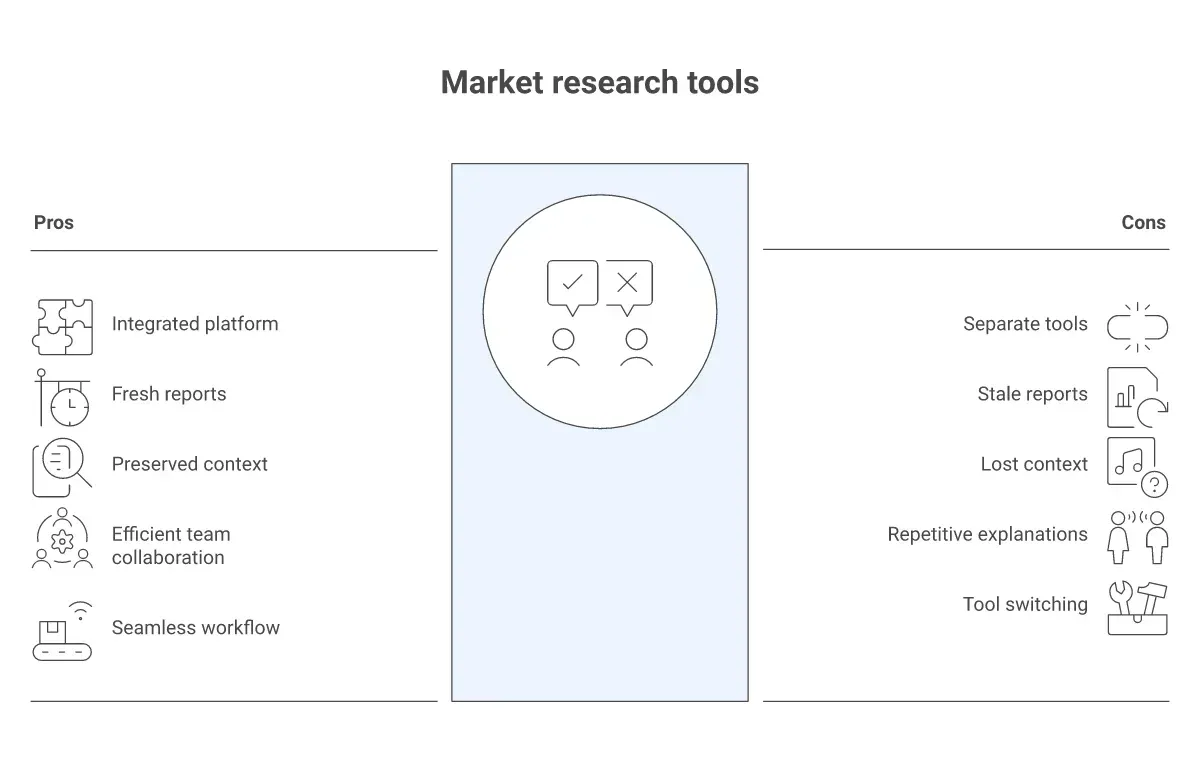
Section Image - Traditional Tools vs Rocket.new
Rocket.new: Where Your Market Research Report Becomes Action
This is the part traditional market research tools miss. Research lives in one place. Decisions happen somewhere else. Building happens in a completely different tool. For founders moving fast, that gap is expensive.
Rocket.new is the world's first Vibe Solutioning platform - a single workspace where business research, building, and monitoring all connect. Over 1.5 million people across 180 countries use it, from solopreneurs validating their first idea to enterprise teams running strategy and execution on the same platform.
Solve: Turn Research Questions into a Structured Market Research Report
Rocket.new's Solve feature takes any business question and returns a complete, structured solution - with findings, evidence, and clear recommendations. You set the research objectives, Solve organizes the output into a usable format, and you can export results as PDF or PPT to share with your team or investors in minutes.
Think of it as a market research analysis template that fills itself in - based on real information about your market, your ideal customer, and your competitive standing.
Intelligence: Ongoing Competitive Research, Automatically
Traditional market research reports capture competitor data at one point in time. Rocket.new's Intelligence feature monitors every public platform a competitor operates on, continuously, and tells you what signals mean for your company and strategies.
Instead of a one-time competitor snapshot that goes stale, you get live competitive intelligence delivered where your team works. That's a complete picture that actually stays complete.
Context: Your Research Stays Connected to Everything You Build
Rocket.new's Context feature means the files, research notes, and market findings you add to a project carry into every future task. Your market research report isn't a PDF buried in a shared drive. It becomes the shared memory of your entire product build - so every decision your team makes is grounded in the same research your company gathered.
Build: From Research Findings to Product, Without Switching Tools
Once your research is done, most tools leave you to figure out the next step on your own. With Rocket.new, the research context from your Solve output carries directly into your Build. The findings your team collected become the foundation of the product you create.
Web apps in Next.js. Mobile apps in Flutter. Landing pages. Internal dashboards. All starting from the market intelligence your company already has - with no re-explaining, no lost context, and no gap between research and execution.
When Standard Research Report Formats Fall Short
Enterprise research tools and standard market research platforms are built for large teams with quarterly timelines and big budgets. For founders, the gaps show up fast:
-
Reports live in separate tools that don't connect to product decisions
-
Competitor data goes stale within weeks of collection
-
Templates are rigid structures that don't adapt to your specific research objectives
-
There is no path from research findings to actual building
AI builders like Bolt and Lovable skip the research phase entirely. They build what you tell them to build - without helping you figure out what's worth building in the first place. Rocket.new solves the first half of the problem and then connects directly to everything that comes after.
Your Market Research Report Template in 2026
The real cost of skipping structured market research isn't the missed data. It's the building that happens without it.
A solid market research report template gives your research a structure that turns data into decisions your whole team can get behind. Rocket.new takes that further connecting your market research findings directly to the product you build, the competitive signals you track, and the insights your team accumulates over time.
The market research report template is where the validation stack starts. Rocket.new is where it goes to work.
Table of contents
- -Why Founders Misread the Market (and How a Template Fixes It)
- -What a Market Research Report Template Should Cover
- -Market Research Report Template: Core Sections at a Glance
- -The Market Research Process: Step by Step
- -Data Collection Methods Worth Including in Your Report
- -What the 2026 Validation Stack Actually Looks Like
- -Rocket.new: Where Your Market Research Report Becomes Action
- -Solve: Turn Research Questions into a Structured Market Research Report
- -Intelligence: Ongoing Competitive Research, Automatically
- -Context: Your Research Stays Connected to Everything You Build
- -Build: From Research Findings to Product, Without Switching Tools
- -When Standard Research Report Formats Fall Short
- -Your Market Research Report Template in 2026