
A practical guide to the best market research tools for small businesses in 2026. Covers the founder's validation stack from Google Trends and survey tools to competitive analysis and Rocket.new's AI-powered Solve feature - with verified stats.
What If Your Business Idea Is Already Dead Before You Build It?
That's not a rhetorical question. It's the uncomfortable reality most founders run into after the fact - not before.
According to a CB Insights analysis of over 100 startup post-mortems, 42% of businesses fail because there was no real market need for their product.
Not bad execution. Not wrong pricing. Not the wrong team. Just - nobody wanted it. And that number holds up year after year, across industries, team sizes, and funding levels.
The good news? This is the one failure mode you can actually test your way out of. The right market research tool for small business can tell you - before you spend a single dollar on development - whether people want what you're building, and whether they'll pay for it.
This blog walks through the best market research tools available in 2026, how to build a validation stack that works on a small business budget, and where Rocket.new fits in for founders who want smarter research without a full research team.
Why Market Research Is the First Thing Small Businesses Skip
Here's what a founder on r/Entrepreneur wrote after failing five business ideas back-to-back:
"I've failed not because these models or ideas of business don't work - but because I've never actually VALIDATED if there is actually real demand for this. I call this the classic rookie mistake for first time founders."- r/Entrepreneur, November 2024
Most founders skip market research for a few predictable reasons. They believe they already understand their target audience. They think market research is only for large companies with research budgets. They'd rather build something and see what happens. Or it just feels slow and academic compared to actually making something.
But market research data doesn't have to be a 50-page industry report. It can be a quick Google Trends check, a five-question survey sent to 50 people, or a simple competitive analysis of the top three players in your space. The goal is to gather data before you commit your time and money to something the market might not want.
According to Fortunly, 22.6% of small businesses fail within their first year. About half won't make it to year five. And the single most preventable reason is building without understanding the market.
That's what makes conducting market research the smartest thing any founder can do before writing a single line of code or signing a lease.
The 2026 Founder's Validation Stack: Best Market Research Tools
Think of your research resources as a layered stack each tool answers different questions about your target market. Some are free tools. Some are paid. All are useful when applied in the right order.
Here's a comparison of the best market research tools available for small businesses in 2026:
| Tool | Primary Use | Free Tier? | Best For |
|---|---|---|---|
| Google Trends | Search trends, regional market demand | Yes | Idea validation, topic research |
| Google Analytics | Website traffic, consumer behavior | Yes | Existing businesses |
| Google Data Studio / Looker Studio | Data visualization, dashboards | Yes | Reporting, pattern recognition |
| SurveyMonkey / Typeform | Survey tools for primary research | Limited | Customer feedback, survey responses |
| Semrush / Ahrefs | Keyword research, competitor research | Limited | Competitive analysis |
| Statista / IBISWorld | Industry reports, market data | Paid | Sector-level market analysis |
| Reddit / Quora | Qualitative insights, community sentiment | Yes | Uncovering real pain points |
| Pew Research Center | Demographic research, public data | Yes | Demographic data, population trends |
| Rocket.new (Solve) | AI-powered structured market analysis | Yes (free tier) | Founders needing market insights fast |
Conducting Market Research: Where to Actually Start
When founders picture conducting market research, they imagine survey platforms, focus groups, and long research cycles that run for months. But the most practical starting point is a lot simpler: get clear on exactly what you're trying to learn before picking any tool.
Before choosing a research tool, answer these three questions:
-
Who is your target audience and what do they currently do to solve this problem?
-
Who are your competitors, and where are they weakest?
-
Is there existing market demand, or is this a problem nobody has paid attention to yet?
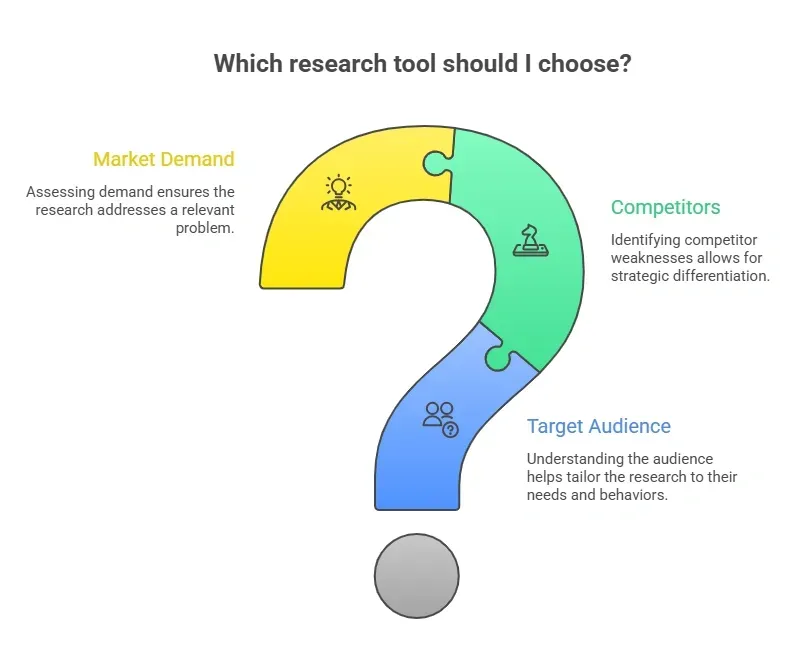 These questions point you toward different research methods. The research flow typically starts with checking search trends to confirm market demand, moves into a competitive analysis to map who already serves your target market, then shifts to primary research to hear directly from potential customers. If the patterns confirm your assumptions, you're ready to build your business plan. If not, you refine your approach based on what the data actually shows.
This flow works whether you're testing a new business idea, entering a new market, or validating a product addition to an existing business.
Google Trends and Google Data Studio: Free Tools That Cover a Lot of Ground
Google Trends is one of the most underused free tools in any founder's research toolkit. It shows you search trends over time - how often people search a specific term, where they're searching from, and what related topics are rising alongside it.
For a small business, Google Trends answers one direct question: are people actively looking for this?
If you're building around a niche topic, you want to see consistent or growing search trends. A flat line tells you interest is stable. A declining curve is a warning. A sharp spike tells you to investigate whether it's a long-term trend or a one-off event.
Google Trends also shows geographic breakouts. If you're targeting a specific city or region, this market research data pinpoints where the highest concentration of interest lives - so your marketing strategies follow real demand, not your assumptions.
Google Analytics and Google Data Studio (now Looker Studio) sit alongside Google Trends in most founders' free toolkit. Google Analytics shows you how users find and interact with your existing website - traffic sources, session behavior, conversion paths. Looker Studio turns that raw data into visual dashboards for easier pattern recognition. Together, these tools cover a lot of market research ground without costing anything.
Search data has limits, though. It tells you that people search for something. It doesn't tell you why, or whether they'd pay to fix it. That's where competitor research and primary research come in.
Competitive Analysis: Reading the Competitive Landscape
You can't position your business without understanding what already exists in your space. Competitor research maps the competitive landscape - who the players are, what they offer, where they fall short, and what the market has already told them it wants.
A solid competitive analysis for a small business typically covers:
-
Who the top three to five competitors are in your niche
-
Their key features, pricing, and positioning
-
What existing customers say about them on review platforms like G2, Capterra, and Yelp
-
What they're missing the gaps your business could fill
For founders on tight budgets, free and freemium tools get you far. The Semrush free tier gives you basic keyword research and traffic data on competitor sites. Google Alerts delivers news about competitors to your inbox. Social listening tools track mentions of competitor brands across the internet in near-real time.
Industry reports from Statista, IBISWorld, or the Pew Research Center give you the bigger picture - market size, industry trends, consumer spending patterns, economic indicators, and demographic data for your target market. Many of these sources have free tiers or are accessible through a public library.
The objective of a competitive analysis isn't to copy what competitors are doing. It's to find where your target audience is underserved, and build toward that gap with confidence.
Survey Tools and Primary Research: Hearing It Directly from Potential Customers
Secondary research industry reports, existing data, Google search trends - tells you what's already known about the market. Primary research tells you what your specific potential customers actually think, feel, and want.
Survey tools like SurveyMonkey, Typeform, and Google Forms let you design and send surveys to real respondents. Survey responses are only as useful as the questions you ask, though. Open-ended questions like "What's the hardest part of this problem?" produce qualitative insights that no industry report will surface. Closed questions with defined options give you clean survey results you can measure and track over time.
A few things that make primary research more effective:
-
Keep surveys short under 10 questions gets significantly better completion rates
-
Find respondents where your target audience actually spends time: Reddit communities, LinkedIn groups, niche forums, and Facebook groups all work well
-
Avoid leading questions biased survey responses produce bad data that will mislead your decisions
One-on-one interviews are often more valuable than large surveys for early-stage validation. Five to ten conversations with potential customers will reveal patterns in how people describe their problems in their exact words - that you simply can't get from survey platforms or industry reports. You're not collecting statistical significance. You're listening for recurring themes in the language real people use.
This is the kind of qualitative research that sharpens positioning, reveals the real pain points your product should address, and gives you language to use in your marketing strategies.
Data Visualization: Turning Raw Research Into Decisions
Once you've gathered data across multiple sources, the challenge becomes extracting meaningful insights without getting lost in spreadsheets. Data visualization tools convert raw market research data into charts, maps, and dashboards that make patterns visible at a glance.
Google Data Studio connects directly to Google Analytics and Google Ads. Tableau is more powerful for complex datasets but has a steeper cost and learning curve. For most small businesses, a well-organized spreadsheet with a few charts is enough to spot the patterns that matter.
Visualization tools aren't about making things look polished. They're about making complex data legible so you - and anyone you're presenting to - can make faster, better decisions. A clear visual representation of market demand trends or survey results communicates in seconds what paragraphs of text take minutes to read.
When you're building a business plan, pitching investors, or presenting to your team, the ability to show your market research data in a clean visual format builds credibility and makes the narrative stick.
A Practical Research Approach: A Five-Week Validation Sprint
Here's a five-week research process that any small business can run using mostly free tools:
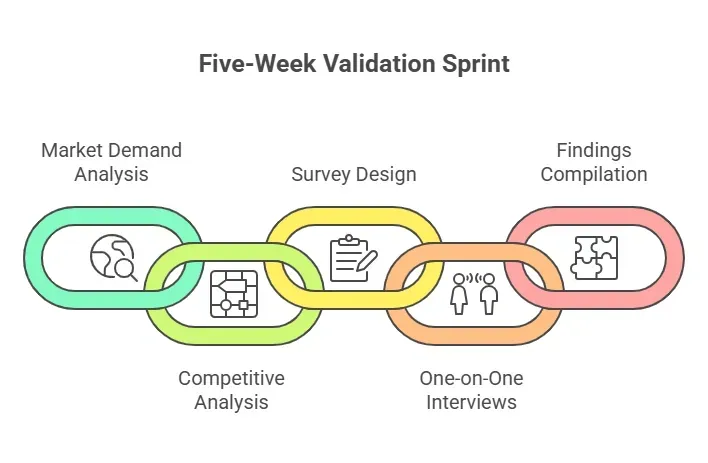 Week 1 - Use Google Trends and keyword research to check whether people actively search for your product or a close substitute. This is your fastest signal on market demand.
Week 2 - Run a competitive analysis. Map the top five competitors. Look at their pricing, key features, and what customers say about them on review sites and in community forums.
Week 3 - Design a short survey of five to seven questions and send it to 50 to 100 people from your target audience. Use social media, Reddit, LinkedIn, or your existing network to recruit respondents.
Week 4 - Run five to ten one-on-one interviews with potential customers. Record them and note the exact words people use to describe the problem. Patterns in language matter more than opinions on your solution.
Week 5 - Compile the findings across all four research efforts. Look for themes. Identify where real demand exists, where the competitive landscape has gaps, and what your target market is realistically willing to pay.
This process produces more validated market insight than most startups gather before launch. And most of it costs nothing.
Rocket.new: Your Mission Control for the 2026 Validation Stack
Most market research tools give you raw data. What founders actually need is a structured answer to the real question: should I build this, and if so, how?
That's what Rocket.new's Solve does and it's where the platform stands apart from every standalone research tool on this list.
Solve: AI-Powered Decision Intelligence
Solve is Rocket.new's decision intelligence layer. You describe your business situation, your market, and your question in plain language the way you'd explain it to a smart colleague and Solve runs thousands of queries across 150+ sources at once.
Within 60 to 90 minutes, you get a structured analytical deliverable that covers:
-
Market demand and size assessment
-
Competitive landscape mapping with signal strength ratings (HIGH / MEDIUM / LOW)
-
Consumer behavior signals and market insights
-
Identified risks and gaps in your market
-
A clear execution path with recommendations
This is the kind of comprehensive research that would take a research team days or a strategy firm weeks to produce. For a small business or early-stage startup, Solve compresses that into a single session. And if new information surfaces that you didn't ask about a regulatory shift, a competitor move, a structural market risk it appears in the output automatically, with the reasoning for why it matters.
Users can upload internal files financial models, annual reports, customer research - and Rocket.new reads them structurally, mapping every formula, cell reference, and cross-sheet dependency. The output becomes the foundation of everything that follows in the project. When you move from research to build, the context is already there.
Intelligence: Continuous Competitive Monitoring
Beyond point-in-time market analysis, Rocket.new's Intelligence feature monitors every public platform your competitors operate on - continuously. It doesn't just surface what changed. It tells you what each signal means for your business strategy, delivered as daily, weekly, or monthly briefs wherever you work.
For founders who need to stay ahead of market trends and industry trends without spending hours each week on manual tracking, Intelligence replaces the ongoing research effort with a continuous feed of relevant data that's already been interpreted.
Build: From Validated Insight to Live Product in One Platform
Where Rocket.new separates itself from every other research tool is what happens after the research is done. Once Solve has validated your direction, the output doesn't get filed away. It becomes the foundation of the Build phase - web apps in Next.js, mobile apps in Flutter, landing pages, internal tools, customer portals. When you generate a product, the research context is already present. No re-explaining. No context loss between strategy and execution.
For small businesses that want to move from validated idea to live product without switching between six tools and losing the thread, this end-to-end workflow is where Rocket.new creates the most value.
How Rocket.new Compares to Standalone Research Tools
| Feature | Google Trends | SurveyMonkey | Statista | Rocket.new Solve |
|---|---|---|---|---|
| Structured research output | No | No | No | Yes |
| Competitive landscape mapping | No | No | Partial | Yes |
| AI-powered data synthesis | No | No | No | Yes |
| Connects to build workflow | No | No | No | Yes |
| Signal strength ratings | No | No | No | Yes |
| Free tier available | Yes | Limited | No | Yes |
| Time to full market analysis | Varies | Days | Hours | 60-90 mins |
Traditional market research tools are excellent at what they do individually. Google Trends shows search data. Survey platforms collect survey responses. Industry reports provide demographic data and sector trends. But none of them connect the research to the next decision - and none synthesize across sources into a single, structured recommendation.
The gap most small businesses fall into isn't a lack of market research resources. It's the time and expertise needed to go from market research data to a decision you can act on. Rocket.new closes that gap.
The Bottom Line on Market Research for Small Business
The data on why businesses fail doesn't change much from year to year. According to Failory, 9 out of 10 startups fail - and the single biggest preventable cause is building without properly understanding whether the market actually wants it.
The right market research tool for small business in 2026 isn't one single tool. It's a validation stack: Google Trends for early signals on market demand, survey tools for direct customer feedback, competitor research tools to map the competitive landscape, industry reports for demographic data and economic indicators, and Rocket.new's Solve to synthesize all of it into a structured analysis you can act on the same day.
Founders who avoid the failure statistics aren't better at guessing. They're better at testing assumptions before committing resources. Start with what's free and accessible right now. A few searches on Google Trends, five customer conversations, a simple survey.
Then build from there - and when you're ready to go faster, Rocket.new compresses weeks of research into a single structured session, already connected to your next step.
Try building your next project with Rocket, sign up now!
Table of contents
- -Why Market Research Is the First Thing Small Businesses Skip
- -The 2026 Founder's Validation Stack: Best Market Research Tools
- -Conducting Market Research: Where to Actually Start
- -Google Trends and Google Data Studio: Free Tools That Cover a Lot of Ground
- -Competitive Analysis: Reading the Competitive Landscape
- -Survey Tools and Primary Research: Hearing It Directly from Potential Customers
- -Data Visualization: Turning Raw Research Into Decisions
- -A Practical Research Approach: A Five-Week Validation Sprint
- -Rocket.new: Your Mission Control for the 2026 Validation Stack
- -Solve: AI-Powered Decision Intelligence
- -Intelligence: Continuous Competitive Monitoring
- -Build: From Validated Insight to Live Product in One Platform
- -How Rocket.new Compares to Standalone Research Tools
- -The Bottom Line on Market Research for Small Business