
Can natural language really write code? See how natural language to code bridges human language and programming, simplifies tasks, supports non-programmers, and integrates smoothly into modern software development workflows.
Can human language really turn into working code?
Yes, it already does, and natural language-to-code translation is becoming a regular part of modern programming.
Developers can now describe logic in plain language and let systems generate code that actually runs. Within the first few steps, this approach reduces friction in programming and opens opportunities for non-programmers.
Recent industry reports indicate that more than half of developers rely on AI-assisted coding tools in their daily software development, confirming that this shift is already underway.
The goal is simple: reduce manual effort while keeping programs clear, readable, and useful.
What is Natural Language Programming?
Natural language programming brings human language closer to how computers operate.
Instead of focusing only on strict syntax rules, users describe what they want a program to do. The system then converts that description into executable code. This process depends on artificial intelligence and machine learning to understand intent, structure, and context.
So rather than memorizing every keyword, developers can focus on logic and outcomes. Non-programmers also benefit because they can contribute without deep technical training.
Natural language programming supports many activities, such as code generation, sentiment analysis, and language translation, while maintaining a workflow that is approachable and flexible.
Programming Languages
Programming languages exist to enable humans to communicate instructions to machines. Each language has its own syntax and rules, which computers follow precisely. High-level programming languages such as Python and Java simplify program construction and reduce errors.
Natural language-to-code systems work alongside traditional programming languages. They translate human-readable instructions into valid code that machines can run. This facilitates working across multiple languages without rewriting logic. Programming languages remain the foundation that supports every NLP-driven system.
Natural Programming Language
A natural programming language allows users to express logic using sentences that resemble everyday language. Tools like Inform 7 show how natural language input can describe rules and flows without heavy syntax.
These languages rely on structured ontologies that organize actions and logic. Each instruction has a precise description so the system can process it correctly. A natural programming language reduces barriers to learning and supports non-programmers while still producing reliable programs.
NLP Models
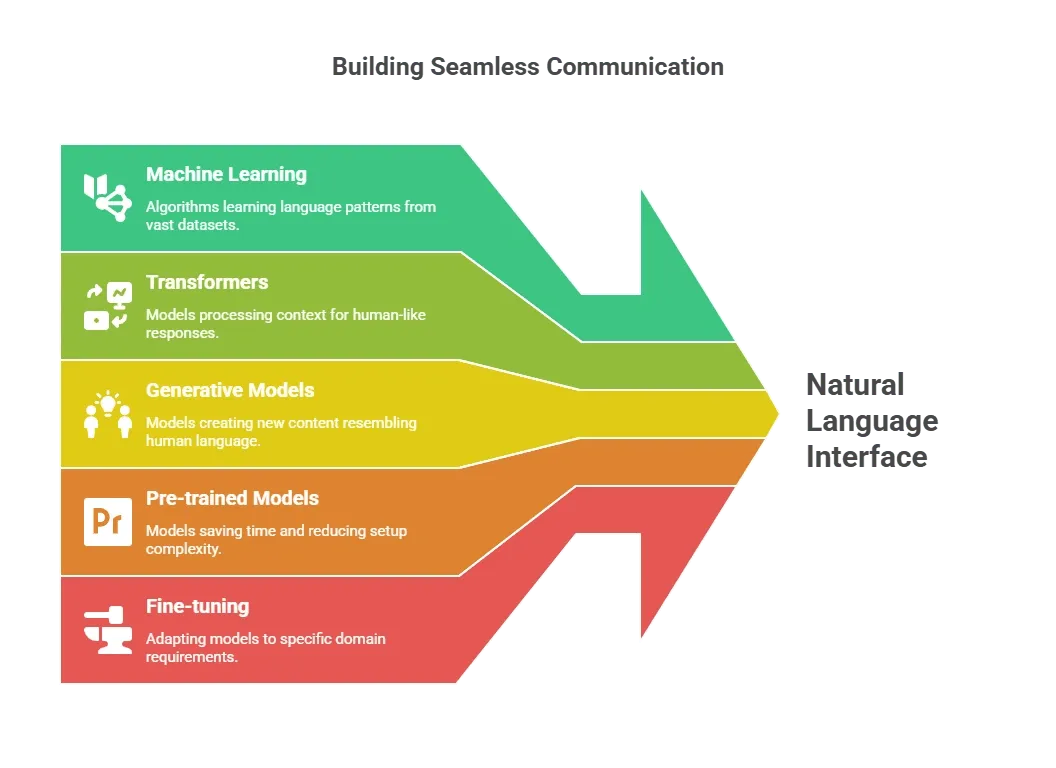
NLP models power every natural language interface.
These machine learning models are trained on large datasets to learn patterns in language. Many systems rely on transformers and generative models to process context and generate human-like responses.
Entity Recognition
Entity recognition identifies specific entities such as names, dates, locations, or technical terms within text. Named entity recognition plays a key role in organizing unstructured text.
In practice, entity recognition supports data analysis, search features, and user queries. It also assists with code reviews by identifying variables, functions, and references in complex code. This enables systems to reason about relationships rather than relying on raw text alone.
NLP Tasks
NLP tasks describe the action systems that perform with language. These tasks include sentiment analysis, text classification, language translation, and speech recognition.
Then there are structural tasks like part-of-speech tagging and dependency parsing. These help systems understand how words relate to each other. NLP tasks form the backbone of conversational agents, NLP-powered chatbots, and many real-world applications.
Data Analysis
Data analysis plays a steady role in natural language programming.
Text data often arrives in unstructured text formats such as emails, documents, or social media posts. NLP techniques help organize this information.
NLP-powered tools scan large datasets to detect patterns, opinions, and trends. This supports sentiment analysis, reporting, and cross-team decision-making. Data analysis transforms raw language into actionable insights without manual sorting.
Getting Started with Natural Language Programming
Getting started does not require deep expertise. A basic understanding of programming concepts and natural language processing provides a strong foundation.
Subsequently, learning about NLP models, entity recognition, and common NLP tasks helps users progress. Tutorials and libraries allow experimentation with small programs before scaling up. Hands-on practice builds confidence and reduces confusion early on.
Best Practices
Best practices help maintain quality when working with natural language programming.
- Use pre trained models to reduce setup time
- Fine-tune models with labeled data
- Validate outputs with real test cases
- Avoid relying solely on generated code
Ethical considerations also matter. Bias and fairness affect how NLP systems behave. Testing and review help maintain trust and reliability.
Tools and Resources
Many tools support natural language programming workflows.
- NLTK supports learning and experimentation
- spaCy offers production-ready pipelines
- TensorFlow supports training machine learning models
These tools help teams write code, review logic, and process language inside a single system. Learning resources and community guides also provide ongoing support.
Real-World Applications
Natural language programming is used in real-world applications.
Software development teams use it to speed up documentation and code generation. Customer service teams rely on conversational agents that support human agents.
Industries such as healthcare, finance, and education benefit from sentiment analysis, language translation, and structured insights from text data. These systems help organizations respond more quickly and with greater context.
Community Insight
Developer communities share practical feedback.
A LinkedIn post shows how OpenAI Codex translates natural language into code using an AI that understands developer intent and produces working code from a plain-language prompt.
In the ever-evolving landscape of artificial intelligence, few innovations have sparked as much excitement in the developer community as OpenAI Codex.
This reflects a common view. Natural language-to-code support facilitates programming work, yet judgment and understanding still matter.
Rocket.new and Natural Language Workflows
Rocket.new streamlines modern programming by turning natural language descriptions into executable app. Teams can move from idea to a working program more quickly, reducing the need for repetitive boilerplate.
- Converts natural language descriptions into executable app
- Supports multiple languages within one system
- Maintains context and program structure automatically
- Speeds up iterations and reduces development friction
By keeping code aligned with human language, Rocket.new simplifies collaboration between developers, designers, and non-programmers.
Future Directions
Future progress focuses on improving accuracy and accessibility. Machine learning and artificial intelligence continue to refine how systems understand language and context.
Multimodal approaches, transfer learning, and few-shot learning guide how future programs handle data, spoken language, and written input. These directions aim to reduce effort while maintaining reliable outputs.
Natural Language to Code: Where Things Stand
Natural language-to-code translation simplifies programming by bridging human language and reliable systems. It supports non-programmers, reduces repetitive tasks, and fits into modern software development without disrupting existing workflows. Today, this approach is becoming increasingly practical, with AI-powered tools helping teams write, review, and iterate code faster while keeping programs clear and maintainable.
Table of contents
- -What is Natural Language Programming?
- -Programming Languages
- -Natural Programming Language
- -NLP Models
- -Entity Recognition
- -NLP Tasks
- -Data Analysis
- -Getting Started with Natural Language Programming
- -Best Practices
- -Tools and Resources
- -Real-World Applications
- -Community Insight
- -Rocket.new and Natural Language Workflows
- -Future Directions
- -Natural Language to Code: Where Things Stand