
Most builders skip qualitative research and pay for it later. This blog breaks down the fast-track research process - from defining research objectives to running focus groups and depth interviews and shows how Rocket.new connects research directly to building in one workspace.
What separates the builders who ship products people love from those who ship products nobody uses?
It starts before the first line of code. Qualitative market research is what gets you there - and for builders moving at speed, the traditional research process is too slow, too expensive, and far too disconnected from the actual work of building. According to a 2025 report by Founders Forum Group, 42% of startups fail because they build products nobody wants. That's not a technology problem. It's a research problem.
This blog walks you through what qualitative research means for builders, how to fast-track the whole research process, and how Rocket.new brings research and building into one connected workflow.
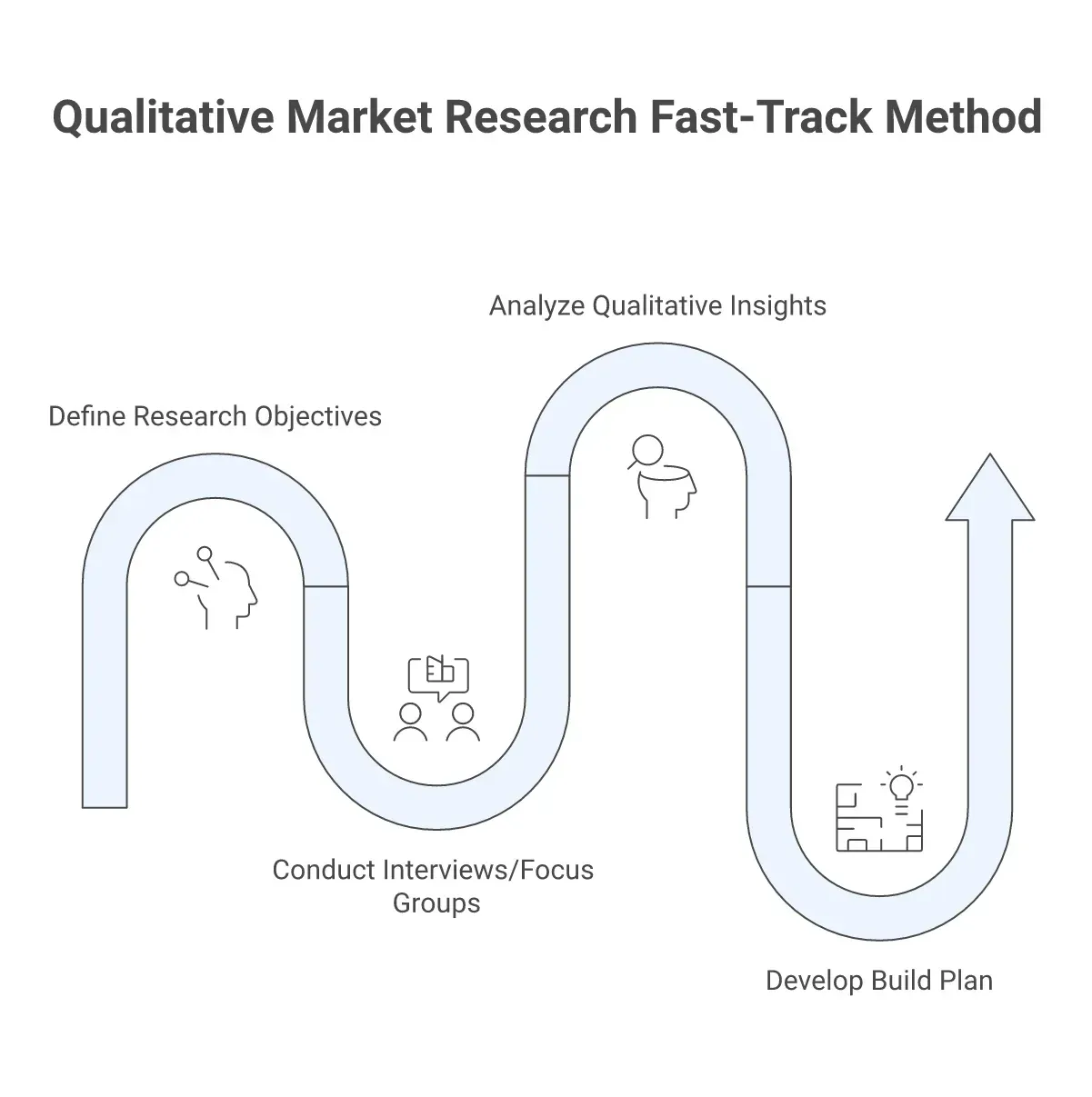 Cover Image
What Qualitative Research Really Means for Builders
Beyond the Buzzword
Most builders hear "qualitative research" and picture long focus groups in a sterile conference room, or surveys with 50 questions nobody finishes. That mental image is keeping you from one of the most useful things you can do before you build.
Qualitative research is the practice of collecting in-depth, non-numerical data about people's motivations, pain points, and behaviors. It tells you the why behind what users do. Unlike quantitative data, which tells you how many people clicked a button, qualitative insights tell you why they clicked it - or why they didn't.
For builders, understanding the emotional drivers behind user decisions matters more than most people admit. You can have all the quantitative data in the world and still be building the wrong thing.
Qualitative Research vs. Quantitative Data
| Factor | Qualitative Research | Quantitative Data |
|---|---|---|
| Output | Words, themes, motivations | Numbers, percentages, metrics |
| Sample Size | Small groups (5-20 people) | Large, statistically significant samples |
| Methods | Interviews, focus groups, observation | Surveys, analytics, A/B tests |
| Best For | Understanding why | Measuring how many |
| Stage | Early discovery, concept validation | Scaling, measuring outcomes |
| Potential Risks Surfaced | Adoption blockers, wrong assumptions | Performance gaps, conversion issues |
Both belong in a serious research methodology. But for builders in the early stages of app development, qualitative research is almost always the right first move. You need to understand the problem deeply before you can measure your solution.
Where Builders Go Wrong in the Research Process
Here's a pattern that plays out constantly. A builder has an idea, gets excited, opens their code editor, and starts shipping. Weeks - sometimes months - later, they share their product and discover that their target audience has no idea what problem it solves.
This isn't a failure of execution. It's a failure to define research objectives before the build began. When builders skip the research process, they're not saving time. They're spending time building something that may need to be thrown away entirely. The costly mistakes in app development are almost always upstream of the code.
Aashay Kapoor captured this pattern directly in a LinkedIn post:
"Startups don't fail because of bad tech. They fail because of unvalidated assumptions. Founders spending months building full-blown platforms, automating workflows no one's using, designing dashboards for users that don't even exist yet - all without a single real validation. No one tested the problem. No one talked to users. No one shipped fast experiments."
Early qualitative data collection is what prevents these downstream disasters. The research process isn't a detour from building - it's the foundation of it.
The Core Methods of Qualitative Research
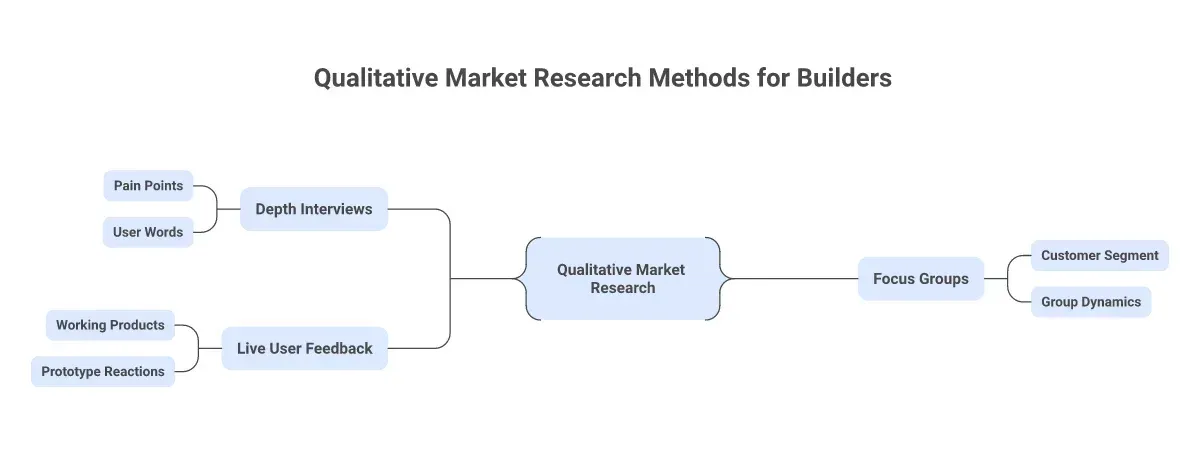 Research Methods
Depth Interviews: Listening in Your Users' Own Words
One-on-one interviews are the most direct qualitative research method available to builders. You sit with a potential user - in person or on video - and ask open-ended questions. You let them describe their world in their own words. What problems do they run into every day? What tools do they already use? What would make their life measurably better?
The goal is not to pitch your idea. The goal is to understand their context, their pain points, and the factors that drive their decisions. A good interview guide has five to eight questions. Most builders find that five to seven conversations surface the same key themes repeatedly - and that pattern is enough to act on.
Depth interviews are especially powerful for understanding emotional drivers. Users rarely say "I chose your competitor because of feature X." They say things like "I just trust it more" or "it feels like it was built for someone like me." That kind of qualitative insight doesn't show up in quantitative data.
Focus Groups: Where Group Dynamics Reveal Hidden Patterns
Conduct focus groups when you want to observe how a small group of people in your target market discuss a topic together, rather than one-on-one. A typical focus group involves six to ten people from the same customer segment and a moderator who guides the research process without leading it.
Focus groups surface insights that individual interviews miss. One person's comment about a pain point triggers another person's story. Agreement and disagreement in a small group shows you which pain points are broadly shared and which are specific to certain customer segments.
For builders testing a concept, focus groups are a fast-track way to pressure-test your assumptions across multiple people at once. One well-run focus group can replace hours of separate interviews.
You can also conduct focus groups remotely - 87% of market researchers now run at least half their qualitative research online. Tools like Zoom, Luma, and Typeform make remote focus groups accessible to any builder without a research team.
Collecting Feedback from Real Users
If you already have an MVP or prototype, collecting feedback directly from users in your target market is one of the fastest forms of qualitative research available. Session recordings, post-onboarding interviews, and live observation all qualify.
The discipline is to capture feedback in the user's own words, without filtering it through your assumptions first. What are they saying when they're confused? What do they describe as the most helpful part? These findings become the research objectives for your next iteration.
Collecting feedback consistently - not just at launch - is what keeps qualitative insights current as your target market evolves.
Qualitative Data Analysis: From Raw Feedback to Real Direction
Identifying Key Themes
Once you've completed interviews or focus groups, qualitative data analysis begins. This is the process of reviewing notes and transcripts, looking for patterns, and grouping findings into key themes.
At the early stage, a spreadsheet works fine. Create columns for participant, direct quote, theme, and priority level. You're looking for themes that appear across multiple people - that's where the signal is strongest.
Statistical significance doesn't apply to qualitative research the same way it applies to quantitative data. You're not proving a hypothesis with numbers. You're building an accurate model of your customers' mental world - and ten good conversations can do that.
Decision Making Driven by Qualitative Insights
The output of qualitative data analysis should feed directly into decision making. Which features show up in every conversation? Which pain points are described as genuinely disruptive to the user's day? Which customer segments express the strongest desire for a solution?
These findings should shape:
-
Your product roadmap and feature prioritization
-
Your positioning and marketing campaigns
-
How you define your target market and customer segments
-
Early estimates of your total addressable market
Many builders skip this step and go straight from interviews to code. When that happens, the research process stops being useful. Good qualitative research only works when the findings actually change what you build and how you talk about it.
The Fast-Track Research Process: Getting to Insights Without the Wait
Traditional research methodology takes weeks. Recruiting participants for focus groups, scheduling interviews across time zones, running qualitative data analysis, writing stakeholder reports - it's a process built for large research teams with months of runway.
Builders don't have that. But there is a faster way to run the research process without losing the depth that makes qualitative research valuable. The fast-track approach compresses the timeline by running focused, targeted data collection against clear research objectives from day one.
Define Research Objectives Before Any Data Collection
Before talking to a single user, write down three to five research objectives. What do you need to know to make your next big product decision? Qualitative research without clear objectives is just conversation. Research with clear objectives produces findings you can act on.
Good research objectives for a builder might include:
-
Identify the top three pain points in the target market
-
Understand what tools the target audience currently uses
-
Learn what factors make users reluctant to switch from existing solutions
-
Identify potential risks to early adoption
Generative AI and Modern Tools in the Research Process
Generative AI has changed what's possible in qualitative research. Modern tools now help builders generate interview guides, synthesize transcripts at scale, detect patterns across qualitative data sets, and model target market behavior before real users are even recruited.
The global market research industry reached $150 billion in 2025, with AI adoption accelerating across every research methodology - 83% of research professionals plan to invest in AI tools for research this year.
Generative AI is not replacing qualitative insights from real people. It's compressing the research process so that builders can act on qualitative data faster than ever before.
Surface Potential Risks Before They Become Problems
One of the most underappreciated benefits of qualitative research is that it surfaces potential risks early, before they become expensive. When you talk to real people in your target market, they'll tell you - directly or indirectly - why they wouldn't buy your product, what would block adoption, and what alternatives they're already committed to.
These potential risks won't appear in quantitative data until much later in the build cycle, when fixing them costs far more. Catching potential risks early is one of the most reliable ways to avoid the costly mistakes that end projects before they gain traction.
Launch Into Orbit with Rocket.new
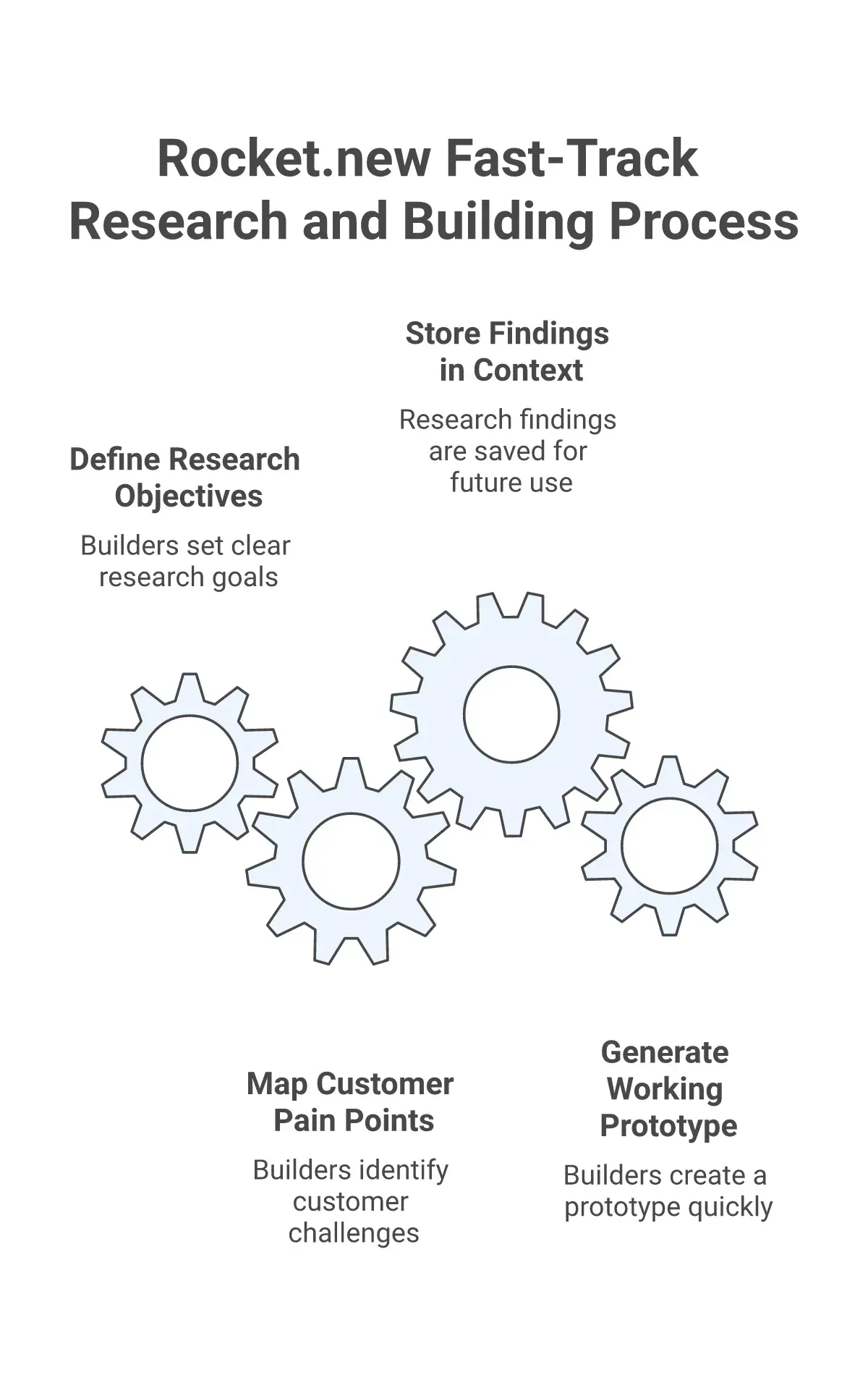 Rocket.new Fast-Track Flow
Most platforms give you either research or building. Rocket.new gives you both - connected, in one place.
Rocket.new is the world's first Vibe Solutioning platform. It covers the complete arc from strategic intelligence to execution inside a single workspace with shared compound context. That means your research doesn't disappear when you open your code editor. It informs every build decision you make from that point forward.
Solve: Decision Intelligence for Builders
Rocket's Solve feature is the fast-track answer to the traditional research process. You bring any business question - your target market definition, a competitor analysis, a total addressable market estimate, a deep-dive on customer segments and their pain points - and Solve returns a complete, structured response with findings, evidence, and clear recommendations.
For qualitative research, this means you can fast-track a structured exploration of your market, your users' motivations, and your potential risks in a fraction of the time a traditional research methodology would require. The findings export as PDF or presentation, and they carry forward into every build task inside Rocket.
This is where the Rocket.new fast-track method earns its name. Research objectives set in Solve become the foundation of what gets built in the same platform.
Context That Carries Research Forward Into Every Task
Rocket's Context feature is persistent shared memory. Research you add once - your target audience profiles, qualitative insights from user interviews, focus groups summaries, competitive positioning - flows automatically into every new task you create in the platform.
You don't re-explain your market every time you start a new build. You don't lose research findings from last month when you spin up a new project. Everything compounds over time.
Build Prototypes to Test Your Qualitative Findings
One of the fastest ways to validate qualitative insights is to put a working prototype in front of real users and observe what happens. Rocket's Build feature generates production-grade web apps, mobile apps, and landing pages from a plain language description - most apps go from prompt to working preview in one to three minutes.
This means a builder can move from a qualitative research finding like "users are confused by multi-step onboarding flows" to a working prototype testing a new approach in the same afternoon. That's a research-to-build cycle that traditional tools and agencies can't match.
Working interactive prototypes are not mockups. They're real products users can click through, fill in, and navigate. The feedback they generate is more accurate qualitative data than any wireframe review.
What Other AI Builders Miss
Competitors like Bolt, Lovable, and v0 are fast code generators. They build what you tell them to build. But they start from the assumption that you already know what to build.
Rocket.new starts from a different question: what's actually worth building, and why?
Other AI builders have no pre-build intelligence layer, no shared memory architecture, and no connection between your research objectives and your app development process. You can build quickly with those tools - but you might be building the wrong thing quickly.
The Rocket.new fast-track method closes the gap between research and execution that every other builder tool leaves open.
Qualitative Market Research Matters More Than You Think
The biggest reason builder projects fail isn't bad technology or poor execution. It's the gap between what builders think their target market wants and what their target market actually wants.
Qualitative market research closes that gap. It gives you the qualitative data and qualitative insights you need to make confident decisions, reduce potential risks, and build products that your target audience has already told you they need - in their own words.
The Rocket.new fast-track method brings the research process and the build process together in one workspace, so your findings don't sit in a folder somewhere. They shape every decision from first concept to launch day.
The qualitative research you do before you build is the confidence you build with.
Table of contents
- -What Qualitative Research Really Means for Builders
- -Beyond the Buzzword
- -Qualitative Research vs. Quantitative Data
- -Where Builders Go Wrong in the Research Process
- -The Core Methods of Qualitative Research
- -Depth Interviews: Listening in Your Users' Own Words
- -Focus Groups: Where Group Dynamics Reveal Hidden Patterns
- -Collecting Feedback from Real Users
- -Qualitative Data Analysis: From Raw Feedback to Real Direction
- -Identifying Key Themes
- -Decision Making Driven by Qualitative Insights
- -The Fast-Track Research Process: Getting to Insights Without the Wait
- -Define Research Objectives Before Any Data Collection
- -Generative AI and Modern Tools in the Research Process
- -Surface Potential Risks Before They Become Problems
- -Launch Into Orbit with Rocket.new
- -Solve: Decision Intelligence for Builders
- -Context That Carries Research Forward Into Every Task
- -Build Prototypes to Test Your Qualitative Findings
- -What Other AI Builders Miss
- -Qualitative Market Research Matters More Than You Think