
Rocket.new keeps pace with 2026 market demands by combining AI-driven insights, automation, and real-time data analysis, enabling businesses to monitor competitors, adapt strategies quickly, and stay ahead in fast-moving industries.
What does it really take to track competitors without falling behind?
Rocket.new's competitive intelligence does it automatically - watching every public signal your competitors send out, collecting data from six different platforms at once, and turning raw signals into decisions your team can act on the same day. In 2026, that speed matters.
According to Fortune Business Insights, the global competitive intelligence tools market is projected to grow from $0.87 billion in 2026 to $4.03 billion by 2034, at a CAGR of 21.17%. Teams built for real time competitive intelligence are pulling ahead of those still doing it manually.
This blog will show you exactly how to move from scattered competitor tracking to a streamlined, real-time system so you can act faster, make smarter decisions, and stay ahead consistently.
What Modern Competitive Intelligence Actually Looks Like?
Markets don’t move in neat, predictable cycles anymore. Signals show up early, scattered across different platforms, and the teams that win are the ones that know how to read them before they become obvious.
What actually matters today:
-
Pricing changes don’t come with announcements: A competitor can quietly update their pricing page overnight no press release, no email blast. If you’re not tracking it in real time, you’re already reacting late.
-
Hiring patterns reveal future moves: A sudden cluster of product, AI, or growth hires often signals what’s being built next weeks or even months before anything goes public.
-
Messaging shifts before repositioning: Tone changes across blogs, ads, or social media usually happen before a full rebrand or strategic pivot. The language changes first then the strategy follows.
-
No single signal tells the full story: One isolated update is just noise. It’s easy to overreact if you’re looking at data points individually.
-
Patterns are where strategy becomes visible: When multiple signals start moving in the same direction pricing, hiring, messaging that’s when you’re seeing intent, not coincidence.
Modern competitive intelligence isn’t about collecting more data it’s about connecting the right signals. The advantage comes from spotting patterns early, so you can act before the market catches up.
The Gap Most Teams are Stuck In
Most teams still rely on a patchwork system to track competitors and that’s exactly where things start to fall apart.
Where things break down:
-
Fragmented tracking methods: Competitor updates are spread across Google Alerts, saved tabs, Slack messages, and shared docs that no one consistently maintains.
-
Scattered data, no clarity: Insights exist, but they’re disconnected. There’s no single place to see what actually matters or how things are changing over time.
-
Always a step behind: Decisions are made after information is collected manually, which means reacting late instead of acting early.
-
Manual research slows everything down: As the volume of signals increases, keeping up without automation becomes inefficient and unsustainable.
-
The AI adoption gap is real: Sedulo Group’s 2026 competitive intelligence research drawing on insights from 949,079 business leaders across platforms like Reddit, X, and Quora found that 40% of leaders now review competitive intelligence continuously through monitoring tools, yet 56% still say AI plays no role in their process at all.
The difference is clear: teams that have built continuous intelligence into their daily workflow are making faster, more confident decisions while those relying on manual tracking are still trying to catch up.
How Rocket.new's Competitive Intelligence Works?
Add a competitor by name or URL. Rocket immediately begins watching across six signal categories simultaneously. No manual configuration per source. The intelligence runs continuously and automatically from that point.
The intelligence reads signal clusters, not individual data points. A pricing update alone tells you little. That same pricing update alongside new enterprise sales hires, a tone shift on social media, and defensive review responses connect into one clear strategic signal. Rocket surfaces what those signals mean together.
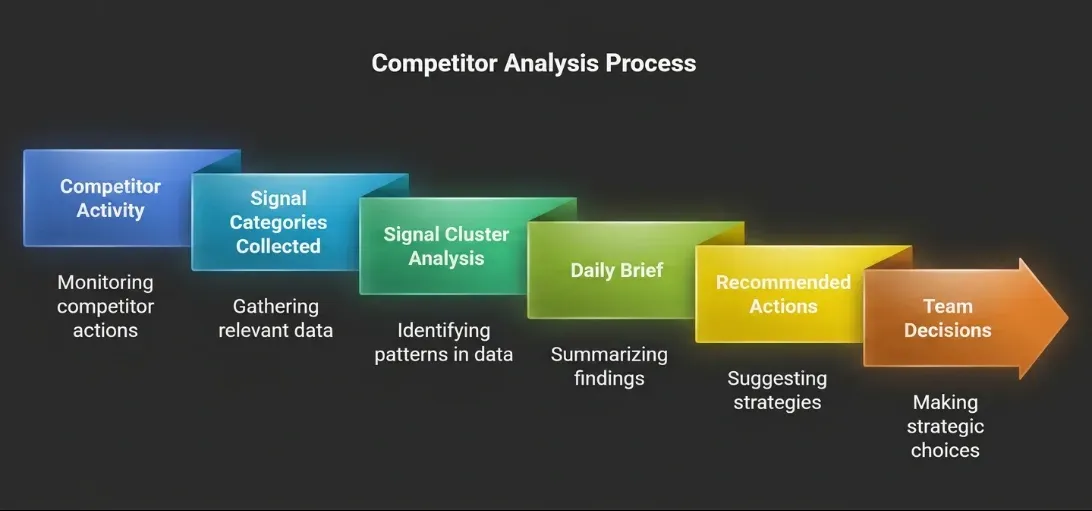
Step 1 - Collecting Data Across Six Signal Categories
Every competitor profile tracks six areas in real time:
-
Website: Every pricing page change, feature announcement, and messaging shift. Full before/after diff with strategic context.
-
Social media: Posts, campaigns, and engagement patterns across LinkedIn, X, Instagram, Facebook, YouTube, TikTok, and Reddit.
-
News and press releases: Media mentions, partnership announcements, and executive interviews tracked by volume over time.
-
Reviews: Sentiment shifts on G2, Glassdoor, and Capterra, flagged automatically when patterns change.
-
People: Headcount, hiring velocity, open positions by department, and an executive activity feed. Where competitors hire reveals where they are building next.
-
Advertising: Ad activity across LinkedIn, Meta, and TikTok, including positioning shifts and new creative directions.
Step 2: From Raw Signals to Actionable Insights
Raw data alone doesn’t tell your team what to do; that’s where most tools fall short.
Rocket connects signals into a daily intelligence brief.
Each brief includes:
-
A clear summary of what changed
-
Patterns that are starting to emerge
-
Specific recommended actions (product, marketing, pricing)
The result: insights your team can act on before the day even begins.
Step 3: Decisions That Carry Into the Rest of Your Work
Most tools stop at delivering insights. Rocket integrates them into execution.
The intelligence doesn’t live in isolation:
-
A product manager sees competitor signals while working on features
-
Marketing uses real-time context while crafting messaging
-
Ongoing competitor moves inform pricing decisions
Instead of resetting every day, the intelligence compounds across teams and workflows.
Rocket.new doesn’t just help you track competitors, it helps you understand them in motion. By turning scattered signals into connected insights and embedding them into your workflow, it ensures every decision your team makes is faster, sharper, and grounded in what’s actually happening in the market.
What Makes Rocket.new's Competitive Intelligence Different
Most competitive intelligence tools stop at collecting data. The real difference shows up in how that data is interpreted, connected, and turned into action.
| Feature | Standard CI Tools | Rocket.new |
|---|---|---|
| Signal sources | 1-2 (web or social) | 6 (web, social, news, reviews, people, ads) |
| Output | Raw data alerts | Interpreted daily brief + recommended action |
| Pricing monitoring | Partial | Full page diff with strategic context |
| Platform connection | Standalone tool | Connects to build, research, and project context |
| Early warning signals | Limited | Hiring trends, exec activity, review shifts - all tracked |
The difference isn’t just in how much data you collect—it’s in how quickly you can understand and act on it. Rocket.new shifts competitive intelligence from passive monitoring to an active, decision-driving system.
Early Warning Built Into Your Competitive Strategy
The most valuable competitive insights don’t come from announcements; they show up earlier in subtle patterns.
What this looks like in practice:
-
Hiring trends as early signals: Sedulo Group found that 54% of business leaders see hiring patterns as the earliest indicator of competitive change.
-
Deeper analysis drives value: 59% say stronger competitor analysis would significantly improve their intelligence programs.
-
Continuous job tracking: Rocket monitors competitor hiring across roles and departments in real time.
-
Patterns before proof: A spike in hiring in one area gets flagged early and connected with other signals.
-
Action before announcements: These insights appear in your daily brief weeks before anything becomes official.
Early warning isn’t about more effort it’s about seeing sooner. Rocket.new turns early signals into clear direction so your team can act ahead of the market.
Competitive Intelligence for 2026 Speed
Most teams are still tracking competitors with tools designed for a slower pace. Research is scattered, reports arrive late, and raw data lacks context. The result is a reactive workflow—teams spend more time gathering information than acting on it, often missing the moment when decisions actually matter.
Rocket.new changes that by creating one connected system that continuously monitors every public competitor signal, reads patterns across data, and delivers clear, actionable insights each morning. In 2026, markets move fast and your competitive intelligence needs to keep up, not fall behind.
If you want to move from delayed insights to real-time decisions, Rocket.new shows how to turn competitive intelligence into a system your team can actually act on every single day.
Table of contents
- -What Modern Competitive Intelligence Actually Looks Like?
- -The Gap Most Teams are Stuck In
- -How Rocket.new's Competitive Intelligence Works?
- -Step 1 - Collecting Data Across Six Signal Categories
- -Step 2: From Raw Signals to Actionable Insights
- -Step 3: Decisions That Carry Into the Rest of Your Work
- -What Makes Rocket.new's Competitive Intelligence Different
- -Early Warning Built Into Your Competitive Strategy
- -Competitive Intelligence for 2026 Speed