
A competitive moat argument on Rocket.new means turning your data, AI systems, and switching costs into verifiable proof for Series A investors. This guide covers each moat layer, where pitches fail, and how Rocket's Solve, Build, and Intelligence pillars generate evidence competitors can't easily replicate.
A competitive moat argument on Rocket.new is a structured, evidence-backed case showing investors that your advantage, built on proprietary data, network effects, and high switching costs, cannot be quickly copied. This guide covers each moat layer, where most founder pitches fail, and how Rocket's Solve, Build, and Intelligence pillars generate the proof investors actually verify.
What Is a Competitive Moat?
A competitive moat is a set of structural advantages, including proprietary data, network effects, switching costs, and brand trust, that make it difficult for competitors to replicate your business, even with similar resources or technology.
As explained in a LinkedIn article by Marcin Duszynski, a competitive moat is a company's ability to maintain a long-term advantage that protects its market share and profits from competitors.
For Series A investors, a moat is not a feature list. It is a system of interlocking advantages that compounds over time and raises the cost of replication for any competitor.
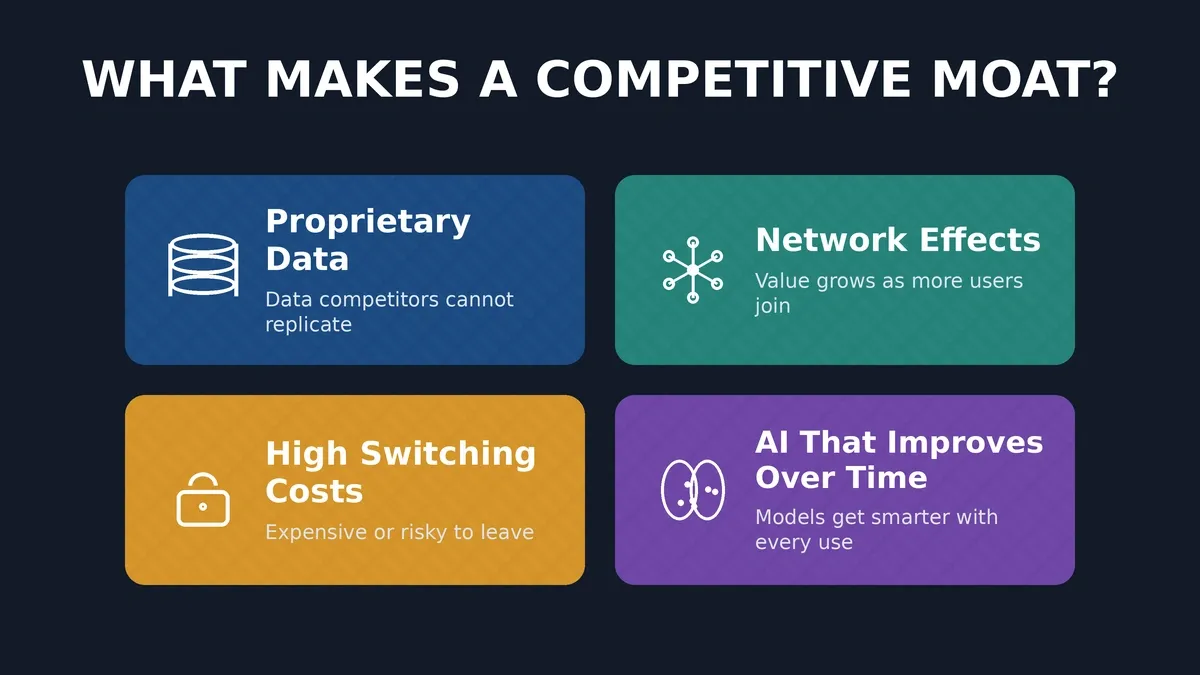
The four structural layers that make a moat defensible, and why no single layer is enough on its own.
What Investors Actually Look For in a Competitive Moat
Investors are not just checking if your product works. They are asking one question:
Why can't someone else do this faster or cheaper?
That's where your competitive moat comes in. It's not just a concept. It's your company's ability to hold a long-term advantage in the market.
A strong competitive advantage comes from:
- Unique proprietary data
- Strong network effects
- High switching costs
- AI systems that improve with usage
And yes, your business model matters here too. If your company is operating with a model that scales while keeping costs under control, you already have a solid base.
Research on what makes AI startups defensible consistently shows that sustainable competitive advantages depend on proprietary data and network effects rather than product features alone. This is exactly why founders must go beyond features when making their moat argument to Series A investors.
Breaking Down the Core Elements of a Strong Moat
What actually makes a moat strong in today's market is not one single thing. It is a combination of systems, data, and behavior that work together over time.
1. Data Network Effects
Data is power, but not just any data. You need data that improves your product over time.
When more customers use your platform, you collect more data. That data feeds your AI models. Your models improve. Your product gets better. More customers join.
That is a loop. This is what people mean by data network effects. If your company can show this loop clearly, investors pay attention.
2. Switching Costs That Hurt to Leave
If customers can leave your product in one click, you don't have a moat. Switching costs are what keep customers in your ecosystem.
These costs can be:
- Data migration challenges
- Learning curves
- Workflow dependencies
- Custom AI systems tied to your platform
The higher the switching costs, the stronger your competitive advantage. Understanding how to build a B2B SaaS product with deep integrations is one of the fastest ways to engineer meaningful switching costs from day one.
3. AI Systems That Improve Over Time
We are in a new paradigm where AI systems are not static. They learn. They adapt. They improve. If your company uses AI models that get better with usage, you're building a real moat.
You can:
- Build AI systems trained on your own data sources
- Use large language models and fine-tune them on proprietary data
- Combine open-source with first-party feedback loops
This is where many AI startups are competing. But only a few actually build systems that scale well.
4. Network Effects That Multiply Growth
Network effects are simple: more users equal value. But in practice, they are hard to build.
In a platform business, network effects show up when:
- Sellers attract buyers
- Buyers attract more sellers
- Data improves recommendations
This loop creates a strong competitive moat that competitors struggle to break. When you look at your company, ask how these elements work together. A real competitive advantage comes from stacking these layers, not relying on just one.
Where Most Founders Go Wrong
This is where many founders lose investors without realizing it. The story sounds good, the product looks solid, but the moat just isn't there.
Many founders confuse:
- Features with moat
- Speed with advantage
- Hype with value
A feature can be copied fast. A moat cannot. If your argument depends only on product features, investors will see through it.
Take a step back and look at your company honestly. If a competitor can rebuild what you have in a few months, you don't have a competitive moat yet. You have a product.
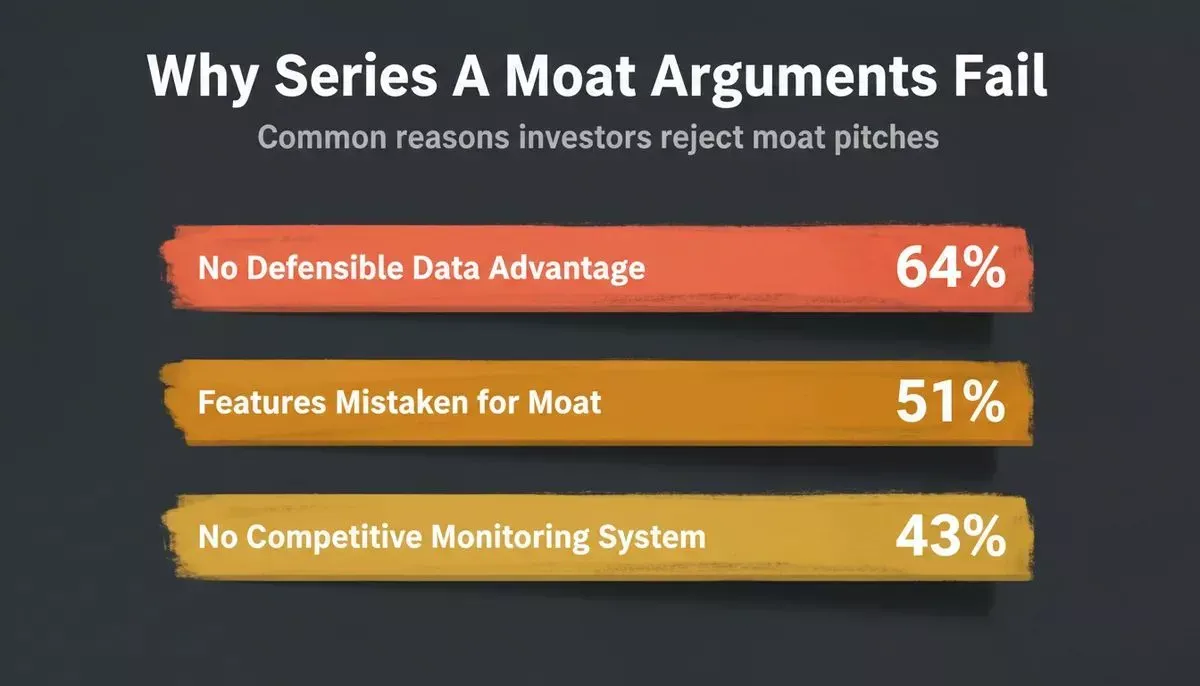
The most common failure points in Series A moat arguments. Features and hype consistently fail to hold up under investor scrutiny.
The Role of AI, Open Source, and Foundation Models
AI is changing how companies build moats. With open-source foundation models, anyone can build a product quickly. That means your edge cannot come from just using AI tools.
Instead, your advantage should come from:
- Unique data processing pipelines
- Custom AI models trained on your proprietary data
- Strong feedback loops that improve outputs over time
Even open-source LLMs are powerful. But they are not your moat. Your data is. The companies that win will combine open-source models, proprietary data, and smart execution. This is how successful companies think about scale in the long run.
What is Rocket and Why Does It Matter for Moat Arguments?
Rocket.new is the vibe solutioning platform for builders and founders. It is built on three named pillars that share context and interconnect. Research flows into building, building generates product data, and intelligence feeds back into research.
If your goal is to present a strong moat, you need more than a story. You need systems that generate the proof investors verify.
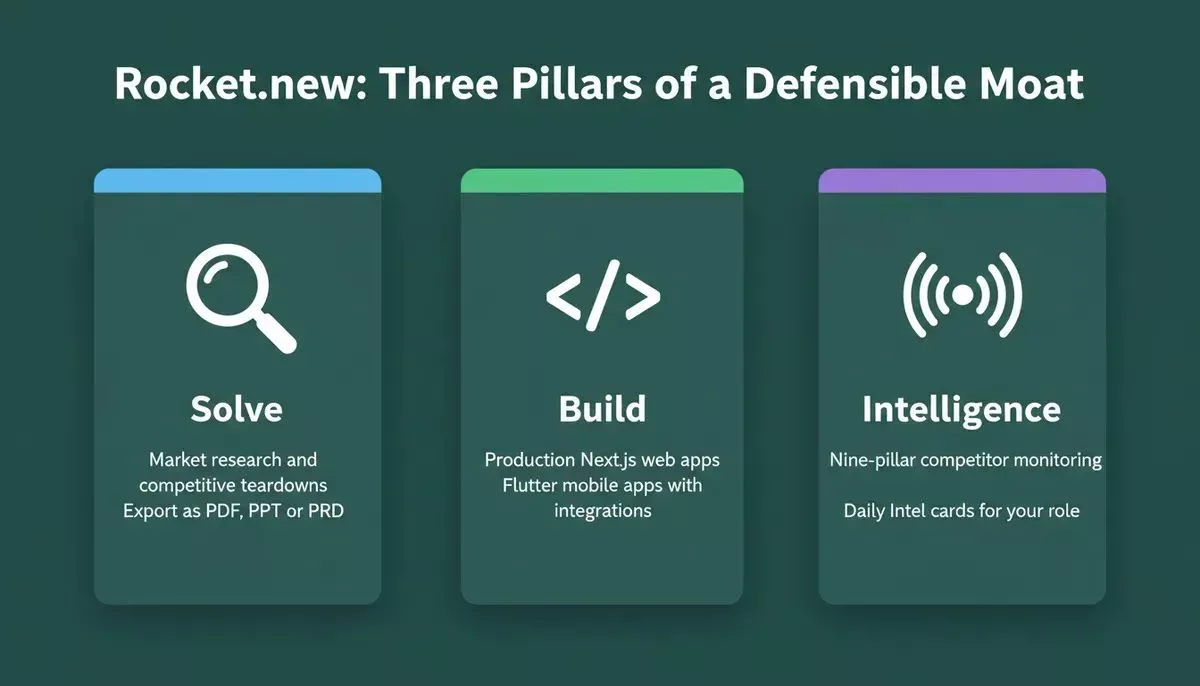
Rocket.new's three interconnected pillars, each one addressing a different layer of your moat argument.
Solve: Turn Business Questions Into Investor-Ready Evidence
Solve is Rocket's research engine. Before you build anything, Solve helps you validate ideas, size markets, run competitive analysis, and answer complex business questions with structured, evidence-backed reports.
Type a question in plain language and get back a multi-source report with an executive summary, supporting evidence, and actionable recommendations. Reports export as PDF, PPT, HTML, or PRD, formats you can hand directly to investors or include in a data room.
For your moat argument, Solve produces:
- Market sizing analysis that validates your TAM/SAM/SOM claims
- Competitive teardowns comparing your positioning against named rivals
- Investment analysis reports structured for due diligence review
- Pricing strategy benchmarks showing where you sit in the market
This is first-party evidence, not borrowed credibility. When an investor asks "how do you know your market is this large?" you open a Solve report, not a slide with a number you found on Google.
Use Solve to validate your market before you build, so every product decision is anchored in real demand rather than assumption.
Build: Ship Production Apps That Demonstrate Execution
Build generates production-ready web apps in Next.js and mobile apps in Flutter from a prompt, a Figma file, or a GitHub repo. It connects to 25+ integrations including Supabase, Stripe, Airtable, and HubSpot from a single prompt.
For your moat argument, Build demonstrates:
- Execution speed: a working MVP shipped in days, not months
- Technical depth: production Next.js or Flutter code, not a prototype
- Integration breadth: Stripe payments, Supabase auth, Mixpanel analytics wired up from chat
- Scalable architecture: the Advisor Agent resolves error loops and makes architectural decisions automatically
When investors ask "can this team actually ship?" you show them a live, deployed product, not a demo.
Intelligence: Prove You Understand the Competitive Landscape
Intelligence watches competitors across nine signal pillars and delivers Intel cards framed to your role and strategic questions. It monitors website changes, pricing updates, hiring patterns, product releases, funding rounds, and customer reviews, continuously, not as a one-time snapshot.
For your moat argument, Intelligence proves:
- You track competitor moves before they become threats
- You have a system for turning market signals into strategic decisions
- Your competitive awareness compounds over time: more competitors tracked means sharper Intel
When an investor asks "what happens when Competitor X launches this feature?" you pull up an Intel card showing you already spotted the signal weeks ago and adjusted your roadmap. Understanding how competitive intelligence software informs product strategy is the difference between reactive and proactive positioning.
How Rocket's Three Pillars Build Each Moat Layer
Here is how each Rocket pillar maps directly to a moat layer investors scrutinize:
| Moat Layer | What Investors Ask | How Rocket Helps |
|---|---|---|
| Proprietary data | What data do you have that competitors can't buy? | Solve reports aggregate live market data into structured, exportable evidence |
| Network effects | How does value increase as users grow? | Build generates the product infrastructure that captures and compounds usage data |
| Switching costs | How hard is it for customers to leave? | Build creates deep integrations (Supabase, Stripe, HubSpot) that embed your product in customer workflows |
| Competitive intelligence | Do you know what competitors are doing? | Intelligence monitors nine signal pillars continuously and delivers daily Intel cards |
| Execution proof | Can this team actually ship? | Build produces production Next.js and Flutter apps that investors can open and use |
These features are not just about convenience. They help your company build systems that improve over time and give investors verifiable proof at every layer of your moat argument.
The Moat-Building Process: From Concept to Investor-Ready Proof
Understanding the relationship between each moat layer and how Rocket supports it is critical. The process flows from market validation through product building to competitive monitoring, with each stage feeding back into the next to compound your moat evidence over time.
Rocket's research-to-intelligence loop: Solve validates the market, Build ships the product, Intelligence monitors the competitive landscape, and the cycle compounds your moat evidence over time.
Building Your Moat Step by Step
A strong moat doesn't appear overnight. It is built step by step through clear decisions, systems, and consistent focus.
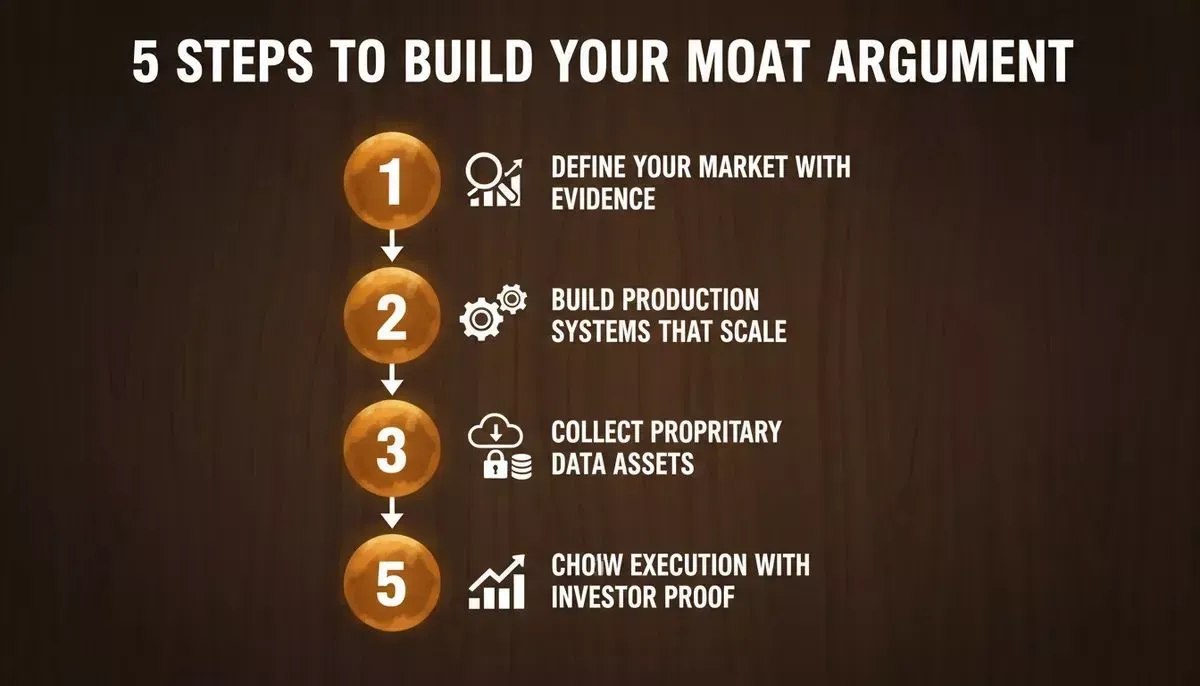
The five-step framework for building a moat argument that holds up under Series A scrutiny.
Step 1: Define Your Market Clearly
Your market should not be vague. Use Solve to run a market analysis that produces a structured report with TAM/SAM/SOM sizing, competitive landscape mapping, and evidence-backed opportunity assessment. This report is exportable as PDF or PPT, ready to hand directly to investors.
You need clear demand validated by live data, identified customer segments with specific pain points, and a competitive landscape you can defend with evidence.
Step 2: Build Systems That Scale
Don't just build features. Build systems. Use Build to generate a production-ready Next.js web app or Flutter mobile app. Wire in Supabase for your database and auth, Stripe for payments, and Mixpanel for analytics, all from a single prompt.
The result is a live, deployed product with real infrastructure, not a prototype. Systems create consistency in how your product delivers value, efficiency that reduces cost as you scale, and long-term switching costs as customers embed your product in their workflows. Scaling a SaaS product built with AI tools requires this kind of infrastructure thinking from the start.
Step 3: Focus on Data as Your Core Asset
Your data should improve your AI models through feedback loops, create proprietary signals competitors cannot replicate, and increase your competitive edge as usage grows. This is where real moat value comes from. Every user interaction is a data point that makes your product better and your competitors' position weaker.
Step 4: Create High Switching Costs
Think about custom workflows built on your platform's specific architecture, deep integrations (Supabase, HubSpot, Airtable) that embed your product in customer operations, and proprietary data stores that don't transfer cleanly to alternatives. This creates lock-in that investors can verify by looking at your integration depth and customer retention data.
Step 5: Show Your Execution Plan With Evidence
Investors want clarity backed by proof. Your execution plan should include key milestones with dates and measurable outcomes, a growth strategy grounded in market data from Solve, and competitive risk management informed by Intelligence monitoring. This builds trust because you are not just describing what you will do. You are showing the systems you already use to track, validate, and execute.
What the Media Says
Here is something from a founder conversation on X:
"Defensibility has always come from two things: things that are hard to do and things that are hard to get." - X (Twitter)
That hits directly. It is not about how fast your company grows at the start. It is about what your competitors can't easily replicate. If your product is easy to build and your data is easy to access, your moat won't hold.
Moat Types Compared
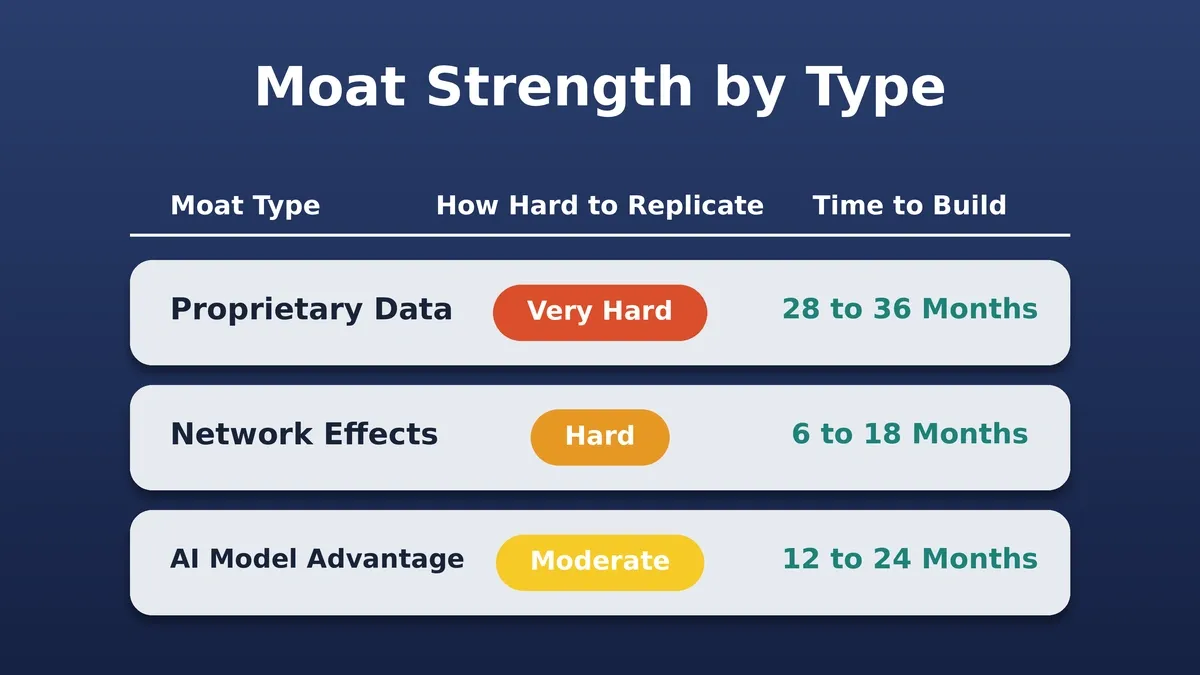
Not all moats are equal. Proprietary data and network effects take the longest to build but are the hardest for competitors to replicate.
| Moat Type | How Hard to Replicate | Time to Build | Rocket Pillar |
|---|---|---|---|
| Proprietary Data | Very Hard | 18-24 months | Solve + Build |
| Network Effects | Hard | 24-36 months | Build |
| Switching Costs | Moderate | 6-18 months | Build (integrations) |
| AI Model Advantage | Moderate | 12-24 months | Solve + Build |
| Competitive Intelligence | Easy to start, hard to systematize | 3-6 months | Intelligence |
| Brand and Trust | Hard | 24-48 months | Intelligence (reviews + media) |
The strongest moat arguments stack at least three of these layers and can show investors evidence for each one, not just a claim.
Turning Your Moat Into Proof That Investors Trust
Many founders struggle to prove their competitive advantage. They lean on ideas instead of data, which creates risk in a crowded market. Weak positioning makes it easy for competitors to step in and take share.
Use Rocket to build systems that generate real, verifiable evidence. Run Solve to produce market analysis reports you can share in your data room. Use Build to ship a production product that demonstrates execution. Set up Intelligence to monitor competitors continuously and show investors you are never caught off guard.
If you want to build a competitive moat argument on Rocket.new, you need proof, not promises. In the long run, combining AI, proprietary data, and clear execution, with the evidence to back it up, is what keeps you ahead. Knowing how to build an investor data room with AI is the final step that packages all of this evidence into a format investors can verify in a single session.
How does Rocket help founders build a moat argument?
Rocket provides three interconnected pillars: Solve produces structured market research reports exportable as PDF, PPT, HTML, or PRD that you can hand directly to investors; Build ships production-ready Next.js and Flutter apps that prove execution; and Intelligence monitors competitors across nine signal pillars so you always know what is coming before it arrives.
Build real proof with Rocket.new and turn your competitive advantage into something Series A investors can verify, not just believe.
Table of contents
- -What Is a Competitive Moat?
- -What Investors Actually Look For in a Competitive Moat
- -Breaking Down the Core Elements of a Strong Moat
- -1. Data Network Effects
- -2. Switching Costs That Hurt to Leave
- -3. AI Systems That Improve Over Time
- -4. Network Effects That Multiply Growth
- -Where Most Founders Go Wrong
- -The Role of AI, Open Source, and Foundation Models
- -What is Rocket and Why Does It Matter for Moat Arguments?
- -Solve: Turn Business Questions Into Investor-Ready Evidence
- -Build: Ship Production Apps That Demonstrate Execution
- -Intelligence: Prove You Understand the Competitive Landscape
- -How Rocket's Three Pillars Build Each Moat Layer
- -The Moat-Building Process: From Concept to Investor-Ready Proof
- -Building Your Moat Step by Step
- -Step 1: Define Your Market Clearly
- -Step 2: Build Systems That Scale
- -Step 3: Focus on Data as Your Core Asset
- -Step 4: Create High Switching Costs
- -Step 5: Show Your Execution Plan With Evidence
- -What the Media Says
- -Moat Types Compared
- -Turning Your Moat Into Proof That Investors Trust
- -How does Rocket help founders build a moat argument?