
Rocket.new helps businesses decode competitor pricing using advanced insights, enabling smarter deal-making, better positioning, and improved negotiation outcomes in competitive markets.
When competitor pricing changes, what does it mean for your next deal?
Most teams don't. They spot the change days later, scramble for context, and walk into that sales call unprepared.
The global competitive intelligence tools market hit $5.70 billion in 2025, growing at 12.9% annually a clear sign that tracking competitors has become a business priority, not an afterthought.
In this blog, I'll show you how to turn competitor signals into real-time intelligence your team can actually act on.
A Pricing Change Is Rarely Just a Pricing Change
Here's what most businesses miss: a pricing change on its own is noise. What makes it a signal is everything happening around it. A competitor drops their free plan credits. On its own minor.
But pair that with:
-
Three new enterprise sales job postings on LinkedIn
-
A shift in G2 reviews toward "team features" and "scalability"
-
Enterprise-focused copy appearing on their homepage
-
A spike in their social content around "security" and "compliance"
Now you have a signal cluster. The competitor is going upmarket. That's the kind of competitive intelligence that helps your team walk into an enterprise deal knowing exactly what card to play instead of guessing.
How Most Teams Handle Competitor Moves?
Most teams don’t lack data they lack speed and context when reacting to competitor moves.
What Typically Happens
-
A signal appears: Someone spots a pricing change and drops a link in Slack.
-
Short-lived discussion: A few replies come in, but the thread fades within days without clear conclusions.
-
No structured insight: The change isn’t analyzed no one defines what it actually means for positioning, strategy, or deals.
-
Missed in execution: Weeks later, an account executive faces the same competitor move in a live deal with no context or preparation.
-
Repeated pattern: This cycle happens multiple times each quarter, across different deals and teams.
-
Long sales cycles increase risk: Enterprise deals now span 6–12 months or more. Competitor moves stack up, and outdated context becomes a serious disadvantage.
"Enterprise sales didn't collapse, but they've quietly reshaped themselves while most teams keep selling like it's still 2019. The average cycle for large deals is now 6 to 12 months, often longer."Mike Groeneveld, Enterprise Sales Advisor (LinkedIn)
Without real-time context, teams don’t lose deals instantly they lose them gradually by showing up unprepared.
What AI App Builders Like Lovable and Bolt Don't Give You
AI app builders have made app building and vibe coding fast. Lovable and Bolt's credit-based pricing model where Pro paid plans give 100 monthly credits and additional credit packs are available on demand is built for individual builders and small teams moving quickly through app generation cycles.
But what those platforms don't include is any kind of competitive monitoring layer. There's no structured brief, no investigative research, no interpretation of what a competitor's pricing change actually means for your business. Most teams end up stitching together four separate tools just to get a partial picture of competitor moves - and still walk into deals underprepared.
| What You Need | Most Teams' Approach | With Rocket.new Intelligence |
|---|---|---|
| Detect a pricing change | Manual page checks | Automatic, with before/after delta |
| Understand the context | Slack threads and guesswork | Signal cluster with strategic read |
| Prepare for a deal | Last-minute research scramble | One structured brief, delivered daily |
| Connect to team strategy | Separate planning session | Flows directly into Solve and Build |
Building fast is useful but knowing what to build and how to position it is what actually wins.
How Rocket.new Reads a Pricing Signal
Rocket.new's Intelligence feature does something competitor tracking tools don't: it doesn't just alert you. It tells you what the change means.
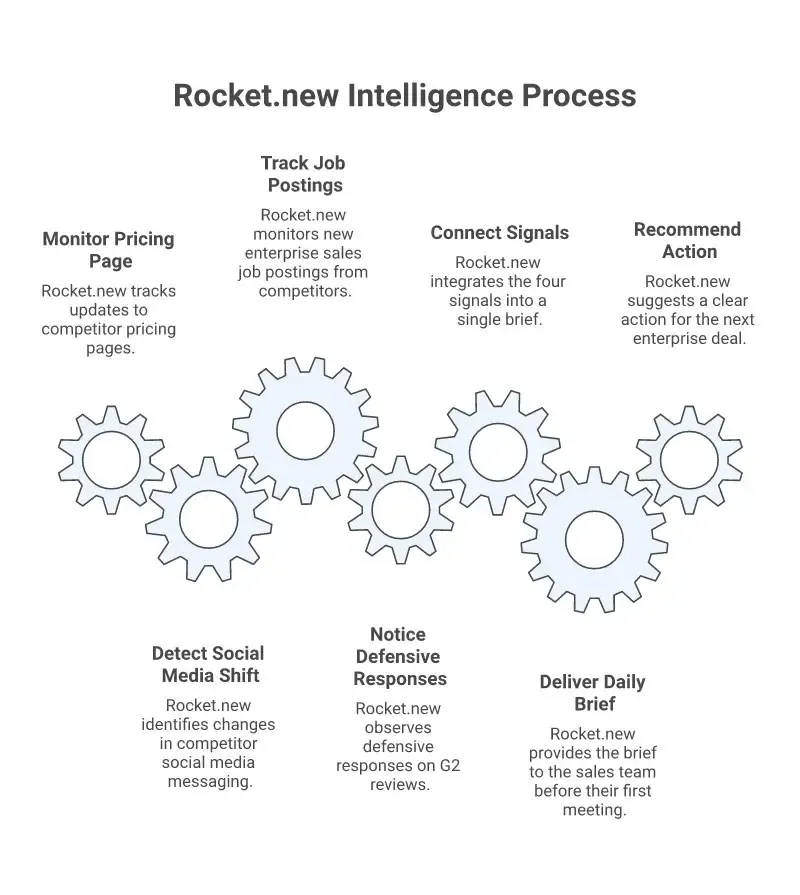
When a competitor updates their pricing page, Intelligence detects the change at the page level - capturing the full before/after with a strategic delta interpretation. That same week, if their social posts shift toward enterprise messaging, their G2 responses start defending security credentials, and new enterprise sales roles appear on LinkedIn, Intelligence connects those signals into one structured brief.
The daily brief gives your team three things:
-
What moved and why it matters (synthesized across all signals)
-
What to watch next (emerging patterns your team should track)
-
A recommended action (a concrete next step tied to your position)
1flowchart TD
2 A[Competitor updates pricing page] --> B[Intelligence detects page change]
3 B --> C{Signal cluster analysis}
4 C --> D[Social media shift tracked]
5 C --> E[Job postings monitored]
6 C --> F[Review sentiment change noted]
7 D --> G[One structured brief generated]
8 E --> G
9 F --> G
10 G --> H[Recommended action surfaced]
11 H --> I[Flows into Solve and Build context]
Because Rocket.new uses a shared context architecture, that competitive intelligence flows directly into your team's Solve and Build workspace. The pricing signal from Monday is present when your account executive opens Rocket on Thursday to prep for a call. No re-explaining. No digging through old Slack threads.
Rocket.new: Built for Teams That Need More Than a Feed
Rocket.new is designed for teams that don’t just want updates they need actionable intelligence that drives decisions across the business.
What Makes It Different
-
All-in-One Intelligence Workspace: Rocket.new combines research, building, and monitoring in one platform so teams don’t just track signals, they act on them.
-
Website Monitoring: Tracks every pricing update, messaging shift, and feature launch with before/after comparisons. Not just what changed but what it signals strategically.
-
People Signals: Surfaces hiring trends, executive moves, and team expansion. Competitor job postings often reveal strategy months before official announcements.
-
Daily Briefs: One structured brief per competitor, delivered every morning. Covers: what changed, what to watch, and what your team should do before the day starts.
-
Shared Context Across Teams: Intelligence lives inside a shared project, giving sales, marketing, product, and strategy teams access to the same real-time context eliminating duplication.
-
Integrated with Solve and Build: Insights flow directly into decision-making (Solve) and execution (Build), covering everything from strategy to apps, landing pages, and internal tools.
When intelligence, decision-making, and execution live in one place, teams move faster and with far more clarity.
Read the Signal, Not Just the Change
A competitor’s pricing update isn’t a conclusion it’s a signal. It reflects how they’re repositioning in the market, and that shift directly impacts your enterprise deal. Most teams notice the change but fail to interpret it in time, missing the strategic meaning behind it.
Rocket.new helps your team go beyond detection. It shows what changed, what it connects to, and what action to take before your next call. The teams that win aren’t just building better they’re reading the market faster and acting with clarity.
Want to stay ahead of competitor moves? Use Rocket.new to turn signals into strategy before your next deal is on the line.
FAQs
What does Rocket.new Intelligence actually monitor?
Intelligence monitors every public platform a competitor operates on pricing page changes, social media activity, news and press coverage, job postings, review sentiment on G2 and Capterra, and performance marketing ads. It interprets what those signals mean for your business, not just that they happened.
How is Rocket.new different from a tool like Crayon or Klue?
Those tools surface information and send alerts. Rocket.new reads signal clusters connecting a pricing change to social shifts, hiring activity, and review sentiment and delivers one structured brief with a recommended action. It's interpretation, not just a feed.
Can sales teams use Rocket.new for enterprise deal prep?
Yes. Sales teams get deal-specific competitive briefs directly from Intelligence. Because it lives inside a shared Rocket project, research done by the strategy team on Monday is available to the account executive prepping for Thursday's enterprise call without any handoff.
Does Rocket.new require separate tools for building and monitoring?
No. Build, Intelligence, and Solve are all part of the Rocket.new platform, connected through shared context. Competitive research, app building, and strategic analysis all happen inside one project without switching platforms or losing context between tasks.