
Rocket.new goes beyond competitive monitoring dashboards by interpreting signals instead of just collecting them. It connects pricing changes, hiring activity, product launches, and market movements into one shared strategic context. Teams can move from competitor insights to investigative research and production software without switching platforms.
How Competitive Intelligence Became a Data Collection Problem
What separates competitive intelligence that changes decisions from competitive intelligence that sits in a folder? Most teams collect competitor data across different tools, then spend hours stitching signals together manually.
AI adoption in competitive intelligence teams jumped 76% year-over-year, with 60% of teams now running AI tools daily. Data collection is mostly solved. Interpretation is not.
Why Most Teams Still Track the Slow Way
-
Most teams rely on Google Alerts, social media platforms, and pricing trackers that run independently.
-
Each tool covers one slice: a LinkedIn post here, pricing changes there, hiring signals somewhere else.
-
The slow way means opening tabs every morning, scanning each, and copying findings into a doc nobody reads. Teams focus on the wrong thing: collecting instead of interpreting.
-
Teams find the real cost is not subscription fees. The real cost is hours turning raw data into something actionable.
The competitive monitoring layer in most teams looks like a patchwork. Signals arrive in different tools with no shared context connecting them.
Monitoring Tells You What Changed, Intelligence Tells You Why
Not a Feed of Updates
-
A competitive monitoring dashboard is a feed. It shows a competitor changed their pricing page on Tuesday at 2 PM. That is not a feed of actionable insights. That is a notification.
-
Not a feed of timestamps, what teams need is a strategic read connecting signals to competitor actions over time.
-
Competitive monitoring alone does not tell you whether pricing changes reflect market performance pressure, an upmarket push, or a reaction to competitor moves.
-
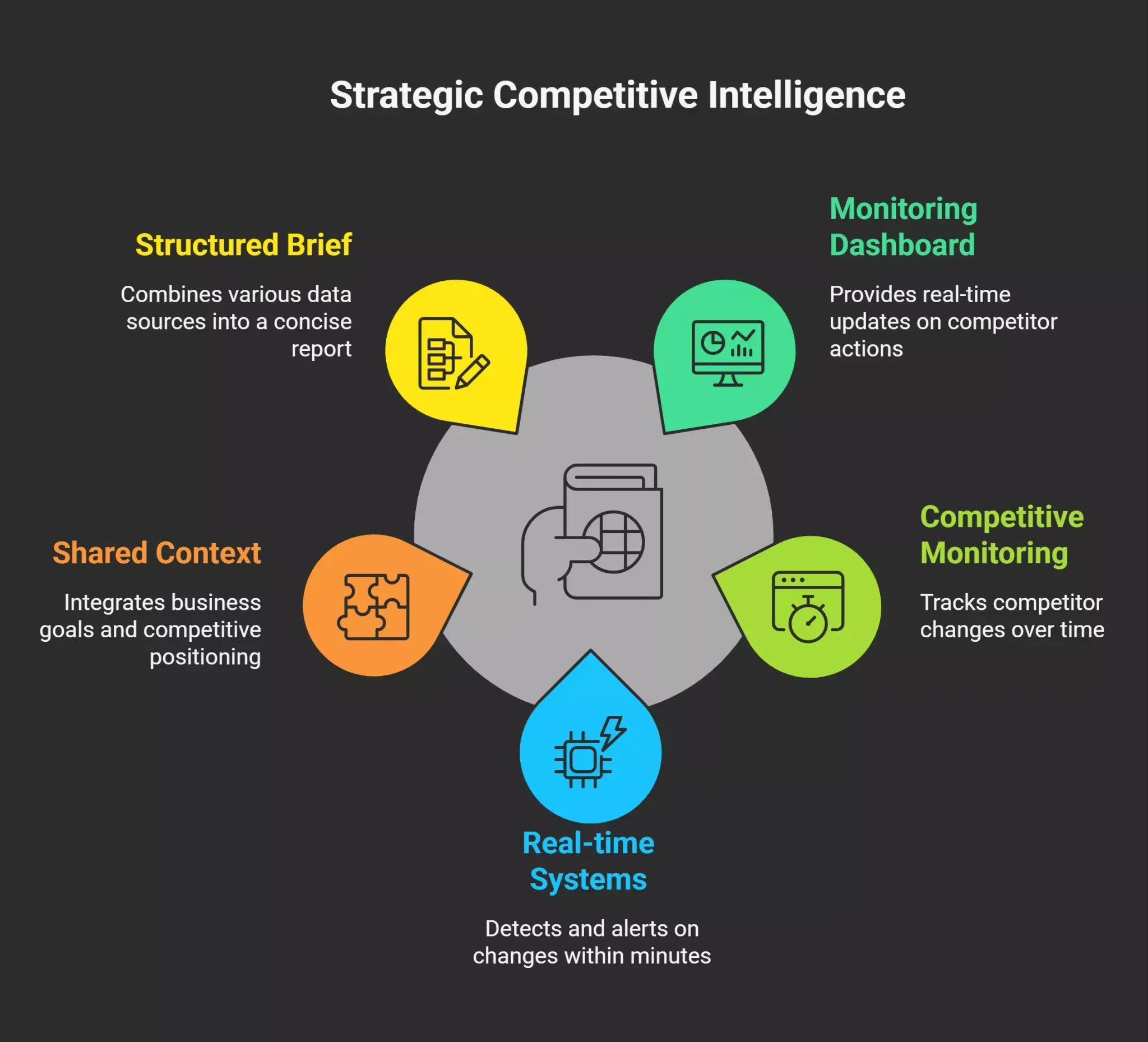
Real-time competitive intelligence systems can detect and alert on competitive changes within minutes rather than hours or days, providing significant strategic advantages.
A Strategic Read With Same Shared Context
-
Intelligence becomes a strategic read when every signal shares the same shared context: your business goals, your competitive positioning, and the full arc of how competitors operate.
-
When teams find a pricing change alone, it looks like one data point. When the same shared context includes a LinkedIn post about a new enterprise push plus hiring signals for account executives, the strategic read changes entirely.
-
Same shared context means website signals, social media data, reviews, and news feed into one structured brief, not a feed of disconnected alerts.
What Happens When Teams Find Signals Without Interpretation
Competitors Operate Faster Than Quarterly Reports
Modern AI competitive intelligence operates on foundational pillars such as automated data collection, real-time analysis, predictive modeling, and actionable alerting, enabling teams to act quickly on insights.
-
Competitors operate on weekly cycles. Pricing changes, product launches, feature sets, and competitive positioning shift faster than most teams can process them.
-
Most teams run competitive analysis quarterly. Competitors operate in real time, and your top competitors update positioning weekly.
-
A live deal in your pipeline right now might hinge on pricing changes from last week that your team has not connected to the broader shift.
| Competitive Monitoring Dashboard | Intelligence Interpretation Layer |
|---|---|
| Shows what changed | Explains why it changed and what to do |
| Raw data from one source | Same shared context across all sources |
| Manual analysis per signal | One structured brief automatically |
| Treats a LinkedIn post and a pricing shift the same | Ranks signals by impact and urgency |
| Teams find signals in scattered tools | Teams find real signals in one strategic read |
When teams find signals without interpretation, they either overreact to noise or miss real competitor actions. A live deal might close or stall based on a pricing change that nobody connected to broader competitor moves. The slow way of processing competitive intelligence manually means strategic decisions lag behind how competitors operate.
How Rocket.new Turns Signals into One Structured Brief
Rocket.new is the first vibe solution platform that connects competitive intelligence to investigative research and app building in one system. Rocket's Intelligence does not just track competitors. It interprets what competitors do, ranks signals, and delivers a structured brief that teams act on without switching tools.
Run Investigative Research Across Every Source
-
Run investigative research across competitor websites, social media, reviews, news, and job boards simultaneously.
-
When you run investigative research through Intelligence, the output is a structured brief with signal strength indicators, not a feed of links.
-
Run investigative research once through the setup wizard, and Rocket handles continuous monitoring and interpretation from there.
-
Investigative research connects each signal to the same shared context of your business, so a LinkedIn post about a competitor's new CTO links to their pricing changes and product launches automatically.
From Competitor Moves to a Build Plan
-
Intelligence surfaces competitor moves like a pricing restructure or feature launch. Teams move into Solve to run investigative research on implications.
-
From there, teams build production software that responds: a comparison landing page, internal tools, or updated mobile apps.
-
Competitor moves in most competitive monitoring tools stay as alerts. In Rocket 1.0, competitor moves become a build plan.
This is how competitive intelligence stops being a competitive monitoring layer of notifications. Teams find that going from signal to structured brief to production software in one platform removes the slow way of switching between scattered tools.
What People Are Saying
"With each piece of intel, ask yourself, 'so what?' Not all product updates, social posts, landing pages, or pricing changes are created equal. As the owner of the CI program, you act as a filter." - Andy McCotter-Bicknell, Head of Competitive Intelligence at Apollo.io, via Building Momentum
That filtering is what separates a competitive monitoring layer from an interpretation layer. Rocket 1.0 automates the "so what?" with signal strength indicators and cross-source correlation, so one structured brief surfaces only the insights that matter for a live deal against competitors or for strategic decisions.
How Rocket.new Handles Competitive Intelligence as an Interpretation Layer
Rocket.new is the first vibe solutioning platform where you research a market, build production software, and track competitors in one product. Intelligence is Rocket's third pillar alongside Solve and Build. The competitive monitoring layer feeds into the same shared context powering everything on the platform.
-
Vibe solutioning platform: Rocket is the first vibe solutioning platform combining research, building, and competitive intelligence.
-
25k+ templates library, free to use: Pre-built templates for landing pages, SaaS dashboards, and mobile apps.
-
Supports Flutter (mobile) and Next.js (web): Build production-grade apps for web and mobile from natural language.
-
Collaboration features built in: Share workspaces, projects, and Intelligence dashboards.
-
3 Products, One platform: Solve, Build, and Intelligence: Run investigative research, build production software, and monitor competitor moves in the same shared context.
So how does Rocket 1.0 connect to competitive intelligence in practice?
-
During a live deal, Intelligence surfaces pricing changes. You run investigative research in Solve for a structured brief. Then Build a comparison landing page. Same shared context from signal to production software.
-
For market research: Run investigative research on how competitors operate in your category. Intelligence shows pricing changes, feature sets, and competitive positioning shifts over time using natural language processing and predictive analytics to anticipate competitor actions.
-
For solo founders and small teams: Most teams cannot afford separate tools for competitive monitoring, competitive analysis, and building production software. Rocket 1.0 replaces that stack. Teams find that the slow way of juggling different tools disappears.
-
Anticipate competitor actions: Intelligence analyzes clusters of signals, like a LinkedIn post about AI agents combined with pricing changes and hiring signals, to flag a shift before competitors operate publicly. This continuous monitoring with natural language processing turns signals into a real competitive advantage and competitive insights.
Why the Shift Decides Your Next Move
What makes Rocket.new's intelligence an interpretation layer and not just a competitive monitoring dashboard comes down to the same shared context. A competitive monitoring layer shows data. An interpretation layer tells you what to do and connects it to how competitors operate over time.
Competitive intelligence in a separate dashboard dies there. When it lives where you run investigative research and build production software, signals become a real competitive advantage.
Sign up and turn competitor signals into strategic action with Rocket.new’s Intelligence, Solve, and Build ecosystem.
Table of contents
- -How Competitive Intelligence Became a Data Collection Problem
- -Why Most Teams Still Track the Slow Way
- -Monitoring Tells You What Changed, Intelligence Tells You Why
- -Not a Feed of Updates
- -A Strategic Read With Same Shared Context
- -What Happens When Teams Find Signals Without Interpretation
- -Competitors Operate Faster Than Quarterly Reports
- -How Rocket.new Turns Signals into One Structured Brief
- -Run Investigative Research Across Every Source
- -From Competitor Moves to a Build Plan
- -What People Are Saying
- -How Rocket.new Handles Competitive Intelligence as an Interpretation Layer
- -Why the Shift Decides Your Next Move