
Learn how The Rocket.new MVP Playbook helps founders validate ideas, streamline product development, and launch scalable MVPs faster with actionable frameworks, startup strategies, and practical execution tips for building products with confidence.
What if the biggest risk in building your product isn't moving too fast but too slow?
A minimum viable product (MVP) is the leanest, most functional version of your idea that you can put in front of real users to test whether it solves a real problem. Not a concept deck. Not a prototype collecting dust on a Figma board.
A working product. And according to CB Insights, 42% of startups fail because they build something nobody wanted a trap that a well-run MVP process is specifically designed to avoid.
What Is a Minimum Viable Product, Really?
The term gets thrown around a lot in the startup world, so it's worth getting precise.
A minimum viable product is the smallest working version of your product idea that delivers enough value to attract early adopters and generate real user feedback. It is not an incomplete product. It is a focused product - one built with only what you need to test your core hypothesis with real users.
The original idea came from Eric Ries' Lean Startup framework: build, measure, learn. Ship an early version, watch how real users interact with it, and let real data drive what comes next. That loop - not a perfect launch - is what produces product market fit.
Think of it this way: an MVP is your fastest, cheapest path to finding out if your idea is worth building into a full product.
Why the Founding Team's Mindset Matters from Day One
Every founding team hits a fork in the road early. On one side: build everything, get it right, launch when it's polished. On the other: ship fast, learn from real users, iterate.
The second path is almost always harder to choose and almost always the right one.
Startups that launch an MVP first reduce development costs by up to 60% and reach product market fit faster than teams that build fully featured products from the start. (Source)
That's not because a smaller product is better. It's because early feedback from real users is worth more than months of internal refinement based on assumptions. Co-founders who align on this from day one build faster, spend smarter, and pivot when the data says to instead of after they've burned through their runway.
The Myth of the "Market-Ready Product"
One of the most persistent traps in early product development is waiting for a market-ready product before launch. The idea being: polish everything, fix every edge case, and then release.
The problem? There is no such thing as "market-ready" before the market has reacted. Real users define what's ready. You don't.
A first-time founder who ships a working early version to 20 real users in week three will learn more in two weeks than a founding team that spent four months building in isolation. Speed matters - not for the sake of speed, but because early feedback is what turns a product idea into a product people actually want.
Defining Your Core Feature: The Only Thing That Matters Right Now
Before a single screen is designed, one question needs a clear answer: what is the single core feature that tests whether this idea works?
Not five features. Not a roadmap. One thing.
Here's a simple framework to define it:
-
State the core problem: Who is the user? What specific pain are they experiencing? The more precise, the better.
-
Name the core feature: What is the smallest action a user can take that directly addresses that pain?
-
Define what success looks like: Not downloads. A specific behavior: a sign-up, a completed task, a payment, a return visit.
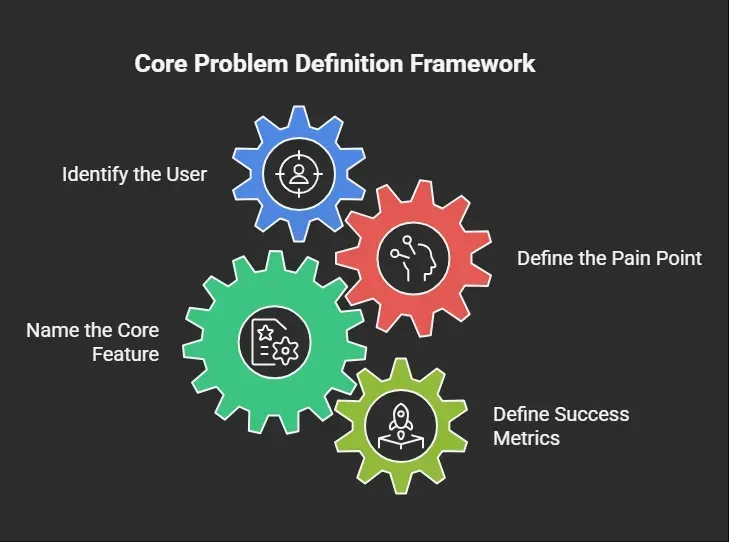 Once those three things are clear, your MVP scope is defined. Everything else goes on a post-launch roadmap.
Scope creep is the single most common reason MVPs go over budget and over deadline. Founders often add new features before the original hypothesis has even been tested. The discipline of staying focused on only what validates the core idea is what separates disciplined execution from endless building.
Building an MVP: A Step-by-Step Process for First-Time Founders
Here's how a structured approach to building an MVP typically plays out for founders who do it right:
Step 1 - Write your hypothesis
One sentence: "I believe [specific user type] will [take this action] because [this reason]." This is your compass for every build decision.
Step 2 - Cut the scope to just the beginning
List every feature idea you have. Then cut it down to the one core feature that tests your hypothesis. Anything else is a distraction.
Step 3 - Choose how to build
This is where many first-time founders get stuck for months. Picking the right tech stack and build method is a speed decision, not a permanence decision. You can always rebuild later. Right now, the goal is getting something in front of real users.
Step 4 - Build the early version and launch fast
Don't wait for a perfect product. Get a working product into the hands of early adopters as quickly as possible. Speed matters because every week without user interaction is a week of learning lost.
Step 5 - Gather early feedback with laser focus
Ask specific questions. Watch what users actually do not what they say they'll do. Real data is the currency of the MVP stage.
Types of MVPs to Consider
Not every MVP looks like a polished app. Choosing the right type for your idea can save time and help you start learning sooner.
| MVP Type | What It Is | Best For |
|---|---|---|
| Landing page MVP | A single page explaining the product with a sign-up CTA | Testing demand before building anything |
| Concierge MVP | Manually delivering the product's promise before automating it | Service-based ideas, marketplaces |
| Wizard of Oz MVP | Front-end looks automated; humans run the backend | Validating AI or automation workflows |
| Prototype MVP | Clickable mock-up without real functionality | Testing UX flows before development |
| Single-feature app | A working app with only the core feature | Direct product testing with real users |
The concierge MVP is especially underused. Airbnb manually photographed apartments and handled bookings before building a platform. Zappos bought shoes from physical stores before investing in warehouse systems. Both tested their core hypothesis with minimal effort before scaling.
How to Gather Early Feedback That Shapes Real Data
Getting feedback from early users is not the same as getting useful feedback. The difference comes down to asking the right questions and watching the right behaviors.
What works for gathering user feedback at the MVP stage:
-
In-app analytics: Track what users actually do, not what they say. Tools like Mixpanel or even simple session tracking reveal real behavior patterns at scale.
-
One-on-one user interviews: Five conversations with real users who've tried the product will surface more insight than a 200-person survey.
-
NPS and micro-surveys: Quick, targeted, and easy to run post-onboarding.
-
Session recordings: Watch real users navigate your product. Moments of hesitation or confusion tell you more than a feedback form.
-
Direct outreach to early customers - Early customers who love the product will often point you toward the next most valuable feature if you simply ask.
The key is to move fast. Early feedback loses its value if the team takes three weeks to act on it. The build-measure-learn loop only works when the loop actually turns.
The Early Version Is Just the Beginning
This is the most misunderstood part of the entire MVP process. Many founders treat the launch as the finish line. It's actually the starting line.
Your early version is a hypothesis made tangible. It will have flaws. It will be missing things users want. Some of what you built will get ignored entirely. That's not failure that's information.
What changes after the first launch:
-
Assumptions get replaced by real data
-
You discover which core feature users actually love versus which ones you assumed they would
-
Early adopters become your most honest advisors
-
You gain clarity on whether to iterate, pivot, or stop
A user in the r/vibecoding community on Reddit shared their experience after experimenting with Rocket.new for app building: "So I've been experimenting with rocket.new recently, and I think it's worth sharing how it works and my experience with it." (Source)
That kind of early exploration is exactly what the MVP mindset is about. Try it, learn from it, share what you find. The product gets better because of what you discover.
Common Scope Creep Traps to Avoid
Even with the best intentions, teams get pulled off course. These are the patterns that repeat most often:
-
Adding features before validating the first one: The most common trap. Enough features to test the idea is all you need at this stage.
-
Skipping the landing page: A simple landing page can validate demand before a single line of backend code is written.
-
Treating feedback as validation: "This looks great!" is not validation. A user returning, paying, or completing the core action is.
-
Over-engineering the tech stack: Non-technical founders especially lose months choosing between frameworks. Pick the fastest path to a working product.
-
Waiting for a clear understanding that never comes: You won't have full certainty before launch. That's the point. The market provides the clarity.
Launch Your MVP Fast with Rocket.new
Here's where the MVP playbook meets the real world.
Rocket.new is an AI-powered app builder that takes a natural language prompt - or a Figma design - and produces a working web or mobile app, complete with backend logic, authentication, database structure, and a deployment pipeline. No large developer teams required. No months of setup.
For non-technical founders, product managers, and small teams, Rocket.new removes the biggest blocker between a product idea and an early version: the build itself.
From Prompt to Working App in Minutes
Describe what you want to build. Rocket.new analyzes the context, plans the structure, generates frontend and backend code, and produces a working app with navigable screens. You pick the framework React, Next.js, or Flutter for mobile and Rocket handles the rest.
This turns what used to be a 3-6 month development cycle into something that can be done in days, with a fixed price plan starting at $25 per month a fraction of traditional development costs that can range up to $150,000 for a comparable build.
Figma to Code: For Teams with Designs Ready
Already have a Figma prototype? Upload the file and Rocket.new converts the visual layout into working code. Designers and product teams can go directly from a design file to a deployable early version without bridging to a separate dev team. That removes weeks of handoff time from the process.
App Studio: Where Early Feedback Shapes the Next Version
After launch, you'll have real user feedback in hand. Rocket.new's App Studio lets you refine, expand, and iterate your app through a continuous chat interface no rebuilding from scratch. Add screens, change logic, connect integrations. All through prompts. This makes the build-measure-learn loop fast enough to act on user feedback before it goes cold.
What Rocket.new Does That Competitors Don't
Traditional no-code tools like Bubble and Webflow are capable but they carry a steep learning curve and hit a ceiling when product complexity grows. AI app builders like Lovable are strong for web, but output only web apps. Rocket.new generates both web and mobile apps from the same prompt, handles the full stack including backend and database, and supports GitHub export for teams that want to continue development manually. For non-technical founders building their first MVP, that full-stack output is the difference between launching in weeks and waiting months.
Your MVP Journey Has Just Begun
Building an MVP is not about cutting corners. It's about building the right thing at the right time for real users and having the discipline to stay focused only on what validates your core hypothesis.
The minimum viable product exists to de-risk the product development process. It replaces assumptions with real data, guesses with early feedback, and wishful thinking with actual user behavior. Every successful product, from Dropbox to Airbnb, started with something far smaller than the finished version and got better because real users, not internal plans, shaped what came next.
Rocket.new makes that starting line accessible without a development team, a large runway, or months of planning. The earliest version of your product is the most important one you'll ever build. It sets the direction for everything that follows.
Table of contents
- -What Is a Minimum Viable Product, Really?
- -Why the Founding Team's Mindset Matters from Day One
- -The Myth of the "Market-Ready Product"
- -Defining Your Core Feature: The Only Thing That Matters Right Now
- -Building an MVP: A Step-by-Step Process for First-Time Founders
- -Types of MVPs to Consider
- -How to Gather Early Feedback That Shapes Real Data
- -The Early Version Is Just the Beginning
- -Common Scope Creep Traps to Avoid
- -Launch Your MVP Fast with Rocket.new
- -From Prompt to Working App in Minutes
- -Figma to Code: For Teams with Designs Ready
- -App Studio: Where Early Feedback Shapes the Next Version
- -What Rocket.new Does That Competitors Don't
- -Your MVP Journey Has Just Begun