
Rocket.new helps brands replace reactive monitoring with predictive competitive intelligence, using AI to surface market shifts, competitor signals, and strategic opportunities before they impact growth, positioning, or customer demand globally.
What Makes Predictive Competitive Research So Important in 2026?
Most businesses still analyze what competitors did yesterday, while leading companies focus on predicting what competitors will do next. That shift from reactive research to predictive intelligence is becoming one of the biggest competitive advantages in 2026.
The demand for predictive intelligence reflects this change. According to Precedence Research, the global predictive analytics market is projected to grow from USD 17.49 billion in 2025 to USD 113.46 billion by 2035 at a CAGR of 20.56%.
This blog will help readers understand how AI-powered competitive research helps businesses predict trends, respond faster, and stay ahead of competitors.
The Real Cost of Staying Reactive
Most companies believe reactive monitoring is “good enough” until competitors start moving faster than they can respond. By the time teams notice pricing changes, feature launches, or positioning shifts, competitors have already captured attention, leads, and market momentum.
-
A competitor updates pricing, and your team discovers it only after losing deals in sales conversations.
-
New product features appear in the market, but your company notices them days later through customer feedback or reviews.
-
Brand positioning changes become visible only after conversion rates and engagement metrics begin dropping.
-
Teams spend more time reacting to competitor moves instead of planning proactive growth strategies.
The same pattern applies to competitive research. Reactive businesses spend their energy catching up, while predictive businesses spend their time staying ahead.
What the Shift Actually Looks Like?
Predictive intelligence is not faster monitoring. It is a fundamentally different operating mode.
Reactive systems wait for events. Predictive systems use historical data, real time data, and machine learning models to catch subtle patterns before anything breaks - or before a competitor makes a public move.
Here is how the progression looks in practice:
-
Reactive Monitoring: Event happens, then you respond
-
Predictive Monitoring: Patterns spotted before events occur, so you can prepare
-
Predictive Intelligence: Signals interpreted in context, so you can act strategically
-
Automated Remediation: Systems respond before impact reaches the business
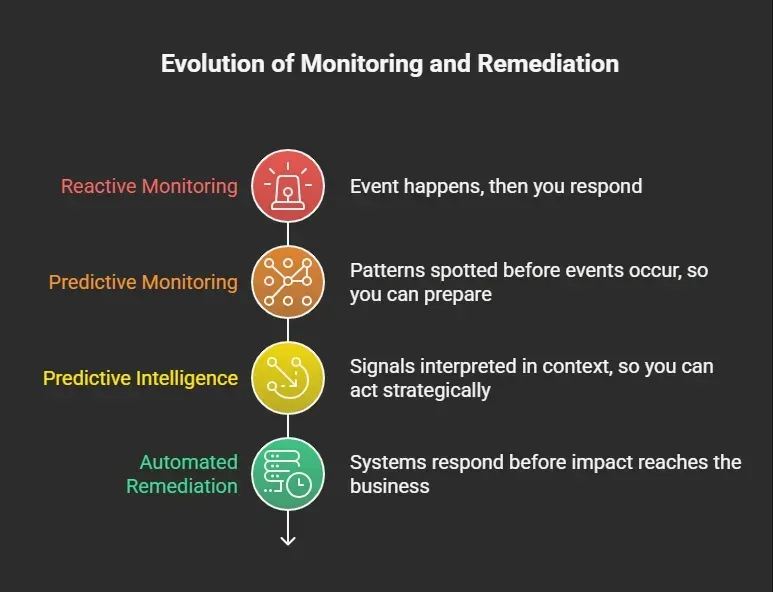 Predictive analytics models learn from patterns over time. Machine learning algorithms apply anomaly detection to flag early warning signals deviations from baseline behaviors that humans would miss scanning manually.
When a competitor starts hiring enterprise sales engineers while quietly updating their pricing page, predictive monitoring catches both signals. Predictive intelligence connects them.
That connection between isolated data points and strategic meaning is the shift organizations are chasing right now.
Predictive Maintenance as a Model for Competitive Research
The manufacturing sector has been running this experiment for years. The results are clear.
These outcomes come from replacing reactive maintenance with predictive models built on sensor data, real time data streams, and advanced analytics.
The logic translates directly to competitive research.
| Approach | When action is taken | Response speed | Operational risk | Data quality needed |
|---|---|---|---|---|
| Reactive monitoring | After event occurs | Slow | High | Low |
| Schedule maintenance | Fixed intervals | Moderate | Moderate | Moderate |
| Predictive monitoring | Before event occurs | Fast | Low | High |
| Automated remediation | System-triggered | Immediate | Minimal | High |
Supply chain teams apply the same predictive models to distribution center inventory, demand patterns, and weather patterns that might disrupt logistics. The early warning system catches costly disruptions before they reach the production line.
Organizations that embrace predictive operations in one area almost always extend the model to others. The question is why competitive research is so often the last function to make the shift.
The Technology Driving Predictive Intelligence
Modern predictive intelligence systems rely on advanced technologies that help businesses identify patterns, detect risks early, and respond faster than competitors.
Instead of relying on delayed reports or manual tracking, organizations now use AI-powered systems that continuously monitor signals across markets, customer behavior, and competitor activity.
Machine Learning, Anomaly Detection, and Behavioral Analytics
Three core technologies power predictive intelligence systems:
-
Machine Learning Models: These models analyze historical data to understand what “normal” market behavior looks like.
-
Anomaly Detection Algorithms: They identify unusual changes in engagement, pricing, product launches, traffic patterns, or competitor activity before those changes become major disruptions.
-
Behavioral Analytics: This layer interprets what those anomalies actually mean for a business, helping teams prioritize actions instead of reacting blindly.
Artificial intelligence connects all three layers. AI systems can process hundreds of data signals simultaneously, something human teams cannot realistically track manually. In many ways, competitor tracking works similarly to predictive maintenance in manufacturing. Both rely on continuous monitoring systems to detect early warning signs before problems become expensive.
Data Quality, Data Integrity, and Cloud Infrastructure
Predictive intelligence systems are only as reliable as the data feeding them.
-
Poor data quality creates inaccurate insights and false alerts.
-
False positives reduce trust in the system over time.
-
A system that teams no longer trust eventually becomes useless, regardless of how advanced the technology is.
Cloud platforms have made predictive intelligence accessible to companies of every size. Businesses no longer need to build expensive proprietary infrastructure from scratch. Instead, teams can connect structured data sources, apply machine learning algorithms, and automate anomaly detection through scalable cloud environments.
Today, collecting competitive signals is relatively easy. The real challenge is interpreting those signals quickly enough to make smarter business decisions before competitors gain the advantage.
Why Competitive Research Needs the Same Upgrade
That same shift now applies directly to competitive intelligence. Manually checking competitor websites, waiting for product announcements, or reacting after pricing changes happen keeps businesses stuck in reactive cycles.
-
Weekly competitor tracking is no longer fast enough for modern markets.
-
Reactive responses create operational delays and missed opportunities.
-
AI-powered predictive monitoring can now identify competitor shifts before they fully impact the market.
-
Cloud-based behavioral analytics and machine learning tools are becoming accessible to teams of every size.
The companies leading in competitive intelligence in 2026 are not spending more time researching competitors. They are building predictive systems that continuously monitor, analyze, and surface strategic insights automatically.
Rocket.new for Predictive Competitive Research
This is the exact gap Rocket.new's Intelligence feature was built to close.
Most competitive tools surface alerts. Something changed here is the raw signal. That is reactive monitoring with a faster refresh rate. Rocket.new does something different: it interprets.
Every public platform a competitor operates on is monitored continuously. Rocket.new reads signals as clusters, not in isolation. A pricing page change alone is noise. That same change, alongside new enterprise sales job postings, a shift in their social messaging tone, and a dip in G2 review scores, is a single clear strategic signal.
What Rocket.new Monitors Continuously
-
Website changes, pricing updates, feature announcements, and messaging shifts
-
Social media activity across LinkedIn, X, Reddit, Instagram, Facebook, YouTube, and TikTok
-
News coverage, press releases, executive interviews, and partnership announcements
-
Customer reviews and sentiment trends on G2, Glassdoor, Capterra, and app stores
-
Hiring velocity, headcount changes, executive activity feeds, and open positions by department
-
Performance marketing activity across LinkedIn, Meta, and TikTok
The daily brief is where predictive intelligence becomes operational. Every morning, Rocket.new produces a structured brief for every competitor you track: what signals moved, what patterns are emerging, and what your business should do about it.
Why Traditional Competitive Tools Fall Short
Tools like Crayon, Klue, and Kompyte surface alerts. They tell you what changed.
Rocket.new tells you what it means - and connects those insights directly to the strategic and product work happening inside the same platform.
The competitive signal from Monday's brief is present when a product manager opens a task on Wednesday. The pricing move spotted last week informs the landing page written today. Nothing resets between sessions. Every signal compounds.
That compound context architecture is what separates predictive intelligence from reactive monitoring. It also replaces four separate competitive intelligence setups sales, marketing, product, and strategic intelligence with one shared source and four lenses.
Making the Move
The companies leading competitive research in 2026 are no longer relying on weekly manual tracking. They use predictive analytics systems to monitor competitor behavior continuously, identify subtle positioning changes early, and act on market signals before competitors make public announcements. Instead of reacting to outdated information, they operate with faster insights and more proactive decision-making.
This shift is not only about adopting new technology. It changes how organizations plan, respond, and make strategic decisions. Rocket.new helps teams make that transition with continuous monitoring, AI-powered interpretation, and compound intelligence that becomes smarter over time.
If your team wants to move from reactive competitor tracking to predictive intelligence, Rocket.new provides one platform built for modern competitive research workflows.
Table of contents
- -The Real Cost of Staying Reactive
- -What the Shift Actually Looks Like?
- -Predictive Maintenance as a Model for Competitive Research
- -The Technology Driving Predictive Intelligence
- -Machine Learning, Anomaly Detection, and Behavioral Analytics
- -Data Quality, Data Integrity, and Cloud Infrastructure
- -Why Competitive Research Needs the Same Upgrade
- -Rocket.new for Predictive Competitive Research
- -What Rocket.new Monitors Continuously
- -Why Traditional Competitive Tools Fall Short
- -Making the Move