
Discover how Rocket.new helps founders move from market research and sizing to a validated live MVP in just one week using a fast, repeatable product validation loop designed to reduce risk and accelerate learning.
What if your next product idea could go from a blank page to real users in seven days?
Not a mockup, not a pitch deck a live, deployable minimum viable product with actual feedback rolling in.
That is not a fantasy. It is a repeatable process. And according to CB Insights, the teams that skip it pay a steep price: 42% of startups fail because they build products nobody wants. The global MVP development market is growing from USD 288 million in 2024 to a projected USD 541 million by 2031 because more teams are learning that fast validation beats perfect planning every time.
Why Most MVPs Still Miss the Mark?
The idea of a minimum viable product has been around since Eric Ries put it in The Lean Startup. And yet, most teams still get it wrong.
Some build too much loading their MVP with features that looked great in a deck but solved no real user need. Others skip market research entirely and jump straight into development, betting on gut feel. Both paths lead to the same result: wasted development cost, frustrated early adopters, and no clear signal on product market fit.
The root cause is always the same. The build started before the thinking was done.
The Validation Loop: A Week, Not a Quarter
The build measure learn loop is simple in theory build something small, put it in front of real users, measure what happens, and learn from the data. Repeat. That is the whole game.
Most teams break the loop at step one. They build too much before anything gets measured. They confuse "having a product" with "having validated a product."
The Rocket.new validation loop compresses the entire cycle. Market research, market sizing, mvp development, launch, and real user feedback treated as one continuous sprint, not a series of sequential months.
Here is what that cycle looks like in practice:
Step 1: Market Research and Market Sizing - Start With the Problem, Not the Product
Good market research is not about confirming an idea. It is about understanding the problem well enough that whatever gets built actually solves something real.
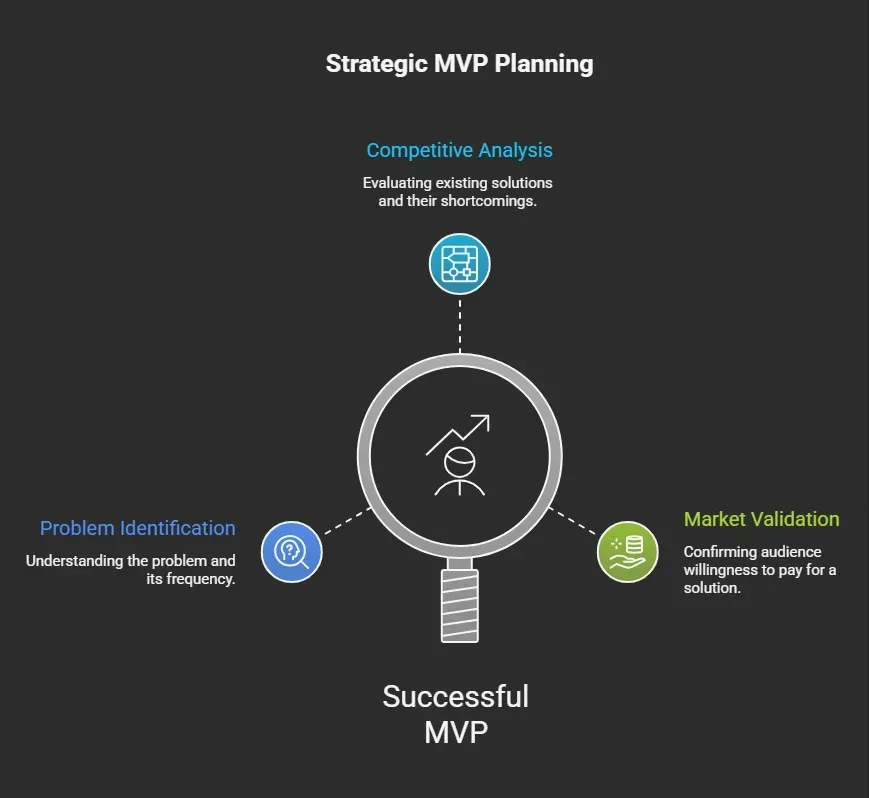 For market sizing, you do not need a full analyst report. A rough estimate of your target audience size, multiplied by a reasonable price point, tells you whether the market demand justifies moving forward. If the number is too small, no amount of good mvp development will change that.
User interviews are the fastest way to validate market need before writing a line of code. Talk to 10-15 people in your target audience. Ask them about the problem, not the solution. What tools do they use now? What frustrates them about those tools? What would they pay to fix that frustration?
This is where qualitative insights come from — not surveys with five-point scales, but real conversations that surface the language your target audience uses to describe their own pain points. That language later becomes your messaging, your landing page copy, and your onboarding flow.
"The real winners talk to 50 users before opening Figma. They validate on WhatsApp, test manually, and track pain like it's gold. Their MVP is not a prototype — it is a pain notebook." - E-Cell JEC, LinkedIn (Source)
Step 2: Identify Core Features - The MoSCoW Method
Once the market research is done, the next decision is feature prioritization. And the hardest part is not figuring out what to build it is deciding what not to build.
Must Have vs. Nice to Have: The Full Breakdown
The MoSCoW method gives teams a clear framework for sorting features before mvp development starts:
| Priority | Category | What It Means |
|---|---|---|
| M | Must have | Core features that deliver the core value proposition. Without these, the MVP does not work. |
| S | Should have | High-value additions that improve the product, but are not launch-critical. |
| C | Could have (nice to have) | Features that improve user experience but can wait. |
| W | Won't have | Out of scope for this MVP stage. Revisit post-launch. |
For a one-week MVP, only the core features from the "must have" column make the cut. Everything else gets logged for future iterations.
Too many features at the mvp stage bloat development cost, confuse early users, and delay the collection of real user feedback on what actually matters. Focus means shipping sooner, learning faster, and spending less.
Step 3: Building Your Minimum Viable Product MVP
With must-have features locked, the mvp development process begins. The goal is not a polished product. The goal is the simplest version of your core user flows that lets real users experience your core value.
The Development Cost Reality Check
Traditional software development costs $10,000+ per month for a single developer, with a typical MVP timeline of three to six months. With no code tools, the same MVP can come together in two to four weeks at roughly $300 to $500 per month for the platform. Over 70% of new apps are now built via no/low-code approaches. (Source: thesmallsquare.com)
For a week-long MVP sprint, you are building even leaner:
-
A landing page that captures sign-ups and communicates the value proposition clearly
-
A user interface covering two or three core user flows
-
Basic authentication and data storage
-
Mobile apps that ship the same core experience to iOS and Android users
Nothing more. The question that governs every feature decision: does this help real users experience the core value? If not, it stays out.
The Most Common Mistake at This Stage
Teams add features mid-build. A "nice to have" sneaks into the sprint. Then another. Then another. This is feature creep and it is how a one-week MVP turns into a four-month project.
Set a hard scope. Write down what goes in. Write down everything that gets deferred. Treat the deferred list as a sign of discipline, not a sign of an incomplete product.
Step 4: Launch Your Landing Page and Get to Real Users
Your mvp development is done. Now comes the part most teams underinvest in: getting it in front of real users quickly.
The Landing Page as a Validation Tool
Before the full app is even ready, a simple landing page can test whether there is real market demand. Describe the core value proposition, include a clear call to action, and track sign-ups. If people are not interested enough to give you an email address, you have important data before you build anything at all.
Post in communities where your target audience spends time. Share directly with people from your user interviews. Run a small targeted campaign. The goal is not a thousand sign-ups. The goal is ten to twenty early adopters who have the problem you are solving and want to see if you have solved it.
Early adopters are not looking for a perfect product. They are looking for something that solves their specific problem. Their tolerance for bugs and rough edges is high. Their patience for a product that does not address their core need is zero.
Step 5: Analyze User Behavior and Decide What Comes Next
Once real user feedback starts coming in, the most important decision of the entire mvp development process arrives: do you iterate on what you have, or change direction?
What User Behavior Actually Tells You
The data from your early users shapes the next sprint. If users are dropping off before they reach the moment where the product delivers its core value, the onboarding flow needs work. If users arrive, complete the core flow, and then never return, the core value proposition itself might need rethinking.
Track these success metrics separately:
-
Daily active users: Even a small number returning daily is a real signal.
-
Core flow completion rate: Are users completing the main action the MVP was built for?
-
User retention: Do they come back after day one?
-
Usability testing results: Can users complete the main task without asking for help?
-
Net promoter score: Would they recommend this to someone with the same problem?
A word of caution: do not mistake activity for product market fit. Sign-ups are not retention. Retention is not revenue. Measure each one separately, and do not move on until you see genuine signals on the retention layer.
Getting Qualitative Insights That Data Cannot Give You
Analytics tools tell you what users do. User interviews tell you why.
After your first week of real user feedback, reach back out to the people who signed up. Ask them to walk you through what they tried. Ask where they got confused. Ask what problem they were hoping the product would solve and whether it did.
These conversations surface things no dashboard can show: the language gap between what you built and what users expected, the step that felt obvious to you but confused everyone else, and the feature nobody asked for but everyone wanted.
Most Builders Start at Build. Rocket.new Starts at the Beginning.
Most no code tools and AI app builders solve the build step. You describe an app, they generate one. That is genuinely useful. But it leaves two large gaps uncovered: what to build, and what to build next.
Without structured market research, teams build on assumptions. Without competitive intelligence, they miss what is already in the market. Without shared context across the team, every sprint restarts from scratch.
Rocket.new was built to close all three gaps.
Launch the Whole Validation Loop with Rocket.new
Rocket.new is the world's first Vibe Solutioning platform where market research, app building, and competitive monitoring all happen in one place, connected by a shared context that carries every decision forward.
Here is how the Rocket.new validation loop covers the full journey from idea to live MVP in a week:
Solve: Market Research and Market Sizing in 60-90 Minutes
Rocket's Solve pillar takes any business question "Is there demand for a project tracking tool built for freelance designers?" and returns a full structured analysis in 60 to 90 minutes. It searches across 150+ sources at the same time, covering market dynamics, competitive position, risks, and opportunities.
The output includes:
-
A direct verdict: is this worth building?
-
Core objectives and target audience breakdown
-
Key findings tagged by signal strength (HIGH / MEDIUM / LOW)
-
Competitive landscape with real data
-
Risk matrix and recommended execution path
Teams typically spend days doing this research manually. Solve compresses it to a single morning. And the output does not disappear after export it becomes the foundation for every build task that follows inside the same project, so nothing gets re-explained from scratch.
Build: From Features List to Live App in Minutes
Once market research is done and core features are locked, Rocket's Build pillar generates a production-grade app from a plain language description. Web apps come out in Next.js. Mobile apps use Flutter, ready for both iOS and Android from a single codebase.
That means:
-
A landing page to validate demand and capture early users built from the market research Solve already produced
-
A full web app with your must-have features and a polished user interface
-
Mobile apps with real design systems, dark and light theming, and fluid navigation
The development cost is a fraction of traditional approaches. MVP development timelines that once took months shrink to hours. After launch, Rocket's built-in analytics track visitors, conversions, and Core Web Vitals from day one no separate analytics tools to set up.
Intelligence: Track Competitor Moves While Your MVP Collects Feedback
The Rocket.new validation loop does not stop at launch. Rocket's Intelligence pillar monitors competitors continuously tracking pricing changes, product updates, customer sentiment, and social signals so you know what is shifting in the market as your MVP gathers early user feedback.
This is the layer most MVP development approaches miss entirely. You ship. You collect feedback. But you have no view of what competitors are doing in response. Rocket keeps that loop closed.
How Rocket.new Compares
| Feature | Lovable / Bolt / v0 | Rocket.new |
|---|---|---|
| Market research and sizing | Not included | Built in via Solve |
| MVP development | Yes (prompt to app) | Yes (prompt to production-grade app) |
| Shared team context | No | Yes (compound memory across every task) |
| Competitive intelligence | No | Yes (Intelligence pillar, continuous) |
| Post-launch analytics | No | Yes (built in from day one) |
| Design quality | Generic output | Production-grade, design-quality |
Competitors like Lovable, Bolt, and v0 build what you tell them to build. Rocket figures out what is worth building then builds it.
The Loop Closes, Now What?
The problem with most MVP development is not the building. It is everything that comes before and after it.
Teams skip market research and guess at what their target audience wants. They build too many features and overwhelm their early adopters. They launch, collect a little user feedback, and then lack a clear process to act on what they learn.
The Rocket.new validation loop from market research and market sizing, through mvp development, to real user feedback compresses this into a repeatable, week-long cycle. Research the market. Build only the core features. Track what real users do. Iterate with real data.
That is the path to product market fit without burning months of runway on the wrong product. The minimum viable product MVP is just the beginning. The real work listening, learning, and shipping the next iteration starts the day it goes live.
Table of contents
- -Why Most MVPs Still Miss the Mark?
- -The Validation Loop: A Week, Not a Quarter
- -Step 1: Market Research and Market Sizing - Start With the Problem, Not the Product
- -Step 2: Identify Core Features - The MoSCoW Method
- -Must Have vs. Nice to Have: The Full Breakdown
- -Step 3: Building Your Minimum Viable Product MVP
- -The Development Cost Reality Check
- -The Most Common Mistake at This Stage
- -Step 4: Launch Your Landing Page and Get to Real Users
- -The Landing Page as a Validation Tool
- -Step 5: Analyze User Behavior and Decide What Comes Next
- -What User Behavior Actually Tells You
- -Getting Qualitative Insights That Data Cannot Give You
- -Most Builders Start at Build. Rocket.new Starts at the Beginning.
- -Launch the Whole Validation Loop with Rocket.new
- -Solve: Market Research and Market Sizing in 60-90 Minutes
- -Build: From Features List to Live App in Minutes
- -Intelligence: Track Competitor Moves While Your MVP Collects Feedback
- -How Rocket.new Compares
- -The Loop Closes, Now What?