
A comprehensive comparison of enterprise security features, including SOC 2 compliance, authentication, data protection, and certifications, to help businesses choose the right AI app builder in 2026.
Quick Answer: When evaluating Rocket vs lovable for enterprise, which has better security, Rocket.new takes the lead. It ships SOC 2 Type II, ISO 27001, GDPR, CCPA, and HIPAA compliance by default, globally, for every user from day one, with no enterprise tier required.
Rocket.new is built to pass procurement on day one. SOC 2 Type II, ISO 27001, GDPR, CCPA, SSO/SAML, role-based access, and audit logs are all on by default, not bolted on later. Every team, in every country, gets the same security posture from their first project.
Lovable also holds SOC 2 Type II and ISO 27001:2022 certifications, offers enterprise SSO/SAML, role-based access control, and automated security scanning. However, some features are gated behind higher-tier plans.
Market Context
The shift toward AI-powered app development has accelerated dramatically, making platform security evaluation more critical than ever.
-
Global AI spending reached $2.52 trillion in 2026 (Gartner)
-
The low-code/no-code market is projected to exceed $65 billion by 2027
-
65% of enterprises increased AI budgets in 2026, with a median year-over-year increase of 22%
-
Large enterprises hold 62.6% of the app development software market in 2026
-
Low-code tools now power over 60% of new projects
-
Lovable reached $206M ARR in November 2025, up from $7M at the end of 2024, representing 2,800% YoY growth
Understanding Enterprise Security in AI App Builders
Enterprise security means more than basic password protection. Choosing the right app development platform can significantly affect the speed and efficiency of the development process, saving hours of setup time while simplifying team collaboration.
AI-powered platforms handle sensitive data from multiple sources, including user feedback, internal tools, and production environments. Without proper security controls, GitHub integration and API connections become points of vulnerability.
Key features that separate enterprise-ready app builders from basic tools:
-
Audit logs to track and review all platform activity
-
Role-based access control ensures users only access what they need
-
Compliance certifications meeting regulatory and industry standards
-
Support for enterprise authentication policies and custom domains
-
Dedicated support for compliance requirements
Why security evaluation matters for enterprise platform selection:
-
Regulated industries require formal certifications, not just architectural security
-
Enterprise teams need platforms that combine speed with governance and complex integrations
-
Scalability is a crucial factor, especially for full-stack projects that grow into business-critical applications
-
A platform that aligns with existing enterprise infrastructure while supporting rapid prototyping provides the strongest competitive advantage
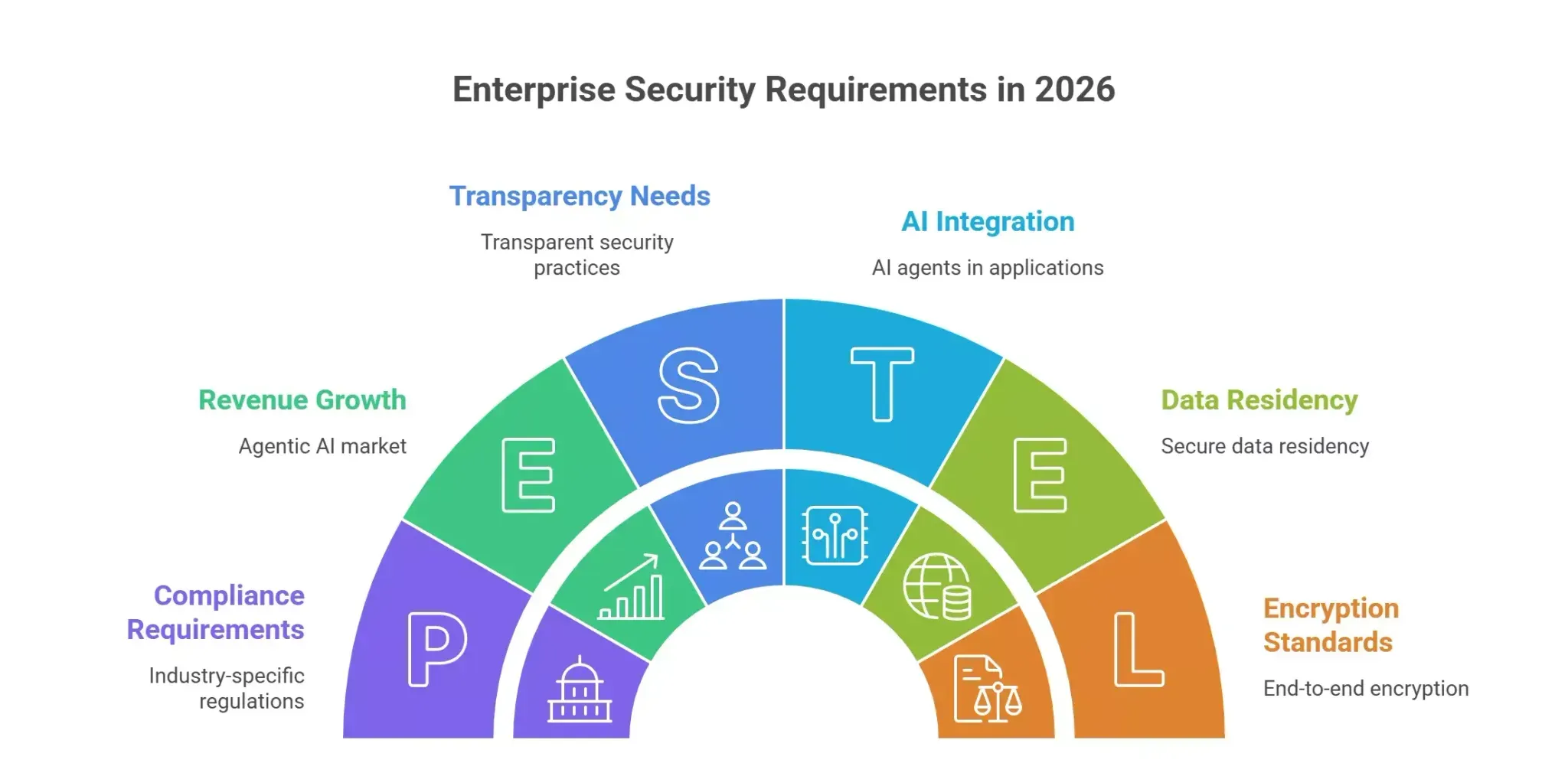
Enterprise Security Requirements in 2026
The security landscape has evolved significantly, with new requirements emerging around AI agents and AI-specific threats.
-
Gartner projects 40% of enterprise applications will include task-specific AI agents by the end of 2026
-
Agentic AI could generate nearly 30% of enterprise application software revenue by 2035, surpassing $450 billion
-
Organizations now require end-to-end encryption, secure data residency, and transparent security practices
-
Compliance requirements vary by industry: HIPAA for healthcare, SOC 2 for financial services, GDPR for international operations
-
Emerging threats include prompt injection, model manipulation, and AI-generated vulnerabilities targeting development platforms
Lovable Enterprise Security Features
Lovable is an AI-powered app development platform that helps users create complete web applications from natural language prompts. It eliminates traditional coding bottlenecks and delivers instant app creation with a click-to-deploy workflow, while maintaining enterprise-grade security at every layer.
Lovable explicitly targets enterprises with SOC 2 Type II and ISO 27001:2022 certifications, making it well-suited for compliance-heavy industries. It is better suited for protecting sensitive data in an enterprise environment due to its security certifications and automated scanning.
Compliance and Certifications
| Certification | Status | Details |
|---|---|---|
| SOC 2 Type I | Certified (Aug 13, 2025) | Security, availability, and confidentiality controls |
| SOC 2 Type II | Certified (Aug 13, 2025) | Ongoing verified security standards |
| ISO 27001:2022 | Certified | International information security management standard |
| GDPR | Compliant | Includes EU-US Data Privacy Framework certification |
| Regional Data Hosting | Available | EU, US, and Australia hosting options |
Authentication and Access Control
Lovable provides enterprise features, including audit logging, role-based access control (RBAC), and SAML/OIDC integration for enterprise SSO, covering most enterprise identity management needs.
-
SSO/SAML - Single sign-on via major identity providers, including Okta and Azure AD
-
SCIM Provisioning - Automated user provisioning and deprovisioning
-
Role-Based Access Control (RBAC) - Granular roles for editing, approving, and publishing
-
Least-Privilege Access - Users receive only the permissions required for their responsibilities
-
Unlimited Collaborators - Scales across large teams while maintaining security controls
-
MFA and Session Management - Comprehensive enterprise authentication built into the platform
Data Protection
Lovable offers regional data hosting in the EU, the US, and Australia, with strict rules that ensure customer prompts and code are never used to train AI models.
-
No AI Training on Customer Data - Prompts, code, and workspace data are never used to train Lovable models
-
Contractual Restrictions - Third-party AI providers are contractually restricted from training on or retaining customer data
-
Logical Data Separation - Workspaces and projects are isolated; data is not accessible across accounts
-
Row-Level Security (RLS) - Built on Supabase with an RLS analyzer for database-level protection
-
Encryption - Comprehensive encryption for data at rest and in transit
-
Data Processing Agreement (DPA) - Included for Business and Enterprise plans as part of the Terms of Service
Security Monitoring
Lovable has an integrated security scanner that checks generated code, dependencies, and database configurations for vulnerabilities. Its Security Checker 2.0 detects vulnerabilities, exposed keys, and insecure configurations before deployment.
-
Continuous monitoring for misuse, anomalous behavior, and compromise
-
Automated rate limits and abuse detection across users and workspaces
-
Vulnerability scanning across generated code, dependency trees, and database schema configurations
-
API key detection with guidance for secure storage
-
Findings categorized by severity and surfaced before deployment
-
Centralized logging with one-year retention
-
Annual SOC 2 Type II audits
-
24/7 incident response team with customer notification within 72 hours of a confirmed breach
Integration and API Security
-
Secrets encrypted at rest and scoped to specific environments
-
Role-controlled and auditable credential access
-
Secrets can be rotated or revoked without full system redeployment
-
Automated credential protection for databases, payment systems, and business integrations
Enterprise Support
-
Priority SLAs with guaranteed response times
-
White-glove onboarding and workspace configuration
-
Security and compliance review assistance
-
Ongoing training programs for platform best practices
-
Dedicated support channels with direct access to security teams
-
Comprehensive security documentation, including compliance reports
Rocket.new Security Approach and Capabilities
Rocket.new is an AI-driven vibe solutioning platform built around three pillars: Solve, Build, and Intelligence. It transforms natural language prompts into production-ready full-stack web and mobile apps, SaaS products, and internal tools, automatically handling frontend, backend, authentication, databases, APIs, payments, and deployment.
What sets Rocket.new apart for enterprise buyers is that compliance is not an add-on or an upgrade tier. SOC 2 (Type I and Type II), ISO 27001, GDPR, CCPA, and HIPAA are included by default, globally, for every user from day one.
Built-In Compliance and Certifications
Rocket.new ships procurement-ready security out of the box. No forms to fill, no sales calls to schedule, no enterprise plan required.
| Certification / Standard | Status |
|---|---|
| SOC 2 Type I | Certified, included by default |
| SOC 2 Type II | Certified, included by default |
| ISO 27001 | Certified, included by default |
| GDPR | Compliant by default |
| CCPA | Compliant by default |
| HIPAA | Compliant by default |
Authentication and Access Control
Rocket.new provides enterprise-grade identity and access management for every workspace:
-
SSO/SAML authentication for centralized identity management
-
Role-Based Access Control (RBAC) with three clearly defined roles: Admins manage the workspace, Creators build and research, Viewers see without editing. Nothing is over-shared.
-
Multi-Factor Authentication (MFA) for additional account protection
-
Audit Logs that record every action across the workspace for compliance traceability
-
Session Management with configurable policies
Development and Deployment Capabilities
The platform supports full-stack generation with security baked into the development process:
-
Code generation in multiple programming languages using user-selected frameworks
-
Instant deployment to hosting platforms with one-click deployment
-
GitHub integration for repository synchronization and version control
-
Custom domains support with enterprise deployment control
-
Self-hosting options and integration with existing enterprise security infrastructure
-
AI assistance for market research, feature planning, UI/UX design, and SEO-optimized copy
-
Full code visibility and export, giving enterprises direct control over their security posture
Intelligence Feature and Data Privacy
Rocket.new's Intelligence feature monitors publicly available information only. It does not access private company data, internal communications, or non-public sources. This means teams can use Intelligence for competitive research and market insights without risking exposure of sensitive internal information.
Head-to-Head Comparisons
Security Compliance
| Compliance Category | Lovable | Rocket.new |
|---|---|---|
| SOC 2 Type I | Certified | Certified, included by default |
| SOC 2 Type II | Certified | Certified, included by default |
| ISO 27001:2022 | Certified | Certified, included by default |
| GDPR Compliance | Supported | Compliant by default |
| CCPA Compliance | Not documented | Compliant by default |
| HIPAA Compliance | Not documented | Compliant by default |
| Data Residency Controls | EU, US, Australia | Global, flexible via hosting choice |
| Third-Party Validation | Independent audits | Independent audits |
| Certification Maintenance | Maintained for full agreement term | Maintained continuously |
| Security Documentation | Extensive | Extensive |
| Regulated Industry Suitability | Healthcare, finance, and government ready | Healthcare, finance, government, and all regulated industries ready from day one |
| Enterprise Procurement | Streamlined path | Built to pass procurement on day one, no enterprise tier required |
Access Control and Authentication
| Feature | Lovable | Rocket.new |
|---|---|---|
| SSO/SAML | Built-in | Built-in, on by default |
| SCIM Provisioning | Built-in | Built-in |
| Granular RBAC | Built-in | Built-in: Admins, Creators, Viewers |
| Identity Provider Support | Okta, Azure AD, SAML | SSO/SAML with major identity providers |
| Approval Workflows | Built-in | Built-in |
| MFA | Built-in | Built-in |
| Audit Logs | Built-in | Built-in, on by default |
Data Protection
| Factor | Lovable | Rocket.new |
|---|---|---|
| Security Management | Managed | Managed, built-in from day one |
| Compliance Frameworks | Included | Included by default (SOC 2, ISO 27001, GDPR, CCPA, HIPAA) |
| Data Residency | EU, US, Australia | Global, flexible via hosting choice |
| AI Training on Customer Data | Never | Never trains on private customer data |
| DPA Available | Yes (Business and Enterprise plans) | Yes, included by default |
| Best For | Teams needing managed compliance | All teams, from startups to regulated enterprises |
Cost and Implementation
| Factor | Lovable | Rocket.new |
|---|---|---|
| Platform Cost | Higher | Competitive, compliance included at no extra cost |
| Implementation Speed | Fast | Faster, full-stack generation with compliance ready on day one |
| Internal Security Resources Needed | Minimal | Minimal, compliance is built-in |
| Compliance Cost | Built-in | Built-in, no additional investment required |
| Best For | Teams needing managed compliance | All teams, with compliance and speed from day one |
Security Monitoring and Incident Response
Lovable: Managed Security Monitoring
-
Continuously monitors platform activity for misuse, anomalous behavior, and compromise
-
Automated rate limits and abuse detection across users and workspaces
-
Scans generated code, dependencies, and configurations for vulnerabilities before deployment
-
Centralized logging with one-year retention
-
Annual SOC 2 Type II audits
-
24/7 incident response team with customer notification within 72 hours of a confirmed breach
Rocket.new: Built-In Security Monitoring
-
Continuous monitoring of platform activity, with compliance-grade logging on by default
-
Automated rate limits and abuse detection across workspaces
-
Vulnerability scanning integrated into the build and deployment pipeline
-
Centralized audit logs for every workspace action, accessible to Admins
-
Full code visibility and export enables enterprises to layer their own scanning and testing on top
-
Incident response backed by the same SOC 2 and ISO 27001 processes that cover the entire platform
Team Collaboration and Security
Effective team collaboration is at the heart of successful software development, whether teams are building web apps, mobile apps, or internal tools. The right platform aligns with existing development workflows while maintaining strict security standards.
Lovable's collaboration strengths:
-
Unlimited collaborators on projects, enabling product managers, developers, and business users to work together seamlessly
-
Role-based access control ensuring only authorized team members can access or modify specific code snippets
-
Audit logs allow organizations to track changes and monitor user activity for compliance
-
Dedicated support channels providing expert guidance on security and collaboration challenges
-
AI assistance features that reduce repetitive tasks and accelerate team velocity
Rocket.new's collaboration strengths:
-
Role-Based Access Control with three distinct roles: Admins manage the workspace, Creators build and research, Viewers see without editing. Every team member has exactly the permissions they need.
-
Audit logs record every action across the workspace, giving Admins full traceability for compliance
-
GitHub integration enables development-focused team collaboration through familiar version control workflows
-
Code editing flexibility, allowing teams to customize and extend generated applications
-
Intelligence feature gives teams competitive research and market insights using only publicly available data, with no risk to private company information
-
Scales from small prototyping teams to large enterprise departments with the same built-in security controls
No-code and AI-powered builders make team collaboration accessible to non-technical users while maintaining enterprise-grade controls. Rocket.new's combination of RBAC, audit logs, and SSO means teams can move fast without compromising on governance. AI agents and AI models further enhance security by generating code snippets that adhere to best practices, reducing vulnerability risks during rapid development cycles.
Natural Language Processing and Security
Natural language prompts are transforming how developers and non-developers build apps. AI-powered platforms like Lovable and Rocket.new lower the barrier to entry for software development, enabling faster prototyping without requiring deep coding knowledge.
However, automatically generated code introduces unique security considerations. Leading platforms address this through:
-
AI models trained specifically on secure coding practices
-
Automated scanning of generating code snippets for vulnerabilities before deployment
-
One-click deployment workflows that include security checks at each stage
-
Dedicated support teams guiding users through security trade-offs between speed and control
Lovable's AI is trained specifically for app logic, meaning it can automatically create CRUD operations, API endpoints, and integrations based on the contextual understanding of prompts. This means better software is produced with fewer manual security fixes downstream.
Choosing the right tool means balancing the convenience of natural language with the need for secure, maintainable code. Platforms that prioritize security through rigorous model training, transparent code generation, and responsive support enable teams to confidently build production-ready applications.
Real-World Enterprise Security Testing
Lovable's certified security posture in testing:
-
Wins the privacy and security category with SOC 2 Type II and ISO 27001:2022 certifications
-
Security Checker 2.0 actively prevents threats during the development process
-
Applications inherit compliance from platform components, reducing the burden on individual apps
-
Formal certifications provide measurable advantages for organizations with strict compliance requirements
-
Transparent security practices and regular audits support better vendor risk assessment
Rocket.new in testing:
-
Matches Lovable's compliance posture with SOC 2 (Type I and Type II), ISO 27001, GDPR, CCPA, and HIPAA, all included by default
-
SSO/SAML, RBAC, MFA, and audit logs are active from day one with no configuration required
-
Code transparency enables manual security review and custom scanning on top of platform-provided protections
-
Built to pass procurement on day one, eliminating the back-and-forth that typically delays enterprise adoption
-
Intelligence feature operates on publicly available data only, keeping private company information completely out of scope
Alternative Platforms Worth Considering
For enterprises evaluating the broader landscape of AI-powered development and security tooling, several alternatives are worth a look:
| Platform | Type | Key Security Strengths |
|---|---|---|
| ToolJet | Low-code platform | SOC 2, GDPR, ISO 27001, RBAC, audit logs, SSO, 60+ connectors |
| Cursor | AI code editor | Intelligent AI assistance, software development collaboration features |
| Firebase | Backend-as-a-service | Real-time data syncing, secure user management, scalable infrastructure |
| Windsurf | AI dev environment | Coding productivity, integrated collaboration tools |
| GitLab | DevOps platform | Development, security, and operations in a single application |
| Hostinger Horizons | No-code AI platform | Plain language app creation, website development |
None of these alternatives combine the breadth of Rocket.new's approach: full-stack generation from natural language, day-one global compliance (SOC 2, ISO 27001, GDPR, CCPA, HIPAA), built-in SSO/SAML and RBAC, and an Intelligence layer for market research, all in a single platform.
How to Choose: Decision Framework
Choose Rocket.new if your organization:
-
Wants compliance (SOC 2, ISO 27001, GDPR, CCPA, HIPAA) included by default, globally, from day one
-
Operates in a regulated industry such as healthcare, finance, or government and needs to pass procurement fast
-
Wants built-in SSO/SAML, RBAC (Admins, Creators, Viewers), MFA, and audit logs without extra configuration
-
Values full-stack generation speed combined with enterprise-grade security
-
Needs a single platform for building, researching (Intelligence), and deploying production-ready apps
-
Prefers full code visibility and export alongside managed compliance
-
Wants lower total cost of ownership with no hidden compliance add-ons
Choose Lovable if your organization:
-
Already uses Lovable and is satisfied with its SOC 2 Type II and ISO 27001:2022 certifications
-
Prefers Lovable's specific workflow for web app generation and deployment
-
Has existing integrations deeply tied to the Lovable ecosystem
Ready to build production-ready apps at speed with enterprise security from day one? Sign up for Rocket.new and turn your ideas into fully working applications in minutes.
Best Practices for Enterprise AI App Builder Security
Regardless of platform choice, enterprises should follow these practices to ensure secure full-stack development:
-
Define security requirements before evaluating platforms, not after
-
Conduct a full risk assessment covering vendor security, application security, and data protection
-
Plan for future compliance needs, particularly for international expansion
-
Train development teams on both platform-specific security features and general AI app security awareness
-
Align monitoring and incident response procedures with the platform's security model
-
Schedule regular security reviews as platform capabilities and threat landscapes evolve
Table of contents
- -Market Context
- -Understanding Enterprise Security in AI App Builders
- -Enterprise Security Requirements in 2026
- -Lovable Enterprise Security Features
- -Compliance and Certifications
- -Authentication and Access Control
- -Data Protection
- -Security Monitoring
- -Integration and API Security
- -Enterprise Support
- -Rocket.new Security Approach and Capabilities
- -Built-In Compliance and Certifications
- -Authentication and Access Control
- -Development and Deployment Capabilities
- -Intelligence Feature and Data Privacy
- -Head-to-Head Comparisons
- -Security Compliance
- -Access Control and Authentication
- -Data Protection
- -Cost and Implementation
- -Security Monitoring and Incident Response
- -Lovable: Managed Security Monitoring
- -Rocket.new: Built-In Security Monitoring
- -Team Collaboration and Security
- -Lovable's collaboration strengths:
- -Rocket.new's collaboration strengths:
- -Natural Language Processing and Security
- -Real-World Enterprise Security Testing
- -Alternative Platforms Worth Considering
- -How to Choose: Decision Framework
- -Best Practices for Enterprise AI App Builder Security