
Rocket.new and Lovable both use credit-based pricing, but their economics differ significantly at scale. Rocket.new offers higher credit volumes, non-expiring credits, and includes hosting, while Lovable's unlimited-user model benefits larger teams with lighter usage. The best choice depends on your growth pattern.
Which AI app builder gives you more bang for your buck when you start scaling up?
If you're comparing Rocket.new vs Lovable pricing, the short answer is this: Rocket.new's credit-based model tends to cost 30 to 50 percent less at high volume, while Lovable's unlimited-users credit model wins for larger teams with moderate per-person usage.
The real cost goes way past the sticker price on each plan. With Gartner forecasting $6.15 trillion in worldwide IT spending for 2026, and AI spending alone projected to hit $2.52 trillion, choosing the right tool is a real financial decision, not just a feature comparison.
What "Scale" Actually Means in App Creation
It's Not Just Headcount Scale has multiple dimensions; some platforms now report 100,000+ new projects daily, generating ~5 million combined visits.
Four Dimensions That Matter
- Headcount: Growing from 1–2 developers to 5 or more.
- Project: Running multiple apps simultaneously.
- Usage: Moving from prototypes to production apps with real traffic.
- Feature: Adding payments, authentication, and third-party integrations.
Who Is Scaling Now?
Not just developers, entrepreneurs, marketers, and small business owners are now shipping web, mobile, and internal tools at a speed unthinkable just three years ago.
The Broader App Development Market in 2026
The no-code/low-code space is crowded, but Rocket.new and Lovable carve out distinct positions. One bets on code quality and production readiness; the other on speed and design polish. Here's what each actually does.
Rocket.new: Turns a natural-language prompt into a fully deployed, production-ready app, backend, connections, and all, without you writing a single line of code. Everything happens within a single browser workspace, making it ideal for moving fast from idea to live product.
Lovable: Takes a similar input but focuses on the full-stack experience, auto-generating frontend, backend, and database schema from plain English. Lovable focuses heavily on UI experience, making it ideal for teams that prioritize beautiful interfaces. Its visual interface lets you tweak designs and behavior, striking a balance between automation and hands-on control.
Two tools, same starting point, different strengths, and choosing the right one depends entirely on what you're building.
Find out more about Rocket vs Lovable for non-technical founders.
Other Players Worth Knowing
Understanding the strengths and weaknesses of each platform helps you match the right tool to your workflow, saving time and reducing frustration.
Emergent: Emergent is a full-stack, AI-powered vibe coding platform that allows startups, founders, and teams to build production-ready applications directly from natural language prompts. Emergent automates frontend, backend, database, hosting, authentication, and deployment in a single browser-based workspace.
Cursor: Cursor is an AI-first code editor built to make software development faster, smarter, and more collaborative. Cursor helps developers write, refactor, debug, and understand codebases through intelligent chat, autocomplete, and inline code editing features.
Windsurf: Windsurf is an AI-powered development environment built to enhance coding productivity through intelligent assistance, automation, and integrated collaboration tools. Its built-in assistant understands context across entire projects, generating code snippets, explaining logic, and suggesting improvements.
Replit: Replit is a cloud-based code editor and AI app builder that allows developers to write, run, and deploy code from a single location. Replit is best for developers who want control and speed without juggling multiple tools, making it suitable for sophisticated projects that span multiple programming languages and frameworks.
Firebase: Firebase is Google's comprehensive backend-as-a-service (BaaS) platform designed to help developers build, deploy, and scale applications faster. Firebase provides ready-to-use backend features such as authentication, databases, hosting, analytics, and cloud functions that remove the need for server management.
Why Pricing Matters More Than Ever
The SaaSpocalypse Effect
With worldwide AI spending forecast at $2.52 trillion this year, choosing the right tool is not just about features. It's about total cost and long-term viability.
The SaaSpocalypse of February 2026 wiped $285 billion off SaaS company valuations. Investors anticipated that vibe coding platforms and AI agents would disrupt traditional software businesses. If non-engineers can ship custom software in minutes, why pay $50 to $200 per seat per month for rigid off-the-shelf SaaS products?
Planning Your 2026 Technology Stack
This shift makes understanding the true economics of these AI tools critical for any organization. Both platforms are designed to help users rapidly create and launch applications with minimal setup. But the way they charge for that speed differs in ways that compound at scale.
How the Subscription Plans Compare
The Core Difference: It comes down to predictability. Both Rocket.new and Lovable now run on credits. They sound alike but behave very differently at scale, and that gap widens the more seriously you build.
Lovable's Credit-Based Plans
Pricing starts at $25/month for 100 credits, shared across unlimited users. The Pro plan ($25/mo) includes 100 monthly credits plus 5 daily credits (up to 150/month), credit rollovers, on-demand top-ups, unlimited lovable.app domains, custom domains, and user roles and permissions.
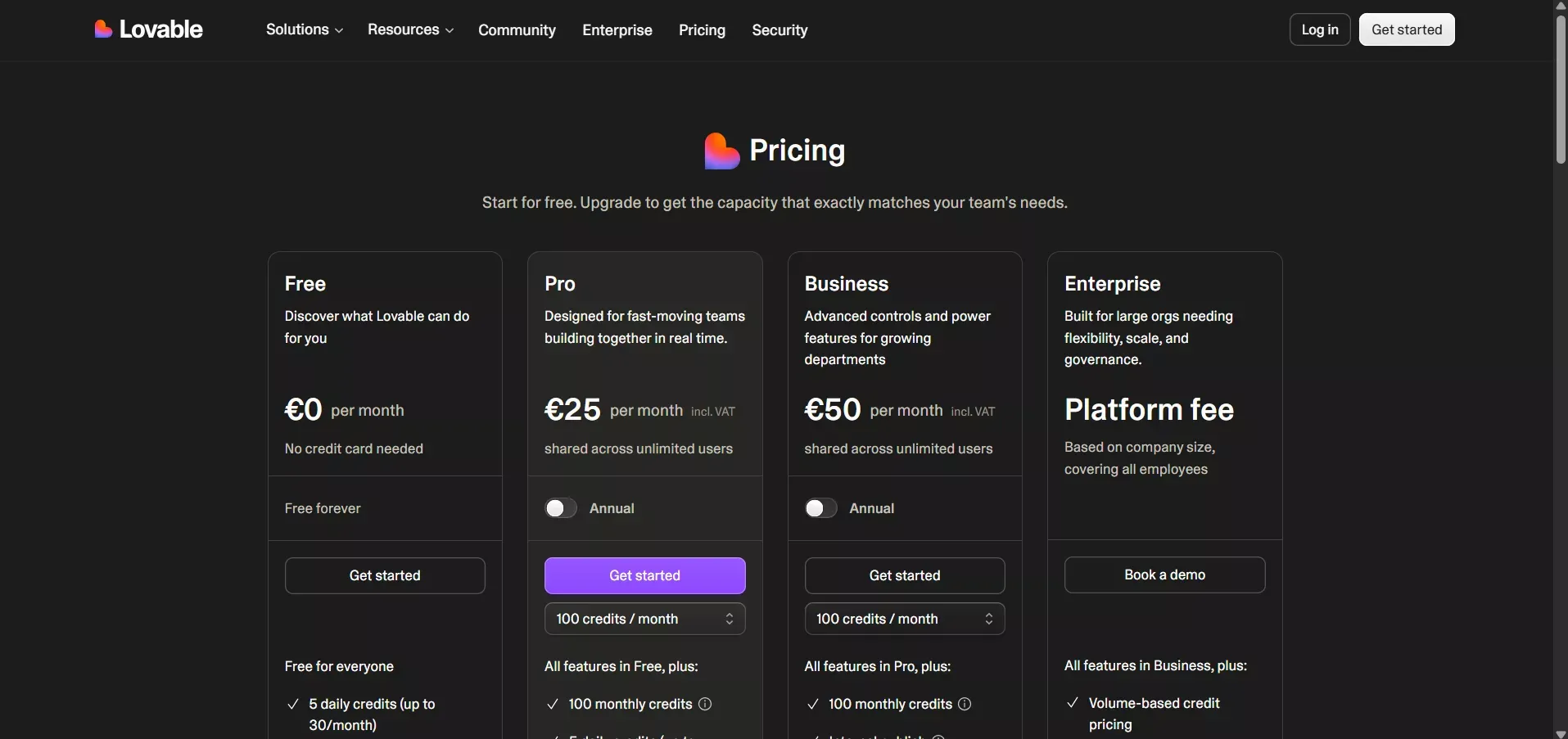
The Business plan ($50/mo) adds 100 monthly credits, SSO, team workspace, personal projects, design templates, role-based access, and a security center. Enterprise pricing is based on company size and covers all employees.
- Default mode deducts credits based on code complexity. Chat mode (no code edits) costs 1 credit per message; heavier requests may incur higher charges.
- Chat mode's flat rate helps budget for simple tasks, but generation mode usage varies.
- Free credits run out fast, roughly 3 meaningful interactions. Fine for evaluation; paid plan needed for real work.
- The Pro plan's unlimited-user policy means teams share a single credit pool, far cheaper than per-seat pricing, making it a strong pick for rapid prototyping, client presentations, and visual design iteration.
Sophisticated, high-frequency projects can burn through credits quickly.
Rocket.new's Credit-Based Plans
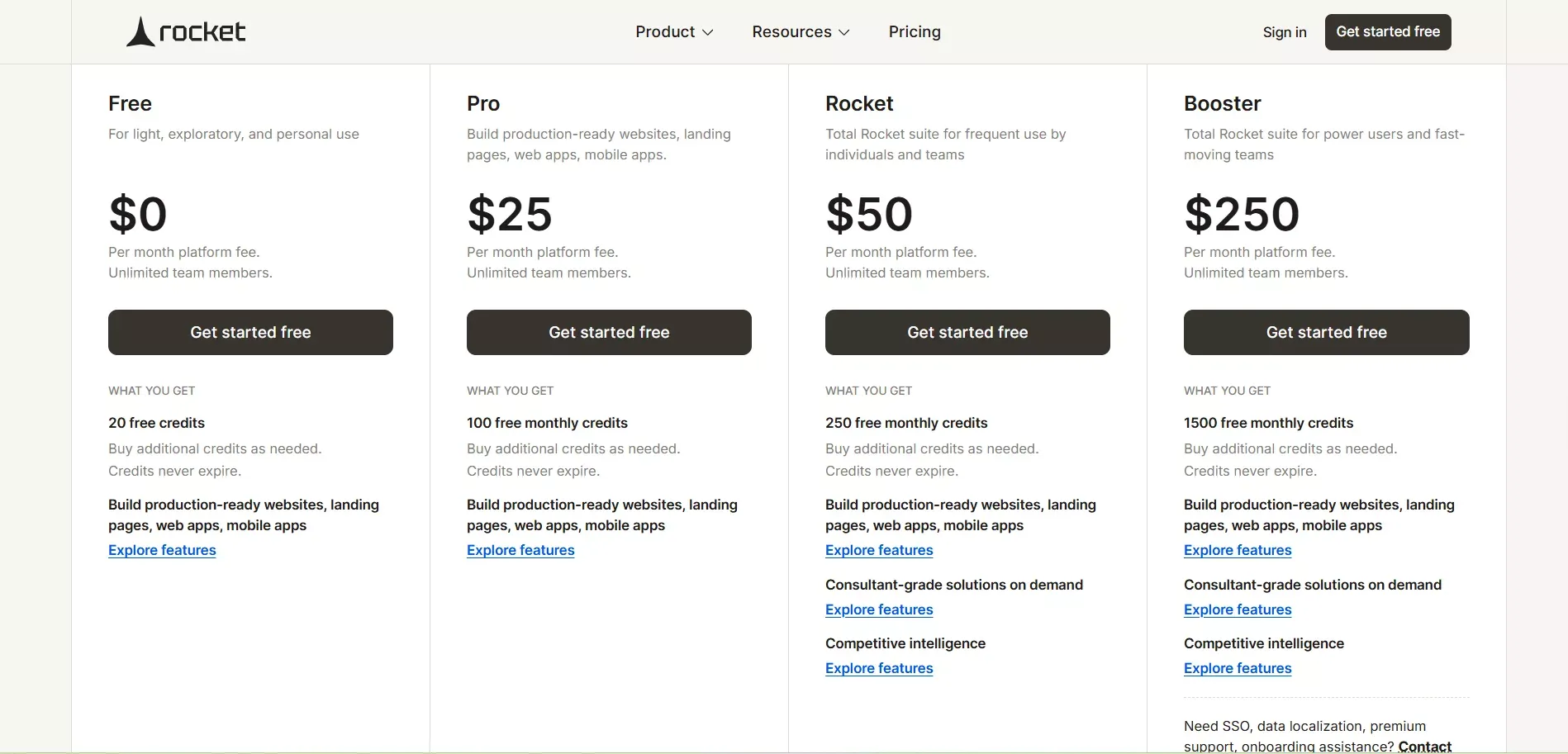
Plans: Free (20 credits, never expire), Pro ($25/mo, 100 monthly credits), Rocket ($50/mo, 250 monthly credits), and Booster ($250/mo, 1,500 monthly credits). Annual billing saves 20%. All plans include unlimited team members, and additional credits can be purchased as needed and never expire.
- Credits offer more consistent, predictable consumption, especially valuable for complex, iterative builds.
- The Booster plan at $250/month delivers 1,500 monthly credits, making it the go-to for solo power users and fast-moving teams tackling demanding, high-volume projects.
- Rocket.new includes features such as Figma-to-code screen limits, making it cost-effective for designers scaling UI prototypes.
For large-scale production work, Rocket.new's higher credit volumes make it the more affordable option per interaction.
Plan Price Comparison
| Plan | Rocket.new (Monthly) | Rocket.new (Annual) | Lovable (Monthly) | Lovable (Annual) |
|---|---|---|---|---|
| Free | 20 credits (never expire) | N/A | Free (limited credits/day) | N/A |
| Tier 1 | $25 (100 credits) | $20 | $25 (100 credits) | $21 |
| Tier 2 | $50 (250 credits) | $40 | $50 (100 credits) | $42 |
| Tier 3 | $250 (1,500 credits) | $200 | Custom (Enterprise) | Custom |
Entry price is identical at Tier 1, but Rocket.new delivers significantly more credits at Tier 2 and beyond for the same spend.
Free Plan vs. Free Trial
Lovable offers a free plan with limited daily credits for public work, good for ongoing experimentation. Rocket.new's free plan includes 20 non-expiring credits, generous enough for initial testing and exploring its full capability range.
Moving to Paid Plans
Both services start paid plans at $25/month, with private work and live deployment included. For teams of 4–10, the $50/month tier is where things get interesting: Rocket.new delivers 250 credits for power builders, while Lovable offers 100 credits with unlimited users sharing the pool — each a strong value depending on how your team works.
Total Expenditure Analysis: Where Each Platform Wins
Individual Developers and Small Prototypes
For solo creators just getting started, both services start at $25/month. Rocket gives 100 credits; Lovable gives 100 credits plus daily top-ups. Lovable's Pro plan unlimited-users feature means a small team of 3 can share one subscription.
Growing Teams of 4 to 10 Members
Real data shows a medium-sophistication app (authentication, database, API connections) consumed 73 credits in two weeks on Lovable. At this scale, teams likely need the $50/month tier on either service.
Users calculated that hiring a junior developer runs $4,000+ per month, while a $25/month subscription delivers comparable output for specific project types. The savings are big for any business creating production applications.
Enterprise Organizations of 10+ Members
Rocket.new keeps healthy gross margins of 50 to 55% and targets 60 to 70%, with the U.S. contributing 26% of revenue, followed by Europe at 15 to 20%. This suggests sustainable fee structures at enterprise scale.
Lovable secured $330 million in a Series B funding round at a $6.6 billion valuation in December 2025, after collecting $200 million at a $1.8 billion valuation earlier that year. This indicates strong enterprise traction for the credit-based service.
Both platforms show enterprise viability, but Rocket.new's higher credit volumes at the Booster tier provide more predictable rates for high-volume usage.
Six-Month Project Breakdown
For a medium-sophistication app with authentication, database, and connections:
Lovable total: Business Plan ($50 x 6 = $300) + hosting if needed ($25 x 6 = $150) + potential credit overages ($50 to $100) = $500 to $550
Rocket.new total: Rocket plan ($50 x 6 = $300) + hosting included + credits never expire, reducing waste = $300
Rocket.new provides 45 to 55% savings over six months in this scenario.
Hosting, Connections, and Other Charges
Separate Hosting Charges
Lovable charges separately for Cloud hosting and usage outside subscription credits. Every workspace gets $25/month in free Cloud hosting and $1/month in free usage. For small apps (under 5,000 monthly visits), the free allowance typically covers everything.
You can export code to GitHub and deploy to Vercel, Netlify, or another provider instead of using proprietary hosting. This is a go-to strategy for teams that want to control infrastructure spending.
The All-Inclusive Model
Rocket.new includes hosting and deployment in the credit subscription, making the total cost more predictable. This all-inclusive approach removes surprise infrastructure charges.
Code Export and Migration
Lovable's GitHub handoff means you are not locked into their infrastructure forever. This dramatically changes the value equation compared to subscription traps.
Rocket.new also provides source downloads, so you retain ownership of your applications. If you ever want to move to a self-hosted setup, both services let you take your source files with you.
Use Cases That Connect to Scale and Pricing
Solo Founders Building MVPs: You can build a working MVP in a single day for $25/month. Compare that to hiring a developer at $4,000+ per month. The economics are hard to ignore.
Teams Creating Internal Tools: Admin dashboards, CRM interfaces, and reporting panels come together fast. The credit model keeps costs steady even during heavy iteration weeks.
E-Commerce and Fintech Apps: Roughly 12% of Rocket's subscribers create e-commerce services, and 10% build fintech apps. These are not toy projects. They are production applications handling real money.
Agencies Managing Multiple Client Projects: The Booster plan, at $250/month, provides 1,500 monthly credits. That is enough to run multiple client projects simultaneously without switching between accounts or worrying about credit limits.
Mobile and Web App Combos: Build your website and mobile app from the same workspace. No need to switch platforms or learn a second tool. This saves both time and money.
Comparing Key Features Side by Side
| Feature | Rocket.new | Lovable |
|---|---|---|
| Speed & Workflow | Built for rapid development, AI assistance, one-click deployment, and collaboration features minimize setup friction; it shines most in the first 48 hours | Exceptional for prototyping and client presentations; idea to clickable app in hours, sometimes minutes |
| Prompt-to-App | Describe your idea in plain language, Rocket.new builds a complete app with screens, logic, and data storage via a four-step loop: describe, build, refine, ship | Natural language input generates full web apps, including frontend, backend, and database schema |
| Figma-to-Code | Import Figma mockups and convert directly into working code; design-to-development handoff is practically instant | — |
| Code Quality | Production-ready code out of the box; ~80% of users build serious applications; output quality stands out among competitors | UI-first output that learns and improves through user refinements; significant quality gains through 2025–2026 |
| Backend & Logic | Full-stack coverage, app logic, backend systems, database schemas, authentication, API connections, and deployment all in one place; no separate backend service needed | Visual editor handles automated and manual customization; adjust designs, content, and logic without touching raw code |
| One-Click Deployment | Go from finished app to live URL with a single click; the platform handles code preparation and server configuration | Deployment supported with GitHub export option for further hosting flexibility |
| Credit Rollover | Credits never expire on any plan | Credits roll over on paid plans |
| Code Export | Full code export to GitHub, you own the code, host it anywhere, modify with any tool; zero vendor lock-in | GitHub export available; prototype can evolve into a production app without starting over |
| Template Library | Production-ready templates that reduce credit consumption; head start on common app patterns | Built-in templates for login flows, dashboards, and onboarding screens |
| Security & Access Control | Security features at every tier; enterprise plans include advanced access control, audit logs, and dedicated support | Business plan: SSO, privacy controls, audit logs; Enterprise plan: advanced security, governance tools, and dedicated support |
| Version History | Revision tracking to revert changes; Figma-to-code design templates for designers scaling UI prototypes | Revision tracking to revert changes; built-in templates for common app patterns |
| Custom Domain Support | Included on all subscription tiers | Available from Pro plan onwards |
| Layout Control | Standard layout management customized with AI support via chat interface and visual edits | Fine-grained control over spacing, typography, and component placement via a visual interface |
| Analytics | Connect custom tracking tools via scripts or integration hooks | Business tier includes built-in analytics; custom tracking is also supported via scripts |
| Testing & QA | Staging environments, automated checks, multi-device and screen-size testing before going live | Real-time preview of every change; iterative testing with sample data generation and traffic simulation |
| AI Agents | Agents automate server setup, deployment, backend wiring, authentication, and database connections | Agents focus on UI refinement, frontend code generation, and fixing broken logic |
| Automation | Handles multi-step workflow automation; generates scaffolding and wires up connections end-to-end | Expanding automation in 2026; agents turn specifications into working frontend code |
| Mobile & Web Support | Covers both, 45% mobile apps, 55% websites; generates mobile and web apps from one workspace | Primarily web-focused, landing pages, dashboards, and internal tools; limited native mobile support |
| Internal Tools | Ideal for fast-building admin panels, CRMs, reporting tools, and data viewers | Strong UI polish makes internal tools presentable enough for client-facing use |
| MVP & Prototyping | Best for production-grade MVPs requiring a robust backend and deployment | Great for early-stage validation; GitHub export lets prototypes evolve into production apps without starting over |
| Best For | Solo power users, speed-obsessed teams, and production-grade applications | UI-focused teams, designers, and groups sharing one subscription with moderate individual usage |
What Real Users Are Saying
One user shared on Reddit:
"Rocket.new is surprisingly smooth for creating internal tools. The AI agent setup saves me hours of boilerplate work, and the vibe coding interface is pretty addictive."
What Credit-Based Subscribers Report
The credit model is a frequent point of friction. One Reddit subscriber noted: "Three or four times I found myself looking at my credit spend... This is not sustainable." Others report "wasting credits" in back-and-forth battles to fix simple bugs.
Multiple G2 reviews confirm unpredictable consumption and retries due to inconsistencies.
What Token-Based Subscribers Report
One user shared on Reddit: "Rocket.new is surprisingly smooth for creating internal tools. The AI agent setup saves me hours of boilerplate work, and the vibe coding interface is pretty addictive."
Another noted: "I stumbled upon this tool in my search for something to create a mini social network. I tried the credit-based option and Replit at the same time, but this one seems to work much better so far."
Users report that Rocket is optimized for getting projects off the ground quickly. The limitations become more noticeable as products mature and demand for scalability and flexibility increases. The service is typically used for quick launches and early experimentation rather than for constructing deeply customized software systems.
When to Choose Rocket.new vs Lovable
| Category | When to Choose Rocket.new | When to Choose Lovable |
|---|---|---|
| Best For | Production-grade apps, sophisticated applications | UI-focused teams, polished interfaces |
| Solo Users | Booster plan ($250/mo) offers 1,500 credits for intensive, multi-week projects | — |
| Team Use | Speed-obsessed teams focused on fast builds and automation | Unlimited users share one Pro plan ($25/mo) — ideal for teams with moderate individual usage |
| Prototyping | — | Rapid prototyping, client presentations, landing pages, and marketing sites |
| Mobile & Desktop | Generates both from one workspace; popular for e-commerce, fintech, B2B, and health apps | — |
| Design Workflow | Figma-to-code integration for designers scaling UI prototypes | — |
| MVPs | Faster MVP development based on market research, startups, and founders | Early-stage founders; GitHub export lets prototypes evolve into production apps |
| Speed | Strongest in the first 48 hours, zero to deployed app, fast | Fast idea-to-prototype, especially for stakeholder-ready demos |
| Priority | Code quality, production readiness, deployment speed | UI/UX quality, visual design, ease of customization |
Head-to-Head Verdict
What Matters Most at Scale
For individual developers and small prototypes, both platforms offer similar value at $25/month entry. Both are designed to help users rapidly create and launch applications with minimal setup.
For growing teams (5 to 15 people), Rocket.new provides better value for high-volume creators, typically 30 to 50% cheaper when factoring in total charges. Lovable's unlimited users per plan makes it more economical for larger teams with moderate per-person usage.
For enterprise organizations, Rocket.new's Booster tier scales more predictably for high-volume usage. Both platforms require custom enterprise negotiations with dedicated support.
The Predictability Factor
All consumption-based tools can lead to higher-than-expected charges during iterative development cycles. Rocket.new's non-expiring credits provide clearer forecasting for budget-conscious teams. The credit system with unlimited users provides better economics when many people need access without per-seat fees.
Where Each Platform Hits Its Limits
Rocket.new is designed for quick launches and early experimentation rather than for constructing deeply customized or long-term scalable software systems. Lovable's charges can escalate rapidly for projects requiring thousands of iterations. Both tools have real ceilings that you should plan around.
Rocket.new vs Lovable Pricing: The Final Take
Both platforms deliver 10–20x faster creation cycles than traditional development. The right choice comes down to what you're building and how you like to budget.
Choose Rocket.new if code quality, full-stack capability, and non-expiring credits with higher volume tiers are your priority, it's built for production-grade apps that need to scale.
Choose Lovable if UI polish and rapid prototyping matter most, especially for design-led teams comfortable with variable credit usage.
Ready to test it yourself? Start with Rocket.new's free tier and experience the difference firsthand.
Table of contents
- -What "Scale" Actually Means in App Creation
- -The Broader App Development Market in 2026
- -Other Players Worth Knowing
- -Why Pricing Matters More Than Ever
- -The SaaSpocalypse Effect
- -Planning Your 2026 Technology Stack
- -How the Subscription Plans Compare
- -Lovable's Credit-Based Plans
- -Rocket.new's Credit-Based Plans
- -Plan Price Comparison
- -Free Plan vs. Free Trial
- -Moving to Paid Plans
- -Total Expenditure Analysis: Where Each Platform Wins
- -Hosting, Connections, and Other Charges
- -What Real Users Are Saying
- -What Token-Based Subscribers Report
- -When to Choose Rocket.new vs Lovable
- -Head-to-Head Verdict