Rocket.new vs Lovable comparison 2026: Which AI app builder creates production-ready applications vs prototypes? Compare features, pricing, deployment capabilities, and real user experiences to choose the right platform.
Are you tired of AI app builders that create great-looking demos but fail when you try to scale them?
In 2026, AI app builders have evolved. They can now generate applications using the same architecture, security standards, and deployment patterns as real production software. This makes it easier to understand what “production-ready” truly means—and how to deploy apps with confidence.
The AI app development market is growing fast—from USD 40.3 billion in 2024 to USD 221.9 billion by 2034, with a strong CAGR of 18.60%.
As a result, the Rocket.new vs Lovable debate is heating up. More founders are realizing the key difference between tools that build impressive prototypes and those that create apps capable of handling real users and real business logic.
The Production vs Prototype Problem in AI App Building
When evaluating AI app builders, the most important distinction isn't speed or user interface design, it's whether the platform generates code that can actually support a real business.
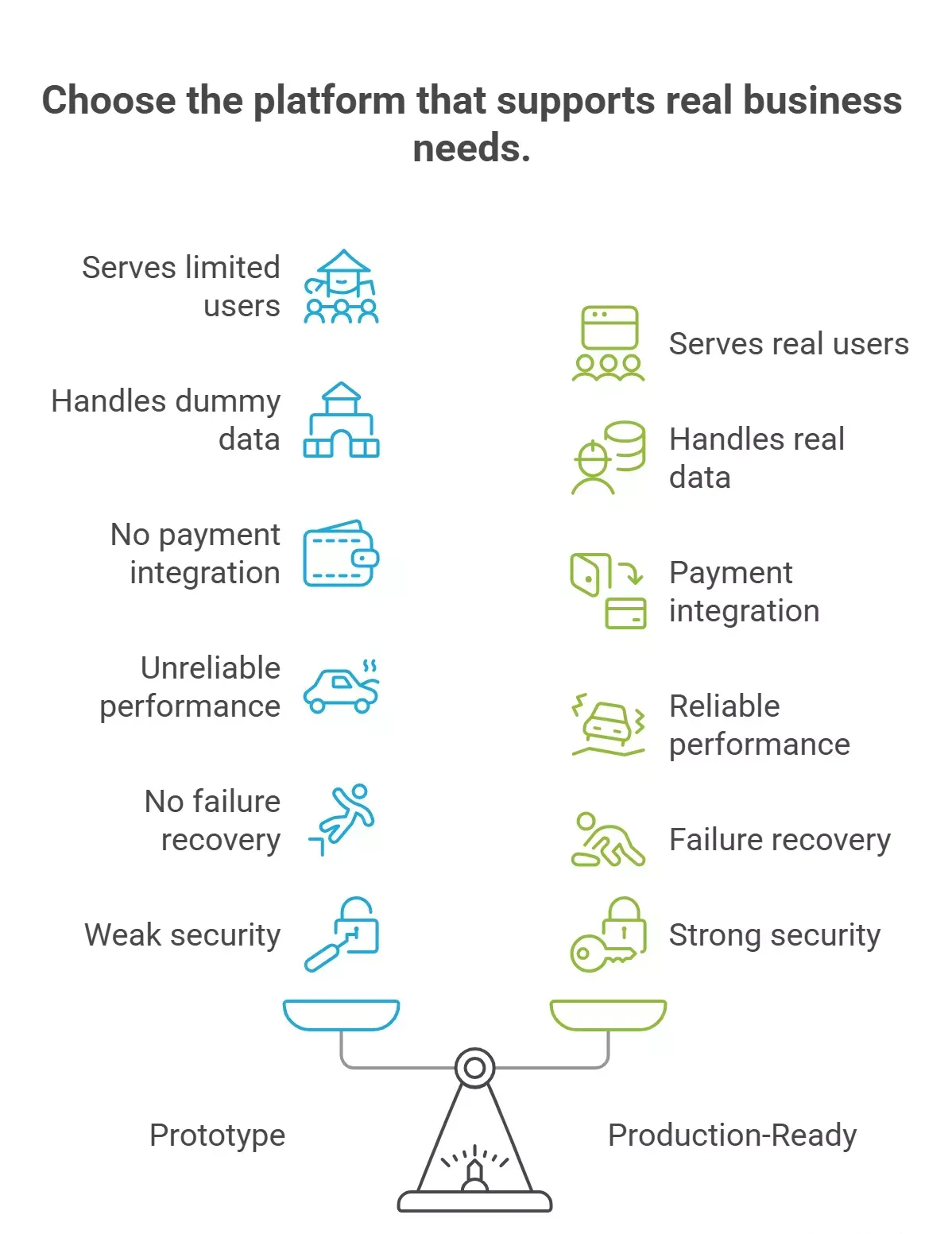
A production-ready application is not a prototype, a demo, or a proof of concept. It's software that carries real weight:
- It serves real users who depend on it for their work
- It handles real data that must not be lost or corrupted
- It processes real money through payment integrations
- It operates reliably under normal traffic conditions
- It recovers from failures without losing data or user sessions
- It protects user data with proper security and access controls
Many app builders in the space excel at creating what the industry calls "the technical cliff" problem. A tool that generates a beautiful UI but can't handle a database or authentication will eventually hit a wall.
InfoWorld reports that teams routinely build working prototypes only to discover that custom features are impossible without hiring a developer, leaving them stranded between a demo that works and a product that never ships.
The question worth asking before committing to any platform isn't "how fast can I build something?" It's "how far can this actually take me?"
What Makes Apps Production-Ready vs Prototypes?
Backend Logic and Database Integration
Production-ready code includes more than just a pretty frontend. Here's what it actually requires:
- Backend logic that powers real business workflows
- Database configuration that keeps data structured and safe
- User authentication to control who accesses what
- Robust error handling so failures don't break the experience
Rocket.new's platform is built to handle backend integrations, deployment, and code generation, making it suitable for serious app makers. It covers more use cases out of the box compared to Lovable:
- Mobile apps, web apps, websites, landing pages, dashboards, and internal tools
- Richer integrations, including AI models, payments, email, and deployment
- Multi-page generation built in
- Built-in SEO via Next.js
Deployment and Infrastructure
No manual DevOps. No configuration headaches. With Rocket.new:
- Every layer is generated and configured automatically
- One-click deploy to Rocket's cloud infrastructure
- Zero manual setup required from the developer
This level of deployment automation is what separates production-ready applications from prototypes that leave teams stuck doing infrastructure work before they can ship.
Scalability and Performance
The best AI app builders don't just help you launch, they help you grow. Rocket.new generates applications built to scale:
- Supports real users and growing data volumes
- Handles multiple programming languages
- Built for complex business logic, not just simple demos
- Integrates with existing business systems without friction
Rocket.new vs Lovable: Development Approach, Use Cases, and Code Quality
Full Stack Generation Capabilities
The two platforms take fundamentally different approaches. Traditional no-code AI tools require constant back-and-forth interaction, submitting multiple prompts for each feature. Rocket.new eliminates that friction entirely:
- Rocket.new uses natural language prompts to generate a complete application from a single, detailed prompt, reducing development time from weeks to minutes and producing consistent, production-ready output. It also provides a visual editor and an AI chat interface for further refinement.
- Lovable emphasizes iterative development with a visual editor for ongoing refinement, designed for startups, solo founders, and small teams who want to eliminate coding bottlenecks
Users report that Rocket.new can generate applications with AI assistance in about 10 to 15 minutes, significantly reducing development timelines compared to traditional methods.
Code Quality and Ownership
Both platforms export real, usable code, but with key differences:
- Lovable gives you a full repo to own and extend, making it better for developers who want clean, editable code and full control
- Rocket.new leans more toward its visual builder and hosted setup, which some developers find limiting
However, Rocket.new users argue the platform offers more control than critics claim, including full access to the codebase and deployment infrastructure
AI Features and Development Experience
Natural Language Processing and Vibe Coding
Both platforms use vibe coding, where you describe what you want in plain English and AI builds it. Vibe coding reduces the barriers to app development, enabling users to focus on their business ideas rather than technical details:
- Describe your app in natural language, and the AI writes the code
- Generates complete, deployable applications from a single description
- No manual coding required to get a working structure
- The use of vibe coding tools is rapidly increasing, with a significant percentage of developers planning to incorporate AI coding tools into their workflows
AI Agent Support and Integrations
Rocket.new offers more comprehensive AI support for complex builds:
- Easy integrations with multiple tools, including AI models, payments, AI agents, and email
- Multi-page generation out of the box
- Built-in SEO via Next.js
- Better suited for complex integrations vs. rapid prototyping tools
Backend Control and Database Management
Both platforms handle the heavy lifting automatically:
- AI creates the frontend, backend, and database schema from your description
- No manual coding needed to get a deployable app
- Built-in hosting manages scalability, SSL, and backend setup
- Removes the need for third-party infrastructure tools
Where Lovable has limitations:
- Can restrict backend control when apps need custom business logic
- Less flexible when specialized AI agents are required
- AI-generated apps sometimes require manual intervention to ensure production readiness
Hosting and Custom Domain Support
- Rocket.new offers one-click deployment to production environments
- Lovable requires additional configuration for production-ready hosting
- Lovable Pro includes custom domains, user roles, credit rollovers, and unlimited subdomains
- Both support custom domains but differ in setup complexity
Pricing and Value Comparison
| Feature | Rocket.new | Lovable |
|---|---|---|
| Free Plan | Available | 5 credits/day (30/month max) |
| Pro Plan | Competitive | $25/month (100 credits) |
| Production Features | Full-stack, backend included | Visual editor, Supabase required |
| Mobile Apps | Native support | Web apps primarily |
| Enterprise | Built-in capabilities | $50/month Business tier |
The sweet spot for most builders is $20 to $25/month for full features. Hidden costs add up fast: Supabase backend ($25/month), hosting upgrades ($20/month), domains ($15/year), and API overages can push real costs to $50 to $100/month for production apps.
Real User Experiences and Community Feedback
The testimonials reveal significant differences in real-world performance:
"I tested Rocket vs Lovable with the same idea. Lovable gave me a layout. Rocket gave me the app." - Source
This feedback highlights a critical advantage: the ability to go from concept to deployed application without getting stuck in development limbo.
Market Growth and Industry Trends
AI App Builder Market Explosion
- The global AI code tools market was valued at $4.86 billion in 2023 and is projected to reach $26.03 billion by 2030 at a 27.1% CAGR
- The no-code development platform market is projected to reach $84.47 billion by 2027, growing at a CAGR of 28.9%
- Lovable hit $206M ARR in November 2025, up from $7M at the end of 2024, a 2,800% YoY growth rate
No-Code and Vibe Coding Adoption
About 70% of new applications built by organizations in 2025 used low-code or no-code tools, up from less than 25% in 2020. This trend strongly favors platforms that can generate production apps rather than just prototypes, as organizations need tools that scale beyond initial validation.
Developer Productivity and AI Integration
With 92% of developers using AI tools for coding or app development in 2025, knowing which platform aligns with your workflow matters more than ever. AI can automate up to 40% of development tasks, fundamentally transforming how software is built. Developers now expect platforms that understand complex business logic, handle authentication, support version history, and integrate with existing teams.
Why Rocket.new Excels at Production Apps
Rocket.new's one-shot prompting capability enables faster development timelines, eliminating the need for iterative refinements and streamlining the entire process. Key advantages include:
- Complete app generation: Interprets comprehensive requirements and generates full-stack applications in one go
- Built-in production infrastructure: Backend logic, database configuration, and deployment handled automatically
- Broader use case support: Mobile apps, internal tools, and landing pages are supported natively
- Integration-ready architecture: APIs, payment processing, and third-party integrations built into the generated architecture
When to Choose Each Platform
| Criteria | Choose Rocket.new | Choose Lovable |
|---|---|---|
| Best Use Case | Production-ready applications | Rapid prototyping and demos |
| App Readiness | Supports real users and real data | Ideal for early-stage concepts |
| Development Approach | One-shot app generation without extensive back-and-forth | Iterative design and visual refinement |
| Backend & Deployment | Built-in backend logic with production deployment out of the box | Limited backend; suited for simple use cases |
| Code Ownership | Complete solution (less focus on manual editing) | Clean, fully owned, editable codebase |
| App Complexity | Suitable for complex, scalable applications | Best for simple web apps with CRUD operations |
| Target Users | Individual developers, technical teams, and non-technical founders | Designers, developers testing ideas, and early-stage builders |
| Primary Goal | Build and launch a complete, production-grade app | Create polished demos or validate ideas before production |
The Future of Production-Ready AI App Development
The market opportunity is massive and growing fast:
- AI agent adoption projected to reach 40% of enterprise applications by 2026
- Total addressable market for AI-assisted software creation forecast at $325 billion by 2040
- This opportunity belongs to platforms that deliver real software, not just demos
With 20+ well-funded players competing, consolidation is inevitable. The 2026-2027 M&A cycle is expected to be one of the largest in developer tooling history. Platforms with proven production capabilities will win. Those limited to prototyping will not survive.
Need an app that works in the real world?
The Rocket.new vs Lovable decision comes down to one question: Do you need an app that works in the real world, or one that demonstrates an idea?
The gap between knowing what to build and actually shipping it is exactly what the best AI app builders close in 2026. Pick the tool that matches how you work and what you are actually trying to ship.
Table of contents
- -The Production vs Prototype Problem in AI App Building
- -What Makes Apps Production-Ready vs Prototypes?
- -Backend Logic and Database Integration
- -Deployment and Infrastructure
- -Scalability and Performance
- -Rocket.new vs Lovable: Development Approach, Use Cases, and Code Quality
- -Full Stack Generation Capabilities
- -Code Quality and Ownership
- -AI Features and Development Experience
- -Natural Language Processing and Vibe Coding
- -AI Agent Support and Integrations
- -Backend Control and Database Management
- -Hosting and Custom Domain Support
- -Pricing and Value Comparison
- -Real User Experiences and Community Feedback
- -Market Growth and Industry Trends
- -AI App Builder Market Explosion
- -No-Code and Vibe Coding Adoption
- -Developer Productivity and AI Integration
- -Why Rocket.new Excels at Production Apps
- -When to Choose Each Platform
- -The Future of Production-Ready AI App Development