
Rocket.new beats Lovable for teams that need speed, full-stack support, and production-ready apps. Lovable is great for visual prototyping and UI iteration. If you need better collaborate and want to ship fast across web, mobile, and internal tools, Rocket.new is the stronger pick.
What if you could ship a production-ready app before your coffee gets cold?
The race between AI app builders is heating up, and for teams, one platform pulls ahead. Rocket.new beats Lovable in collaboration, offering a faster idea-to-launch pipeline, built-in backend logic, and support for a wider range of project types.
The numbers back it up: the global low-code/no-code market is projected to hit $65 billion by 2027 (Statista). AI app builders aren't a trend; they're the new standard.
Here is what this blog covers:
-
What AI app builders are and why they matter for teams
-
A full breakdown of Rocket.new and Lovable, feature by feature
-
A side-by-side comparison table with key features
-
How each platform handles collaboration, speed, and production apps
-
Community insights from real users
-
A dedicated deep-dive into Rocket.new's top features and use cases
-
When to choose Rocket.new vs when to choose Lovable
-
FAQs to clear up common questions
So which platform wins for teams? Let us break it down.
What Are AI App Builders and Why Do They Matter?
Traditional app development demands coding expertise, multiple programming languages, and a full dev team. AI app builders flip that, letting non-technical users build real, functional apps without writing a single line of code, while helping developers ship faster.
Here is why AI app builders matter for teams:
-
Speed: Teams can go from idea to working app in hours.
-
Lower cost: Does not require a full development team for early-stage apps or prototypes.
-
Collaboration: Non-technical users can participate in app development.
-
Full control: Give you code ownership and the ability to export or extend the project later.
-
Flexibility: Build web apps, mobile apps, internal tools, and landing pages.
-
AI assistance: The AI handles code generation, backend logic, and deployment.
That last point is where things get interesting. Not all AI app builders give you the same level of control. And that is exactly where the Rocket.new vs Lovable debate gets real.
What is Rocket.new? A Quick Overview
Rocket.new is a vibe solutioning platform that generates complete, production-ready applications from a single comprehensive prompt. You describe your app idea in natural language, and the platform builds the entire thing: frontend UI, backend logic, database setup, authentication, and deployment. All from one shot.
Most AI app builders require you to go back and forth with iterative prompts. Rocket.new eliminates that. You write one detailed prompt, and the platform handles code generation, design, and core functionality in one go.
Rocket.new supports a wide range of use cases:
-
Web apps and full-stack applications
-
Mobile apps (Android and iOS)
-
Landing pages and marketing sites
-
Dashboards and internal tools for teams
-
Production apps with complex data models
-
Websites with built-in SEO through Next.js
-
Figma import to turn design into code
-
Integration with Stripe, AI models, and email services.
Rocket covers more use cases out of the box than most competitors, and that includes Lovable.
Key things that make Rocket.new stand out:
-
One-shot prompting: no iterative refinement needed
-
Full-stack code generation from a single prompt
-
Native mobile app support (Android and iOS)
-
AI agents and AI models built into the platform
-
Pre-built templates and reusable components
-
Code export for full code ownership
-
Integration with collaboration tools like Google Workspace, Notion, and Linear
What Is Lovable? A Quick Overview
Lovable is an AI app builder that turns natural language prompts into full web apps, generating frontend, backend, and database schema using React, TypeScript, and Supabase.
Lovable is best known for rapid prototyping, client presentations, and visual design iteration. The platform provides a visual editor for real-time customization for designers and product teams.
Where Lovable hits limits:
-
It does not support native mobile apps (web only)
-
Its credit-based pricing can become unpredictable, especially when the AI makes errors
-
Complex backend logic requires more manual setup via Supabase
-
Landing pages and internal tools are not its core strength
-
Users report AI hallucinations that waste credits during iterative refinement
Lovable creates beautiful interfaces and gives non-technical users a smooth path to their first working app. Lovable allows for both AI-driven and manual customization, making it suitable for early-stage founders building MVPs. But it does not match Rocket.new on scope or production readiness.
Lovable vs Rocket.new: Head-to-Head Feature Comparison
Now, let us put these two platforms side by side. This is where the differences become clear.
Speed and App Generation
Rocket.new wins on speed. Here is how the two compare:
-
Rocket.new: One-shot prompting generates your entire app, including frontend, backend logic, and deployment, in about 10 to 15 minutes.
-
Lovable: Fast for rapid prototyping, but relies on iterative prompting. You refine and adjust across multiple rounds. For quick mockups, that is fine.
Bottom line: If your team values speed above all else, Rocket.new gets you from idea to working app with fewer steps.
Backend Logic and Full Stack Support
-
Rocket.new handles authentication, payments, data modeling, and AI agents straight from the prompt
-
Lovable connects to Supabase and manages CRUD operations and APIs well, but needs more configuration for complex setups
For projects that go beyond a prototype, Rocket.new covers more ground out of the box
Code Quality and Code Ownership
Both platforms produce production-ready code. Here is the breakdown:
-
Lovable: Generates clean React and TypeScript. Syncs to GitHub for full code ownership. You can export and extend the code anytime.
-
Rocket.new: Also provides code export and full control over the generated code. Its code structure is better suited for production apps, especially for complex backend logic or multi-page generation.
For technical teams: Rocket.new gives a better foundation for scaling full stack projects because the production ready code is built for maintainability from the start.
Use Cases and Platform Breadth
This is where Rocket.new pulls far ahead. Rocket supports a broader range of use cases across a single platform:
-
Web apps
-
Mobile apps (native Android and iOS)
-
Landing pages with built in seo
-
Dashboards
-
Internal tools
-
Production websites
Lovable is focused primarily on web apps and landing pages. It does not offer the same breadth for mobile apps or internal tools. If your team works across multiple platforms, Rocket.new covers more ground without requiring multiple tools.
Visual Editor and Design
Both platforms handle design, but differently:
-
Lovable provides a strong visual editor for real-time customization. You can tweak layouts, colors, and components directly.
-
Rocket.new takes a different approach with its Figma import feature. You convert Figma designs into live, working layouts with high accuracy.
For teams already using Figma: Rocket.new saves time and keeps design consistency intact. The visual editor in Lovable is more hands-on, which some users prefer for iterative design work.
AI Features and AI Models
AI capabilities are a growing differentiator in the AI app builder space:
-
Rocket.new ships with AI features that go beyond basic code generation. It supports AI agents, AI models, and AI-driven workflows inside the app. You can add AI support directly into your project.
-
Lovable recently added its own AI features through Lovable AI, which supports multiple AI models like GPT-5.2 and Gemini. But this was a later addition.
Rocket.new had deeper AI assistance baked into the platform from the start, making it more natural for teams building ai powered apps and ai app solutions.
Lovable vs Rocket.new: Quick Comparison Table
Here is a side-by-side look at the key features that matter most for teams and collaboration.
| Feature | Rocket.new | Lovable |
|---|---|---|
| One-Shot Prompting | Yes, full app from one prompt | No, iterative prompting |
| Web Apps | Yes | Yes |
| Mobile Apps | Yes (Android + iOS) | No (web only) |
| Internal Tools | Yes | Limited |
| Landing Pages | Yes, with built-in SEO | Yes |
| Backend Logic | Strong, built-in via Supabase | Via Supabase |
| Figma Import | Yes, high accuracy | Limited |
| Collaboration | Yes, using integration with Google Workspace, Notion, and Linear | Only within the project workspace |
| AI Agents | Yes | Recently added |
| Code Export | Yes | Yes (GitHub sync) |
| Visual Editor | Real-time with prompt-based edit option | Real-time visual editor |
| Multi-Page Generation | Yes | Yes |
| Pre-built Templates | Yes, 25K+ | Yes |
| Best For | Production apps, complex projects, teams | Prototyping, UI design iteration |
Which Platform is Better for Teams and Collaboration?
Rocket.new is built for teams that need to move fast, from idea to production on a single platform.
-
Non-technical users prompt the app; developers extend the exported code
-
One-shot generation removes early bottlenecks
-
Best for startups, agencies, and product teams shipping MVPs fast
-
Integration with collaboration tools like Google Workspace, Notion, and Linear
Lovable shines for design-focused teams iterating on visuals.
-
Up to 20 collaborators with real-time editing
-
Clean React/TypeScript code synced to GitHub
-
Best for prototypes and client presentations
Where Lovable falls short:
-
Credit-based pricing gets unpredictable during debug loops
-
Limited mobile, internal tools, and complex backend support
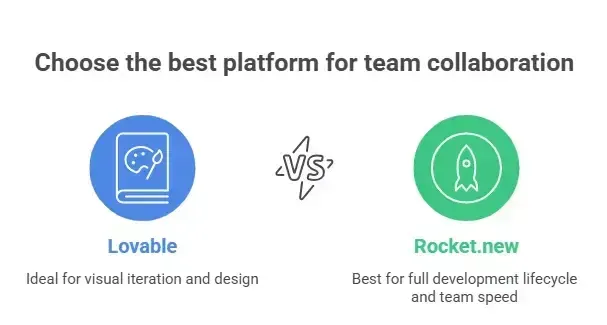
Bottom line: Lovable is great for visual iteration. But for the full development lifecycle, backend, frontend, deployment and collaboration, Rocket.new is the stronger team tool.
Turning Ideas into Apps: The Speed Factor
Every day spent setting up environments and writing boilerplate is a day your idea isn't in front of users. Here's how the options stack up:
| Approach | Time to App |
|---|---|
| Traditional Development | Weeks to months |
| Lovable | Hours to days |
| Rocket.new | 10–15 minutes |
Speed isn't just a nice-to-have, it changes how you build:
-
Validate ideas before committing resources
-
Ship faster and get real user feedback sooner
-
Pivot quickly without starting from scratch
Rocket.new's one-shot generation handles the heavy lifting at every stage, so your team stays focused on the product, not the process.
How AI App Builders Help Non-Technical Users Build Real Apps
Non-technical users can now build real apps, no coding degree required, just an idea and the right tool.
-
Rocket.new removes all friction, one prompt, one app, done. No setup, no debugging.
-
Lovable offers a hands-on visual editor, giving more control but a steeper learning curve.
The impact is real: founders validate ideas before hiring developers, designers turn Figma mockups into live apps, and product managers ship prototypes instead of static wireframes.
Alternatives to Consider: Other AI App Builders in the Space
Rocket.new and Lovable are not the only players. The AI app builder space is growing fast. Here are a few other tools worth knowing about:
| Tool | Type | Best For | Coding Required | Key Limitation |
|---|---|---|---|---|
| Cursor | AI-assisted coding | Developers wanting AI + full code control | Yes | Not a full app builder |
| Emergent | Full-stack AI builder | Full-stack projects from natural language | Minimal | Different approach to autonomous dev |
| Windsurf | AI dev environment | AI support within an IDE | Yes | Coding productivity only |
| Replit | Online coding + AI | Learning & experimentation | Yes | More code-focused than app building |
| Firebase | Backend-as-a-service | Backend without building from scratch | Yes | No frontend or full app generation |
What the Community Is Saying: Real User Insights
It is one thing to compare features on paper. It is another thing to hear from people who have actually used these platforms. Here is a real perspective shared on Rocket.new's community page:
"I've been paid user of lovable for last 4 months to build my idea and mainly for ui inspiration for the user flows. Honestly, I hadn't considered there could be any real competition to Lovable's UIs...until I tried Rocket.new today. Figma design results: 100% accurate. User flows: much better UI than Lovable. Super impressed." - Source
That quote captures what many users experience. They start with Lovable because it is well known for its design. Then they try Rocket.new and realize it delivers better results across the board.
Here is what other users are saying:
-
"I just one-shotted a prompt using Rocket.new, and I can't put into words how much better it is than any other no-code AI tool."
-
"I've been trying out every no-code AI website/app builder you can think of for months, and Rocket is 100x better than anything else."
-
"I've tried Replit and Lovable, but Rocket's ability to one-shot a working app is next level."
Key patterns from community feedback:
-
Users consistently choose Rocket over Lovable for production work
-
The one-shot prompting is a major draw for teams that do not want to iterate endlessly
-
Figma import accuracy surprises users who expected it to be average
-
Non-technical users find Rocket.new easier to get started with compared to other AI app builders
-
Real users are building production apps, internal tools, and landing pages with Rocket.new daily
Rocket.new: The Launchpad for Teams That Want to Ship Fast
Rocket.new an AI-powered platform generates complete, production-ready apps from a single prompt, acting as your product manager, designer, and developer for software development.
-
Founders describe an idea and get a working app in minutes
-
Designers import Figma files and see them converted to live layouts
-
Developers export and extend the code for full customization
-
Everyone works on one platform, with AI handling the heavy lifting
Top Features of Rocket.new
Here are the key features that make Rocket.new the top pick for teams:
-
Prompt to App Creation: Build full production ready apps from a single natural language prompt. No iterative refinement needed.
-
Figma Import: Convert Figma design files into live, editable layouts with near-perfect accuracy.
-
AI-Powered Backend: Automatically handles backend logic, data models, authentication, and workflows.
-
Multi-Page Generation: Create multi-page apps with complex navigation in one shot.
-
Reusable Components: Speed up building with pre built templates and ready-to-use elements.
-
Custom Domain Support: Publish apps with your own branded domain.
-
Code Export: Full code ownership. Download or extend the code anytime.
-
Richer Integrations: Stripe payments, AI models, email services, analytics, and more built in.
-
Built-in SEO: Apps built on Next.js with SEO support baked in.
-
Mobile App Support: Build native mobile apps for Android and iOS, not just web.
-
AI Agents: Add AI-driven workflows, chatbots, and smart features directly into your app.
Use Cases for Teams
Here is how teams are using Rocket.new in practice:
-
Startup founders validating a business idea with a production-ready MVP in hours, not weeks.
-
Agencies building client apps and landing pages with speed and full control over the output.
-
Technical teams are creating internal tools for managing workflows, data, and operations.
-
Non technical users bringing their app idea to life without any coding skills or development experience.
-
Product teams generating prototypes for stakeholder presentations and user testing.
-
Developers who want AI assistance for the heavy lifting but still want full control over the code.
Rocket.new is the right tool for teams at different stages. Whether you are validating an idea, building an MVP, or scaling a production app, the platform adapts to your needs. And because it supports web apps, mobile apps, internal tools, and landing pages, you do not need to switch between multiple tools.
When to Choose Rocket.new vs When to Choose Lovable
Let us keep this simple. Here is when each platform makes sense:
Choose Rocket.new When:
-
You need production ready applications, not just prototypes
-
Your project involves complex web apps with strong backend logic
-
You want to build mobile apps alongside web apps on one platform
-
Your team includes both non technical users and developers
-
You want one-shot app generation without iterative prompting
-
You care about code quality and want to scale products later
-
You need internal tools, dashboards, or data-heavy applications built fast
-
You want AI agents and AI models integrated into your app from the start
Choose Lovable When:
-
You need a quick visual prototype for a client presentation
-
Your primary focus is UI design iteration and rapid prototyping
-
You are a solo developer working on a simple web app
-
You want a visual editor for hands-on design customization
-
Your project does not require mobile apps or complex internal tools
Both Rocket.new and Lovable are useful AI tools. But they serve different needs. Lovable vs Rocket.new is not about which is bad. It is about which is the right tool for your project. And for teams that need speed, depth, and full control, the answer is Rocket.new.
Key Takeaways: Lovable vs Rocket.new for Teams
Let us wrap up the core point
-
Rocket.new builds full, production-ready apps from a single prompt, no refinement needed
-
Lovable excels at prototyping, visual design, and client presentations
-
Rocket.new supports web, mobile, internal tools, dashboards, and landing pages; Lovable focuses on web apps
-
Rocket.new offers stronger backend logic, richer integrations, and better code structure
-
Both work for non-technical users, but Rocket.new gives teams more functionality and control
-
For teams that want to ship fast and scale, Rocket.new is the stronger pick
Building Production Ready Apps with AI: What Teams Need to Know
There is a big difference between a prototype and a production app. Prototypes prove a concept. Production apps serve real users, handle real data, and need to work reliably at scale.
-
Prototype: Quick mockup to test an idea. May lack a real backend, authentication, or data handling. Good for presentations and validation.
-
Production app: Serves real users, processes real data, handles authentication and payments, and needs to scale. Requires maintainable code and strong backend logic.
Many AI app builders are great at prototyping but struggle with production-ready code.
How each platform handles production readiness:
-
Rocket.new is built with production apps in mind. The code it generates is structured for maintainability and scalability. The platform handles authentication, payments, AI agents, and backend logic from the start.
-
Lovable produces clean code too, and its GitHub sync is great for code ownership. But its strength is in the prototype-to-MVP stage.
For production ready applications that need deeper functionality, Rocket.new is the stronger choice. You are not just getting a mockup. You are getting an app that can serve real users from day one.
The Rise of Autonomous Development and AI Agents
We are entering an era of autonomous development. AI agents are starting to handle not just code generation but also planning, debugging, testing, and deployment. The idea of describing an app and having AI build the entire thing is becoming a reality.
How each platform approaches autonomous development:
-
Rocket.new leans into this trend fully. Its one-shot prompting and AI-driven approach means less human intervention is needed. The platform acts as a product manager, designer, and developer. For teams, this means fewer people are needed in the early stages and a faster time to market.
-
Lovable also uses AI agents, with its Agent Mode providing autonomous development capabilities. But Rocket.new's approach is more complete.
What this means for teams going forward:
-
AI tools will continue to evolve, blurring the line between AI assistance and full autonomous development.
-
Platforms like Rocket.new are at the front of that shift.
-
Teams that choose the right platform now will be better positioned as AI app builders become more powerful.
-
The demand for AI agents in apps is growing, and Rocket.new already supports them natively.
-
Non-technical users will be able to build increasingly complex applications without any coding knowledge.
The Verdict: Which AI App Builder Should Your Team Pick?
So, Rocket.new vs lovable, which is better for teams and collaboration?
Here is the final breakdown:
-
Choose Rocket.new if your team needs production apps, mobile apps, internal tools, complex backend logic, AI agents, and full control over the code. It is the right tool for teams that want to ship fast and scale products.
-
Choose Lovable if your team is focused on UI iteration, visual prototyping, and quick mockups for client presentations. It works well for design-focused teams on simple web apps.
-
For most teams, Rocket.new delivers more value because it handles the full development lifecycle on a single platform, from idea to production app to deployment.
The platform supports web apps, mobile apps, internal tools, landing pages, and dashboards from a single prompt. It handles backend logic, integrations, and AI features out of the box. And it gives teams full control over the generated code.
For teams that want to move fast, ship production apps, and scale products without spending weeks writing code, Rocket.new is the right tool.
Stop building slow and start shipping fast with Rocket.new today!
Table of contents
- -What Are AI App Builders and Why Do They Matter?
- -What is Rocket.new? A Quick Overview
- -What Is Lovable? A Quick Overview
- -Lovable vs Rocket.new: Head-to-Head Feature Comparison
- -Speed and App Generation
- -Backend Logic and Full Stack Support
- -Code Quality and Code Ownership
- -Use Cases and Platform Breadth
- -Visual Editor and Design
- -AI Features and AI Models
- -Lovable vs Rocket.new: Quick Comparison Table
- -Which Platform is Better for Teams and Collaboration?
- -Turning Ideas into Apps: The Speed Factor
- -How AI App Builders Help Non-Technical Users Build Real Apps
- -Alternatives to Consider: Other AI App Builders in the Space
- -What the Community Is Saying: Real User Insights
- -Rocket.new: The Launchpad for Teams That Want to Ship Fast
- -Top Features of Rocket.new
- -Use Cases for Teams
- -When to Choose Rocket.new vs When to Choose Lovable
- -Choose Rocket.new When:
- -Choose Lovable When:
- -Key Takeaways: Lovable vs Rocket.new for Teams
- -Building Production Ready Apps with AI: What Teams Need to Know
- -The Rise of Autonomous Development and AI Agents
- -The Verdict: Which AI App Builder Should Your Team Pick?